

Hold
Bapcor is an ASX-listed distributor of vehicle parts, accessories, automotive equipment, service and solutions, with most of its sales coming from repeat customer orders.
Institutional sell-side research rates it Hold because the FY26 result improved the picture but the turnaround is still at a relatively early stage. Adjusted EBITDA of A$153 million beat lowered guidance, net debt fell to A$135 million, and sales momentum improved in every segment. Against that, the company gave little detail on costs and margins for FY27, and the research judged risk and return as balanced.
- Sell-side rating
- Hold
- Sell-side target
- A$0.60
- Upside to target
- −33.3%
- Initial price
- A$0.8121 Sep 2026
- Last close
- A$0.9019 Nov 2026
Bapcor, which sells and distributes vehicle parts, accessories, automotive equipment, service and solutions, reported an FY26 result in August 2026 that beat its own guidance. Adjusted EBITDA came in at A$153 million, above the A$144 million to A$150 million range the company set after cutting guidance in May. Net debt fell to A$135 million, sales momentum improved across every segment over February to June, and staff turnover dropped. The result brought an upgrade from Sell and a rise in the target from A$0.36. Institutional sell-side research has Bapcor rated Hold with a 12 month price target of A$0.60, about 25.9 per cent below the share price of A$0.81 when this research was published. The research describes the turnaround as being at a relatively early stage, with earnings outcomes still variable in a challenging operating environment. The company also gave little detail on costs and margins for FY27, and the shares now trade above the research’s target.
Research published 21 September 2026. Price target and upside based on prices at time of publication.
Table of contents [hideshow]
- 1. About Bapcor
- 2. FY26 Earnings Landed Above a Lowered Guidance Range
- 3. Sales Momentum Improved in Every Segment
- 4. Lower Net Debt and Revised Covenants Ease Balance Sheet Pressure
- 5. Staff Turnover Falls as Automotive Executives Return
- 6. A Limited Outlook Puts More Weight on the Second Half
- 7. Valuation and Why the Call Is Hold
- 8. Key Risks
- 9. Our View
- 10. Financial Summary
About Bapcor
Bapcor Ltd is listed on the Australian Securities Exchange under the code BAP. It sells and distributes vehicle parts, accessories, automotive equipment, service and solutions, and reports in Australian dollars on a financial year ending in June. A significant majority of its sales come from repeat orders from customers, and its business depends on access to a wide range of automotive parts, particularly parts with established brands that drive customer orders. Trade is one of its segments, and the research names the industry and workshop environment as one of the main influences on its results. Bapcor is in the middle of an operational turnaround after a difficult FY26, in which adjusted earnings fell sharply and guidance was cut in May 2026. It competes with GPC, which owns Repco, and with Super Cheap, both of which have been taking share from Bapcor Trade.
FY26 Earnings Landed Above a Lowered Guidance Range
Adjusted EBITDA, or earnings before interest, tax, depreciation and amortisation, was the headline number in the result. It measures the profit a business makes from running its operations, before the cost of its debt, its tax bill and the accounting charges for the wear and tear on its assets. The adjusted version leaves out items the company treats as outside normal trading.
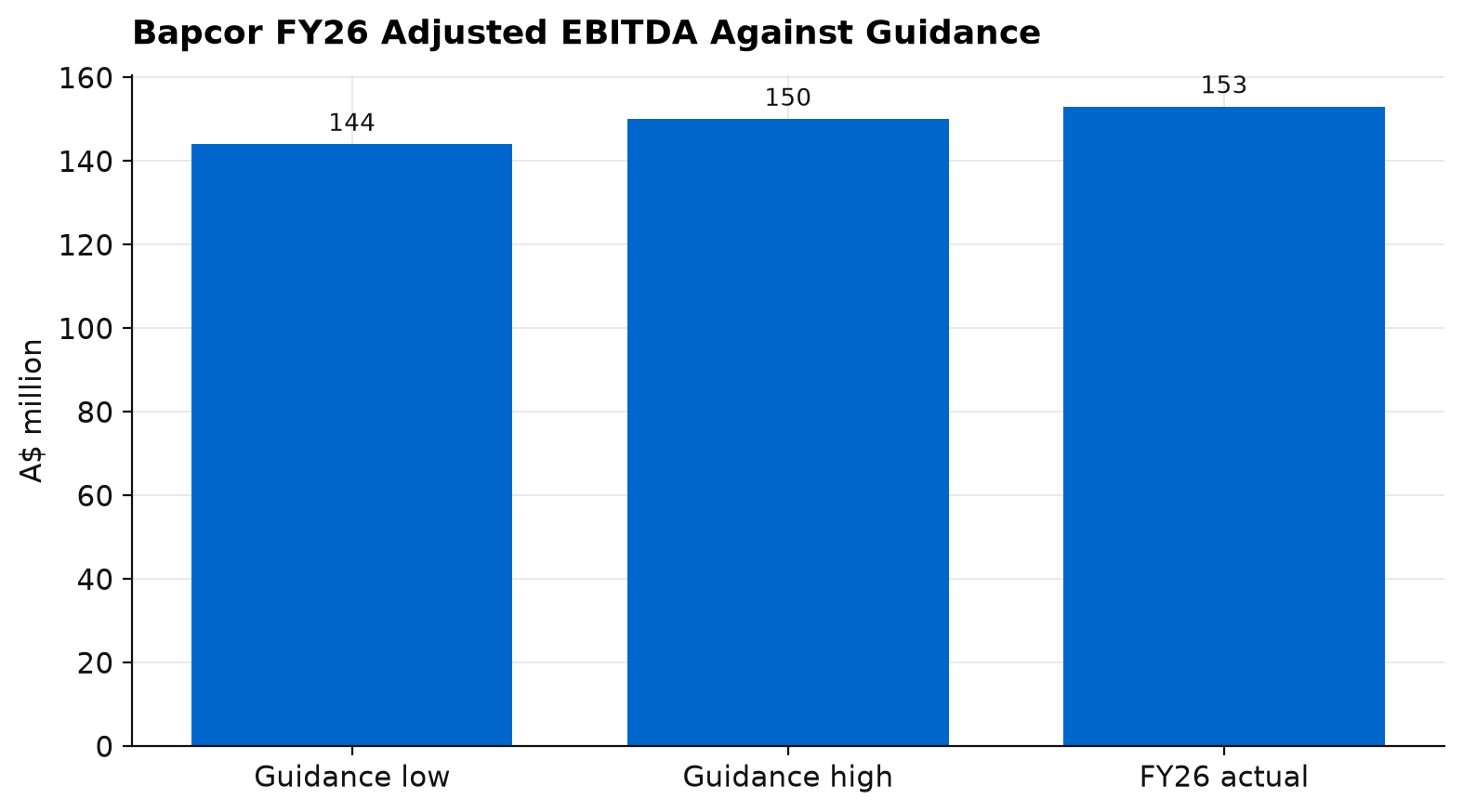
Bapcor reported adjusted EBITDA of A$153 million for FY26. That was above the A$144 million to A$150 million guidance range the company set when it downgraded its outlook in May 2026, a range it then reaffirmed in August. The result was also about 3 per cent ahead of both institutional sell-side forecasts and consensus, where consensus means the average of the forecasts published by analysts who cover the stock.
Having already cut its outlook once, Bapcor needed to at least meet the lowered range, and it finished above the top of it, which the research calls a clear step forward in stabilising operations.
The beat came against a much lower bar, with adjusted EBITDA down 35 per cent in FY26 on the year before. The research’s financial summary also records FY26 EBITDA of negative A$311.5 million, against the A$153 million adjusted figure. The note does not explain the gap between the two measures, though a difference that large means sizeable items in FY26 sit outside the adjusted figure.
Sales Momentum Improved in Every Segment
The research measures sales with same-store sales growth (SSSg), which compares sales at stores that were trading in both periods and leaves out the effect of store openings and closures. For a distributor with a store network, that gives a good guide to whether existing customers are spending more or less.
All of Bapcor’s segments improved their same-store sales momentum over February to June 2026, and Trade appears to have finished strongly. Its same-store sales growth for February to April was 0.7 per cent, and for the wider February to June period it was 1.3 per cent. For the longer period to finish that much higher, the last two months had to be strong, and the research notes that this momentum carried into FY27.
Trade is also where Bapcor has been losing ground. The research shows GPC, through Repco, and Super Cheap taking share from Bapcor Trade, and Bapcor’s same-store sales growth has run below Repco’s since the second half of FY24. Late in the second half of FY26 that momentum appears to have turned. The turnaround needs that trend to hold well beyond a few months to win back the share lost over recent years.
Bapcor has restated its accounts over FY25 and FY26, which makes comparisons with prior years harder, and growth rates of 0.7 per cent and 1.3 per cent are small, so a few weak weeks could undo them.
Early trading in FY27 has started in the same direction, with the company saying sales over the first six weeks were slightly ahead of the prior corresponding period, meaning the same weeks a year earlier. Institutional sell-side research forecasts sales growth of 0.9 per cent for the first half of FY27, and the company has guided to modest revenue growth for the full year, which the research models at 1.2 per cent.
Lower Net Debt and Revised Covenants Ease Balance Sheet Pressure
Net debt is what a company owes its lenders minus the cash it holds. For a business in a turnaround, the trend in net debt often matters as much as profit, because high debt limits how long management has to fix the business before lenders start to set the terms.
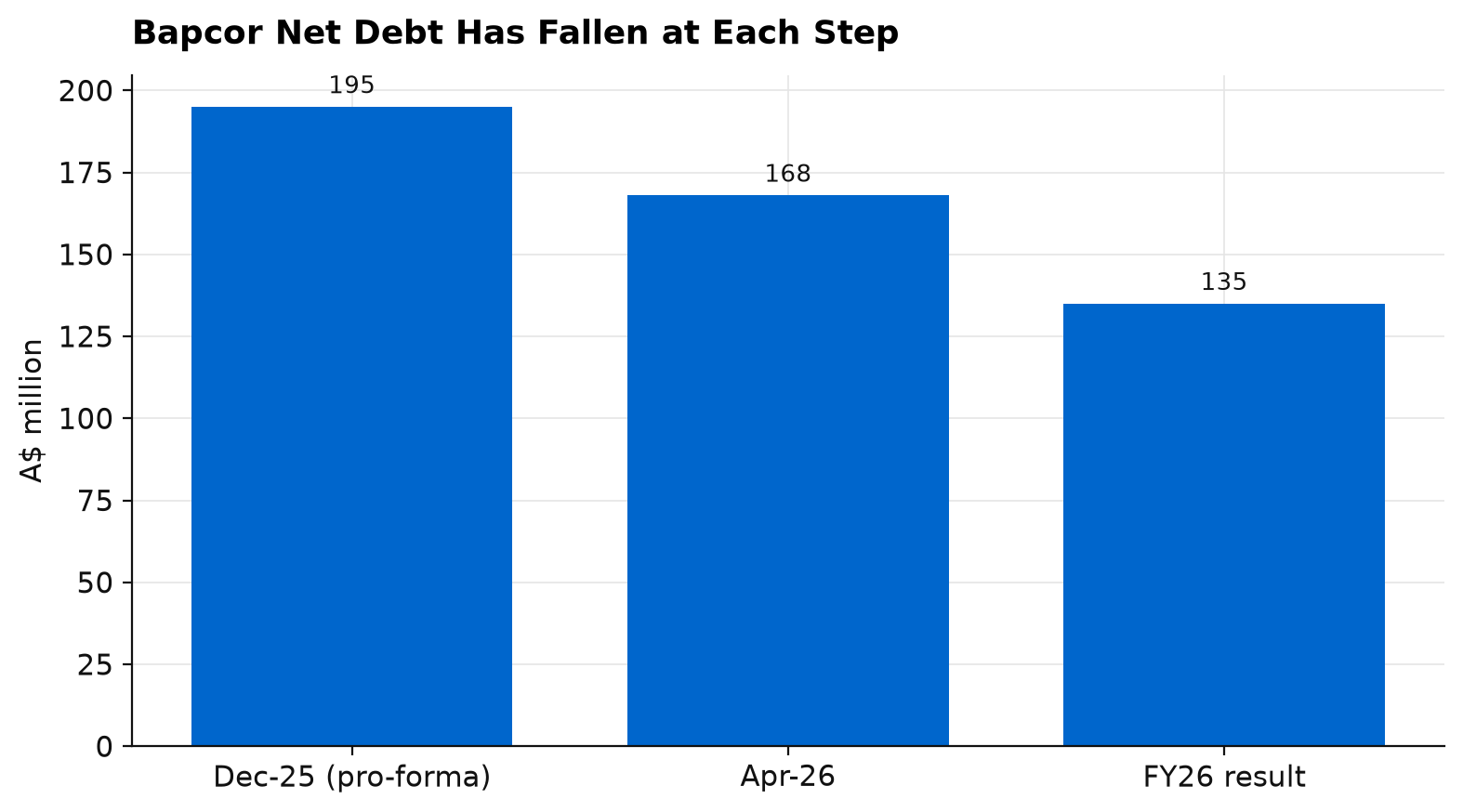
Bapcor’s net debt was A$135 million at the FY26 result. That compares with A$168 million reported in April 2026 and A$195 million at December 2025 on a pro-forma basis, where pro-forma means the figure has been adjusted to show the balance sheet as if certain changes had already taken effect. The research highlights that debt fell even though earnings were depressed.
A rules-based approach to leveraged ETFs
See how our quantitative strategy works and who it suits.
Explore the strategyBecome an authorised representative
Advise your clients under an established AFSL without building your own. Choose AR or CAR.
Become an AR or CARNet leverage was 1.7 times. Leverage here compares the company’s net debt with its earnings, so a lower number means the debt is smaller relative to the profit available to service it.
The loan terms have also changed. Bank loans usually come with covenants, which are conditions the borrower must keep meeting, such as holding debt below a set level relative to earnings. If a company breaches a covenant, lenders can demand changes or repayment. Bapcor’s covenants include a net leverage ratio test and a fixed charge cover ratio, or FCCR, which measures how comfortably earnings cover fixed costs such as interest. As the company announced in August 2026, both covenants have been revised and extended by six months.
The research sees the lower leverage as reducing risk, though the covenant extension only runs for six months, so earnings need to recover within that time.
Staff Turnover Falls as Automotive Executives Return
The research points to strong progress on employee retention, with staff turnover down 15 per cent since December 2025. Turnover is the rate at which staff leave and have to be replaced. High turnover is costly in any business, because new people take time to learn the job, and in a parts distributor it can also hurt customer service.
Automotive executives have also returned to Bapcor. Given how much the industry relies on relationships with customers and suppliers, the research calls this a clear positive and a key driver of the stabilisation in operations, noting that it has shifted focus back onto supplier relationships.
Bapcor depends on access to a wide range of automotive parts, in particular parts with established brands that drive customer orders. If suppliers lose confidence in a distributor, the strongest brands can move elsewhere and customers can follow. The research lists supplier pressure or damage to those relationships as a downside risk, and lists stability in management, with appointments of people who have strong automotive experience, as an upside risk.
A significant majority of Bapcor’s sales come from repeat orders from customers, who can move those orders elsewhere if service slips, so better staff retention and closer supplier ties help protect sales.
A Limited Outlook Puts More Weight on the Second Half
The outlook was the weaker part of the result, with limited commentary from the company, particularly on costs and margins. Margin is the share of each dollar of sales that turns into profit, and for Bapcor, small changes in segment margins move group earnings a long way. Without guidance at that level, forecasting group profit is difficult, and FY26 showed how variable the outcomes can be, with adjusted EBITDA falling 35 per cent.
The company said it expects modest revenue growth in FY27 and that adjusted NPAT will be materially weighted to the second half. NPAT is net profit after tax, the bottom line after all costs, interest and tax. Institutional sell-side research assumes 38 per cent of FY27 adjusted NPAT falls in the first half and 62 per cent in the second. With most of the profit due in the second half, there is less time to recover if that half disappoints.
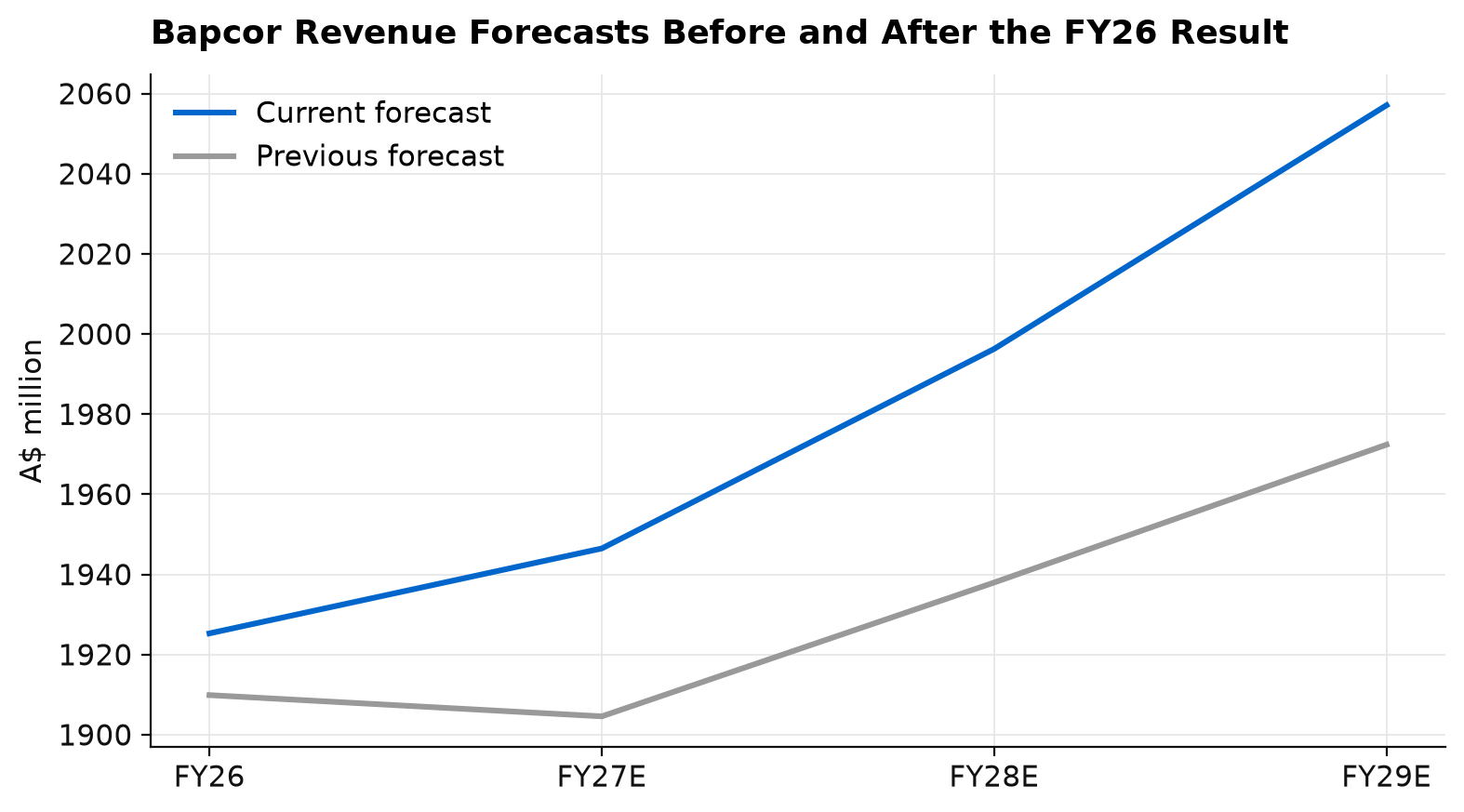
The research still lifted its forecasts after the result. It raised its FY27 to FY29 adjusted EBITDA estimates by 9 to 16 per cent, reflecting improved momentum and reduced downside risks to earnings. Its revenue forecasts rose as well. FY27 revenue is now forecast at A$1,946.5 million, against A$1,904.6 million before the result. The FY28 forecast moved to A$1,996.3 million from A$1,938.0 million, and the FY29 forecast to A$2,057.1 million from A$1,972.4 million. FY26 revenue came in at A$1,925.3 million, against a prior forecast of A$1,909.9 million.
On a per share basis, the research forecasts earnings per share of A$0.03 in FY27 and A$0.04 in both FY28 and FY29, up from A$0.02 in FY26. Its previous forecasts were A$0.03 for each of those years. It also expects segment EBITDA margins to stabilise, while noting there have been multiple restatements in recent years that make the history harder to read.
Valuation and Why the Call Is Hold
Institutional sell-side research lifted its 12 month price target to A$0.60 from A$0.36 and moved its rating to Hold from Sell. The research gives three reasons for the upgrade. First, sales momentum has returned across every segment, easing one of its concerns sooner than it expected. Second, net debt has fallen to A$135 million and the covenants have been revised and extended, which reduces the chance that the balance sheet forces the company’s hand. Third, the return of experienced automotive executives and lower staff turnover support the supplier and customer relationships the business depends on.
Those reasons sit behind the higher forecasts and target, but the research remains cautious given the challenging operating environment and the relatively early stage of the turnaround, and it judged risk and return as balanced at the share price at the time, hence the Hold.
When the research was written the shares were trading only a little above the target, and they have since risen further. The shares closed at A$0.81 on 21 September 2026, and the A$0.60 target sits 25.9 per cent below that price. On the research’s numbers, a share price above the target only makes sense if the turnaround runs faster than it forecasts, with sales growth and segment margins both improving beyond its estimates.
The FY26 result removed several of the reasons behind the earlier Sell call, and the research says it will look for sustained improvement in same-store sales growth and segment margins before turning more positive.
Key Risks
Bapcor continues to name the Middle East, inflation and consumer sentiment as the key external risks, and weaker consumer spending would hit sales just as momentum is returning. Competition is another risk, with Repco and Super Cheap already taking share from Bapcor Trade, new competitors, vehicle manufacturers and new vehicle technologies all able to apply pressure, and customers holding bargaining power because most sales are repeat orders that can move elsewhere. Execution is a risk too, since the turnaround is at a relatively early stage, the company gave limited cost and margin guidance, and FY26 showed how quickly earnings can swing. Supplier relationships also matter, because access to established parts brands drives customer orders and any damage there would flow straight to sales. The covenants were extended by six months, so the balance sheet still depends on earnings recovering within that period. On the upside, effective cost-out initiatives across the segments and continued stability in management could lift profitability faster than forecast.
Our View
The FY26 result deserves credit. Cutting net debt while earnings were depressed is a sound sign for a turnaround, as it reduces the company’s reliance on its lenders. The return of experienced automotive executives also addresses a problem the research ties directly to the stabilisation of operations. The outlook is less clear, with most of FY27’s profit expected in the second half, little guidance on margins and covenant relief that runs for six months, which leaves limited room for setbacks while the shares already sit above the research’s target. Same-store sales growth holding at or above the February to June levels, and segment margins stabilising as the research expects, are the signs that would show the turnaround is lasting.
If you would like to discuss Bapcor, request a callback or call us on 1300 889 603.
Financial Summary
Become an authorised representative
Advise your clients under an established AFSL without building your own. Choose AR or CAR.
Become an AR or CAR