

Sell
PLS is an Australian lithium producer that mines and sells spodumene concentrate from its Pilgangoora operation and ships it out of Port Hedland.
Institutional sell-side research rates it Sell because higher capital, higher unit costs and ongoing stripping and tailings spending keep free cash flow negative to the end of the decade. That drains the net cash balance and moves PLS to net debt. The research also sees production growth as more than priced in, and expects other lithium names to offer a better return for the risk.
- Sell-side rating
- Sell
- Sell-side target
- A$3.50
- Upside to target
- +22.8%
- Initial price
- A$2.612 Nov 2026
- Last close
- A$2.8512 Nov 2026
PLS has given the green light to P2000, the expansion that lifts its Pilgangoora lithium operation to about 2.0 million tonnes a year of spodumene concentrate, the lithium-bearing product the company sells. Production came in about where the market expected, but plant capital, supporting infrastructure and unit operating costs all came in higher than institutional sell-side research had forecast, and the extra spending keeps free cash flow negative until the end of the decade. Institutional sell-side research has PLS rated Sell with a 12 month price target of A$3.50, about 34.1 per cent above the share price of A$2.61 when this research was published. The Sell is measured against the rest of the research’s Australian lithium coverage over roughly 12 months, where the research sees better value. It trimmed its target by 4 per cent after the announcement and flags execution risk for PLS while P2000 is built.
Research published 2 November 2026. Price target and upside based on prices at time of publication.
Table of contents [hideshow]
About PLS
PLS Group is an Australian lithium producer listed on the ASX. Its core asset is the Pilgangoora operation, which ships spodumene concentrate out of Port Hedland. Pilgangoora runs two processing plants today, Pilgan and Ngungaju, and the newly approved Jimmagunya plant will be built next to Pilgan. The operation also produces tantalum as a by-product. PLS has a second growth project, Colina, which the research regards as longer dated. The updated Ore Reserve grades 1.24 per cent lithium oxide, and the wider Mineral Resource, now 8 per cent smaller in tonnes but higher grade, sits at 1.33 per cent. FY27 guidance calls for concentrate production of about 1,030 to 1,100 thousand tonnes. The company reports on a 30 June financial year and ended FY26 with about A$2.3 billion of cash.
P2000 Is Approved but Costs Have Risen
P2000 is the name PLS gives to the expansion of Pilgangoora to about 2.0 million tonnes a year of concentrate. The company has now taken a final investment decision, or FID, which is the formal board commitment to build. The expansion is built around a new plant called Jimmagunya, sized at about 9.0 million tonnes a year on the dry side and about 6.3 million tonnes a year on the wet side, next to the existing Pilgan plant. That is bigger than the June 2024 pre-feasibility study, or PFS, which had about 6.1 million tonnes a year of throughput and a wet plant of about 5 million tonnes a year. The new feasibility study, or FS, targets average steady-state production of about 2.0 million tonnes a year of SC5.2 concentrate over the ten years from FY31 to FY40, slightly up on the PFS and largely in line with market expectations. SC5.2 means concentrate grading 5.2 per cent lithium oxide.
First production has slipped a little, to the September quarter of calendar 2029, roughly FY30, followed by a ramp-up of about six months. Institutional sell-side research had previously assumed first production from the December quarter of 2028. Once Jimmagunya is running, production will be concentrated in the two larger plants sitting side by side, Jimmagunya and Pilgan. The older Ngungaju plant will be idled and kept as flexible capacity, to be used depending on feed availability, costs and market conditions. Management has flagged that Ngungaju production will taper as its workforce moves across to the new plant.
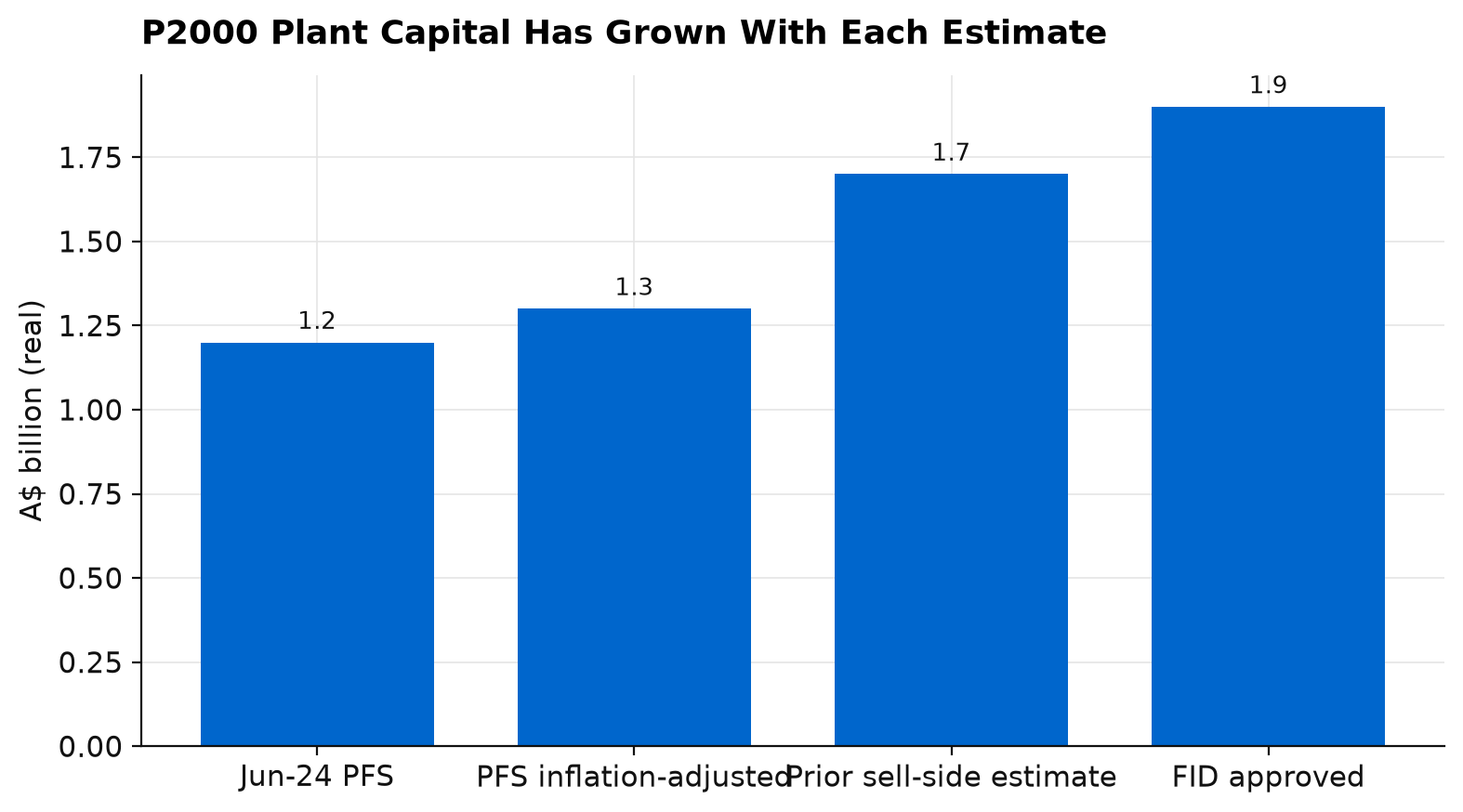
Approved P2000 plant capital is about A$1.9 billion in real terms, meaning today’s dollars before inflation, and that includes about A$175 million of spending already approved before the FID. It is above the prior sell-side estimate of about A$1.7 billion and about 45 per cent above the company’s inflation-adjusted PFS figure of about A$1.3 billion, which itself started life at about A$1.2 billion in June 2024. The company put the increase down mainly to the larger scale and processing capability of Jimmagunya, scope development and greater project definition since the PFS. The budget has no single overall contingency, a buffer for cost overruns, so individual line items include different levels of contingency depending on how far advanced they are, and the research expects aggregate contingency of roughly 10 to 20 per cent.
On top of the plant, PLS announced a separate investment of about A$600 to A$650 million in what it calls enhancing infrastructure, covering an access road, a permanent village and a facility for heavy mobile equipment. That is about 20 per cent higher than the prior sell-side estimate of about A$510 million. Together, the plant and the infrastructure take announced spending to about A$2.5 to A$2.55 billion, against a prior sell-side estimate of about A$2.2 billion.
A revised processing flowsheet, built on about two years of data from sorting waste rock out of Pilgan’s ore since August 2024, lets Jimmagunya tolerate up to 35 per cent waste in its feed. In exchange, Jimmagunya’s target lithia recovery is about 70 per cent, compared with about 75 per cent at Pilgan, and the company aims to lift it over time. The change allowed mineralised contact ore, previously treated as waste, to be reclassified as ore. The Ore Reserve rose about 25 per cent in tonnes and about 30 per cent in contained lithium, helped also by a maiden underground reserve grading 1.50 per cent lithium oxide. The open-pit reserve, grading 1.19 per cent, now supports a mine life of about 20 years on the P2000 schedule, and the company says the new plan smooths the production profile compared with the steep peak and decline in the PFS.
Higher Unit Costs Cut Earnings Forecasts
PLS is targeting average steady-state unit operating costs of about A$620 a tonne in real terms over FY31 to FY40. That figure is measured free on board, or FOB, at Port Hedland, which means the cost of getting concentrate onto the ship, excluding freight and royalties and net of tantalite by-product credits. The company points out this is about a 5 per cent improvement on the inflation-adjusted PFS mid-point of about A$650 a tonne. The research had been using a much lower figure of about A$420 a tonne in real FY27 terms.
Part of the gap is an accounting effect tied to the strip ratio, which measures how much waste rock has to be moved for every tonne of ore mined. Because contact ore has been reclassified from waste to ore, the open-pit life-of-mine strip ratio falls from 7.7 in the PFS to 5.6 in the FS, even though the total material being moved is broadly the same. When more of what is dug up counts as ore, more of the mining cost is expensed through the profit and loss statement each year, and less is capitalised as stripping on the balance sheet. This pushes up reported unit costs and cuts EBITDA (earnings before interest, tax, depreciation and amortisation), and it also reduces capitalised stripping, so cash flow is little changed. The new reserve parameters are not yet in FY27 guidance, and the research flags this could lift FY27 unit costs and lower mine development spending.
A rules-based approach to leveraged ETFs
See how our quantitative strategy works and who it suits.
Explore the strategyBecome an authorised representative
Advise your clients under an established AFSL without building your own. Choose AR or CAR.
Become an AR or CAREven after adjusting for that, costs are higher than forecast. Adding steady-state mine development of about A$91 a tonne to the A$620 a tonne operating figure gives combined costs of A$711 a tonne. The research’s prior estimate was above A$500 a tonne, although that included an earlier and larger move to underground mining. Idling the higher-cost Ngungaju plant and moving output to the larger Jimmagunya plant brought a smaller unit cost benefit than the research expected. Unit costs are still roughly in line with, or above, FY27 guidance of about A$575 to A$625 a tonne in real terms. The study only counts cost performance already achieved, and PLS is targeting further reductions through its Cost Smart Future Ready program.
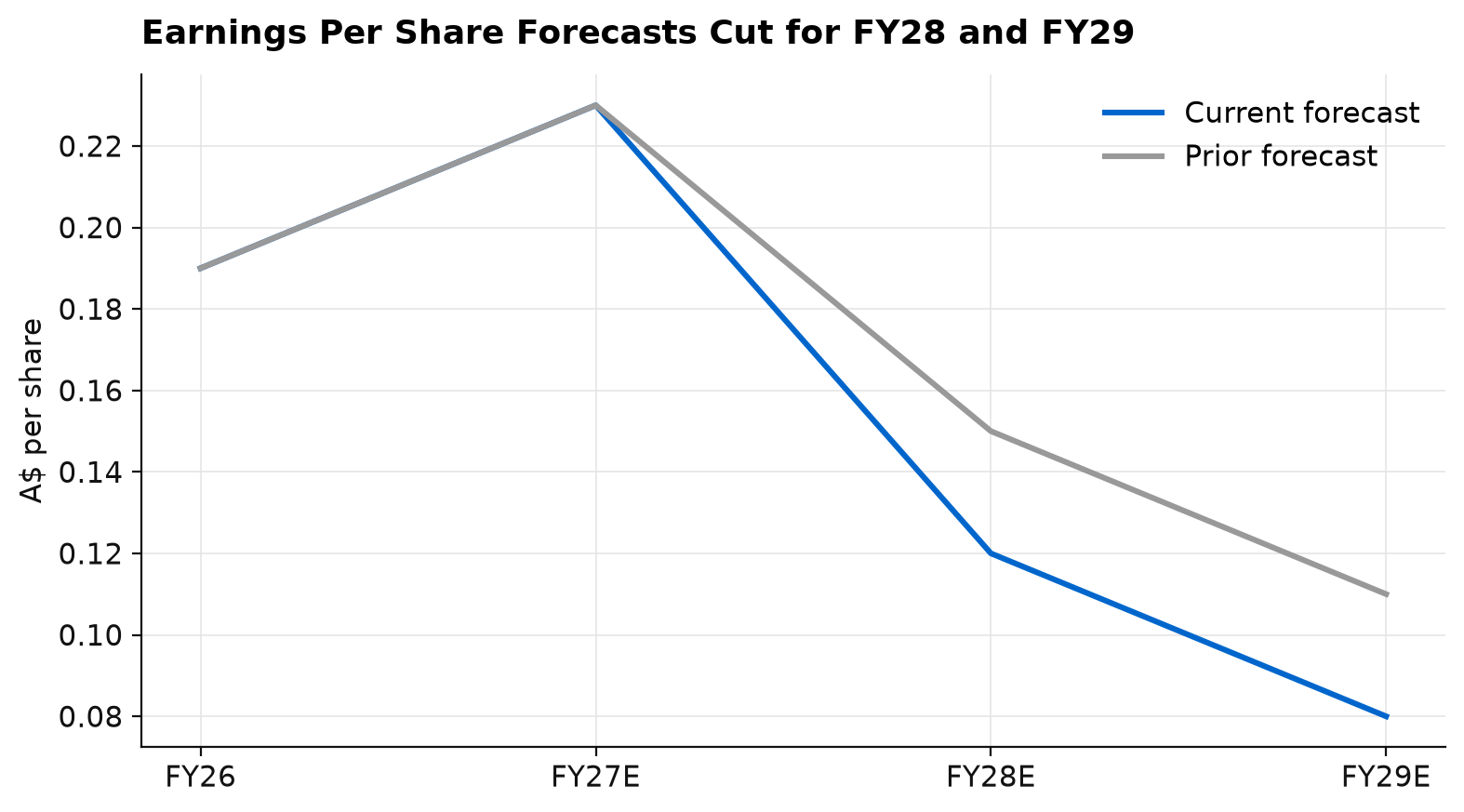
Higher expensed mining costs, later first production and the revised project costs all feed into lower earnings forecasts. The research has cut its EBITDA forecasts for FY27, FY28 and FY29 by 2 per cent, 11 per cent and 17 per cent respectively. EBITDA was A$1,137.0 million in FY26 and is forecast at A$1,454.5 million in FY27, before falling to A$1,029.4 million in FY28 and A$921.2 million in FY29. Revenue of A$1,934.0 million in FY26 is forecast at A$2,473.1 million in FY27, A$2,109.6 million in FY28 and A$2,002.1 million in FY29, down from prior forecasts of A$2,172.0 million and A$2,292.1 million for the last two years. Earnings per share of A$0.19 in FY26 are forecast at A$0.23 in FY27, then A$0.12 in FY28 and A$0.08 in FY29, against prior forecasts of A$0.15 and A$0.11.
Return on capital employed, or ROCE, the profit a business earns on the money tied up in it, points the same way: the research forecasts 23.7 per cent in FY27, falling to 9.2 per cent in FY28 and 4.0 per cent in FY29, against 18.2 per cent in FY26. Over the longer run, the research also argues that declining grades and increasing mine depth at Pilgangoora, and the costs that come with them, remain under-appreciated in consensus expectations. The Ngungaju plant restarted in early FY27, but the research sees it as marginal for earnings before it tapers back into care and maintenance, a state where the plant is kept in order but not operated, as Jimmagunya ramps up.
Capex Rises and Free Cash Flow Turns Negative
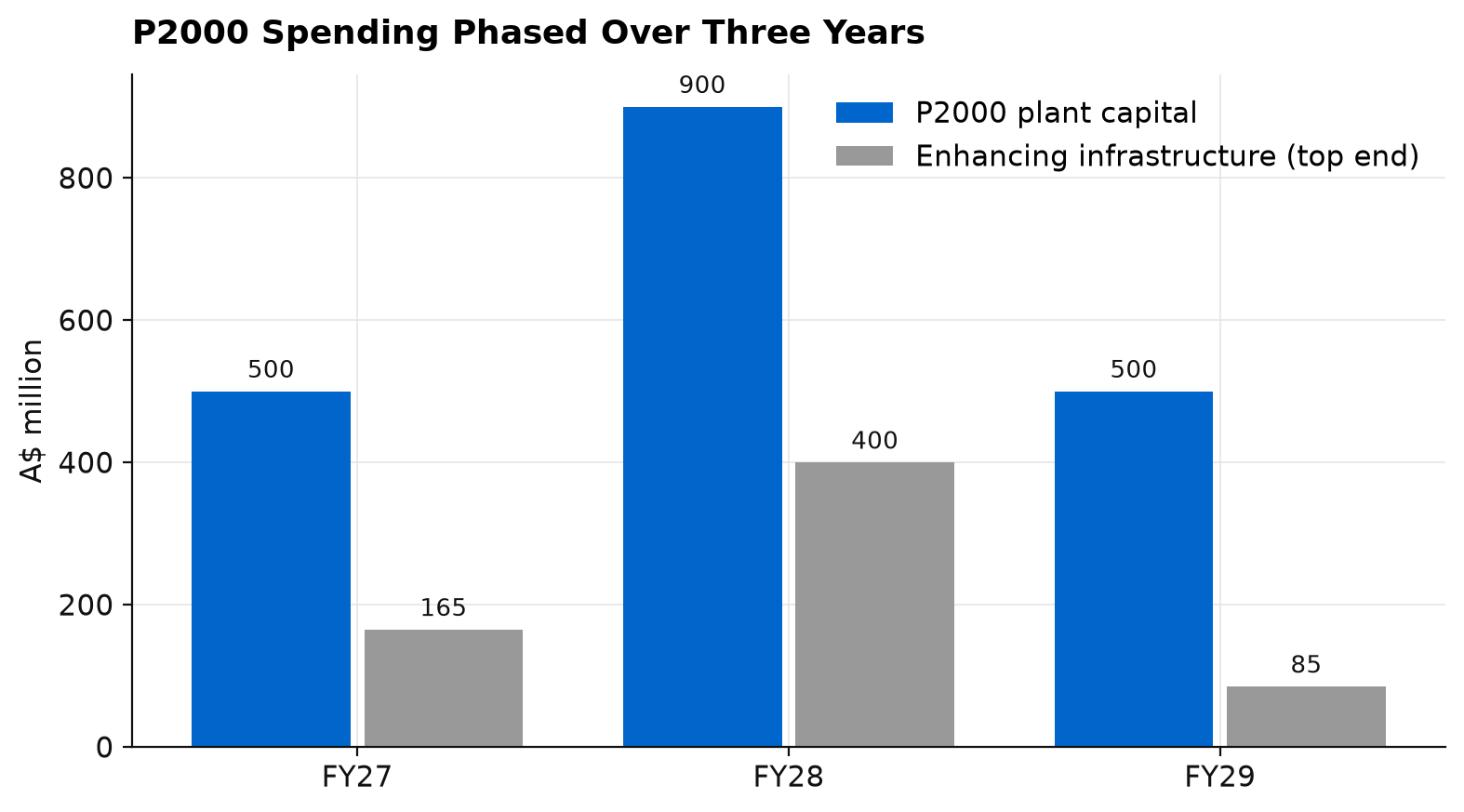
Free cash flow is the cash left after paying for operations and capital expenditure, or capex. FY27 capex guidance has been increased to about A$1,110 to A$1,175 million, from about A$665 to A$740 million at the fourth-quarter result. The increase reflects about A$500 million of P2000 capex, including the A$175 million of pre-FID spending, and about A$165 million of enhancing infrastructure. Base capex guidance is unchanged, covering sustaining capital of about A$85 to A$100 million, mine development of about A$250 to A$280 million, and infrastructure and projects of about A$110 to A$130 million. FY27 production and unit cost guidance are also unchanged.
PLS noted there is no explicit mine development capital tied to the expansion, because total material movements over the life of mine are similar, but it will update capitalised stripping in future guidance, so further spending is likely. The research assumes the current FY27 spending rate continues into FY28 and FY29, adding about A$0.4 billion against its prior P2000 mine development allowance of A$0.5 billion. The research now sees total growth capex at Pilgangoora over FY27 to FY29 at about A$3 billion, above its prior estimate of about A$2.7 billion. Total material movements are expected to stay around 50 to 60 million tonnes a year over FY27 and FY28 before stepping up in FY29, with the research seeing a peak of about 90 to 100 million tonnes a year on the current mine plan.
After construction, PLS guided to sustaining capital of about A$40 to A$60 million a year and mine development of about A$180 million a year over FY31 to FY40 in real terms. Combined ongoing sustaining and mine development spending is above the prior sell-side figure of about A$200 million a year. Lease liabilities are expected to grow from about A$180 million at FY26 to about A$330 million, lifting lease payments from about A$45 million a year to about A$85 million a year before financing terms.
PLS intends to fund P2000 and the infrastructure program entirely from its existing cash of about A$2.3 billion at the end of FY26 plus ongoing operating cash flow. That plan assumes a long-term 2037 SC6 price of US$1,620 a tonne, with higher prices in the interim. The company has previously reiterated a ceiling on net senior debt relative to EBITDA through the cycle and has an undrawn revolving credit facility of about A$500 million. On its own lithium price outlook, the research sees free cash flow negative to the end of the decade, the facility being drawn to fund P2000 and Colina, and PLS moving from net cash to net debt that peaks at about 1.5 times EBITDA.
PLS paid A$0.05 a share over the past twelve months, a trailing yield of 1.9 per cent, fully franked. Under its Capital Management Framework, franked dividends are set from free cash flow excluding major growth spending such as P2000, at the board’s discretion. The research expects payouts to remain modest on its price outlook, particularly if PLS keeps advancing Colina. PLS has also said it remains open to inorganic opportunities, meaning acquisitions, and that its liquidity positions it well for any nearer-term deals.
Valuation and the Sell Rating
Institutional sell-side research has a 12 month price target of A$3.50 on PLS, about 34.1 per cent above the share price of A$2.61 when this research was published. The target was cut by 4 per cent after the P2000 study to reflect the higher costs and capital. The rating is set on a roughly 12 month view relative to the research’s Australian lithium coverage, which is why a Sell can sit alongside a target above the share price. PLS trades at a higher multiple of its estimated net asset value than pure-play lithium peers, and the research expects other lithium names to offer a better return for the risk.
The Sell rests mainly on cash, as higher capital, higher unit costs and ongoing stripping and tailings spending keep free cash flow negative to the end of the decade, drawing down the net cash balance and moving PLS to net debt. PLS already took out cost through 2024, particularly after shutting Ngungaju, and the research expects most of the easier savings have been used up, while grades decline and the mine gets deeper. P2000 is also a large, multi-year construction program that the research sees as harder to wind back than peer projects if lithium prices fall further than it expects, and another cycle of lower prices, combined with PLS’s preference for balance sheet strength, could delay the payoff for shareholders.
The research sees PLS’s production growth, from the Ngungaju restart, P2000 and Colina, as more than priced in. It also includes no takeover premium in its valuation, pointing to limited uncontracted volumes, concentrated end-market exposure and few near-term chances for a value-adding capital injection.
Key Risks
Because this is a Sell, the key risks are the things that could make PLS outperform. The biggest is the lithium price, since a stronger recovery than the research expects would lift cash flow and ease the funding strain, and broader macro conditions can swing demand and sentiment either way. A stronger push into vertical integration, where PLS moves further along the lithium supply chain, could also change how the market values its tonnes. On execution, P2000 construction and commissioning could go better than feared, and operational optimisation, such as lifting Jimmagunya recoveries toward Pilgan’s, could deliver the cost reductions the company is targeting. PLS is also open to acquisitions, and growth or deal activity could move the stock in ways a relative valuation call does not capture.
Our View
We think building P2000 makes sense, since a bigger plant, a larger reserve and a smoother production profile are all improvements on the earlier study, and the separate underground study points to production of about 2.2 million tonnes a year across all three plants and a life beyond 25 years, subject to a further feasibility study and a board decision. We will be watching whether unit costs fall, because the study’s figure is essentially no better than FY27 guidance in real terms and the reclassification effect has not yet reached that guidance. We will also watch whether PLS holds back on acquisitions while the balance sheet moves toward net debt.
If you would like to discuss PLS, request a callback or call us on 1300 889 603.
Financial Summary
Become an authorised representative
Advise your clients under an established AFSL without building your own. Choose AR or CAR.
Become an AR or CAR