

Sell
Wesfarmers is a diversified Australian group whose largest business is the Bunnings home improvement chain, alongside Kmart, Officeworks, health, industrial and chemicals operations.
Institutional sell-side research rates Wesfarmers Sell because a premium valuation leaves little margin for the earnings slippage now coming through. Net interest is forecast at $574m in FY27, up from $476m in FY26 after the $1.7bn capital return, which pulls earnings per share 4 per cent below prior consensus for FY27. Softer housing data and slowing Kmart and Officeworks sales add to the pressure on a stock whose quality is already in the price.
- Sell-side rating
- Sell
- Sell-side target
- A$77.00
- Upside to target
- −0.7%
- Initial price
- A$72.5714 Sep 2026
- Last close
- A$77.5119 Nov 2026
Wesfarmers reported a clean FY26 result at the operating level. Bunnings and Kmart lifted margins, and earnings before interest and tax came in a little ahead of market expectations. Early trading in FY27 has held up too, with Bunnings still growing sales in a tough retail environment. Interest costs, however, rose sharply in the second half after the company returned $1.7bn of capital to shareholders in December 2025, and management is guiding to a further step up in FY27. Institutional sell-side research has Wesfarmers rated Sell with a 12 month price target of A$77.00, about 6.1 per cent above the share price of A$72.57 when this research was published. The target was trimmed from A$78.00, and the research view is that a premium valuation leaves little margin for the earnings slippage now coming through.
Research published 14 September 2026. Price target and upside based on prices at time of publication.
Table of contents [hideshow]
About Wesfarmers
Wesfarmers is a diversified Australian group listed on the Australian Securities Exchange under the code WES. Its largest business is Bunnings, the home improvement chain operating in Australia and New Zealand, with New Zealand making up about 8 per cent of Bunnings sales in FY25. Kmart is the discount department store business, where apparel accounts for 33 per cent of sales, home and living for 30 per cent, and general merchandise together with active and beauty ranges for 26 per cent. Officeworks is the third retail brand. Alongside the retailers sit Wesfarmers Health, the Industrial and Safety division, and WesCEF, the chemicals business behind the group’s ammonia, sodium cyanide and ammonium nitrate operations, along with Covalent. The company reports on a financial year ending in June.
A Clean Trading Result With a Miss After Interest
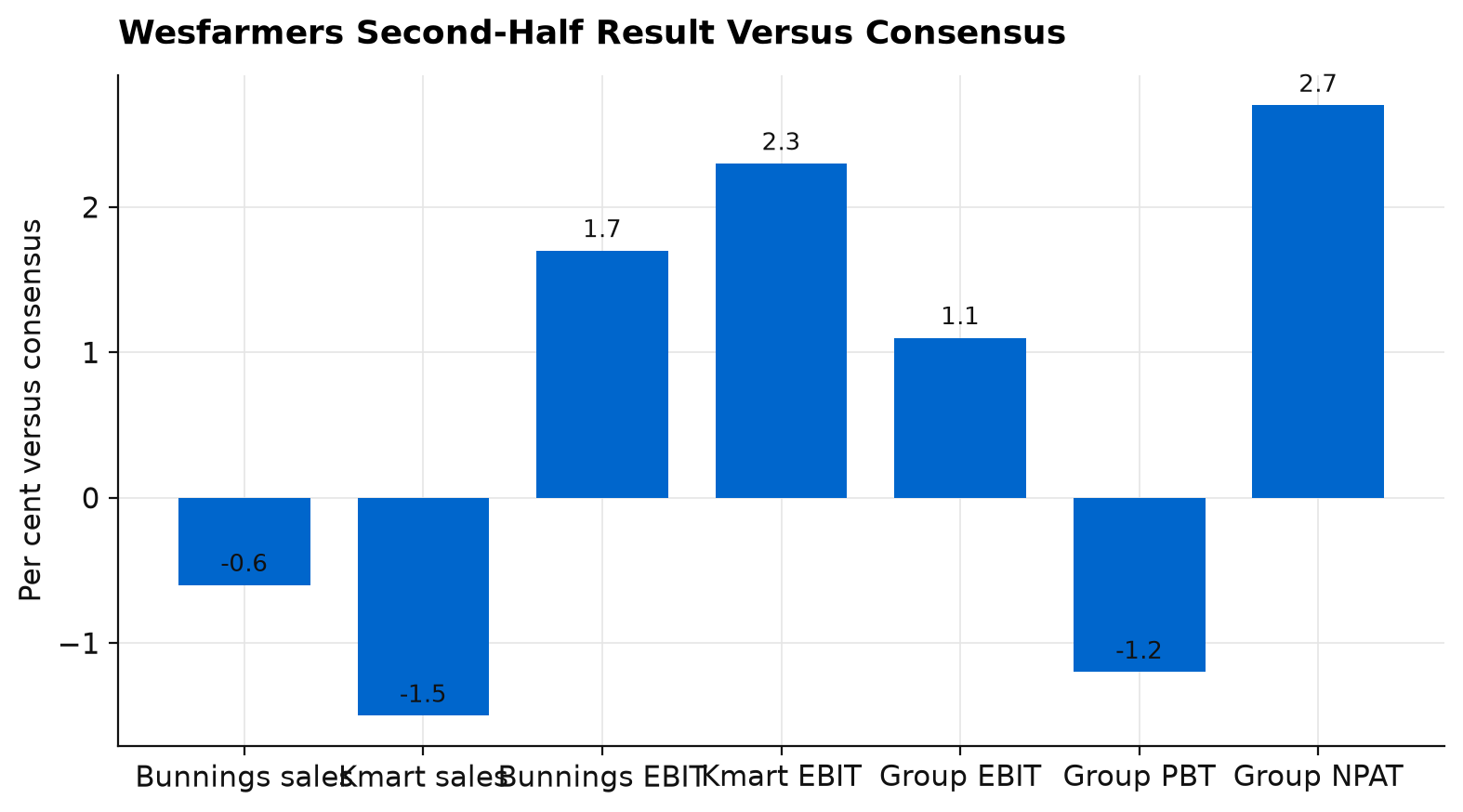
In 2H26, meaning the second half of the 2026 financial year, earnings before interest and tax (EBIT, a measure of operating profit before financing costs and tax) came in 1.1 per cent ahead of Visible Alpha consensus. Consensus is the average of forecasts compiled across the market. The beat was driven by Bunnings, 1.7 per cent ahead, and Kmart, 2.3 per cent ahead, and in both cases the reason was stronger margins. Sales missed, by 0.6 per cent at Bunnings and 1.5 per cent at Kmart. For the full year, Bunnings and Kmart margins landed in line with expectations.
Profit before tax (PBT, profit after interest costs but before tax) missed consensus by about 1.2 per cent, because net interest was higher than expected. Net profit after tax (NPAT) did beat consensus by 2.7 per cent, but that was assisted by a one-off tax item.
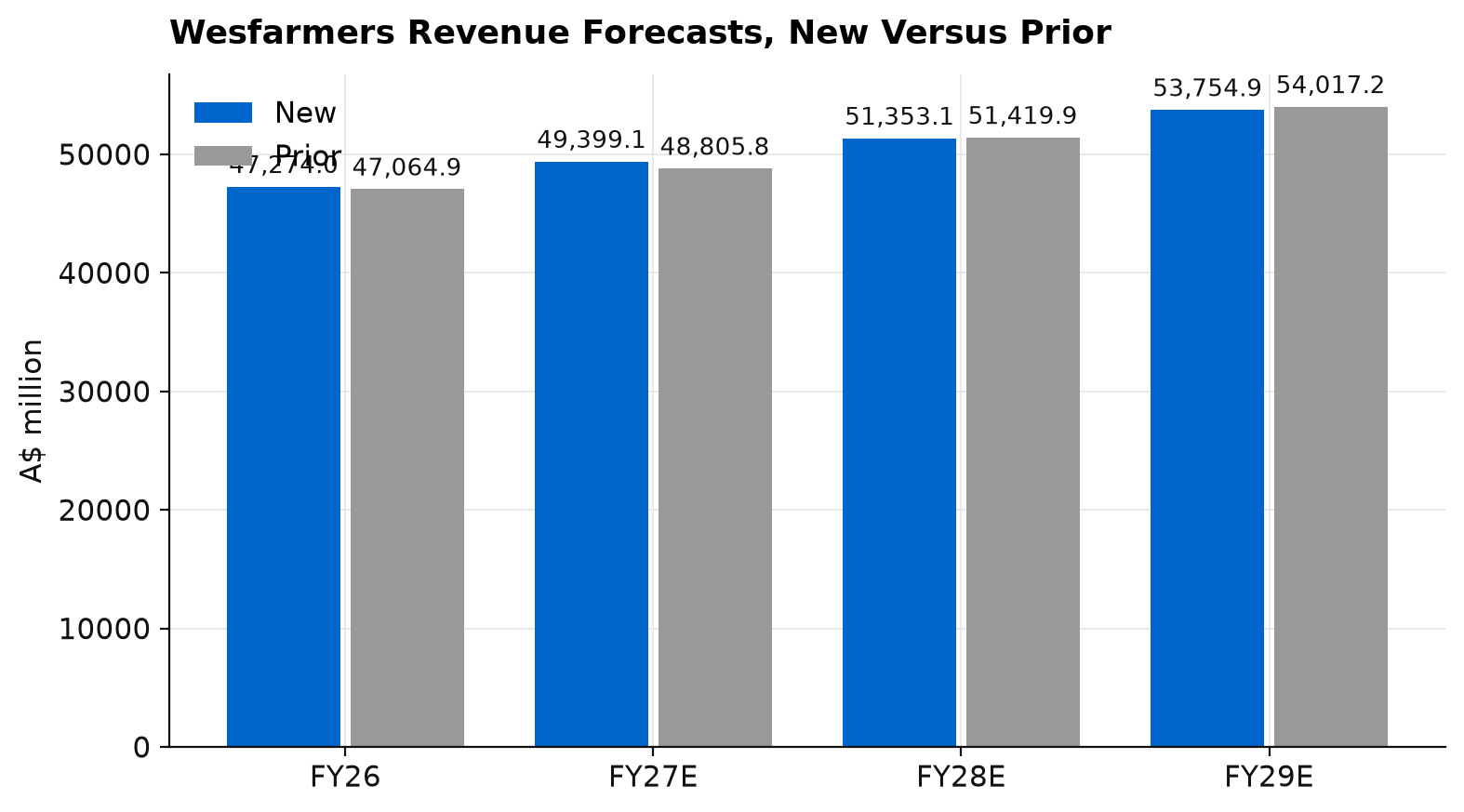
FY26 revenue came to $47,274.0m, and earnings per share were A$1.41 in the first half and A$1.12 in the second, for A$2.53 across the year.
Bunnings Holds Firm While Kmart and Officeworks Slow
In the first seven weeks of FY27, Bunnings sales growth is running slightly better than 3.9 per cent, though July was helped by the weather, which implies August has slowed. Bunnings has also not yet seen a noticeable impact from the federal budget, so that effect is still to show up. Kmart slowed to around 2.2 per cent, with a weaker New Zealand dollar acting as a headwind, and Officeworks slowed to less than 2.6 per cent. Officeworks was still well ahead of JB Hi-Fi in Australia, which came in at minus 0.5 per cent.
Management described shoppers as steady, focused on value and putting fewer items in the basket, but conditions have not worsened since the company’s June Strategy Day. Apparel retailers also had to deal with a warmer than usual June, which hurt the key winter selling period.
The research’s analysis shows that house prices and housing turnover have historically driven Bunnings like-for-like sales, which are sales from stores open in both periods, so the effect of new stores is stripped out. That link held closely across a long run of data from 1H07 to 2H19. From FY24 onward, Bunnings Australia and New Zealand diverged, with New Zealand declining slightly in FY24 and FY25 while Australia generated 2 to 4 per cent growth as house prices rebounded. Australian capital-city dwelling prices fell 0.9 per cent month on month in July, and house prices in Melbourne and Sydney are back around mid-2025 levels. If that softness persists, it is a headwind for the group’s largest business.
Bunnings will keep expanding into new categories including smart home, EV charging and solar, and its online marketplace will continue to grow. It is also launching a new appliances range in around 78 stores, working with a couple of brands, with some launching before Christmas and more in 2H27. Early unbranded in-store promotional drops of dishwashers, washers and dryers have seen strong sell-through, which the company says shows the volume potential and lifts appliance sales alongside kitchens. On costs, the enterprise bargaining agreement, the collective wage deal with employees, is still being negotiated, but the company believes FY27 wage growth is unlikely to run ahead of the 4.75 per cent minimum wage increase. Management sees margin opportunities in global sourcing, where Bunnings is less mature than Kmart, along with productivity, the marketplace and retail media, which is the business of selling advertising space to brands.
A rules-based approach to leveraged ETFs
See how our quantitative strategy works and who it suits.
Explore the strategyBecome an authorised representative
Advise your clients under an established AFSL without building your own. Choose AR or CAR.
Become an AR or CARKmart still aims to grow earnings before tax in FY27, but faces a one-off cost this year. The company took over the site for its new omnichannel distribution centre in October, and there will be dual-run costs, meaning it pays to operate the old and new networks side by side, with no benefit until early FY28. Institutional sell-side research estimates this could cut FY27 EBIT by about 2 per cent. Management expects to offset it with operating leverage, meaning costs grow more slowly than sales so margins widen, helped by pricing and inventory discipline, lower shrink (stock lost to theft and damage), currency tailwinds, sourcing productivity and the digitisation of its network.
WesCEF, the chemicals business, expects a positive FY27. Ammonia pricing is normalising into FY27 and is already helping in 1Q27. A 30kt expansion of sodium cyanide capacity completes around Christmas 2026, with the full 12 month benefit landing in FY28. Ammonium nitrate margins should also lift from a more normal balance of supply and demand, plus a material contract renewal starting in FY27. Across the group, the research forecasts revenue rising from $47,274.0m in FY26 to $49,399.1m in FY27 and $53,754.9m by FY29. The FY27 forecast was lifted from $48,805.8m, while FY28 and FY29 were trimmed slightly to $51,353.1m and $53,754.9m from $51,419.9m and $54,017.2m.
Higher Interest Costs Are Behind the Earnings Downgrades
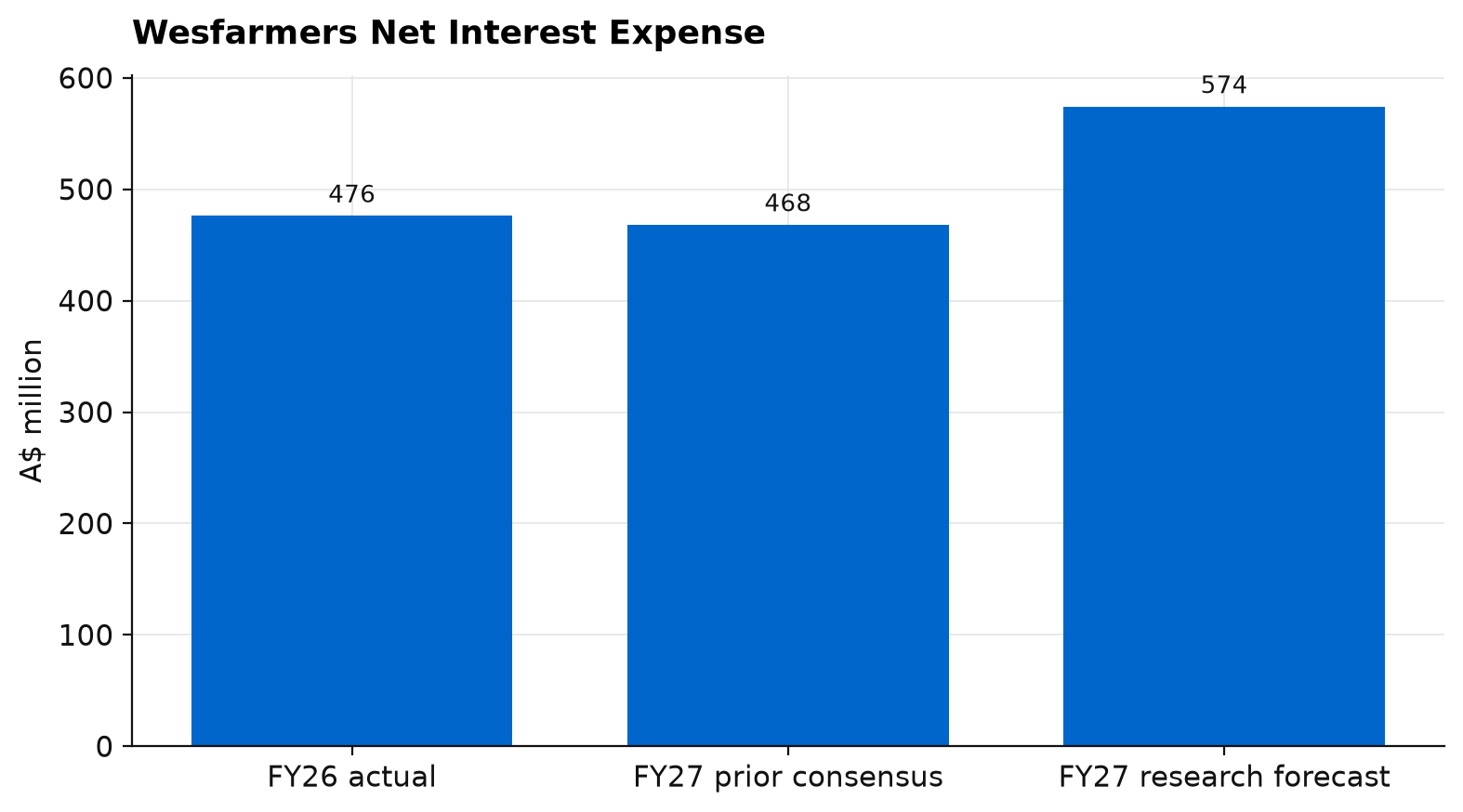
Net interest is what a company pays on its borrowings, less what it earns on its cash. At Wesfarmers it stepped up significantly in 2H26, driven by the $1.7bn capital return in December 2025. A capital return hands surplus money back to shareholders, and in this case it left the group carrying more net debt. Management is guiding to a further step up in FY27 for three reasons: higher net debt, higher interest rates and more variable debt, meaning borrowings whose rate moves with the market.
The research forecasts FY27 net interest of $574m, up from $476m in FY26 and well above the prior consensus of $468m. That gap flows straight to profit before tax and, all else equal, implies a downgrade of around 2.5 per cent to prior consensus FY27 PBT.
The research’s own earnings forecasts came down as a result. Earnings per share, or EPS, is net profit divided by the number of shares, the cleanest measure of what each share earns. FY27 EPS moved to A$2.67 from A$2.70, FY28 to A$2.84 from A$2.92, and FY29 to A$3.07 from A$3.16. Those are cuts of 1 per cent, 3 per cent and 3 per cent, and they leave the research 4 per cent, 5 per cent and 3 per cent below the prior consensus for those three years, suggesting market forecasts may still be too high.
The downgrade comes from higher funding costs. Bunnings and Kmart margins were in line or better, EBIT beat consensus, and the WesCEF outlook is positive. Interest costs depend on the level of debt and on where rates sit, and management has flagged higher net debt and higher rates as drivers of the FY27 increase.
Valuation and Why the Premium Leaves Little Room
Institutional sell-side research sets a 12 month price target of A$77.00, trimmed from A$78.00 after the result, and retains its Sell rating. Against the share price of A$72.57, that target is about 6.1 per cent higher. The research sees that as a modest potential gain for a stock on a premium valuation, with earnings risks skewed to the downside.
A step up in net interest to a forecast $574m in FY27 pulls earnings below where the market had them, and the research sits 4 per cent below prior consensus for FY27 EPS and 5 per cent below for FY28. When the research’s forecasts sit under the market’s, the next round of consensus changes is more likely to be down than up. Bunnings has also historically tracked house prices and turnover, capital-city prices fell 0.9 per cent in July, and Kmart and Officeworks have slowed in the first seven weeks of FY27.
Wesfarmers paid A$2.22 per share over the past twelve months, a trailing yield of about 3.1 per cent at A$72.57, and that dividend is fully franked. Franking credits represent tax the company has already paid, which eligible Australian shareholders can use to reduce their own tax.
The research sees Wesfarmers as a high-quality group whose quality is already in the price, with near-term earnings heading lower because of interest costs the stores cannot offset.
Key Risks
A faster recovery in house prices and turnover, or easier interest rates, could lift Bunnings sales and shrink the interest bill, which would challenge the Sell case, while a deeper housing slowdown would add to the pressure. Competition and the consumer also matter, with shoppers still focused on value, Kmart and Officeworks slowing, and a weaker New Zealand dollar weighing on Kmart. At Kmart, the cost of the new distribution centre and the margin outcome could land better or worse than the research’s estimate. A premium valuation can also last longer than expected for a business of this quality.
Our View
On the trading side, Bunnings is adding categories, pushing into appliances and finding margin in sourcing and retail media, Kmart’s distribution centre will cost money this year with benefits not expected until early FY28, and WesCEF looks set for a stronger year. Against that, a bigger interest bill is now built into FY27, and the housing data that drives Bunnings is softening at the same time. The interest bill and Bunnings sales against softer housing are the figures to watch over the coming year.
If you would like to discuss Wesfarmers, request a callback or call us on 1300 889 603.
Financial Summary
Become an authorised representative
Advise your clients under an established AFSL without building your own. Choose AR or CAR.
Become an AR or CAR