

Sell
Healius is the second largest private pathology network in Australia, running collection centres where patients give samples and laboratories that test them for doctors.
Institutional sell-side research rates it Sell because the FY27 guidance of about 30 per cent underlying EBIT growth and positive cash flow carries clear risk. Lease payments were larger than operating cash flow in FY26, industry volume growth is subdued, and the company must defend its market share while it keeps cutting costs. Earnings per share are forecast to stay near zero until FY28.
- Sell-side rating
- Sell
- Sell-side target
- A$0.39
- Upside to target
- −32.8%
- Initial price
- A$0.3818 Sep 2026
- Last close
- A$0.5818 Nov 2026
Healius showed in the second half of FY26 that its cost cuts are starting to work. The company reduced its headcount early in the first half, and the group EBIT margin moved up in the second half as those savings came through. EBIT is earnings before interest and tax, a simple measure of operating profit. Cash flow is still under pressure, though, with FY26 lease payments larger than operating cash flow, which added to a rise in gearing. Management has guided to underlying EBIT growth of about 30 per cent in FY27 and to positive cash flow in the same year. Institutional sell-side research has Healius rated Sell with a 12 month price target of A$0.39, about 2.6 per cent above the share price of A$0.38 when this research was published. The research sees risk that Healius falls short of its FY27 guidance, because industry volume growth is subdued and the company has to defend its market share while it keeps cutting costs.
Research published 18 September 2026. Price target and upside based on prices at time of publication.
Table of contents [hideshow]
About Healius
Healius is the second largest private pathology network in Australia, measured by revenue. Pathology is the testing of samples, such as blood, that doctors send off to help diagnose and monitor patients. Healius runs a network of collection centres, where patients have samples taken, and laboratories that run the tests. It closed about 100 collection centres during FY26, around 5 per cent of the fleet. It sold Lumus and paid shareholders a special dividend from the proceeds, and it is running a sale process for Agilex, with an update expected at its annual general meeting. Management is running a set of turnaround initiatives under the T27 name and has set a target of a high single digit EBIT margin by December 2028. Healius is listed on the Australian Securities Exchange under the code HLS and reports on a June year end.
Staff Cuts Are Starting to Lift Margins
Healius reduced its headcount, the number of people it employs, early in the first half of FY26, and the strongest part of the FY26 result came in the second half, when the group EBIT margin moved up as those savings flowed through. The EBIT margin is operating profit as a share of revenue, so a higher margin means more profit from each dollar of sales. The research describes the second half as progress on the company’s plans to lift profitability.
Healius carries a high fixed cost base, as many of its costs, such as laboratories, staff and the rent on collection centres, barely change whether test volumes are high or low. Staff are among the biggest of those costs, and the second half margin suggests the headcount cuts are showing up in the numbers. Savings on consumables, the materials used to collect samples and run tests, were also achieved in FY26 and should help in FY27.
For further savings, management’s T27 initiatives include putting one laboratory information system in place across all of its testing disciplines and digitising the company’s platform. Further out, Healius has set a target of a high single digit EBIT margin by December 2028. The research notes that if the company delivers that target, it is likely to lead to upgrades in consensus earnings forecasts, which is the average of what analysts expect the company to earn.
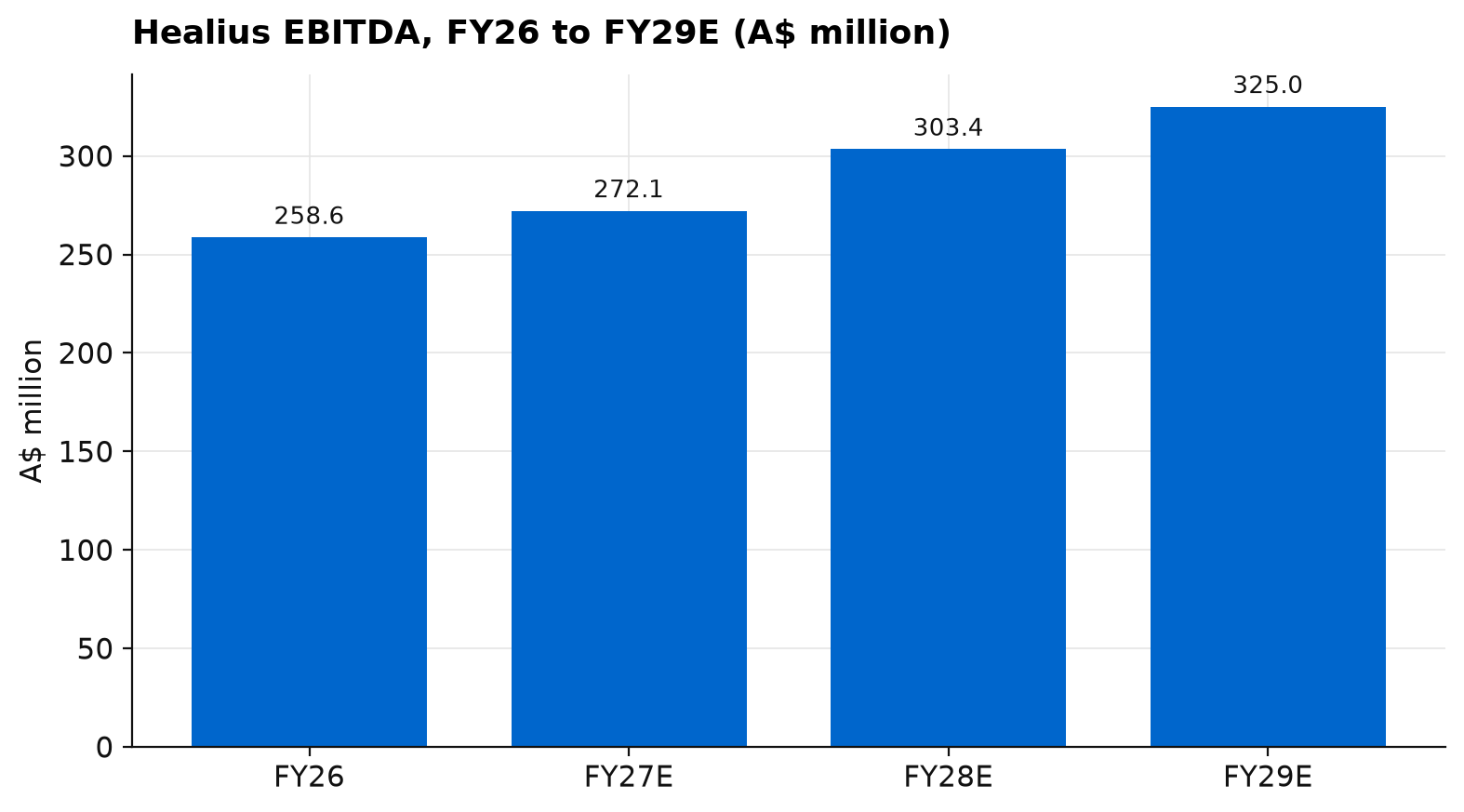
The research forecasts EBITDA to improve every year, to A$272.1 million in FY27 from A$258.6 million in FY26, then A$303.4 million in FY28 and A$325.0 million in FY29. EBITDA is EBIT with depreciation and amortisation added back, the accounting charges that spread the cost of assets, such as equipment and leased sites, over the years they are used. That makes it a rough measure of the cash profit a business earns before it pays for its assets, its debt and its tax. The research’s concern is how much of that improvement reaches cash flow and earnings per share once lease payments and wage increases are counted.
Lease Payments Still Weigh on Cash Flow
In FY26, Healius’s lease payments, mostly the rent on its collection centres and other sites, were higher than the cash its operations generated. When those payments are bigger than the operating cash coming in, the gap has to be funded from somewhere, and in FY26 it showed up as a step up in gearing. Gearing is the level of debt a company carries relative to the size of its business, and more of it leaves less room to absorb a weak year.
Management has guided to positive cash flow in FY27. The research forecasts the business to be at break even in FY27, meaning cash coming in and cash going out roughly match. It sets out three things that all need to happen in the same year to get there. First, Healius needs to cut headcount further, by enough to offset the higher wage costs arriving in FY27. Second, operating costs other than labour need to grow more slowly than CPI, the consumer price index, which is the main measure of inflation. Third, cash lease payments need to grow only in the low single digits in percentage terms.
Management’s FY27 guidance for underlying EBIT growth of about 30 per cent includes the cost of the Fair Work Commission gender-based undervaluation decision, which is A$15 million, and a minimum wage increase of 4.75 per cent. Underlying EBIT is EBIT adjusted to remove one-off items, so it shows the ongoing profit of the business. Healius has to grow that profit by about 30 per cent while absorbing both of those cost increases. That is why the research lists further staff cuts as the first requirement for break even.
A rules-based approach to leveraged ETFs
See how our quantitative strategy works and who it suits.
Explore the strategyBecome an authorised representative
Advise your clients under an established AFSL without building your own. Choose AR or CAR.
Become an AR or CARHealius closed about 100 collection centres during FY26, around 5 per cent of its fleet. Fewer centres should mean lower lease payments over time, and the research expects this to give some help. It also flags a downside risk if competitors lift the pace at which they open new collection centres, since Healius could lose patients and test volumes to those new sites.
In a turnaround like this, cash flow matters more than accounting profit, because a company that pays out more cash than it takes in has to fund the gap with debt or by selling assets. Healius has its Agilex sale process under way and expects to update investors on it at its annual general meeting. Until the business itself generates positive cash flow, the balance sheet will stay under pressure.
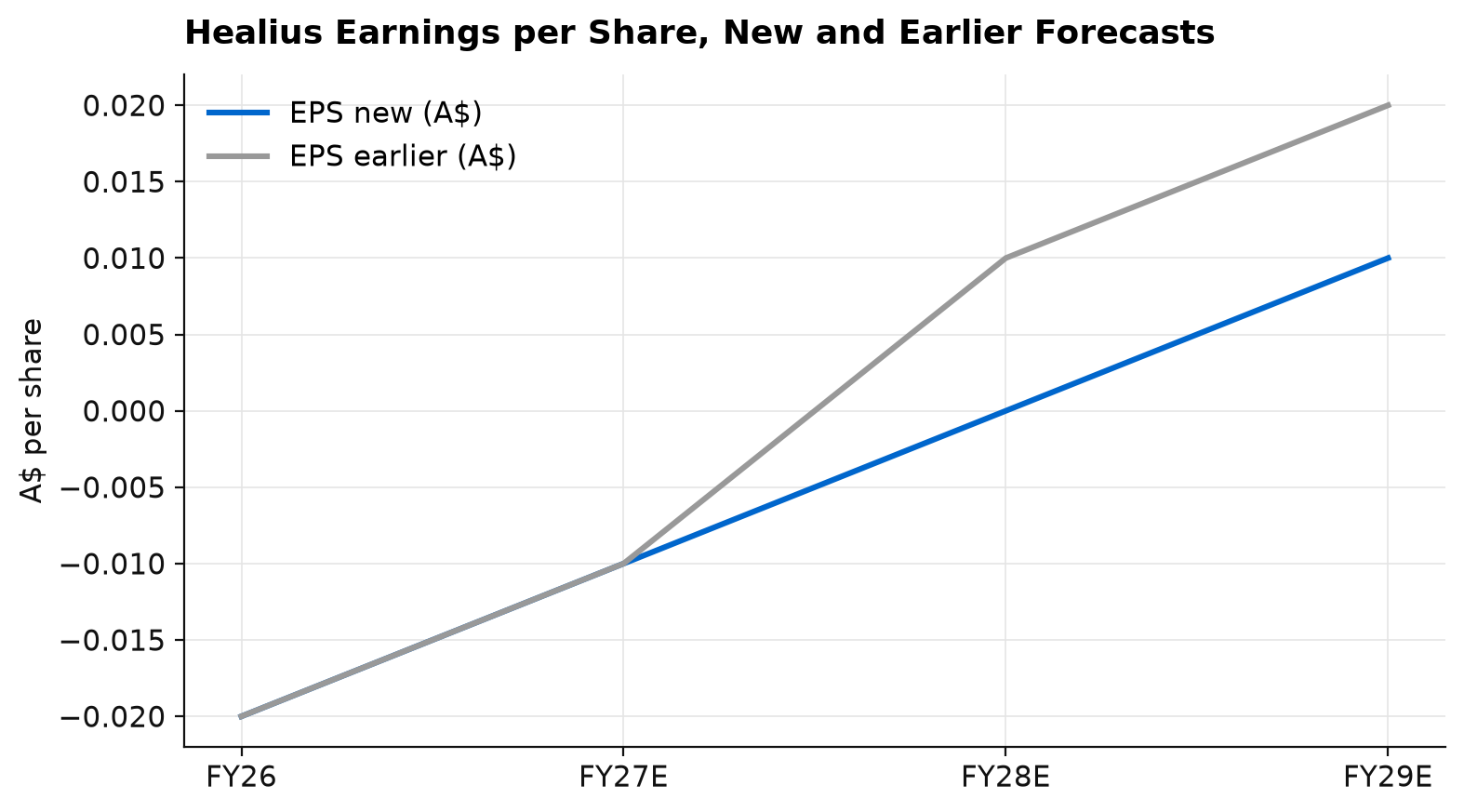
The research forecasts earnings per share near zero for several years, with a loss of A$0.01 per share in FY27, after a loss of A$0.02 per share in FY26, then A$0.00 in FY28 and A$0.01 in FY29. Before the FY26 result it had forecast A$0.01 for FY28 and A$0.02 for FY29. The half year forecasts point the same way, with a loss of A$0.01 per share in each half of FY27. On these numbers Healius does not break even per share until FY28.
Forecasts Cut as Industry Volumes Stay Subdued
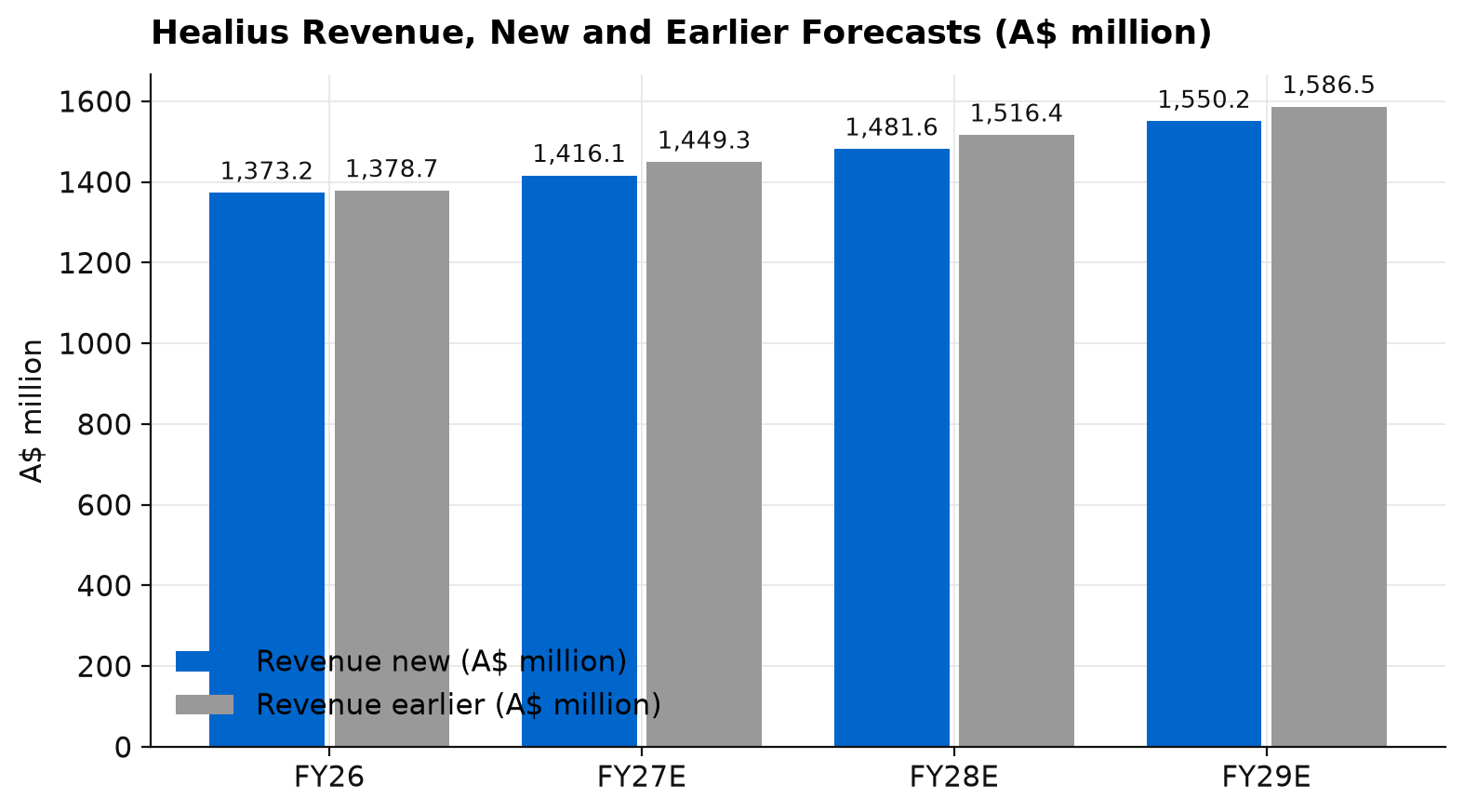
FY26 revenue came in below what the research expected, and it has cut its forecasts as a result. Revenue forecasts are down 2.3 per cent in each of FY27, FY28 and FY29. FY26 revenue was A$1,373.2 million. The research now forecasts A$1,416.1 million for FY27, which is growth of 3.1 per cent on the year, then A$1,481.6 million in FY28 and A$1,550.2 million in FY29. The earlier forecasts were A$1,449.3 million, A$1,516.4 million and A$1,586.5 million.
Underlying EBIT forecasts are cut harder, down 14.9 per cent in FY27, 11.0 per cent in FY28 and 10.3 per cent in FY29, reflecting the miss in FY26. With high fixed costs, a small fall in revenue leaves most costs in place, so profit falls by much more than revenue does, and the same effect works in Healius’s favour if volumes rise.
Industry volume growth is subdued, and this is the main reason the research sees risk to the FY27 guidance. A step up in industry revenue growth would help Healius reach positive cash flow, though the company also has to defend its market share. The research’s central view is that Healius is likely to miss its mid-term targets, given how hard it is to stop market share slipping while also cutting costs.
The research does credit the initiatives Healius put in place across FY25 as a step in the right direction to slow the loss of market share. Its view is that the full benefit is likely to arrive over several years, while management’s FY27 target assumes a quick lift in profitability. That timing gap is a large part of the institutional sell-side Sell case.
Valuation and Why the Target Offers Little Upside
Institutional sell-side research cut its 12 month price target by about 11 per cent to A$0.39, from about A$0.43, mainly because of lower earnings and cash forecasts. When the target was set the shares were trading above it, and they have since fallen below it. At the share price of A$0.38 when this research was published, the target is about 2.6 per cent above the share price. That is a small gap for a business still in a turnaround, with gearing that rose in FY26 and earnings per share forecast to stay near zero until FY28.
Management has chosen not to commit to dividends after the special dividend from the Lumus sale, which the research reads as a sign of how complicated the turnaround is, and it forecasts no dividends through FY29.
The Sell case starts with FY27, where even the research’s break even forecast needs further staff cuts, costs outside labour growing below inflation and lease payments growing slowly, all in the same year and while wage costs rise. Cash flow is also still under pressure from lease payments, which were larger than operating cash flow in FY26, and industry volumes are subdued while Healius defends its market share against competitors that may open new collection centres faster.
The main risk the research sees is a miss on the FY27 guidance, and at A$0.38 the shares sat only 2.6 per cent below the target when this research was published, which leaves little upside to offset it.
Key Risks
Several developments could push the shares higher. On policy, a material increase in pathology volumes from the Australian Federal Government’s investment in GP bulk billing incentives would help, and because Healius has a high fixed cost base, higher volumes should lift its margins. An expansion of funding under the Medicare Benefits Schedule, the government list of services and the rebates it pays, or an easing of wage pressure would also help. On competition, Healius could win back market share faster than the research expects. On execution, delivering the high single digit EBIT margin target by December 2028 would be likely to drive upgrades to consensus earnings forecasts. There has also been interest in acquiring Healius in the past, and a recovery in earnings could attract a bid. The update on the Agilex sale process expected at the annual general meeting could also change how the market views the company.
Our View
We think the second half of FY26 shows that management can take cost out of Healius. The harder part is doing that while keeping doctors and patients using its network, and FY26 shows the cash position still needs work. The research would turn more positive on market share gains that last without an aggressive roll out of collection centres, on digitisation and automation that lift margins, and on a growing share of revenue from specialist referrals, all worth watching in the FY27 results. To us, the better route to positive cash flow is getting more out of the existing network, since more centres would add to the lease bill that is already the main drain on cash. Until those signs appear, the share price sits close to the target and the FY27 guidance carries clear risk.
If you would like to discuss Healius, request a callback or call us on 1300 889 603.
Financial Summary
Become an authorised representative
Advise your clients under an established AFSL without building your own. Choose AR or CAR.
Become an AR or CAR