

Hold
CSL is a global biotechnology company that makes plasma-based medicines, influenza vaccines and iron therapies for rare diseases, immune deficiencies and kidney conditions.
Institutional sell-side research rates CSL Buy because it sees the market's lower valuation of the company as unwarranted given the growth outlook. It points to three drivers: strong growth in the IG market despite new anti-FcRn drugs, market share gains in IG, haemophilia, hereditary angioedema and influenza vaccines, and a lower plasma cost per litre lifting gross margins. Management reiterated FY27 guidance of underlying net profit after tax rising about 5 per cent at constant currency.
- Sell-side rating
- Buy
- Sell-side target
- A$182.50
- Upside to target
- −8.5%
- Initial price
- A$202.9214 Nov 2026
- Last close
- A$199.3818 Nov 2026
Initial Buy based on A$202.92. Now Hold since 13 Nov 2026: the price passed the A$182.50 target.
CSL used its Annual General Meeting, or AGM, to reiterate its FY27 earnings guidance. Group revenue is expected to be broadly in line with FY26, and underlying net profit after tax is expected to rise by about 5 per cent at constant currency, which means the effect of exchange rate moves is stripped out. Management pointed to market share gains in its Behring plasma therapies business and early benefits from the operational separation of its Seqirus vaccines business, while the research credits a much lower cost of collecting plasma with helping CSL compete for sales. Institutional sell-side research has CSL rated Buy with a 12 month price target of A$182.50, about 10.1 per cent below the share price of A$202.92 when this research was published.
Research published 14 November 2026. Price target and upside based on prices at time of publication.
Table of contents [hideshow]
About CSL
CSL is a global biotechnology company with a portfolio of medicines. These include treatments for immune deficiencies, haemophilia and other rare diseases, vaccines that help prevent influenza, and therapies in iron deficiency and nephrology, which is the branch of medicine that deals with the kidneys. The business runs through three segments. Behring is the plasma therapies business, and its core product is immunoglobulins, or IG, which are antibody treatments made from donated human plasma. IG represented about 40 per cent of FY25 group revenue. Seqirus is the influenza vaccines business. Vifor includes the company’s iron portfolio. CSL is listed on the Australian Securities Exchange and reports on a financial year ending in June. It is currently working through a transformation programme that management says is producing a simpler and more productive company.
Guidance Holds and Market Share Is Coming Back
CSL reiterated its FY27 guidance at the AGM based on progress to date, midway through a transformation programme and after the market had marked the stock down on valuation. Management said that over the last nine months it has seen tangible results from the work being done to improve execution and focus, and that Behring and Seqirus are performing well, as expected.
In Behring, management said the early signs of recovery it saw back in May 2026 are now translating into market share benefits. Market share is the slice of total sales in a market that one company wins. A rising share means CSL is taking sales from competitors in plasma therapies on top of any growth in the market itself. In Seqirus, management said it is seeing benefits from operational separation play out in the current northern hemisphere influenza season. Operational separation means giving Seqirus more of its own processes and management focus within the group. The northern hemisphere season is when vaccines are supplied ahead of winter in markets north of the equator, so the current season is an early read on whether the separation is working.
Vifor will continue to face challenges in FY27 from generic competition in its iron portfolio, management said, a headwind the reiterated guidance already allows for. A generic is a cheaper copy of a medicine that can be sold once patent protection lapses, and generic entry usually puts pressure on both volumes and prices for the original product.
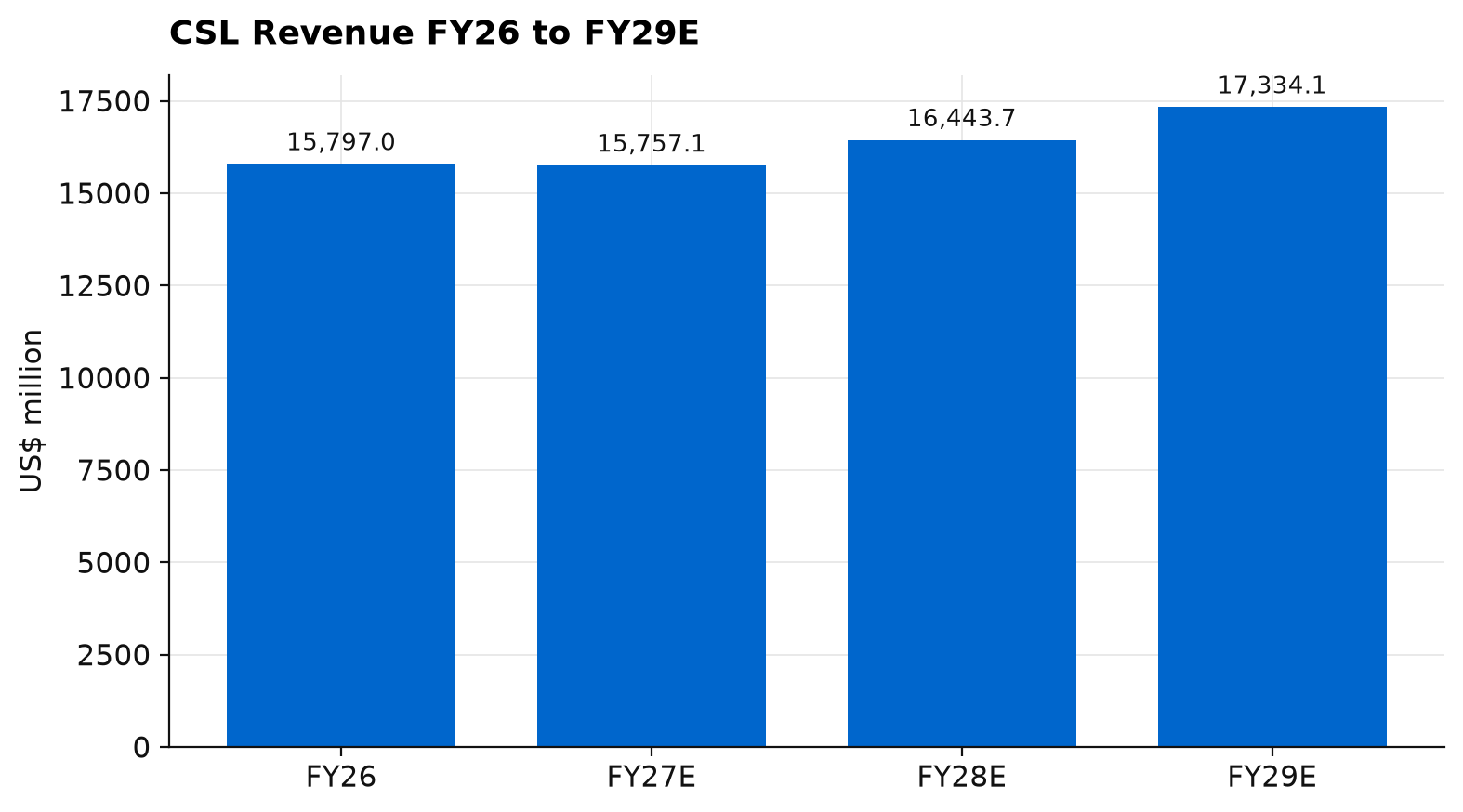
The institutional sell-side forecasts line up with that picture. Revenue was US$15,797.0 million in FY26 and is forecast at US$15,757.1 million in FY27, essentially flat, before rising to US$16,443.7 million in FY28 and US$17,334.1 million in FY29. The research has retained its FY27 estimates and sits ahead of market consensus on net profit, where consensus is the average forecast across the analysts who cover the stock. The gap is largely driven by stronger expected sales in IG, which sits in Behring, and in Seqirus, the two businesses management pointed to at the AGM.
Lower Plasma Costs Support Margins and Sales
Plasma is the liquid part of blood, and it is the raw material for Behring’s therapies, including IG. CSL collects it from donors through collection centres, including its centres in the United States. The key cost measure is cost per litre, often shortened to CPL, which is the all-in cost of collecting each litre of plasma. That includes items such as the fees paid to donors and the cost of running the centres. When CPL falls, every litre of plasma that goes into the manufacturing process is cheaper, and that flows through to the gross margin, which is the share of each sales dollar left after the direct costs of making the product.
The research says CSL’s materially improved plasma CPL has also helped commercial execution through several initiatives, including broader access to US specialty pharmacies. Specialty pharmacies dispense complex, high-cost medicines that need special handling.
A rules-based approach to leveraged ETFs
See how our quantitative strategy works and who it suits.
Explore the strategyBecome an authorised representative
Advise your clients under an established AFSL without building your own. Choose AR or CAR.
Become an AR or CARTwo operational projects flagged at the AGM point to further gains. The first is a higher yielding process. Management is currently working through the clinical and regulatory pathway to introduce it, and it would allow increased plasma therapeutic supply to patients. Yield here means the amount of finished medicine produced from each litre of plasma, so a higher yielding process gets more product out of the same raw material. The second is an expanded collaboration with Haemonetics and the rollout of a next generation platform in CSL’s US centres, which is expected to improve operational efficiency.
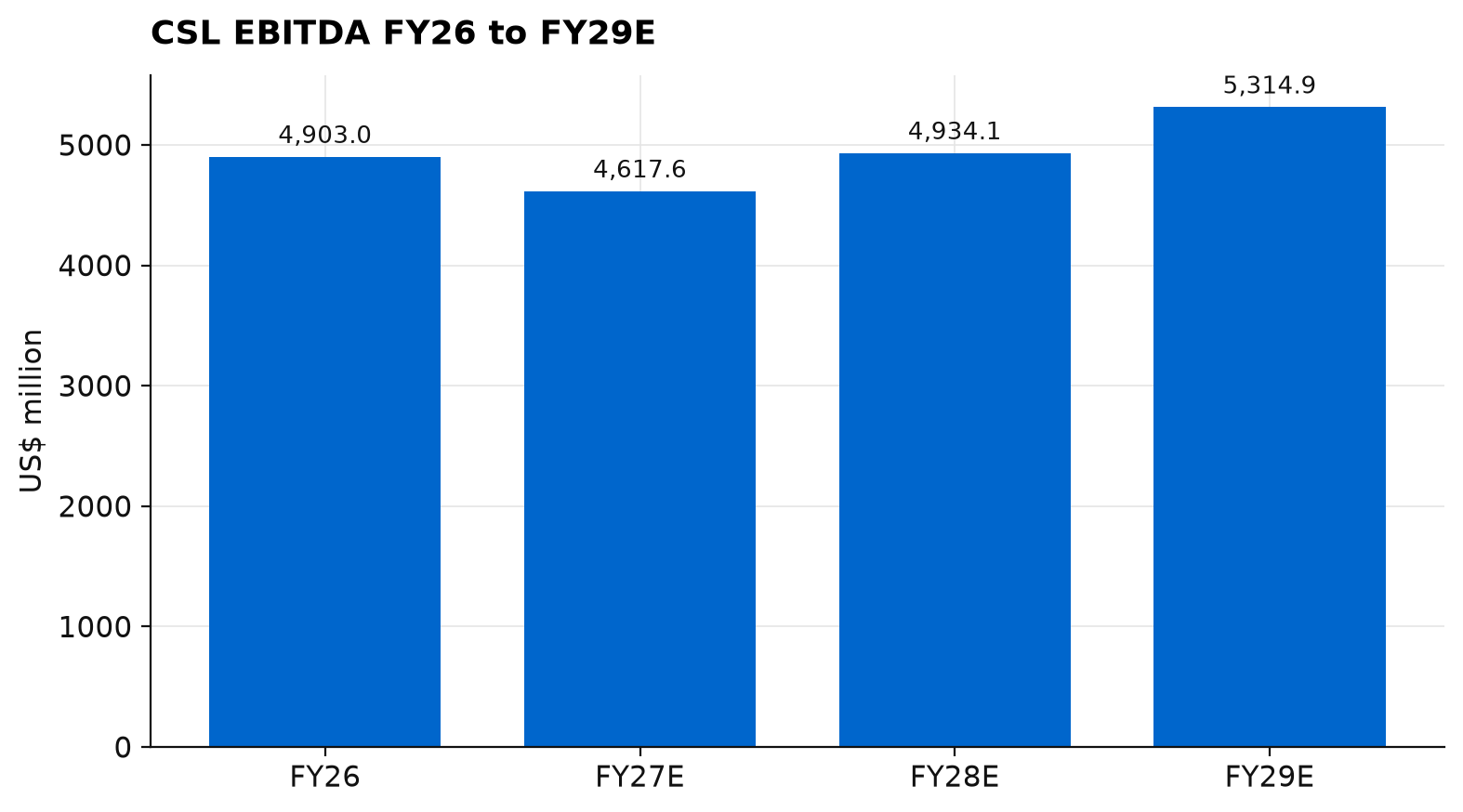
This is the third driver of the research’s Buy case: gross margin accretion driven by operational improvements to the cost base. Accretion means the margin building up over time. EBITDA, which stands for earnings before interest, tax, depreciation and amortisation and is a rough measure of operating profit, was US$4,903.0 million in FY26. It is forecast to dip to US$4,617.6 million in FY27, then recover to US$4,934.1 million in FY28 and climb to US$5,314.9 million in FY29.
Immunoglobulin Demand and Market Share Gains
IG is CSL’s biggest product, so the health of the IG market goes a long way toward deciding how CSL performs. IG therapies are used to treat people whose immune systems do not work properly, among other conditions. The first driver of the research’s Buy case is strong growth in the IG market despite the entry of new drugs, specifically a class known as anti-FcRn therapies. These are newer medicines that work differently from IG and compete with it in some conditions. The research view is that their arrival has not stopped the IG market from growing, and the AGM commentary on Behring market share is consistent with that.
The second driver is market share gains, which the research expects across four areas: IG, haemophilia, hereditary angioedema and influenza vaccines. Haemophilia is an inherited condition in which blood does not clot properly. Hereditary angioedema, or HAE, is a rare genetic condition that causes episodes of severe swelling.
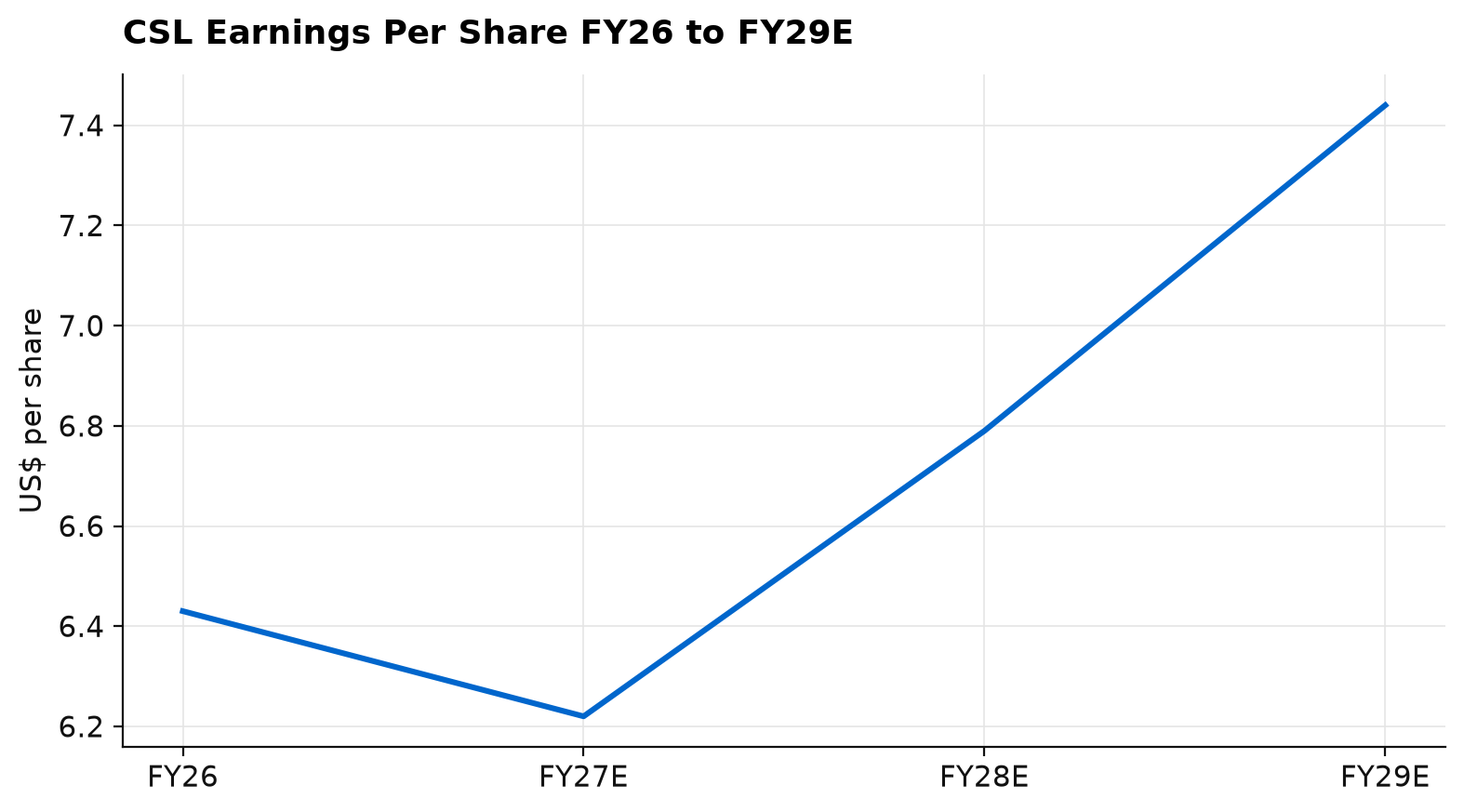
Earnings per share, or EPS, is the profit attributable to each share. EPS was US$6.43 in FY26. The research forecasts US$6.22 in FY27, then US$6.79 in FY28 and US$7.44 in FY29. By half, EPS was US$2.42 in the second half of FY26 and is forecast at US$4.18 in the first half of FY27, US$2.04 in the second half and US$4.41 in the first half of FY28. Earnings are heavily weighted to the December half, so the result for the six months to December 2026 will be the first real check on whether the AGM progress is showing up in the numbers.
CSL guides to underlying net profit after tax, or NPAT, rising by about 5 per cent in FY27 at constant currency. NPAT is the bottom-line profit after all costs and tax, and underlying means one-off items are excluded. The forecasts have EPS dipping slightly in the same year. The two are measured differently, since guidance strips out currency moves and uses an underlying profit measure. FY27 is modest on both, with stronger growth forecast for FY28 and FY29.
Valuation and Why the Price Has Run Past the Target
Institutional sell-side research has a 12 month price target of A$182.50. CSL closed at A$202.92, which puts the target about 10.1 per cent below the current share price. A Buy rating usually comes with a target above the share price, but here the shares have already passed it.
The research keeps its Buy rating because it sees the market’s de-rating of CSL, meaning the lower valuation investors have been willing to pay for its earnings, as unwarranted given the growth outlook, particularly for IG therapies. Its three drivers are IG market growth despite anti-FcRn drugs, share gains in IG, haemophilia, HAE and influenza vaccines, and a lower plasma cost per litre lifting gross margins.
CSL’s trailing dividend yield is about 2.0 per cent, and the dividend is unfranked, meaning no franking credits are attached.
At A$202.92 the shares are above where the research sees value over the next 12 months, and the forecasts put the earnings growth in FY28 and FY29, after a lower FY27.
Key Risks
Adverse reimbursement rates for US drug prices would reduce what CSL is paid for its medicines, where reimbursement is the amount insurers and government programmes pay for a treatment. US inflation could push up the fees paid to plasma donors and erode the cost per litre gains behind the margin case. A successful launch of human recombinant albumin by competitors in China, which is albumin made in a laboratory without donated plasma, would put pressure on plasma-derived albumin. New therapies such as anti-FcRn drugs could take IG market share, and Vifor’s iron portfolio faces continued generic competition in FY27. The higher yielding process also still has to clear its clinical and regulatory pathway, and the transformation programme has to keep delivering.
Our View
The AGM held FY27 guidance and pointed to market share benefits in Behring. The December half result will show whether those gains and the lower plasma cost are lifting profit.
If you would like to discuss CSL, request a callback or call us on 1300 889 603.
The above is general advice and does not consider your individual circumstances. Past performance is not a reliable indicator of future returns.
Financial Summary
Become an authorised representative
Advise your clients under an established AFSL without building your own. Choose AR or CAR.
Become an AR or CAR