

Worley is doing the thing that has historically ruined engineering companies. It is moving out of the drawing office and into the physical delivery of projects, where the revenue pool is far larger and the mistakes are far more expensive. Professional services revenue, the traditional business, fell 13.2 per cent in FY26 to A$6,187 million, while construction and fabrication revenue rose 8.4 per cent and procurement revenue rose 24.1 per cent. The reason we are comfortable with that is the contract mix. Seventy-seven per cent of FY26 revenue was reimbursable, the company states in its annual report that it does not and will not take on competitively bid lump sum turnkey work, and management told the September investor briefing in Houston that it is not doing lump sum construction and is not taking lump sum risk for subcontractor performance. Institutional sell-side research has Worley rated Buy with a 12 month price target of A$13.00, about 31.8 per cent above the recent close of A$9.86.
Research published 22 September 2026. Price target and upside based on prices at time of publication.
About Worley
Worley Limited is a global engineering and project delivery company with a market capitalisation of about A$4.8 billion, over 40,000 people and operations in more than 40 countries. It serves three sectors, energy, chemicals and resources, and works across the whole asset lifecycle, from early consulting and concept work through detailed engineering, procurement and construction and on into operations and remediation. FY26 aggregated revenue was A$12.0 billion, split A$6.2 billion in the Americas, A$4.5 billion across Europe, the Middle East and Africa, and A$1.3 billion in Asia Pacific. The company is listed on the Australian Securities Exchange, reports on a 30 June financial year, and management has said it intends to begin reporting in United States dollars from FY28 while reiterating its commitment to the Australian listing. Results, presentations and governance material are on the investor relations page, and the FY26 full year result was released on 26 August.
The Americas Is Now Half the Company
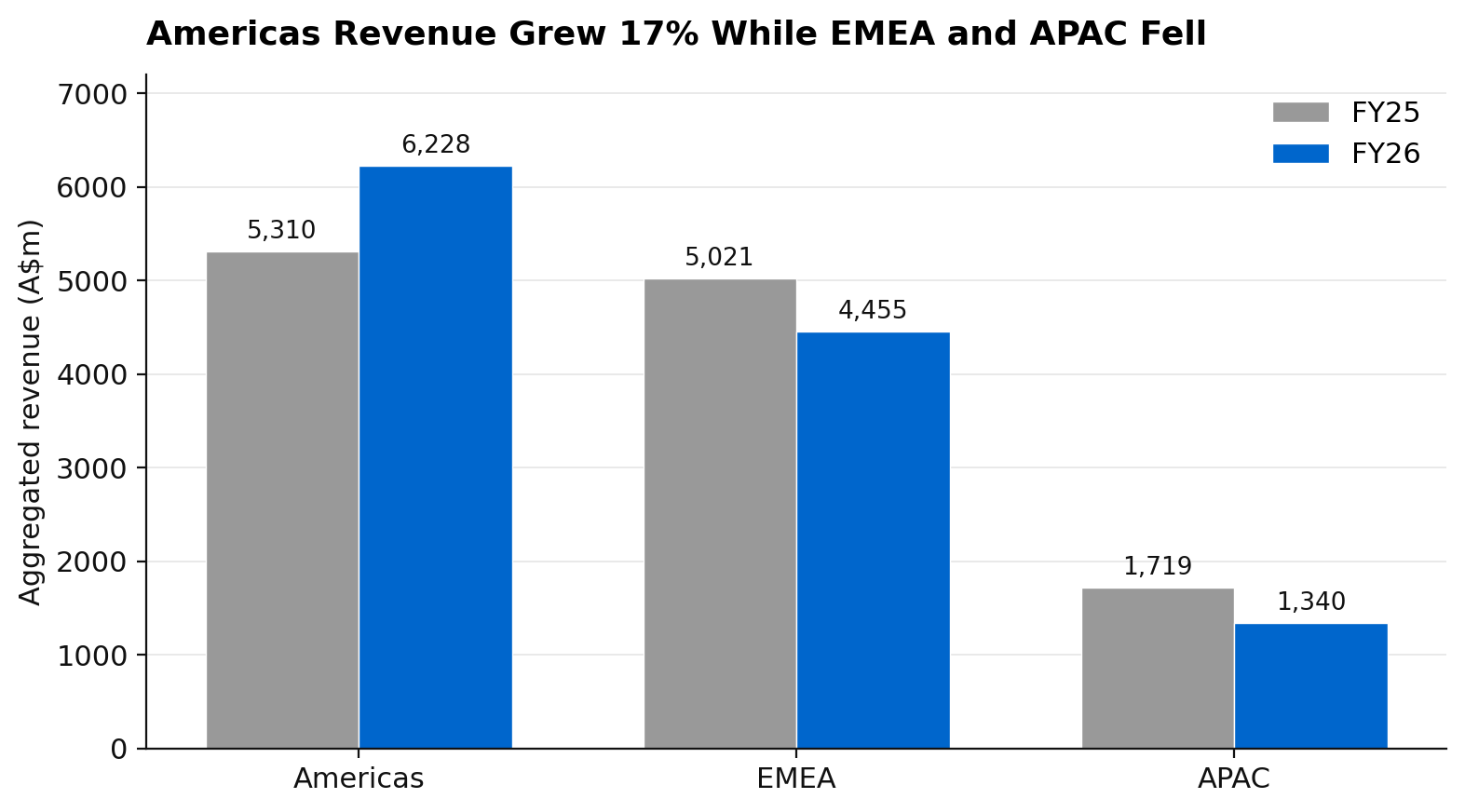
Houston was a deliberate choice of venue. The Americas generated A$6,228 million of aggregated revenue in FY26, up 17.3 per cent, which is a little under 52 per cent of the group. Europe, the Middle East and Africa went the other way, down 11.3 per cent to A$4,455 million as the conflict in the Middle East disrupted project activity and some work was cancelled outright. Asia Pacific fell 22.0 per cent to A$1,340 million as major projects completed without enough new work behind them. The three moves roughly cancelled, leaving group aggregated revenue flat at A$12,023 million, down 0.2 per cent reported and up 2.3 per cent in constant currency.
The regional business Worley showed investors runs 14,000 people across nine countries and around 30 million work hours a year. Energy, including integrated gas, is roughly half of its revenue, followed by chemicals, which remains cyclically challenged though with early stage conversations under way, then resources. The United States is where the group’s engineering, procurement and construction capability is concentrated. Canada adds fabrication to that list and has historically skewed to small and mid sized work, which is now shifting toward major projects. Latin America has strong front end engineering and is expected to draw on the group’s global delivery capability for the rest.
There is a wrinkle worth naming, and it turns out to be arithmetic rather than deterioration. On the reported segment basis the Americas earns the thinnest margin of the three regions, 7.5 per cent against 9.0 per cent in Europe, the Middle East and Africa and 8.4 per cent in Asia Pacific, and it fell 0.9 percentage points over the year. That is largely because the Americas carries A$2,270 million of the group’s A$3,830 million of procurement revenue, which is high volume and low margin by design. Strip procurement out and the Americas margin was 11.7 per cent against 11.8 per cent a year earlier, which is flat. The region growing fastest looks like it is diluting the group average, and on the margin the business actually controls it is doing nothing of the sort.
The Growth Is Coming From Procurement and Construction
A flat top line hides three large moves underneath it. Professional services revenue, the engineering and consulting work that has always been the core, fell from A$7,124 million to A$6,187 million. Construction and fabrication revenue rose from A$1,834 million to A$1,988 million. Procurement revenue at margin rose from A$3,086 million to A$3,830 million, up 24.1 per cent, and is now close to a third of aggregated revenue. Revenue excluding procurement fell 8.6 per cent to A$8,193 million. Procurement carries a thin margin by its nature, so the effect on the reported group margin is exactly what you would expect. Underlying earnings before interest, tax and amortisation came in at A$734 million, 6.1 per cent of aggregated revenue but 9.0 per cent excluding procurement. That 9.0 per cent sat at the bottom of the company’s own 9.0 to 9.5 per cent guidance range, and was 9.2 per cent in constant currency, level with FY25.
The rest of the earnings picture reflects a genuinely difficult year, and none of it is optical. Underlying EBITA fell 10.8 per cent, or 6.1 per cent stripping out currency. Underlying net profit after tax, before the amortisation of acquired intangibles, was A$395 million against A$475 million. Underlying basic earnings per share fell from 90.2 cents to 78.2 cents. Statutory net profit for the group was A$252 million after A$120 million of one off transformation and restructuring costs, most of them from cutting back in Western Europe where redundancy is expensive. The Middle East disruption alone cost about A$58 million of underlying earnings. Against that, the cost programme delivered A$132 million of actions, ahead of an initial A$100 million target from FY27 onwards, with around A$70 million of that being reinvested over two years.
The strategic reason to accept the mix dilution is the size of the pool it opens up. Roughly 75 per cent of a project’s total installed cost sits in the execution phase, which covers detailed engineering, procurement and construction. Engineering, procurement and construction scopes, together with the construction management version of the same work, now make up 45 per cent of the backlog, and opportunities across those categories in the pipeline are up 30 per cent on last year. Twenty or more customers picked Worley for major project and programme work in FY26 across ten or more countries. On a growing revenue base a flat margin still means more absolute earnings, and that is the trade the company is making.
Seventy Seven Per Cent of Revenue Is Reimbursable
This is where the investment case is won or lost, and the disclosure is unusually clear. Reimbursable contracts accounted for 77 per cent of FY26 revenue. Those pay back reasonable and allowable costs plus a margin, can carry incentives for delivering value to the customer, and can typically be adjusted for inflation and wage movements as they are negotiated. The remaining 23 per cent is fixed price, and the company is specific about what that generally means, being lump sum engineering, procurement and construction taken on where the earlier phases are already done and the scope is known, and lump sum services contracts averaging under six months. Materials are generally purchased on the customer’s behalf, so direct supply chain exposure is minimal.
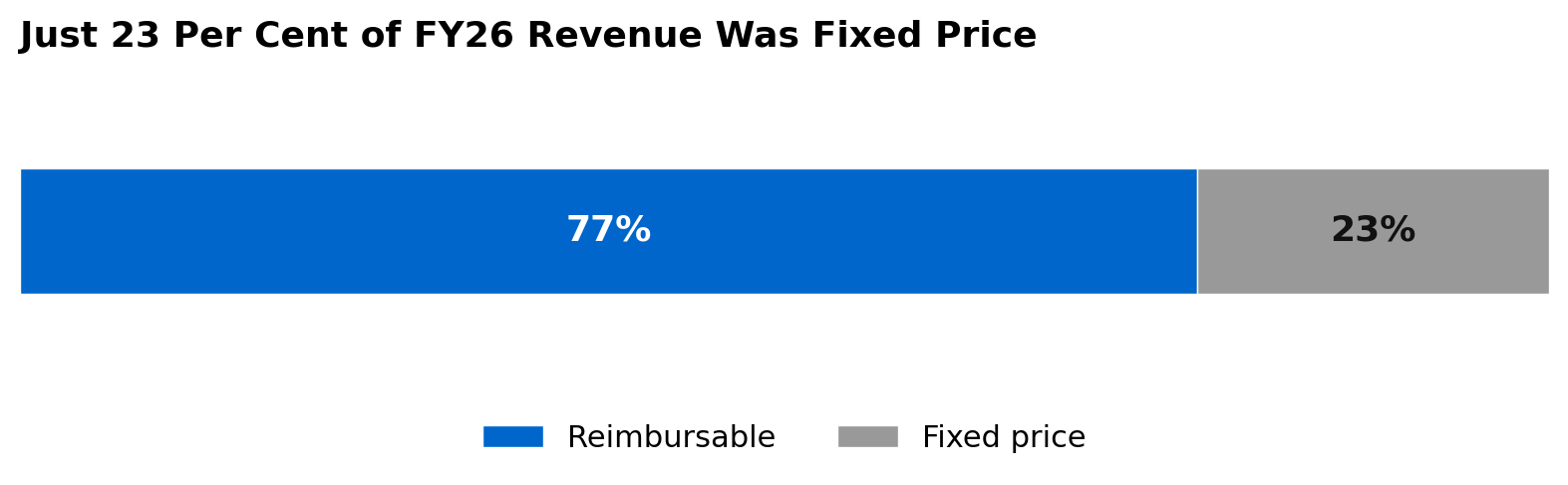
The sentence that matters most is in the annual report, and it is unambiguous. Worley says it does not, and will not, undertake competitively bid lump sum turnkey work, because the risk profile of that work does not align with its risk appetite. Competitively bid turnkey is, in our view, the most dangerous version of this work, and it is a different animal from taking a fixed price on a scope you have already engineered yourself. Management put the same point in plainer language at the briefing, saying much of the major project full delivery work will be reimbursable, that lump sum exposure is generally confined to engineering and equipment where the risk can be managed, and that Worley is not doing lump sum construction and is not carrying lump sum risk for how subcontractors perform. The company describes its own framing as full project delivery within its risk appetite, and we think that qualifier is the whole thing.
The honest counterweight is that the 23 per cent could grow. The company has said it could see more lump sum engineering, procurement and construction in future where it offers higher margins while minimising risk, which is a reasonable thing to say and also exactly how this goes wrong elsewhere. A reimbursable mix reduces cost risk, it does not remove execution, counterparty or working capital risk, and larger scopes carry more of all three. That 23 per cent is the single number we would watch at every result from here.
CP2 and the Work That Is Not in the Backlog
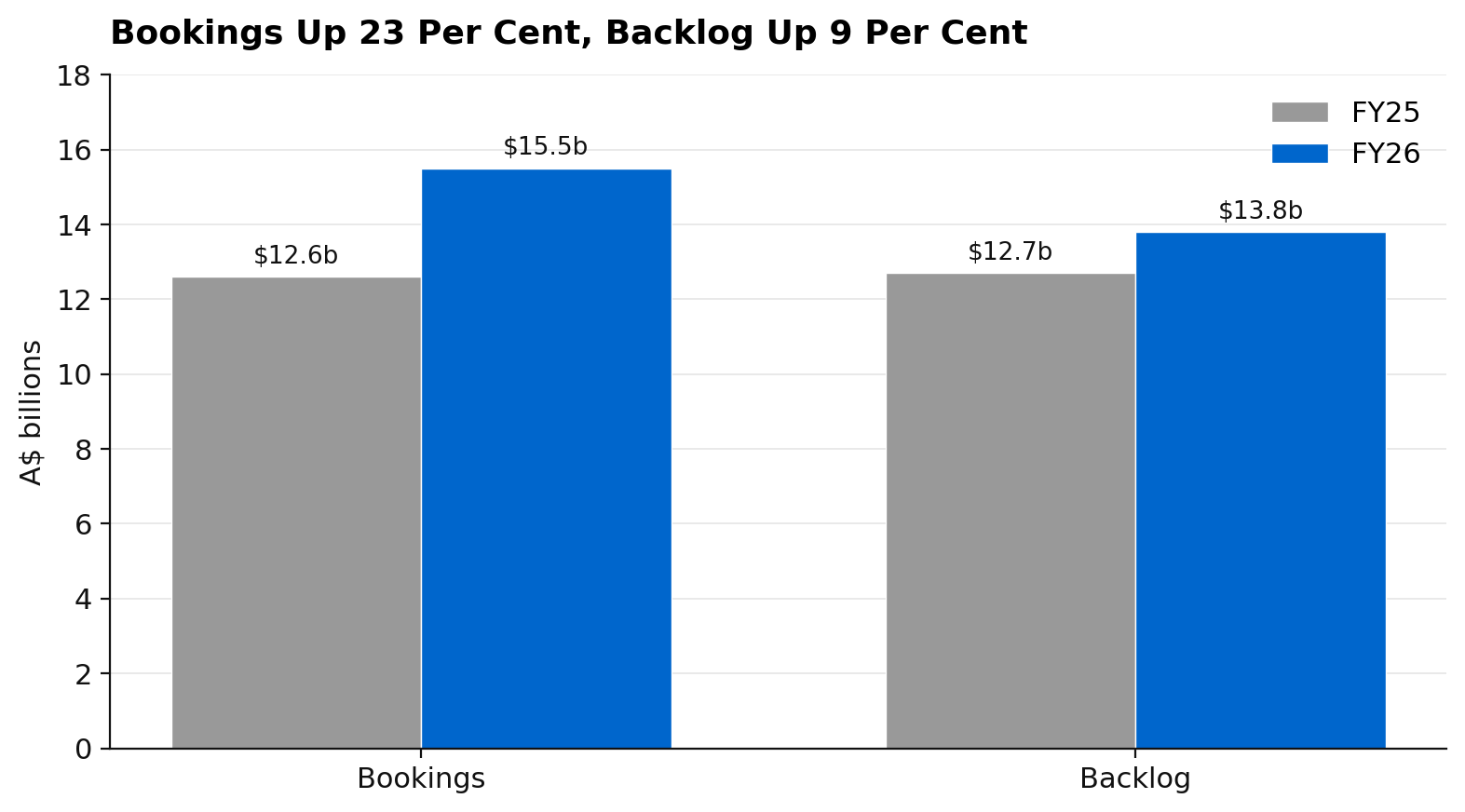
Bookings were A$15.5 billion in FY26, up 23 per cent, with 44 per cent of wins sole sourced, which says something about how customers rate the relationship. Backlog finished the year at A$13.8 billion, up 9 per cent on the reported basis, or A$15.0 billion in constant currency, and the company expects over 62 per cent of it to convert to revenue within twelve months. The factored sales pipeline is up 24 per cent with half of it expected to be awarded in the next year. Not everything went forward, and the company has been open about it, with ExxonMobil’s Baytown blue hydrogen project still paused and taken out of the backlog during the year.
The Venture Global CP2 liquefied natural gas project is the reference case for the whole full delivery strategy, and it is a long way through. Procurement is 79 per cent complete and construction is 36 per cent complete, with first gas expected in the second half of 2027. What is more interesting for a shareholder is what comes next. Worley has signed a master services agreement for the Phase 2 expansion with an engineering, procurement and construction contract expected shortly, and that expansion is expected to be larger than Phase 2 itself, at 11.7 million tonnes a year against 5.6 million. Engineering on it is 8 per cent complete and none of it is in the backlog figure above. It is an opportunity rather than booked work, and what it eventually contributes depends on the contract landing and on timing, but it does mean the reported backlog is not the full picture of what Worley is likely to be building.
Data Centres Are the Next Pool
The growth markets Worley is targeting under the heading of critical infrastructure are data centres, utility power, water and marine infrastructure, and industrial water. Data centres were the focus of that part of the briefing. Most of the investment today is in North America and the company says that is changing significantly, and its pitch is that it can deliver the power that a data centre needs on a global footprint, against incumbents that are more United States centric or lack the power project capability. In its results material the company points to around US$7 trillion of data centre capital expenditure by 2030 in the third party work it cites, which is the kind of number that means very little on its own but does describe the order of magnitude.
The commercial characteristic that matters is a nice one for a contractor. In energy, chemicals and resources the customer is usually optimising cost. In data centres, management says, the binding constraint is schedule, and customers are willing to pay a premium to hit a date. Getting paid for speed rather than being squeezed on price is a better place to stand, and it happens to suit a company that has been recruiting hard for engineering, procurement and construction and pointing to direct hire craft labour as a construction capability.
Direct air capture sits alongside this as optionality. Worley has an alliance with Occidental, was involved in building the innovation centre in Canada, began the front end engineering on STRATOS at 500,000 tonnes a year in 2021 and is now finalising start up there, and has completed the front end work on the next South Texas complex, which will be updated based on the learnings from South Texas Phase 2. Further shifts down the cost curve will be needed as the technology develops, though the incentive backdrop for carbon capture has improved. We would pay nothing for it now and be pleased if it turned into something.
The board declared a final dividend of 25 cents unfranked, payable on 30 September, taking FY26 to 50 cents. That is the same 50 cents Worley has paid in every year since FY2021. At A$9.86 it is a 5.1 per cent yield, and because it is unfranked there are no credits attached, so an Australian resident who is able to use franking gets less after tax from it than from a fully franked dividend of the same cash amount. That needs saying on a stock people buy partly for income. The payout is 64 per cent of the 78.2 cents of underlying earnings, inside the company’s 50 to 70 per cent policy band, though that band is struck on underlying profit and the A$120 million of restructuring cost sits below that line.
The more interesting capital return is the buyback. Worley repurchased and cancelled 29,852,701 shares for A$359 million during FY26 and issued 1,513,731 shares against performance rights, so the register went from 516.3 million shares to 488.0 million, a net reduction of about 5.5 per cent in one year. The A$500 million programme is finished and a further A$300 million is under way, with A$24 million of it done at 30 June. At A$9.86 the shares are on 12.6 times FY26 underlying earnings per share, and buying back stock at that sort of multiple looks a better use of cash to us than lifting a dividend that carries no franking, though what the buyback is ultimately worth depends on the prices paid and on how the business performs from here.
The balance sheet supports it without much room to spare. Net debt was A$1,746 million and leverage 1.8 times against a target of about 2.0 times, with A$2,116 million of liquidity. Normalised cash conversion, which adjusts for movements in advance billings, was 93.6 per cent and inside the 85 to 95 per cent target, and days sales outstanding improved from 52.0 to 44.3. The weighted average cost of debt was 4.4 per cent and management expects it to rise to around 6.0 to 6.2 per cent in FY27 following the note refinancing completed in June, which is a real earnings headwind and is not a surprise to anyone. Tangible asset backing is negative, with net tangible liabilities of A$1.24 a share, so the value here sits in contracts and people rather than in anything you could sell.
Valuation
Institutional sell-side research has Worley rated Buy with a 12 month price target of A$13.00, about 31.8 per cent above the recent close of A$9.86. At that close the stock trades on 12.6 times the 78.2 cents of underlying earnings it produced in a year that absorbed A$58 million of Middle East disruption, an 11.3 per cent fall in its second largest region and a 22.0 per cent fall in its third. The shares are down about 29 per cent over the past twelve months and sit around 2.6 per cent above their twelve month low of A$9.61.
Three things anchor the case. The first is the Americas, which grew aggregated revenue 17.3 per cent in FY26 and is now more than half the company, with group pipeline opportunities in full delivery scopes up 30 per cent behind it. The second is the contract mix, which is what lets the revenue pool expand without the same expansion in fixed price exposure, and which is the reason we would own this rather than a pure construction name. The third is the share count, which came down 5.5 per cent in FY26 with another A$300 million buyback running, while management guides FY27 to mid to high single digit growth in both aggregated revenue and underlying EBITA. If the buyback continues at anything like that pace, the per share outcome should run ahead of the group one, which is the right way round.
The risk and reward looks asymmetric from here, though it is a judgement rather than a calculation. The downside case is another disrupted year in a business that still reported 93.6 per cent normalised cash conversion and is paying an unfranked 5.1 per cent while you wait, and the upside case is a company delivering visibly larger scopes of work without having changed the contract mix underneath them. Underlying EBITA guidance for FY27 is weighted more heavily to the second half than usual, so the first result of the year is unlikely to be the one that settles the argument, and this is a position to hold through a couple of reporting periods rather than into one.
Key Risks
The Middle East is the live one. Disruption and uncertainty persist into FY27 and there are significant second order supply chain effects, particularly the supply of sulphur for fertiliser projects in North Africa. Customers in the region are coming to Worley for damage assessments, reconstruction planning and early stage new projects, and the company expects work volumes there to lift in the second half, which is precisely why FY27 underlying EBITA is back end weighted. A delayed second half recovery would put the full year guidance at risk.
The mix risk needs reading carefully. As procurement keeps growing, the margin on aggregated revenue falls even where the underlying work is unchanged, so investors who anchor on that number rather than the margin excluding procurement will see compression that is partly arithmetic. That is not a reason to wave away FY26, where underlying EBITA fell 10.8 per cent and underlying earnings per share fell from 90.2 cents to 78.2 cents, both of which are real. The version of the mix risk that would genuinely matter is the fixed price share climbing well above 23 per cent, which the company has flagged as possible. Chemicals remains cyclically challenged, Asia Pacific earnings halved in FY26 and need major project wins to stabilise, and the Baytown pause is a reminder that customers can shelve work that is already in the backlog. On the balance sheet, leverage is drifting toward its 2.0 times target, the cost of debt is expected to rise by around 1.6 to 1.8 percentage points in FY27 after June’s refinancing, and there is no net tangible asset backing underneath the dividend if trading deteriorates badly.
If you would like to discuss Worley, request a callback or call us on 1300 889 603.