

Breville Group is one of the better businesses listed in Australia, and for the past year the market has treated it like a problem to be managed. The shares closed Friday at A$31.05, about 16% below their 52-week high of A$37.11, and up about 5% across twelve months while much of the rest of the Australian discretionary retail sector was re-rated upward.
Two worries sit behind that, and the louder of the two is competitive. In July 2024 SharkNinja launched the Ninja Luxe Cafe and walked directly into the premium espresso category that Breville had largely to itself. SharkNinja’s share of the US coffee category went from 9% in 2024 to 14% in 2025. Investors made the obvious extrapolation, which is that a cheaper and well marketed rival is about to commoditise Breville’s most valuable franchise. The quieter worry is margins, where a year of tariff costs ran straight through the accounts.
This piece draws on secondary institutional research alongside our own analysis. That external view carries a Buy rating and a 12-month price target of A$37.90, which against Friday’s close is roughly 22% upside. We are less interested in the target than in two things the market appears to have stopped weighing properly: what the actual sales data says about the competitive threat, and the expectation that Breville’s gross margin troughs this financial year rather than next.
Research published 20 July 2026. Price target and upside based on prices at time of publication.
About Breville Group
Breville Group designs and sells premium kitchen appliances, with espresso machines as its anchor category. It is a genuinely global business rather than an Australian retailer with an export line. Roughly 55% of product sales sit in the Americas division, with the balance across Asia Pacific and Europe.
The economics are those of a branded consumer hardware company rather than a retailer. Breville does not own the shelf, it earns a position on someone else’s, which is why the competitive question below matters more than any macro call on the Australian consumer.
The Competitive Fear, and What the Sales Data Shows
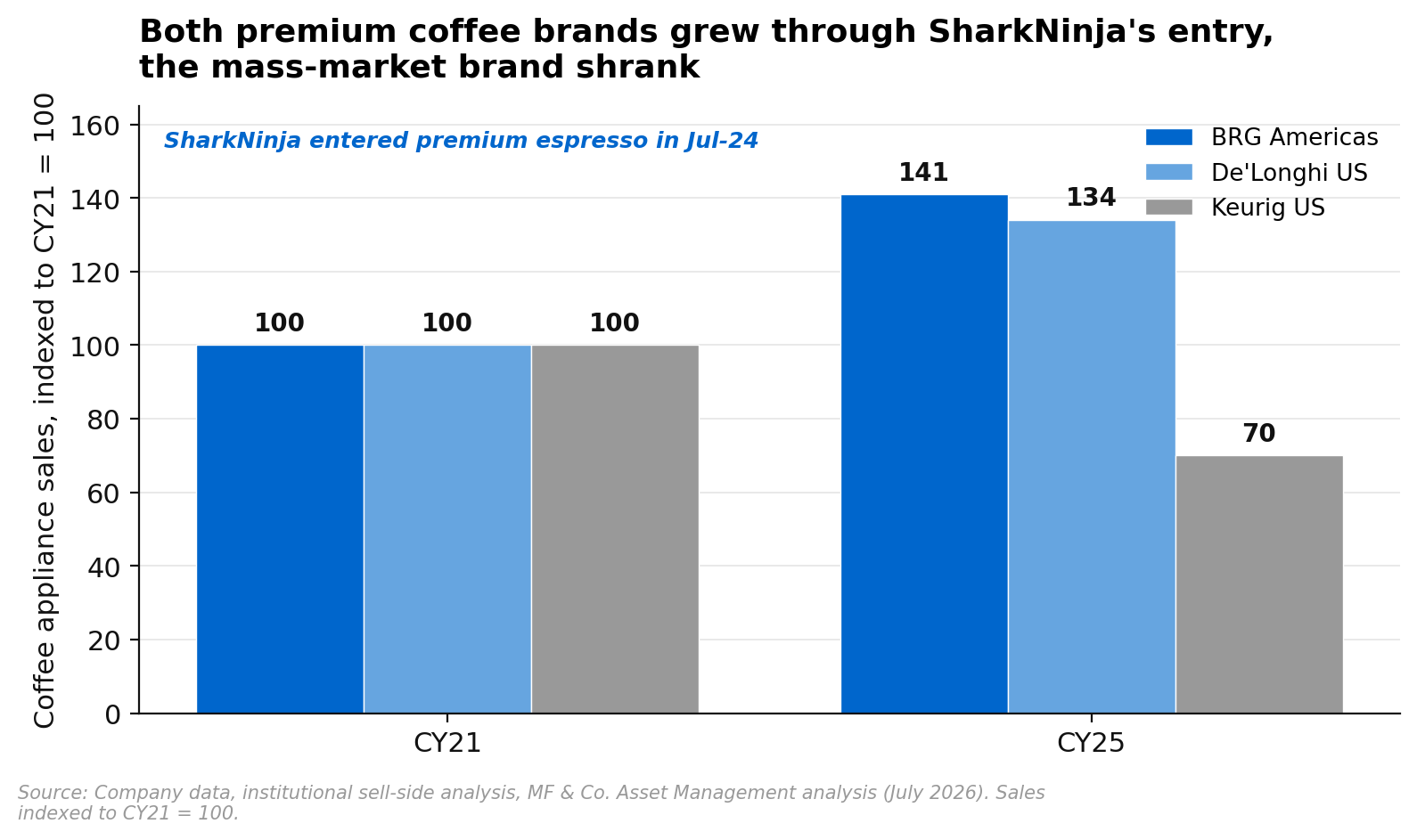
The useful thing about this debate is that it is now testable. SharkNinja entered the category two years ago, so there is a sales record to look at rather than a theory to argue about.
Indexed to 2021, Breville’s Americas coffee appliance sales sat at 141 by the end of 2025. De’Longhi, the other premium incumbent, sat at 134. Keurig, the mass market pod player, sat at 70. Both premium brands grew through the period in which SharkNinja was supposedly taking the category apart, and the brand that actually shrank was the cheap one.
That points to something more specific than a new competitor arriving. SharkNinja’s share gain appears so far to have come from the value end of the market rather than from Breville. Its espresso range to date is concentrated at the entry price points, while Breville sells across a much wider range including the expensive end. Survey work on customer demographics says the same thing from the other direction, with Breville skewing strongly toward households earning US$100,000 or more and SharkNinja skewing the other way.
There is a second piece of this that gets almost no attention. Best Buy is consolidating its in-store espresso range down to three primary brands: SharkNinja, De’Longhi and Breville. For a category where a large share of purchases still happen in front of a physical display, having the shelf cut to three names while remaining one of the three counts as a tailwind rather than a threat.
None of this means the competitive threat is nothing. It means the threat that has actually shown up so far is a threat to Keurig.
Margins Trough in FY26 and Earnings Re-Accelerate
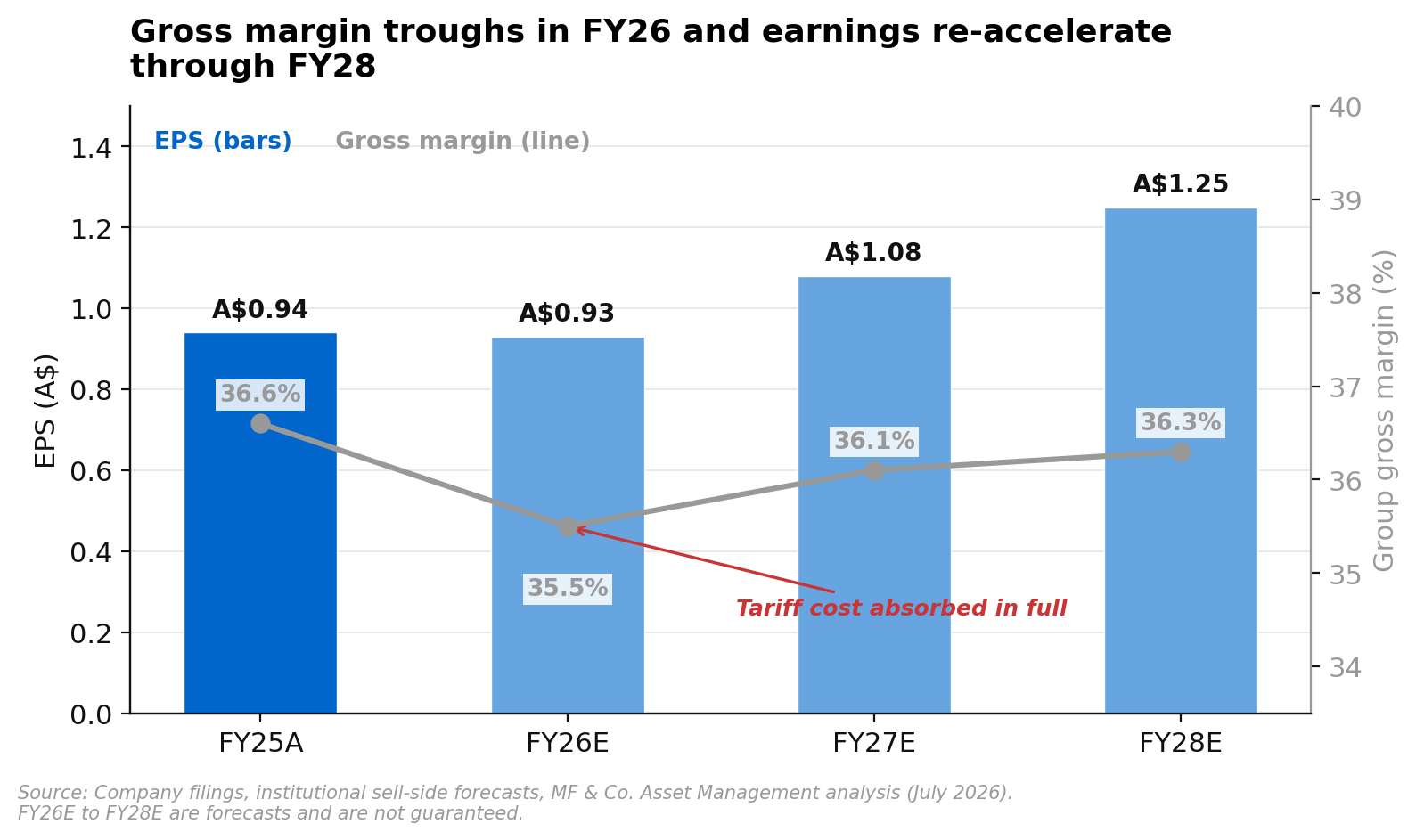
The second half of the bear case is margins, and here the market is extrapolating from the worst possible year.
Breville is a US-facing manufacturer, so the tariff cycle ran straight through its cost of goods. Group gross margin fell about 110 basis points in FY26, from 36.6% to about 35.5%, as those costs were absorbed. That is the number the market has anchored on.
What comes next is forecast to look different. Three separate effects are expected to push margin back up across FY27 and FY28. There are refunds on tariffs already paid, with the first half of FY26 alone carrying a A$42m increase in customs payments that is partly recoverable and partly shared with trading partners. There is the ongoing shift of manufacturing out of the highest tariff jurisdictions. And there is currency. Together they are expected to recover roughly 80 basis points of gross margin between FY26 and FY28, taking group gross margin back to around 36.3%.
On the currency point, one input has already moved further in Breville’s favour since the external analysis was published. That work assumed an Australian dollar of about US$0.69, up from US$0.68 in FY26 and US$0.66 in FY25, with most of the benefit landing in the second half of FY27 and into FY28. The Australian dollar is currently trading around US$0.70. A stronger Australian dollar lowers the cost of the inventory Breville buys in US dollars, which is why it shows up as a gross margin tailwind. The assumption underpinning the margin recovery has, if anything, become slightly conservative.
Put that together with the revenue line and the forecast earnings shape is clear. Revenue is expected to run from A$1,697m in FY25 to A$1,848m in FY26, A$1,993m in FY27 and A$2,188m in FY28. Earnings per share go A$0.94, then A$0.93, then A$1.08, then A$1.25. FY26 is a flat year, down about 1%, because the tariff cost landed in full. FY27 and FY28 are then forecast to deliver roughly 16% growth each. The Americas division does most of the heavy lifting, with growth of about 13% in constant currency expected for FY26, implying something closer to 16% in the second half. There are three offsets worth naming: a softer Australian and New Zealand consumer, where the unwind of the fuel excise and weaker spending through early June point to a slower Asia Pacific contribution; continued investment in the cost of doing business; and modest downgrades to the European forecasts.
One number in the accounts deserves a warning label, and it cuts both ways. FY26 free cash flow drops to about A$5m, against A$61m in FY25. That is a working capital effect rather than a profitability problem, with days of inventory rising from roughly 82 to 97 as the company builds stock through the tariff disruption. It is still real cash going out the door, and the recovery is not instant. Inventory days are forecast to stay elevated in FY27, easing only to about 96, though the working capital release is enough to lift free cash flow back to around A$193m. Anyone screening on trailing cash flow alone will draw a harsher conclusion than the business warrants. The balance sheet is forecast to move from a small net debt position in FY26 to a net cash position by FY27.
The Valuation Gap Against Australian Retail Peers
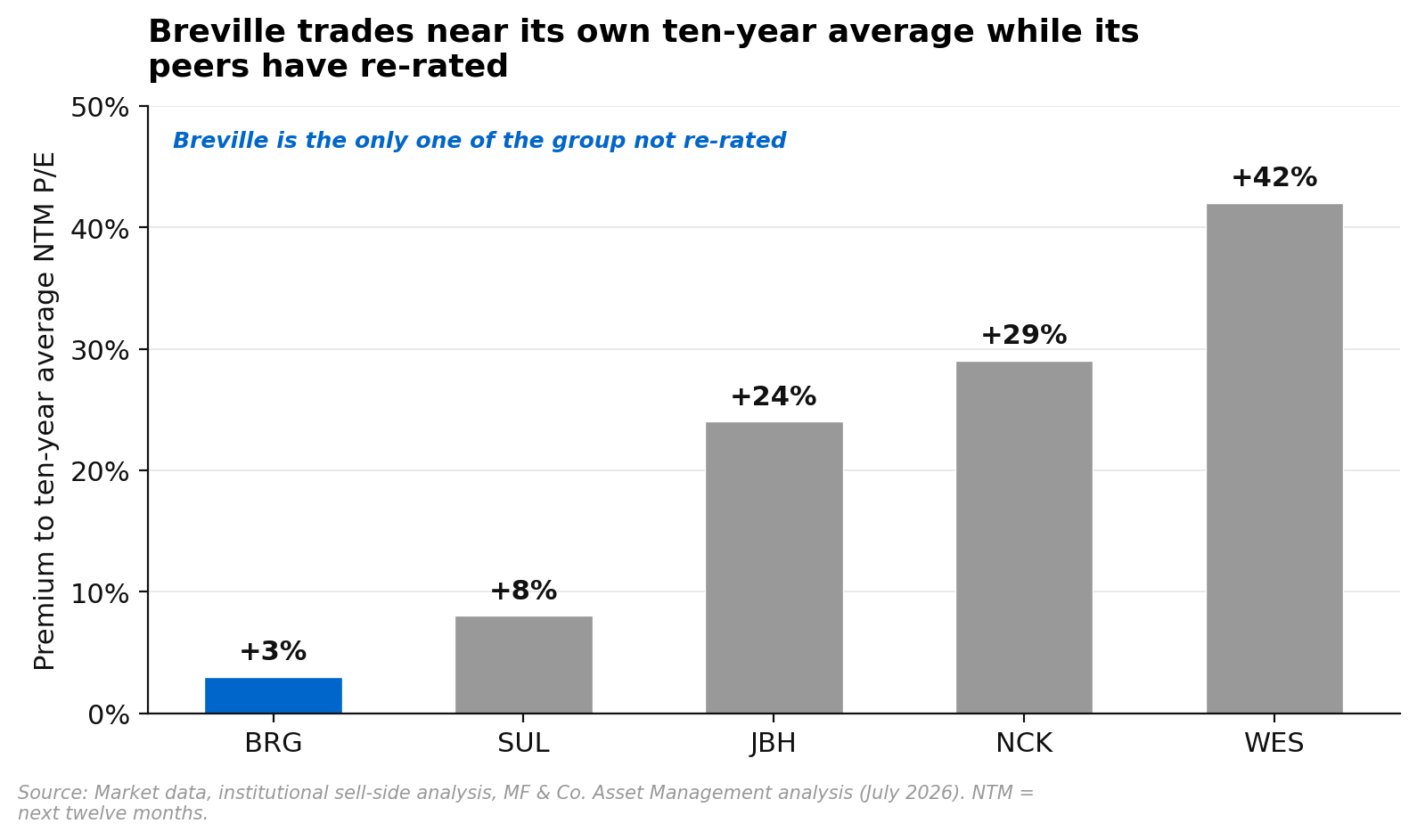
Breville is not a cheap stock and we would not describe it as one. At Friday’s close it trades on about 29 times FY27 earnings and about 25 times FY28. In absolute terms that is a full multiple for a consumer hardware business, and anyone buying it is paying for the brand.
The argument is relative, and it is fairly striking. Breville trades at roughly its own ten-year average multiple, a premium of about 3%. Every comparable quality Australian discretionary retailer trades well above its own history. Wesfarmers sits at about a 42% premium to its ten-year average, Nick Scali about 29%, JB Hi-Fi about 24%, and Super Retail about 8%.
So the market has been willing to pay up for Australian discretionary retail generally, and has specifically declined to do so for the one name in the group with a global brand and a US growth runway. The gap is the competitive fear. If the sales evidence above continues to hold, that fear is the thing most likely to unwind.
It is worth adding that short interest in Breville remains well above its long-run average. A crowded short position sitting against a potential re-rating is not a thesis on its own, but it does shape how quickly the gap could close.
Risks to the Buy Call
Four things, and they are worth taking seriously.
The first is that SharkNinja is not finished. It has moved steadily up-market since the original launch, with the Luxe Cafe Pro in August 2025, its first fully automatic espresso machine announced in May 2026, a smaller format in June 2026, and artificial intelligence led features flagged for the second half of 2026. The evidence to date says the premium end has held, but two years is a short record and the product cycle is accelerating.
The second is the Australian consumer. Asia Pacific is already expected to slow, and a sharper downturn there would offset the American strength that underpins the whole case.
The third is that the margin recovery is a forecast, not a fact. It depends on tariff refunds arriving, on manufacturing localisation landing on schedule, and on the currency staying where it is. Worse than expected cost pass-through, higher freight, or execution slipping would all push it out.
The fourth is simply the multiple. At about 29 times forward earnings there is no valuation cushion. A missed result or a further leg of cost inflation gets punished hard, and the stock has already shown it will move on sentiment alone.
Our View
Breville is a rare thing on the ASX, which is a genuinely global consumer brand with pricing power, trading at a multiple that assumes its best category is about to be taken from it. The available sales data does not support that assumption, the margin damage looks like a tariff cycle effect that is forecast to reverse across FY27 and FY28 rather than a permanent reset, and the currency has moved the right way since the analysis was published. None of that is guaranteed, and the recovery is the part of the case most exposed to being wrong.
We rate Breville Group a Buy. The 12-month target of A$37.90 implies about 22% upside from Friday’s close of A$31.05, and the re-rating case rests on the competitive fear fading rather than on anything heroic happening to earnings.
If you would like to discuss Breville Group, request a callback or call us on 1300 889 603. The above is general advice and does not consider your individual circumstances. Past performance is not a reliable indicator of future returns.