

Buy
IGO is an Australian listed miner that owns about 25 per cent of the Greenbushes lithium mine, the largest and lowest cost hard rock lithium mine in the world.
Institutional sell-side research rates IGO Buy because Greenbushes could follow the rest of the industry by lowering its product grade from about 6 per cent to about 5.6 per cent and keep more lithium from the same ore, lifting output by about 10 per cent with most extra revenue flowing through to profit. The research also sees further gains from mining productivity and wider site optimisation that are not yet fully counted, and expects stronger cash flow to support the return of dividends.
- Sell-side rating
- Buy
- Sell-side target
- A$9.50
- Upside to target
- +97.9%
- Initial price
- A$6.5030 Sep 2026
- Last close
- A$4.8018 Nov 2026
IGO owns about a quarter of the largest and lowest cost hard rock lithium mine in the world, and new research estimates how much more lithium it could recover. Greenbushes still sells its chemical grade concentrate at about 6 per cent lithium oxide, the benchmark grade it historically set for the whole industry. Over the past five years the rest of the industry has lowered its product grades to about 5.3 per cent and, in exchange, lifted the share of lithium it pulls out of the rock from about 60 per cent to about 70 per cent. If Greenbushes followed even part of the way, it could produce about 10 per cent more lithium from the same ore, with most of the extra revenue flowing through to profit. Institutional sell-side research has IGO rated Buy with a 12 month price target of A$9.50, about 46.2 per cent above the share price of A$6.50 when this research was published. Including the broader site optimisation work progressing through the second half of CY26, the research estimates the potential extra value for IGO at about A$1 billion.
Research published 30 September 2026. Price target and upside based on prices at time of publication.
Table of contents [hideshow]
About IGO
IGO is an Australian listed mining and exploration company focused on the metals needed for the clean energy transition. Its main asset is an interest of about 25 per cent in the Greenbushes lithium spodumene mine, the largest and lowest cost hard rock lithium mine globally, held through the TLEA joint venture with Tianqi. Spodumene is the lithium-bearing mineral that is dug out, crushed and concentrated before being refined into battery chemicals. Albemarle is the other major Greenbushes partner, and Talison Lithium is the corporate manager of the mine joint venture. IGO also holds an indirect 49 per cent interest in Kwinana, Australia’s first lithium hydroxide plant, and owns 100 per cent of the Cosmos nickel project, which is on care and maintenance, meaning it is shut but kept ready to restart. Its nickel business is set to wind down in FY27, and its copper ambitions are limited to early stage projects with minimal near-term spending.
Greenbushes Has Room to Trade Grade for Recovery
Greenbushes mines hard rock containing spodumene, crushes it, and concentrates it in processing plants into a product that is shipped to refineries for conversion into battery chemicals. The operator chooses the grade of that concentrate, measured as the share of lithium oxide it contains, and the recovery rate is the share of the lithium in the ore that ends up in the finished concentrate. The two pull against each other: a purer product loses more lithium along the way, so a slightly less pure product lets the plant keep more of it.
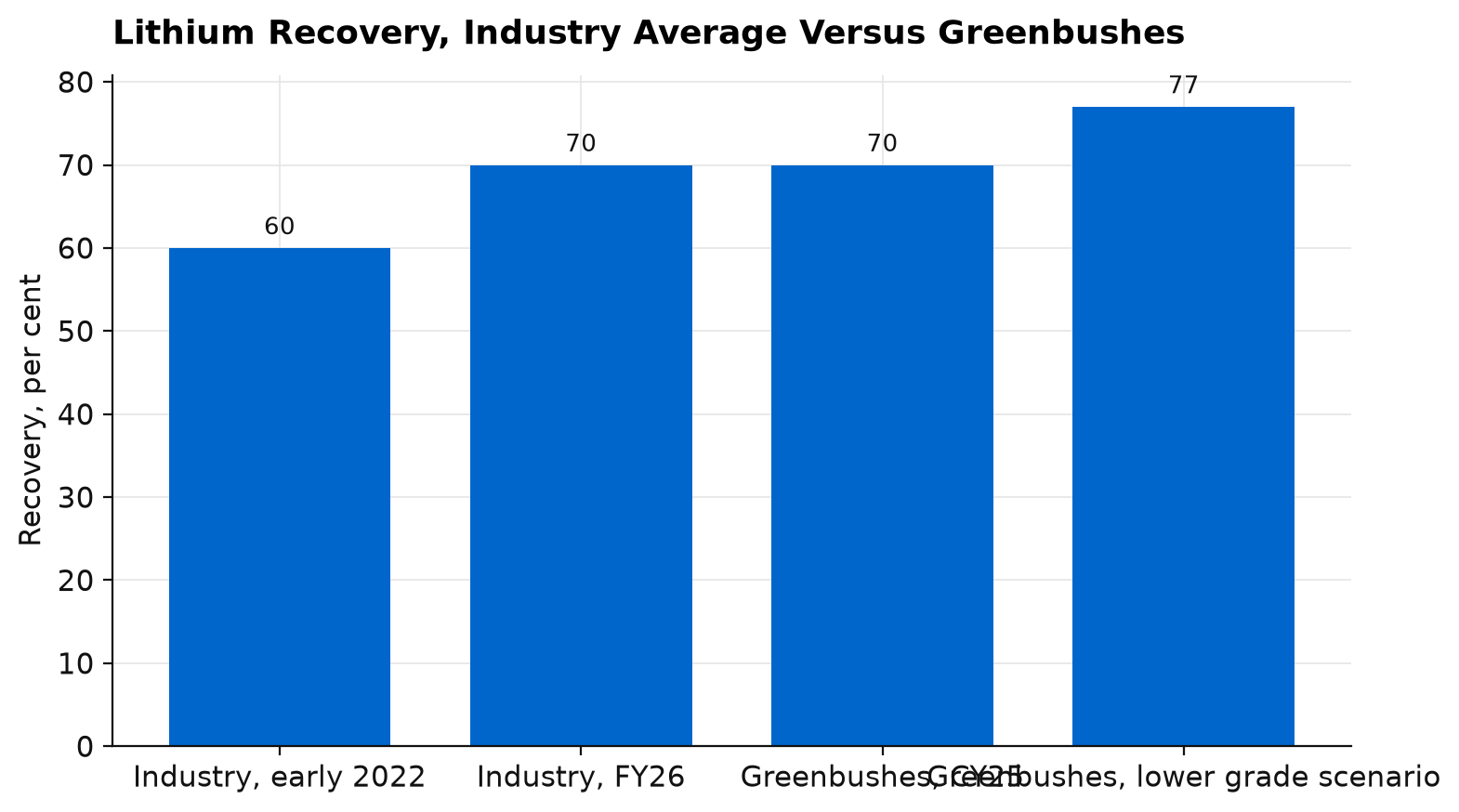
The rest of the spodumene industry has been making that trade for years. Average industry recoveries have risen from about 60 per cent in early 2022 to about 70 per cent in FY26. Much of that improvement came from lowering product grades from about 5.6 per cent to about 5.3 per cent, alongside the general gains that come as a young industry matures. On the research’s figures, cutting product grade by about 5 per cent has raised the amount of lithium each producer ships by about 15 per cent. Greenbushes has not followed: its chemical grade product has stayed at about 6 per cent, and its average recovery broadly flat at about 70 per cent.
The research’s simple scenario assumes Greenbushes lowers its average product grade from about 6 per cent to about 5.6 per cent, roughly halfway to the industry average, and captures only two thirds of the proportional recovery gain the rest of the industry achieved. On those assumptions, average recoveries at Greenbushes lift to about 77 per cent, from about 70 per cent in CY25, from the same ore and plants.
The gain will differ across the site, because Greenbushes runs several chemical grade processing plants that start from different places. The oldest, known as CGP1, already recovers about 80 per cent, so it likely has less room to improve than CGP2 and CGP3, and the research expects a blended final product across the plants. A lower grade could also give the operator more flexibility in how it plans the mine and blends ore through the mills, which the research leaves out of its numbers. On the customer side, other producers have indicated that offtake partners and Chinese refineries have had relatively few issues producing battery grade chemicals from lower grade concentrate.
More Tonnes, and Most of the Extra Revenue Kept
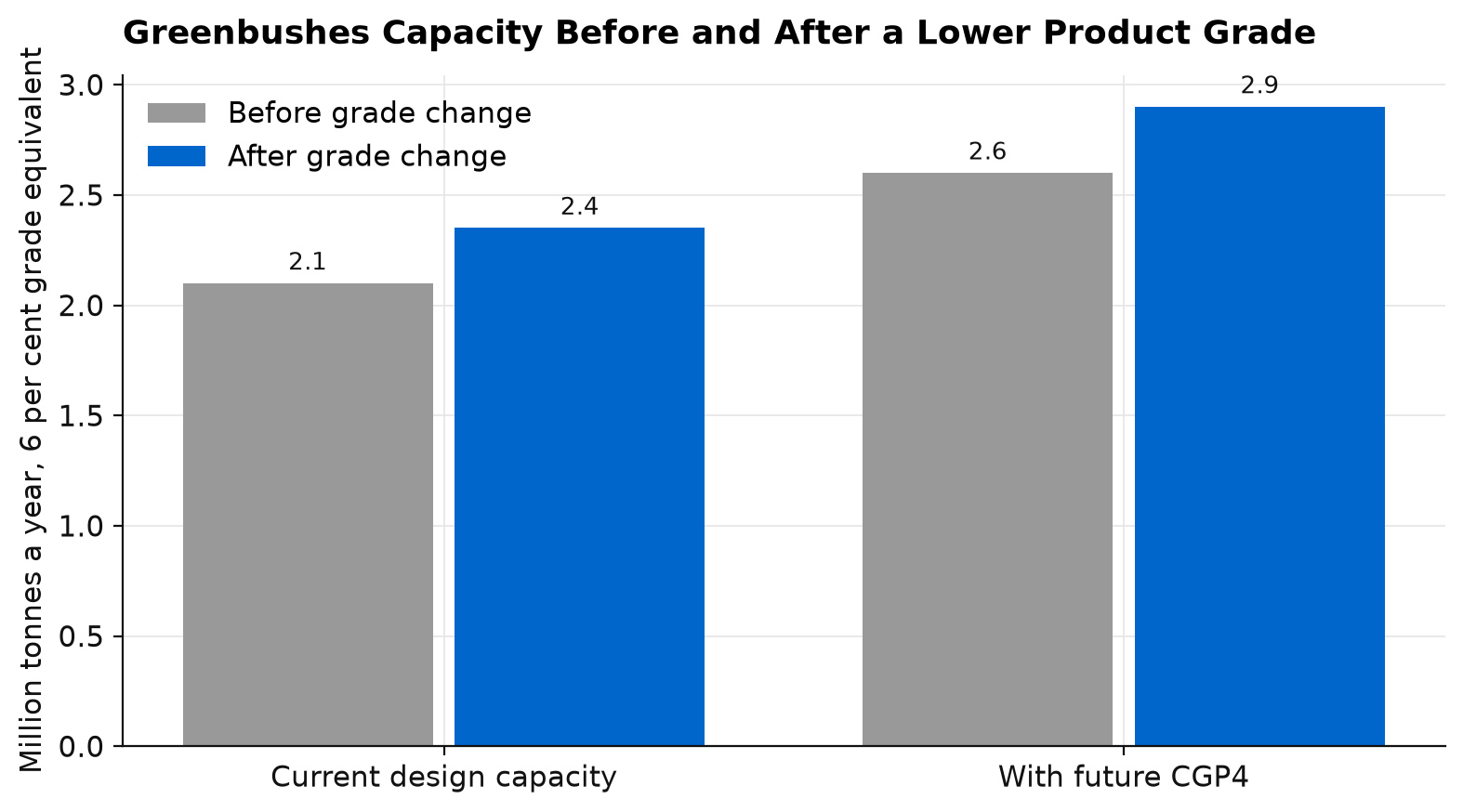
On current design capacity, which includes the CGP3 plant now ramping up and the tailings retreatment plant, known as the TRP, Greenbushes can produce about 2.1 million tonnes a year of concentrate measured on a 6 per cent grade basis. The research estimates the grade change would lift that by about 10 per cent to about 2.35 million tonnes a year on the same basis. Further out, a fourth chemical grade plant, CGP4, would take total capacity to about 2.6 million tonnes a year before the grade change and about 2.9 million tonnes after it.
Under the existing joint venture agreement, Greenbushes chemical grade concentrate is sold to the partners at a 5 per cent discount to a benchmark price lagged by one month. The partners buy all of the volume and must process it themselves or have it toll treated, meaning processed by a third party refinery for a fee, and cannot sell it on the spot market. Taking a lower grade product would add some cost for the partners, including higher variable processing costs on the larger volume and some upfront spending to adapt their refineries. The research estimates this would warrant a further discount of about US$35 a tonne, a price cut of about 1.7 to 3.5 per cent set against a volume gain of about 10 per cent, leaving the partners’ downstream plants roughly neutral.
Running more product through the plants also adds consumables, more wear on equipment, and extra handling, trucking and administration. The research puts that at a modest A$30 million to A$40 million a year in extra site costs, spread over a larger volume, so the cost of each tonne falls by about A$10 to A$20 a tonne.
After both the price and cost effects, at spodumene prices between US$1,000 and US$2,000 a tonne, the research estimates the change lifts annual revenue from the existing Greenbushes plants by about 6 to 8 per cent. EBITDA, which is earnings before interest, tax, depreciation and amortisation and a rough measure of operating profit, rises by about A$135 million to A$420 million a year, or about 6.5 to 8.5 per cent, because the extra tonnes earn an EBITDA margin of about 80 to 90 per cent. On future capacity the extra EBITDA grows to about A$175 million to A$530 million a year.
A rules-based approach to leveraged ETFs
See how our quantitative strategy works and who it suits.
Explore the strategyBecome an authorised representative
Advise your clients under an established AFSL without building your own. Choose AR or CAR.
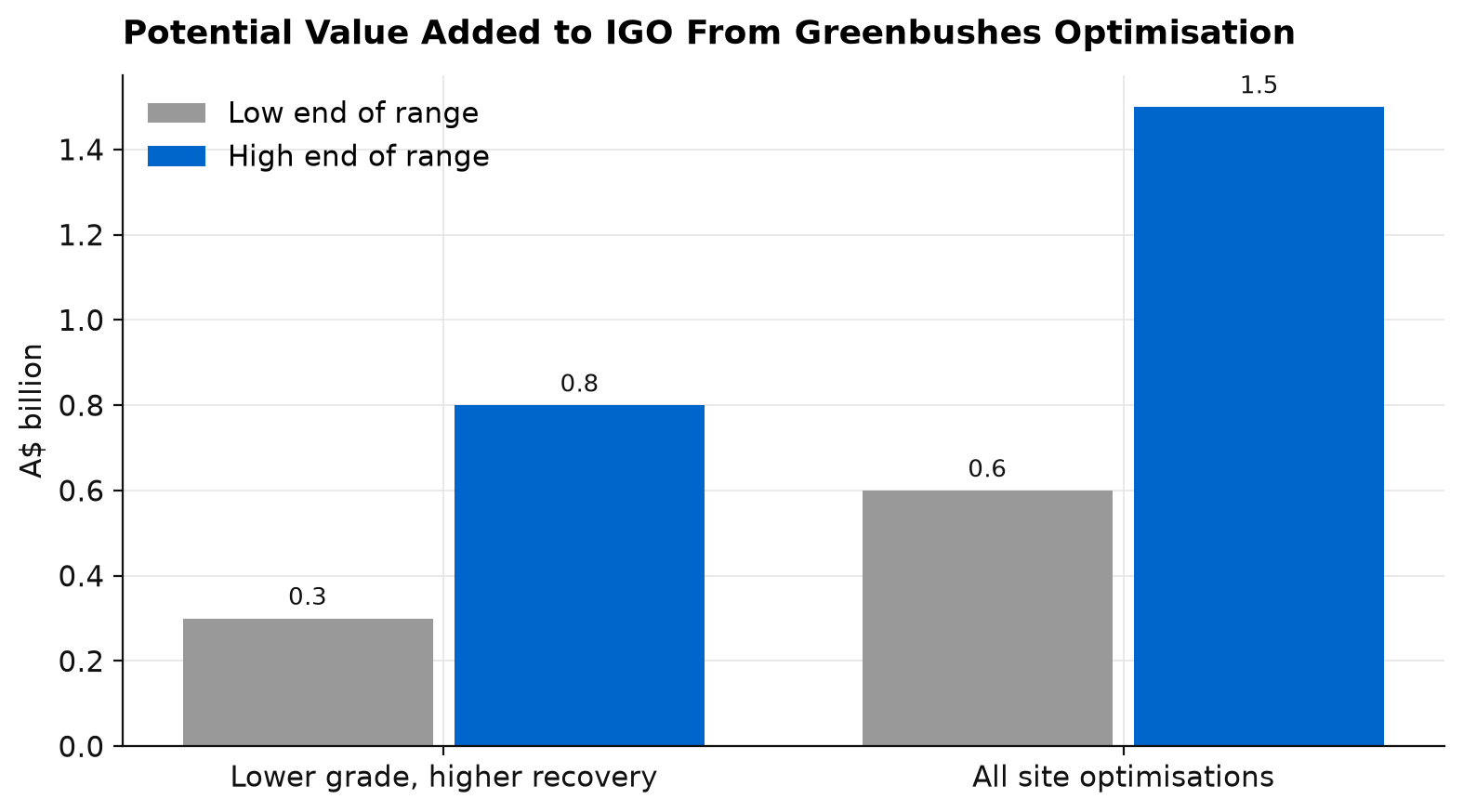
Become an AR or CARFor IGO shareholders, the research estimates the grade change alone adds about A$0.3 billion to A$0.8 billion, or about 6 to 19 per cent, to its prior valuation of the company. The changes would most likely be phased in progressively once CGP3 has finished ramping up, over FY28 and beyond.
The research assumes the TRP, which reprocesses old tailings, is converted into a full processing plant by installing a crusher, a relatively cheap way to add capacity that it describes as a no regrets option. Together with the grade change, that allows CGP4 to be deferred to about FY32, which helps the joint venture manage capital spending. For the two partners, Albemarle and Tianqi, the grade change does not materially lift the volumes they would need to toll treat over the medium term. Without the extra tonnes, volumes around CY29 look increasingly tight against both partners’ downstream needs while the TRP is shut for its conversion.
Wider Site Optimisation at Greenbushes
The grade change is one part of a wider optimisation program at Greenbushes. IGO has optimisation work under way across mining, maintenance, production and costs, and the studies are progressing through the second half of CY26. Albemarle has also said it aims to maximise the value of its resources and ramp up new assets faster, and reiterated after its 2Q CY26 result that all partners are aligned on that goal.
Some gains are already visible. Steepening the walls of the reserve pit has cut the open pit strip ratio, the amount of waste rock moved per unit of ore, over the life of the mine by about 30 per cent to about 3.8. The change reduces total open pit material movement over the life of the mine by about 25 per cent and, on the research’s estimates, adds about A$0.7 billion of after-tax value to Greenbushes based on CY25 mining costs, with potential for further reductions.
Mining productivity is also improving. Over CY25 the tonnes moved per truck rose about 40 per cent across the year, and truck hours rose about 60 per cent, bringing the fleet closer to industry averages, although it was still about 35 per cent below them in CY25. The research leaves further productivity gains out of its forecasts, but estimates that a 10 per cent cut in variable mining costs would save about A$0.5 a tonne of material moved, against CY25 mining costs of about A$6.5 a tonne. That is worth about A$0.5 billion in total savings over the open pit life, or about A$0.2 billion of after-tax value. Reaching industry average productivity could add nearly A$0.9 billion.
Beyond the grade change, broader improvements in how the plants run could lift recoveries further, and the research estimates that each 1 per cent improvement in recovery across the complex adds about 1.5 per cent to its Greenbushes and IGO valuations. At its FY26 result IGO said the ramp up of CGP3, the newest plant, was going extremely well, having already passed the performance it reached before the fire and approaching nameplate, meaning its designed full capacity. On the current trajectory CGP3 may exit the September quarter at nameplate, ahead of both the original ramp up of about 12 months and the joint venture’s revised budget, under which Albemarle budgets nameplate in 1Q CY27, adding upside to Greenbushes FY27 production guidance.
In total, the research sees the cost, productivity and broader site work, together with the grade change, adding about A$2 billion to A$6 billion, or about 10 to 25 per cent, to the value of Greenbushes on a 100 per cent basis, at spodumene prices of US$1,000 to US$2,000 a tonne. For IGO the equivalent figure is about A$0.6 billion to A$1.5 billion, or about 10 to 30 per cent of its valuation, and about A$1 billion at the research’s long-term spodumene price assumption.
Valuation and the Buy Rating
Institutional sell-side research has built the grade change into its base case, along with the conversion of the TRP to a full plant and the deferral of CGP4, and on that basis has moved IGO to Buy. The 12 month price target rises 17 per cent to A$9.50, from A$8.10. Against the A$6.50 share price at publication, that implies about 46.2 per cent upside. EBITDA forecasts are unchanged for FY27 and rise 6 per cent for FY28 and 14 per cent for FY29, with the grade benefit flowing in from about CY28. Earnings per share forecasts rise to A$0.42 from A$0.40 for FY28, and to A$0.44 from A$0.39 for FY29.
The research’s Buy case starts with the optimisation work at Greenbushes. The grade change is in its base case, but further gains in mining productivity and processing are not yet fully counted.
The research also expects more cash to reach shareholders. Greenbushes generates nearly A$1 billion of EBITDA a quarter on a 100 per cent basis, at sector leading margins, and its cash flow should strengthen as capital spending eases. Receivables built up through a payment period of about 90 days and lagged spodumene pricing should also unwind. The research expects that to more than offset ongoing rectification spending at Kwinana, allowing dividends from the TLEA joint venture to return and grow and supporting the restart of IGO’s own dividend. Liquidity largely remains above the A$0.5 billion threshold for excess capital management payouts. Over the past 12 months IGO has paid A$0.05 a share in dividends, a trailing yield of 0.8 per cent, fully franked.
Absent new exploration success or acquisitions, the nickel business winds down in FY27, leaving IGO primarily reliant on dividends from the lithium joint venture. Reported revenue falls from A$488.8 million in FY26 to A$113.3 million in FY27 and to zero from FY28, while earnings per share are forecast to rise from A$0.14 in FY26 to A$0.54 in FY27. Most of IGO’s value sits in its share of Greenbushes, which does not appear in reported revenue.
On valuation, the research judges that IGO is trading at a widened discount to its Australian lithium peers, and it still values IGO’s share of Kwinana and Cosmos below zero.
Key Risks
The biggest risk is the lithium price, and to a lesser degree nickel, because any shift in demand or supply that weakens prices, or makes them more volatile, would cut earnings directly. Currency matters too, since lithium is priced in US dollars and a stronger Australian dollar would reduce the value of those earnings once converted. On the partner side, the grade change depends on the joint venture agreeing to it, and Albemarle and Tianqi will weigh their own downstream processing needs, so it may arrive later or in a smaller form than assumed. Execution is another risk: a slower finish to the CGP3 ramp up, delays on later expansions, or optimisations that add less value than hoped would defer revenue and raise costs or capital spending. Cost inflation across materials, freight and labour could squeeze margins, and higher capital costs on growth projects would weigh on the valuation. Any acquisition or new project could also shift the outlook for IGO in either direction.
Our View
In our view the argument holds up without a rise in the lithium price. It relies on something the rest of the industry has already done, producing a slightly lower grade concentrate to keep more of the lithium, applied to a mine that has so far chosen not to. The scenario assumes Greenbushes moves only about halfway to the industry’s grade and captures only two thirds of the recovery gain. IGO does not control Greenbushes on its own: it owns about 25 per cent through a joint venture, and the decision sits with partners whose interests are aligned on the mine but differ downstream. The signals to watch are CGP3 reaching nameplate and the optimisation studies reporting through the second half of CY26.
If you would like to discuss IGO, request a callback or call us on 1300 889 603.
Financial Summary
Become an authorised representative
Advise your clients under an established AFSL without building your own. Choose AR or CAR.
Become an AR or CAR