

Buy
Iluka Resources digs and sells mineral sands such as zircon and synthetic rutile, and is building a rare earths refinery at Eneabba in Western Australia.
Institutional sell-side research rates it Buy because the first-half result marks the bottom of the mineral sands cycle, with zircon sales and prices already rising. It expects demand for zircon to recover in 2027, with low prices lasting only one to two years. The Eneabba rare earths refinery is on schedule and has signed its first customer.
- Sell-side rating
- Buy
- Sell-side target
- A$8.40
- Upside to target
- +52.5%
- Initial price
- A$6.0416 Sep 2026
- Last close
- A$5.5118 Nov 2026
Iluka Resources‘ first-half 2026 result reflected the bottom of the mineral sands cycle, with earnings from the core mineral sands business the lowest since the June half of 2016. In the same half, zircon sales and prices rose, the business generated strong cash flow, and work progressed at the Balranald mineral sands mine and the Eneabba rare earths refinery. Institutional sell-side research has Iluka Resources rated Buy with a 12 month price target of A$8.40, about 39.1 per cent above the share price of A$6.04 when this research was published. The research trimmed the target from A$8.60 after the result, with its case resting on a recovery in zircon and on Eneabba, which is on schedule and has signed its first customer.
Research published 16 September 2026. Price target and upside based on prices at time of publication.
Table of contents [hideshow]
About Iluka Resources
Iluka Resources is a mineral sands company building a second business in rare earths. Its mineral sands operations produce zircon and synthetic rutile, a high grade titanium dioxide feedstock that is sold under contract to industrial customers. Its three major growth projects are the Balranald mineral sands project, which uses underground mining drilling technology; the Eneabba rare earths refinery, supported by an A$1.65 billion Australian Government debt facility, which institutional sell-side research notes will be only the sixth rare earths refinery in the Western world; and the Wimmera rare earths project in Victoria, where a Definitive Feasibility Study is due in early 2027. Iluka reports on a calendar year and its shares trade on the Australian Securities Exchange under the code ILU.
Zircon Sales and Prices Pick Up
Underlying EBITDA, which is earnings before interest, tax, depreciation and amortisation and a common measure of operating profit, came in at A$53 million for the first half of 2026. Underlying NPAT, or net profit after tax, was a loss of A$24 million. Institutional sell-side research had forecast A$61 million and a loss of A$26 million, so the result was broadly in line given that this half represented bottom-of-the-cycle earnings. Revenue, cash costs and net debt had already been released to the market before the result. Among other costs, inventory movements came in higher than expected, while idle capacity charges were lower.
The interim dividend of 3 cents a share was in line with expectations and was based on passing through the DRR royalty payment. Management also cut its 2026 cash cost guidance by A$40 million to A$380 million.
Zircon sales were materially higher in the June quarter, at 109kt, against 54kt in the March quarter (kt is short for thousand tonnes). The contracted zircon sand price for the September quarter is set to rise by a further US$215 a tonne to about US$1,760 a tonne FOB. FOB, or free on board, is the price at the point of loading, before the buyer pays for shipping. The reported price for the quarter is a little lower, at about US$1,685 a tonne FOB, because some June quarter volumes were sold at the earlier price. Iluka expects prices to hold at these levels in the December quarter. Institutional sell-side research puts the price strength down to ongoing industry supply constraints in high-quality zircon.
Sales of synthetic rutile restarted in the June quarter at 37kt, in line with the schedules in Iluka’s take-or-pay contracts. A take-or-pay contract obliges the buyer to pay for agreed volumes whether or not it takes delivery, which gives the seller more certainty over revenue. Full-year contracted synthetic rutile sales of 110 thousand tonnes will be weighted to the December quarter, so more of it will be sold in the second half of the year than in the first.
Looking further out, institutional sell-side research expects demand for zircon and high grade titanium dioxide feedstock to recover in 2027, with supply shortages over the medium term. Its view is that this period of low prices will be relatively short-lived, at one to two years, compared with prior cycles. The reasons are a constrained supply backdrop and an expected recovery in developed-market demand for both products in 2027.
Cash Flow and Debt
The mineral sands business generated operating cash flow of A$247 million and free cash flow, the cash left after running costs and capital spending, of A$200 million in the first half, a figure that includes a A$53 million tax refund. It did so in a half when mineral sands earnings were the weakest since 2016.
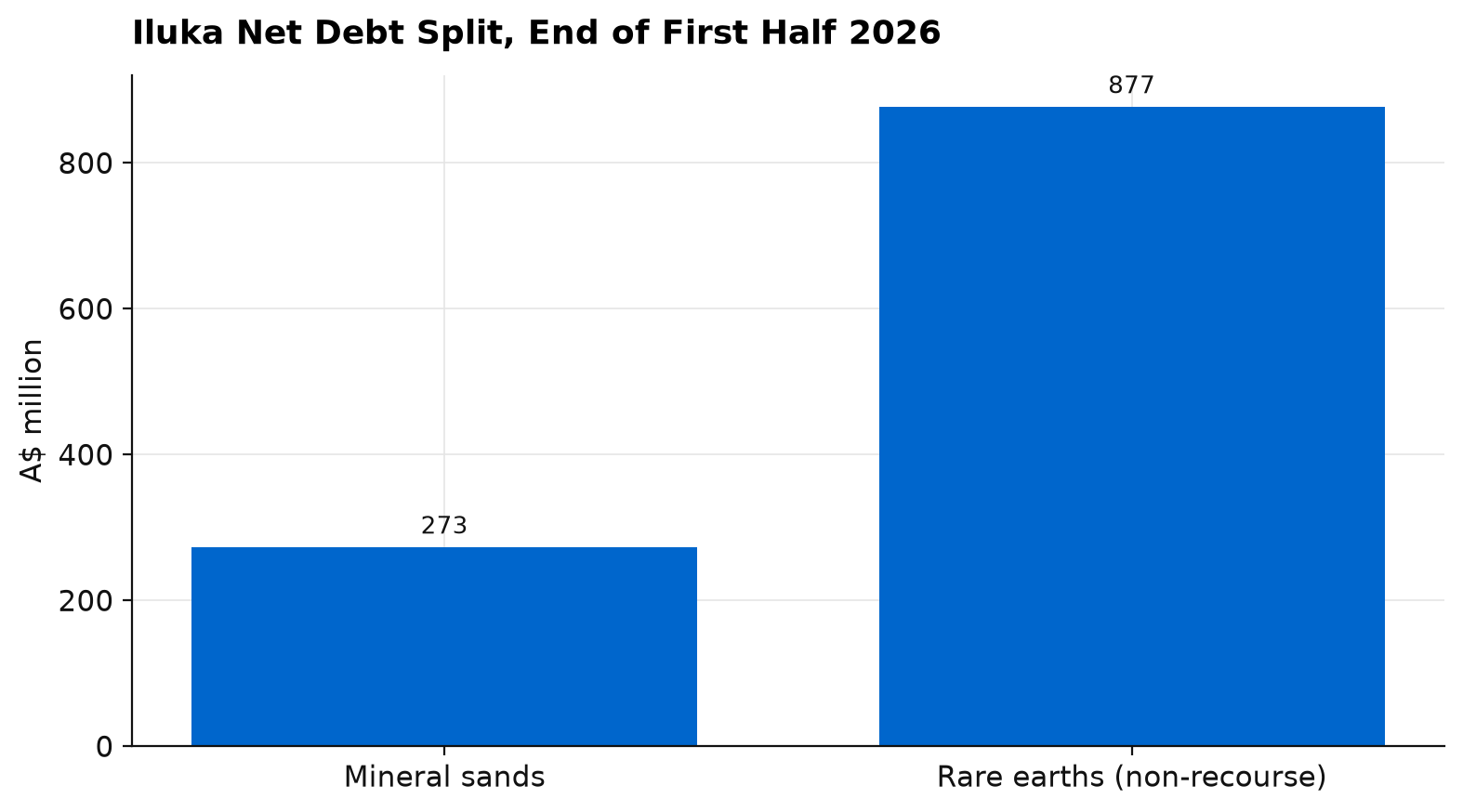
Net debt ended the half at about A$1.15 billion, of which about A$273 million sits with mineral sands, while about A$877 million sits in the rare earths business and is non-recourse, meaning lenders can be repaid only from that project and have no claim on the rest of the company.
Iluka also paid back about A$170 million of its A$800 million Multi Option Facility Agreement during the half, and that facility is now drawn to about A$370 million. On the Eneabba side, around A$900 million of the A$1.65 billion Australian Government debt facility has been drawn, while a separate A$75 million overrun facility remains undrawn. A further A$214 million of equity contributions is still to come, and the company expects the next contribution in early 2027, with about A$82 million allocated for working capital.
A rules-based approach to leveraged ETFs
See how our quantitative strategy works and who it suits.
Explore the strategyBecome an authorised representative
Advise your clients under an established AFSL without building your own. Choose AR or CAR.
Become an AR or CARMineral sands capital spending is expected to be about A$115 million in 2026, slightly below the A$120 million institutional sell-side research had pencilled in, and the business is generating enough cash to reduce corporate borrowing even as the refinery spends heavily.
Eneabba Signs a Customer as Balranald Ramps Up
At Eneabba, total capital spending to 30 June came to A$1.1 billion against the A$1.7 to 1.8 billion budget, including A$265 million in the June quarter. Construction is about 60 per cent complete. Major equipment deliveries to site are tracking ahead of the installation schedule, the roaster kiln is now installed, and the contract for structural, mechanical, piping, electrical and instrumentation work has been awarded. Committed and remaining expenditure is A$0.6 to 0.7 billion. Iluka has kept a contingency ratio of 20 to 30 per cent as spending has progressed, with contingency and growth allowances of about A$170 million set aside for unexpected costs. Management says it is more confident on both capital spending and timing, with progress on schedule and commissioning expected around mid 2027. Institutional sell-side research has still built a little more time into its forecast production ramp-up over 2028.
Iluka recently announced a binding, multi-year, take-or-pay off-take agreement, a contract to buy a set amount of a project’s future production, with an undisclosed global automotive company. The deal covers 1,200 tonnes of rare earth oxides, namely neodymium, praseodymium, dysprosium and terbium, which together are the magnet rare earths. That is about 10 per cent of planned production from the refinery under the stockpile-only scenario, which excludes third-party feed, over an initial four-year term starting in 2028. Pricing is set at the higher of a minimum price or a market-linked price, securing minimum revenue of US$155 million at about a 70 per cent EBITDA margin.
The research notes that this is Iluka’s first rare earths customer and the industry’s first floor price without government backing, meaning the buyer pays at least a set level even if market prices fall below it. Institutional sell-side research expects Iluka to sign similar contracts over the next 6 to 18 months covering more than 80 per cent of production, with manufacturers in several regions, including the United States and Europe. On the supply side, Iluka has signed a new feedstock agreement with VHM, adding to existing arrangements with Northern Minerals and Lindian for third-party feed, rare earth material bought from other miners that can lift refinery output beyond what Iluka’s own stockpile supports.
At Balranald, commissioning is complete after some challenges in the June quarter with pumping and piping seal failures. Key aspects of the underground mining drilling technology are now confirmed, including developing stopes, the underground mining zones, over their full length, moving from a development rig to a mining rig with two now running, and producing both magnetic and non-magnetic heavy mineral concentrate to specification. Heavy mineral concentrate is the partly processed material that is later separated into saleable products such as zircon. The focus has now shifted to improving extraction rates and recoveries as the project ramps up over 2026.
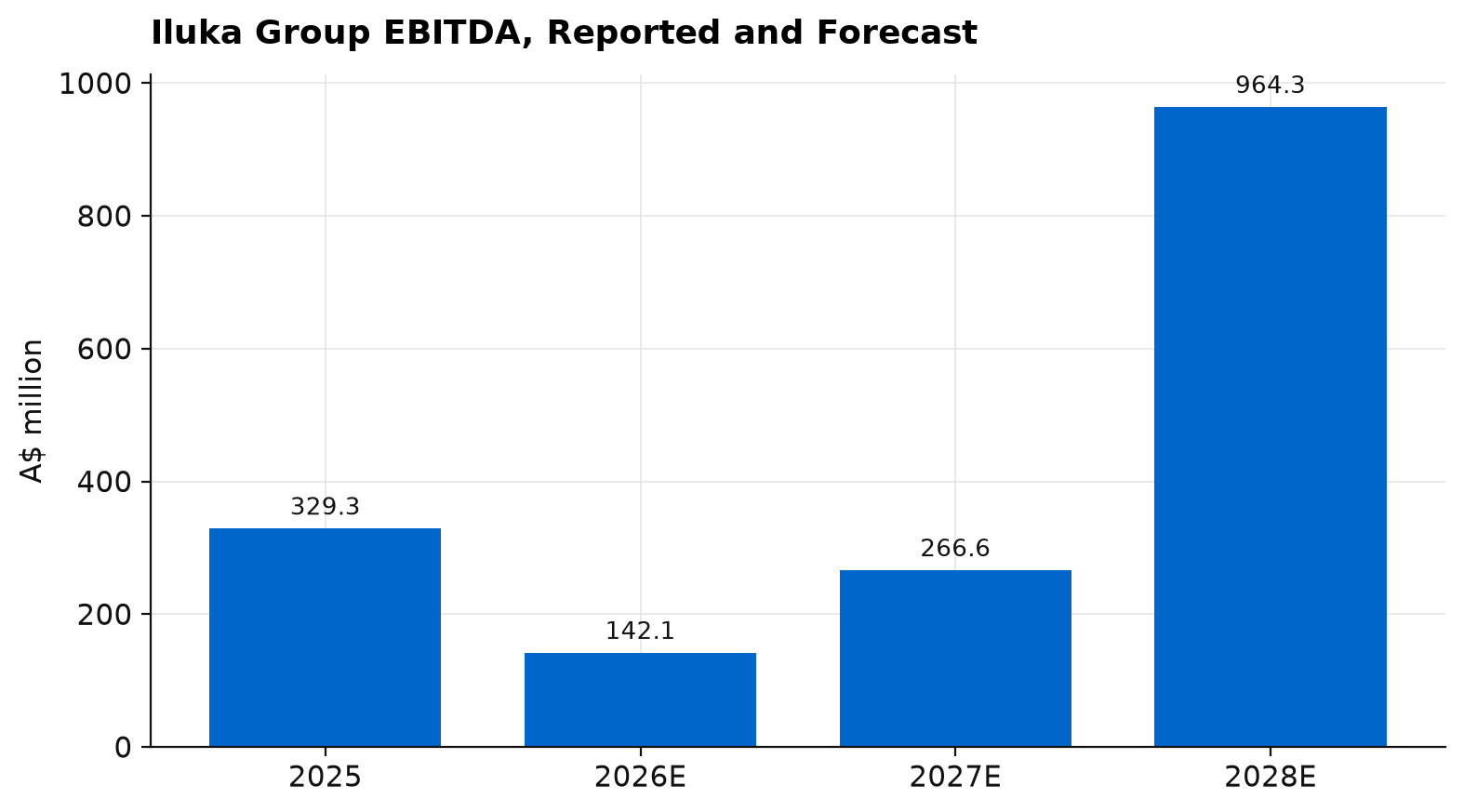
Institutional sell-side research forecasts more than 20 per cent production growth in mineral sands volumes, about 20 thousand tonnes a year of rare earths including about 4.5 to 5 thousand tonnes a year of high value neodymium-praseodymium, over the next five years. It also expects group EBITDA to rise about fivefold to over A$1 billion over the medium term. Its forecasts show EBITDA falling from A$329.3 million in 2025 to A$142.1 million in 2026, then recovering to A$266.6 million in 2027 and A$964.3 million in 2028 as the refinery ramps up.
Valuation and Forecasts
Institutional sell-side research has a 12 month price target of A$8.40 on Iluka, implying 39.1 per cent upside from the share price of A$6.04 when this research was published. The target was trimmed by 2 per cent from A$8.60 after the result, as forecast EBITDA for 2026, 2027 and 2028 was revised down by 6, 7 and 11 per cent respectively. Those revisions reflect higher corporate and marketing costs, an adjustment to the expected inventory unwind, and the extra buffer around the Eneabba ramp-up in 2028.
On valuation, the research’s numbers show the share price implies a flat neodymium-praseodymium oxide price of about US$80 a kilogram. That compares with US$110 a kilogram in the MP Materials and Lynas agreements, a level the research sees as similar to Iluka’s own first off-take. The research values the Eneabba project alone at about A$3.1 billion, or around A$7.20 a share, which is above the share price at publication.
On growth, institutional sell-side research forecasts revenue rising from A$925.2 million in 2026 to A$1,294.4 million in 2027 and A$2,181.8 million in 2028 as the refinery comes on. Earnings per share stay negative in the near term, with forecast losses of A$0.12 a share in 2026 and A$0.21 a share in 2027, before a forecast profit of A$0.55 a share in 2028.
The research’s catalysts include further rare earths off-take agreements after the first, securing the additional A$400 million from government, securing more third-party rare earth feed, the ramp-up of the high grade Balranald project over 2026, first project economics for the Wimmera rare earths project when its Definitive Feasibility Study lands in early 2027, and refinery construction completion and commissioning in mid 2027.
The trailing dividend is A$0.06 a share, a yield of about 1.0 per cent, fully franked, meaning eligible investors receive a credit for the Australian tax the company has already paid on the profits behind it.
Key Risks
Mineral sands demand and prices could be lower than expected, and the recovery in zircon and titanium dioxide feedstock that institutional sell-side research expects in 2027 could arrive later or be weaker. Contracting is another risk, because the research expects further off-take contracts over the next 6 to 18 months, and slower contracting or market-linked rare earth prices moving lower would weaken the case. On execution, Balranald is still working on extraction rates and recoveries, and Eneabba still has to complete construction, commissioning and ramp-up. Industry cost inflation could push capital spending above the current budget despite the contingency held. Permitting, approvals and operational issues could also delay Iluka’s projects or disrupt production.
Our View
In our view the first-half result reflects the low point of the cycle. The mineral sands business produced its weakest earnings since 2016 and still generated A$200 million of free cash flow, cut its cost guidance and repaid debt. The off-take deal covers about 10 per cent of planned production, and its floor price gives Iluka a reference point for the rest of its contracting programme. We will watch whether the next contracts arrive within the window the research expects, and whether Balranald’s recoveries keep improving. The share price may stay volatile while earnings sit at the bottom of the cycle and the refinery is still being built.
If you would like to discuss Iluka Resources, request a callback or call us on 1300 889 603.
Financial Summary
Become an authorised representative
Advise your clients under an established AFSL without building your own. Choose AR or CAR.
Become an AR or CAR