

Hold
Deterra Royalties is an ASX-listed company that collects a share of the revenue from mines run by other companies, mainly an iron ore area in Western Australia.
Institutional sell-side research rates it Hold because an attractive valuation and a supportive, fully franked dividend are weighed against a lack of near-term growth. EBITDA is forecast to fall by about 10 per cent in FY27 on a lower Australian dollar iron ore price. The Thacker Pass lithium royalty is not due to produce until 2028, although net debt roughly halved over the year.
- Sell-side rating
- Hold
- Sell-side target
- A$4.60
- Upside to target
- +24.3%
- Initial price
- A$4.123 Sep 2026
- Last close
- A$3.7018 Nov 2026
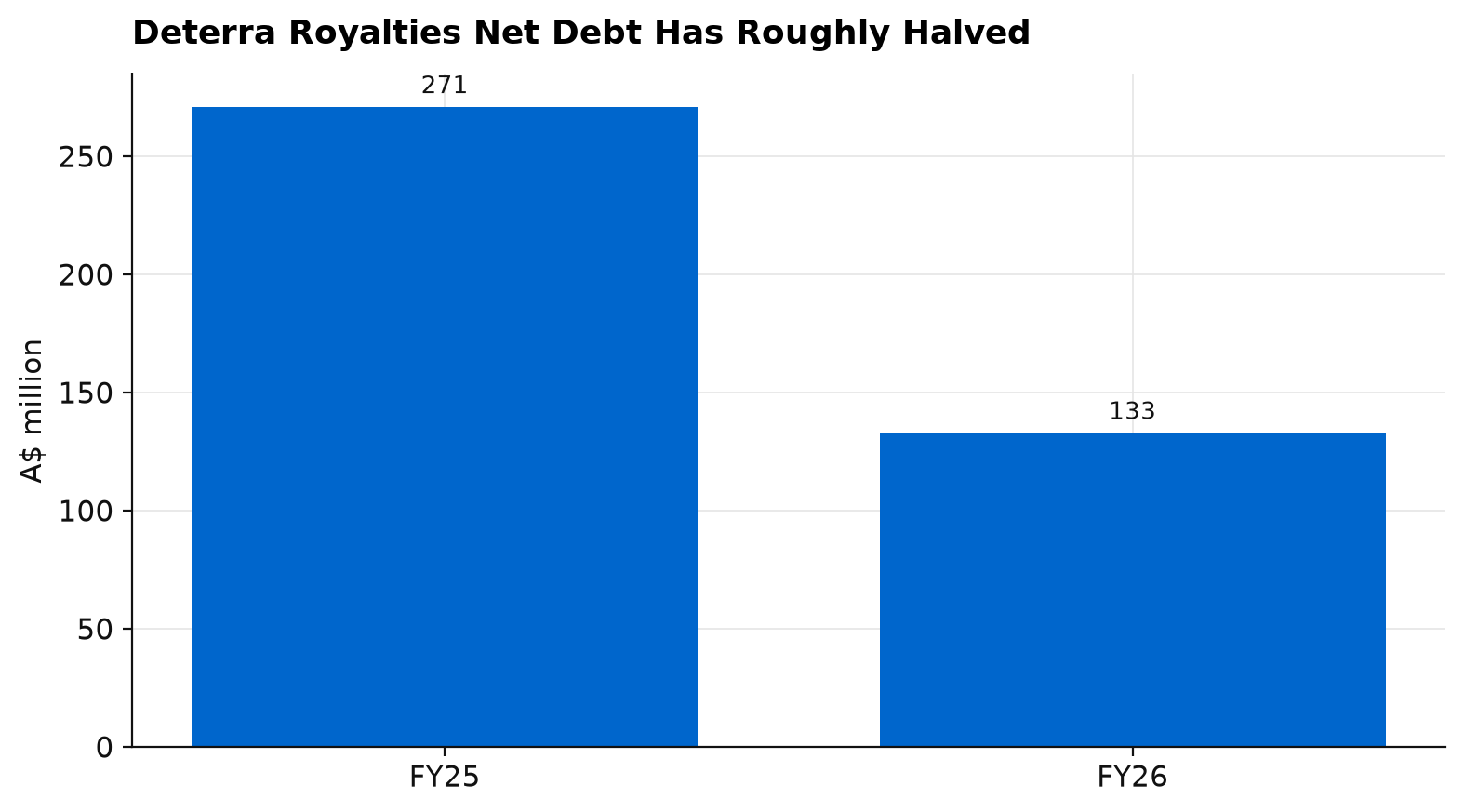
Deterra Royalties reported FY26 EBITDA of A$237 million and a final dividend in line with expectations, and its net debt roughly halved over the year. With iron ore prices easing in Australian dollar terms, earnings are forecast to step down in FY27, and the company’s main growth option, a royalty over the Thacker Pass lithium project in the United States, is not expected to produce its first lithium until 2028. Institutional sell-side research has Deterra Royalties rated Hold with a 12 month price target of A$4.60, about 11.7 per cent above the share price of A$4.12 when this research was published.
Research published 3 September 2026. Price target and upside based on prices at time of publication.
Table of contents [hideshow]
About Deterra Royalties
Deterra Royalties is an ASX-listed royalty company that owns the right to a share of the revenue from mines that other companies operate. Its core asset is a 1.232 per cent royalty linked to BHP’s Mining Area C, an iron ore mining area in Western Australia. It also holds a 4.8 per cent gross royalty over the Thacker Pass Lithium Project in the United States, which is operated by Lithium Americas and is still under construction. The company reports on a June financial year and targets a minimum payout of 75 per cent of earnings as dividends. In August 2025 it sold its Trident gold offtake portfolio, and management has said it continues to look for bolt-on acquisitions to add to the portfolio.
A Clean FY26 Result and a Stronger Balance Sheet
With revenue already released to the market, the FY26 result came down to profit and the dividend. EBITDA, which stands for earnings before interest, tax, depreciation and amortisation and is a rough measure of the cash profit a business generates from its operations, came in at A$237 million. That was ahead of the A$225 million institutional sell-side research had forecast. Net profit after tax, the bottom-line figure left for shareholders once interest and tax are paid, was A$164 million, a touch below the A$167 million forecast.
The board declared a final dividend of 10.8 cents per share, broadly in line with the institutional sell-side research forecast. That represented a payout of 75 per cent of earnings, the same ratio as before. The payout ratio is the share of profit a company hands back to shareholders as dividends, and Deterra targets a minimum of 75 per cent. Because the payout is a share of earnings, the dividend moves up and down with the iron ore price. Over the past 12 months the company has paid 23.2 cents per share in dividends.
Net debt, which is borrowings minus cash, fell to about A$133 million from A$271 million a year earlier, reflecting the sale of the Trident gold offtake portfolio in August 2025. An offtake is an agreement to purchase part of a mine’s production, so selling that portfolio turned a non-core asset into cash. On top of the lower net debt, Deterra has about A$360 million of undrawn debt available, meaning credit lines it has arranged but not yet used.
Management said on the results call that it continues to look for bolt-on acquisitions, meaning smaller royalty purchases that add to the existing portfolio, and the undrawn debt gives it room to fund them. Institutional sell-side research lists value and earnings accretive deals as an upside risk to its view, and dilutive deals as a downside risk.
Iron Ore Prices Set the Near-Term Earnings Path
A royalty holder is paid a set percentage of the revenue a mine generates. The operator pays for the trucks, the fuel, the workforce and the equipment, so the royalty holder’s income depends on how much the mine sells and the price it gets. The 1.232 per cent royalty linked to Mining Area C, which BHP operates in Western Australia, is Deterra’s main source of earnings.
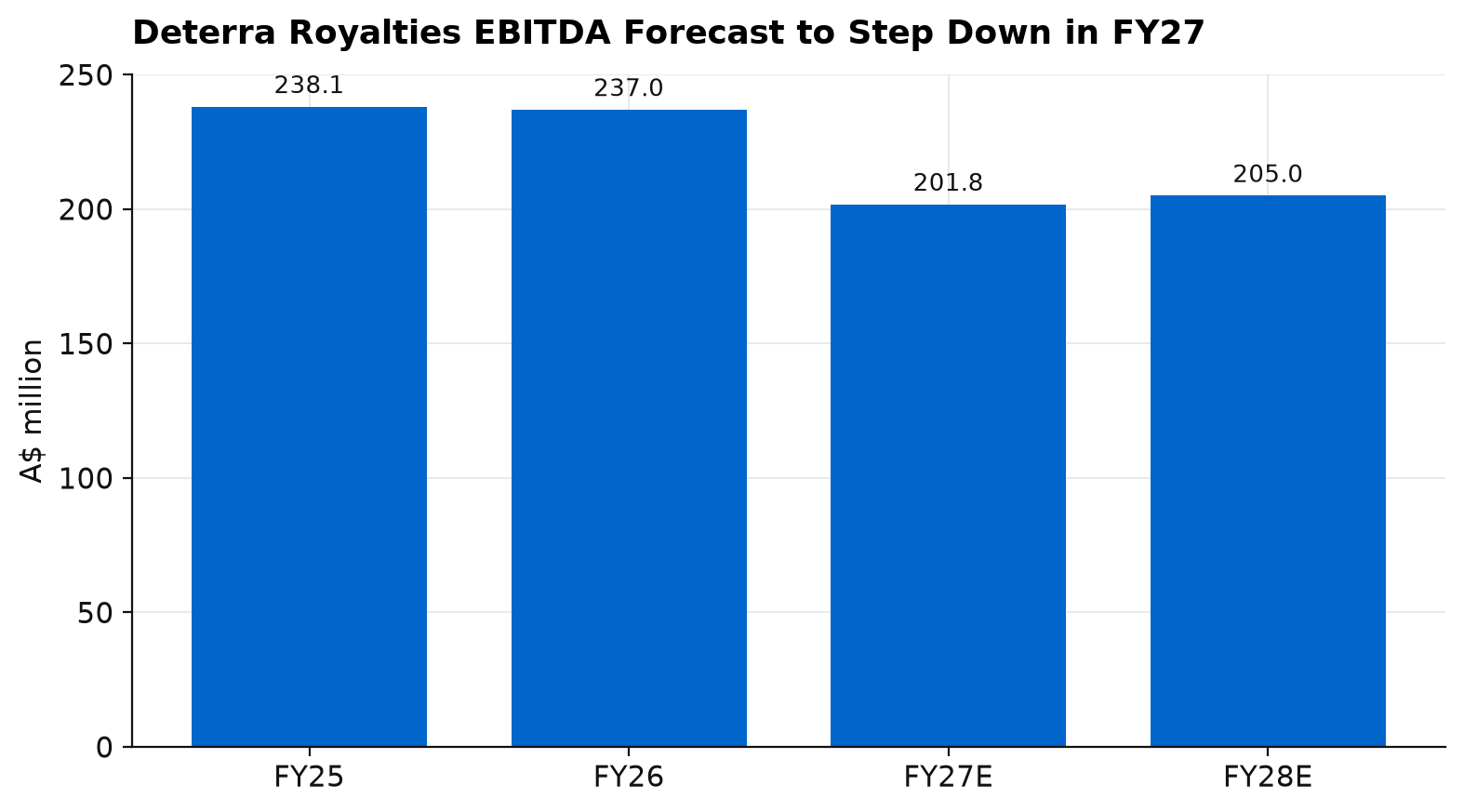
The benchmark iron ore price, quoted for ore with 62 per cent iron content, was around US$100 a tonne at the time of the research. What flows through to Deterra’s reported numbers, though, is the price in Australian dollars. Institutional sell-side research forecasts EBITDA to fall by about 10 per cent in FY27, to around A$200 million, on a lower Australian dollar iron ore price. In its forecast table, that is A$201.8 million in FY27 and A$205.0 million in FY28, against A$237 million reported for FY26 and A$238.1 million for FY25. Revenue is forecast at A$211.5 million in FY27 and A$214.9 million in FY28. Earnings per share are forecast at 26 cents in FY27 and 27 cents in FY28, down from 30 cents in FY25.
The research changed its forecasts only modestly after the result, incorporating the reported numbers and slightly increasing its assumption for corporate costs.
A rules-based approach to leveraged ETFs
See how our quantitative strategy works and who it suits.
Explore the strategyBecome an authorised representative
Advise your clients under an established AFSL without building your own. Choose AR or CAR.
Become an AR or CARBecause a royalty earns revenue without the cost base of a mine, its margins are very high. Institutional sell-side research sees those margins leaving Deterra less exposed than the iron ore miners to falling prices, since a miner’s costs stay roughly fixed when its selling price drops.
Looking further out, the iron ore royalty may last longer than the current mine plan implies. Mining Area C has possible longer-dated mine life extensions from the Mudlark and Tandanya deposits, which are not certain to be developed. Other swing factors the research flags are shipment volumes from Mining Area C, the Australian dollar, where a weaker currency is listed as an upside risk, and freight costs, where lower costs are listed as an upside risk and higher costs as a downside one.
Thacker Pass Is a Longer-Dated Growth Option
Deterra’s growth option is its 4.8 per cent gross royalty over the Thacker Pass Lithium Project in the United States, operated by Lithium Americas. As with the iron ore royalty, it is calculated on revenue before costs.
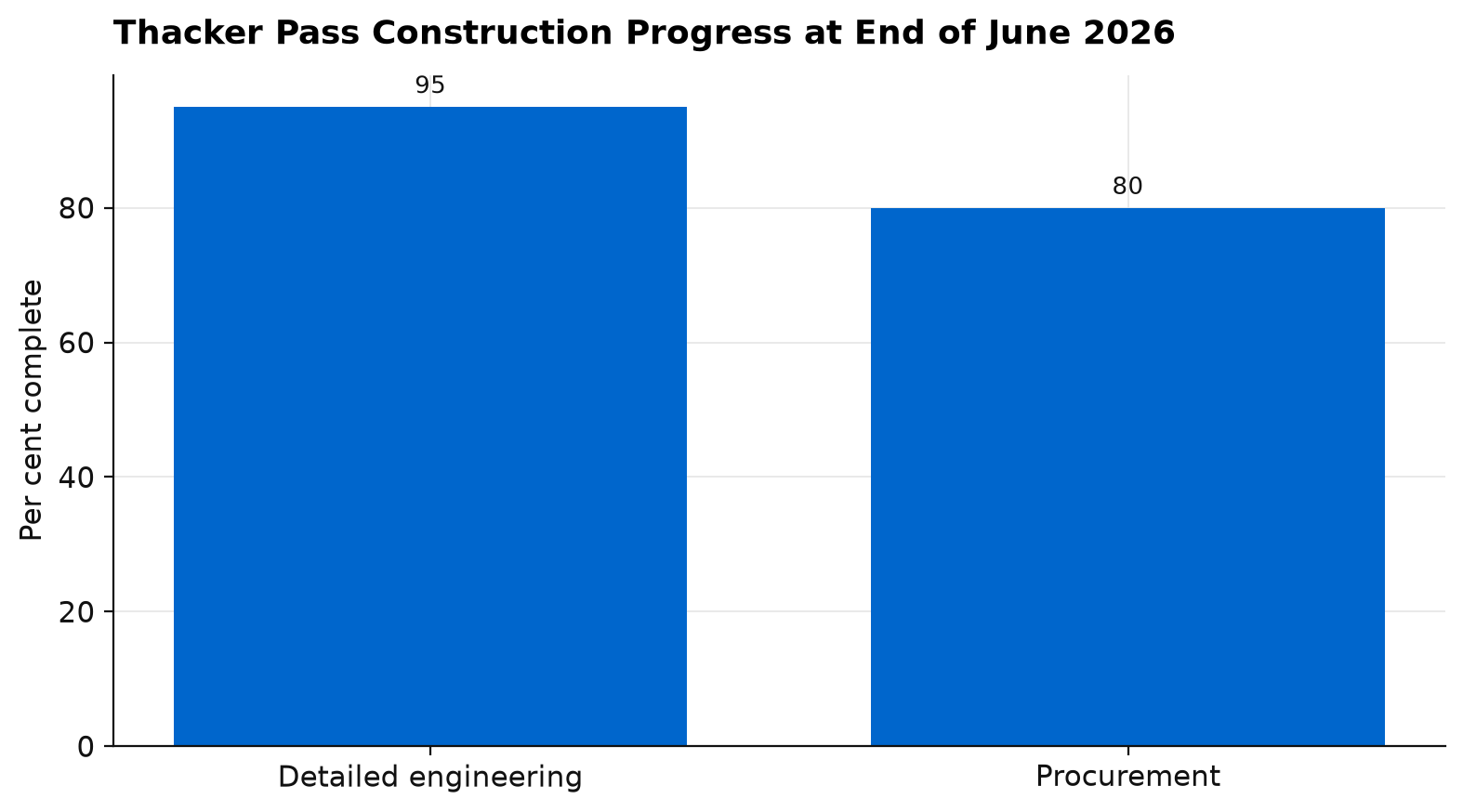
Construction is advancing. At the end of June 2026, detailed engineering was 95 per cent complete and procurement was more than 80 per cent complete. Mechanical completion, the point where the plant is physically built and ready for testing, is expected in late 2027, with first lithium carbonate production likely in the first half of 2028. Institutional sell-side research takes a slightly more cautious line given the scale of the project. It assumes first production in the second quarter of 2028, a delay of about three to six months, with production ramping up to about 80 thousand tonnes a year by 2034, measured in lithium carbonate equivalent (LCE), the industry’s common unit for lithium output.
After an update to the mineral resource estimate in mid-2025, Thacker Pass now contains the largest measured lithium resource globally. That supported a doubling in the project’s planned production capacity to 160 thousand tonnes a year of LCE over four phases, and an increase in the life of mine to 85 years, which sets how long the royalty can pay.
The operator is aiming for a definitive capital estimate by the end of the third quarter of 2026. The last estimate for Phase 1, which covers 40 thousand tonnes a year of lithium, was US$2.93 billion, from a technical report in January 2025. Deterra pays none of the construction bill, though a higher cost could slow decisions on later phases and with them growth in the royalty income.
The royalty is set to reduce to about 1 per cent after the exercise of a partial royalty buyback, under which part of the royalty is repurchased for about US$13 million paid to Deterra. That would put cash in Deterra’s hands but shrink its share of future lithium revenue, and Thacker Pass will not change the earnings picture in FY27.
Valuation and the Hold Rating
Institutional sell-side research left its 12 month price target unchanged at A$4.60 after the result. That target is about 11.7 per cent above the share price of A$4.12 when this research was published. The research describes the valuation as attractive and the dividend yield as supportive, but sees a lack of near-term growth, with EBITDA forecast to fall by about 10 per cent next year and Thacker Pass not due to produce until 2028.
Over the past 12 months Deterra has paid 23.2 cents per share in dividends, a trailing yield of 5.6 per cent at A$4.12, and those dividends are fully franked. Franking means the company has already paid Australian tax on the profit, and shareholders receive a credit for that tax, which can be valuable for SMSF trustees. Institutional sell-side research sees Deterra’s dividend yield as broadly in line with the major iron ore producers, BHP, Rio Tinto and Fortescue.
Iron ore price strength, higher shipments from Mining Area C or a well-priced acquisition could all lift earnings and the dividend. In its Hold rating, the research weighs the attractive valuation against the forecast fall in FY27 earnings.
Key Risks
Further iron ore price weakness would lower both earnings and the dividend, and a stronger Australian dollar and higher freight costs are also listed as downside risks. Shipment volumes from Mining Area C are set by the operator, BHP, and lower volumes would reduce royalty income. Acquisitions are an execution risk, since a value and earnings dilutive deal funded from the undrawn debt would hurt existing holders. Thacker Pass has its own execution risk, with any delay in the mining and processing ramp-up pushing lithium income further out, and the definitive capital estimate still pending. The exercise of the partial royalty buyback would cut the Thacker Pass royalty to about 1 per cent, shrinking the long-term lithium upside.
Our View
Deterra collects a royalty on revenue from a major iron ore operation, and its balance sheet improved sharply over the year. Under the 75 per cent payout policy, the dividend follows earnings, which are forecast to fall in FY27.
Our watch points are the Thacker Pass capital estimate, due by the end of the third quarter of 2026, which will show whether the project’s timetable and later phases look achievable, and how management uses its undrawn debt, where a bolt-on with long-life income would expand the royalty base.
If you would like to discuss Deterra Royalties, request a callback or call us on 1300 889 603.
Financial Summary
Become an authorised representative
Advise your clients under an established AFSL without building your own. Choose AR or CAR.
Become an AR or CAR