

Sell
Bank of Queensland is a licensed Australian bank based in Brisbane that serves personal, small business and niche professional customers through several retail brands across the country.
Institutional sell-side research rates it Sell because the strong second half came mostly from rising interest rates, with deposit rates lagging, and that margin boost is expected to fade as deposit rates catch up. The retail bank is still shrinking, and group return on equity of 6.1 per cent sits well short of the 8 per cent target. Until lending grows again on cheap deposit funding, the research sees no lasting lift in profitability.
- Sell-side rating
- Sell
- Sell-side target
- A$5.90
- Upside to target
- −16.1%
- Initial price
- A$7.0730 Oct 2026
- Last close
- A$7.0318 Nov 2026
Bank of Queensland has delivered an FY26 result that owed most of its strength to interest rates. A sharp rise in interest rates over the second half pushed its net interest margin, the gap between what the bank earns on loans and what it pays for funding, up to 1.73 per cent, and that helped pre-provision operating profit grow 8 per cent on the previous half. Costs fell and fee income from a new partnership beat guidance, but the core retail bank kept shrinking through the year. Institutional sell-side research has Bank of Queensland rated Sell with a 12 month price target of A$5.90, about 16.5 per cent below the share price of A$7.07 when this research was published. The research expects the rate benefit to fade over the next year or two, and until the retail franchise starts growing again it struggles to see a lasting lift in profitability.
Research published 30 October 2026. Price target and upside based on prices at time of publication.
Table of contents [hideshow]
About Bank of Queensland
Bank of Queensland, known as BOQ, is a licensed bank listed on the Australian Securities Exchange and headquartered in Brisbane. It is a second-tier bank, smaller than the major banks, and it was traditionally centred on retail and small and medium business customers in Queensland. Since the 1980s it has expanded beyond its home state, first through a franchise model in which branches were run by owner-managers, and later through acquisitions. Today BOQ runs a multi-brand strategy, including three Retail brands, and serves personal customers, small and medium businesses and niche professional segments across Australia. The group reports through a Retail division, which holds most of its home lending and household deposits, and a Business division. Its financial year ends in August, so FY26 covers the twelve months to August 2026.
Rising Rates Drove the Second Half Result
BOQ reported FY26 cash earnings of A$325 million. Cash earnings is the profit figure banks prefer to highlight, because it strips out some accounting items that do not reflect day to day trading. That number was 1.3 per cent above the institutional sell-side forecast of A$321 million, but 2.7 per cent below the market consensus of A$334 million. The final dividend was in line with the sell-side forecast. The miss against consensus came mainly from bad debts, with the second half bad and doubtful debt expense, the money a bank sets aside for loans it expects will not be repaid, at A$34 million against consensus of A$25 million. The result also showed some deterioration in asset quality in housing and consumer lending, and in commercial asset finance outside equipment finance.
Before bad debts the result was solid, with pre-provision operating profit, or PPOP, up 8 per cent on the previous half. PPOP is the profit a bank makes from lending and fees after costs but before it sets aside money for bad loans. Revenue rose 2 per cent over the half while operating expenses fell 1 per cent. Revenue was also a modest 0.4 per cent ahead of consensus.
The driver of that revenue was the net interest margin, or NIM, the gap between the interest a bank earns on its loans and investments and the interest it pays on deposits and other funding, measured against the assets that earn that interest. Second half NIM rose 6 basis points to 1.73 per cent, against consensus of 1.69 per cent. A basis point is one hundredth of a percentage point.
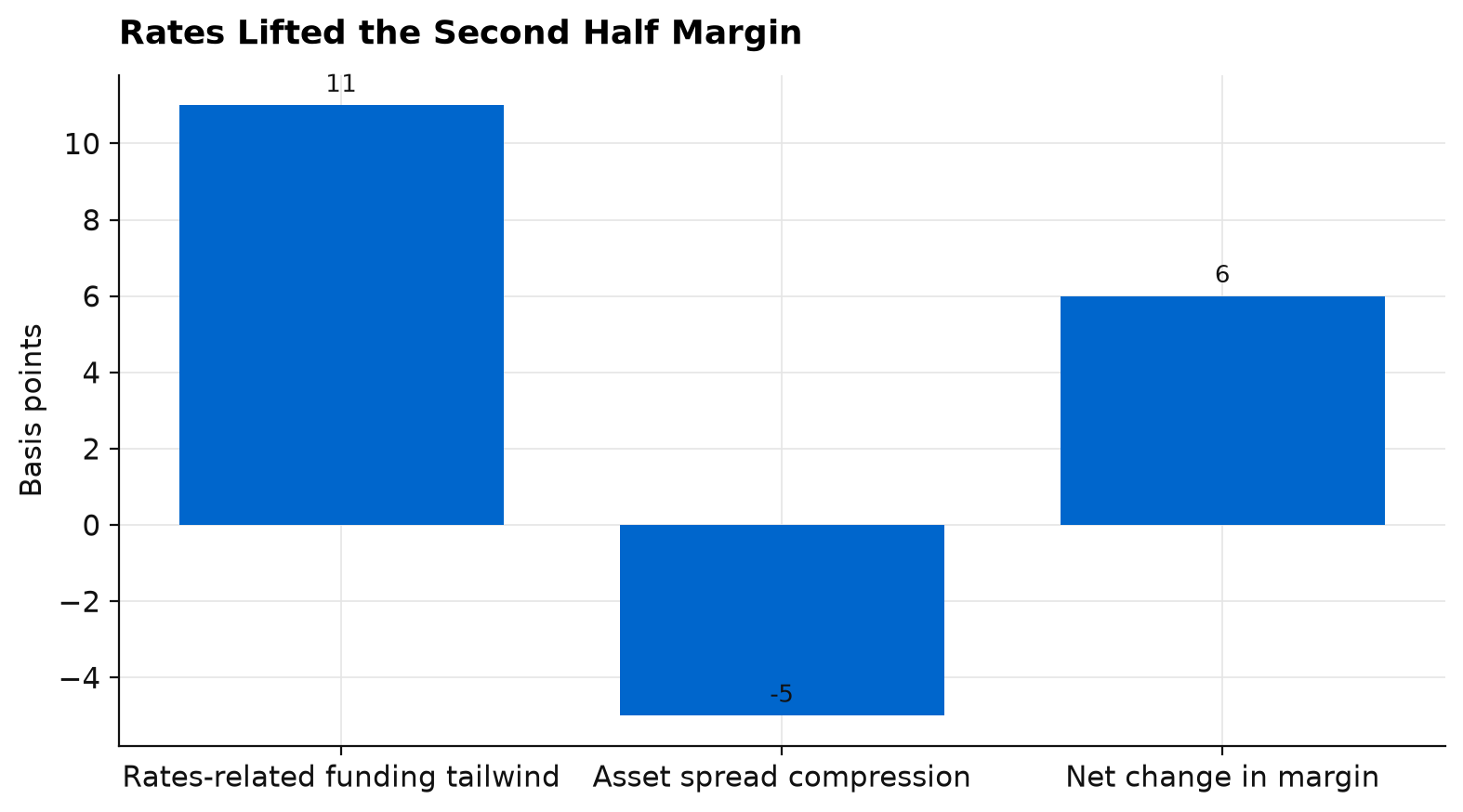
Behind the 6 basis points of improvement, rates-related tailwinds added 11 basis points to the margin, outpacing 5 basis points of asset spread compression from competition. Asset spread compression means lenders cutting the rates they charge new borrowers to win business, which cuts what they earn on loans. The 11 basis point gain came from the funding side of the balance sheet. Over the half, short and long term interest rates rose sharply, while the rates BOQ paid on term deposits and at-call savings accounts lagged behind. A small part of the gain, 1 basis point of the 11, came from relying less on wholesale funding after the sale of the equipment finance loan book.
Two other parts of the result were also better than expected. Other operating income, which covers fees and other revenue that is not interest, beat estimates by around 3 per cent, helped by an A$14 million uplift in fee income from the Challenger capital partnership, ahead of the A$8 million to A$10 million management had originally guided. Costs were also well controlled, with underlying operating expenses down 1 per cent on the previous half, supported by A$60 million in annual productivity benefits that offset structural cost inflation and the cost of converting branches, which the research calls sector-leading cost discipline. Competition for new mortgages and business loans was still a headwind, though less severe than investors had expected. The research sees that as an industry-wide trend that should also support other lenders.
Why the Margin Boost Should Fade From Here
The institutional sell-side research does not expect the second half margin to last. The funding benefit came from deposit rates lagging a sudden rise in the yield curve. The yield curve is the line you get when you plot interest rates for different borrowing periods, from very short terms out to several years. When rates rise quickly, banks that are slow to lift deposit rates enjoy a wider margin for a while. The benefit ends once deposit rates catch up or market rates turn back down.
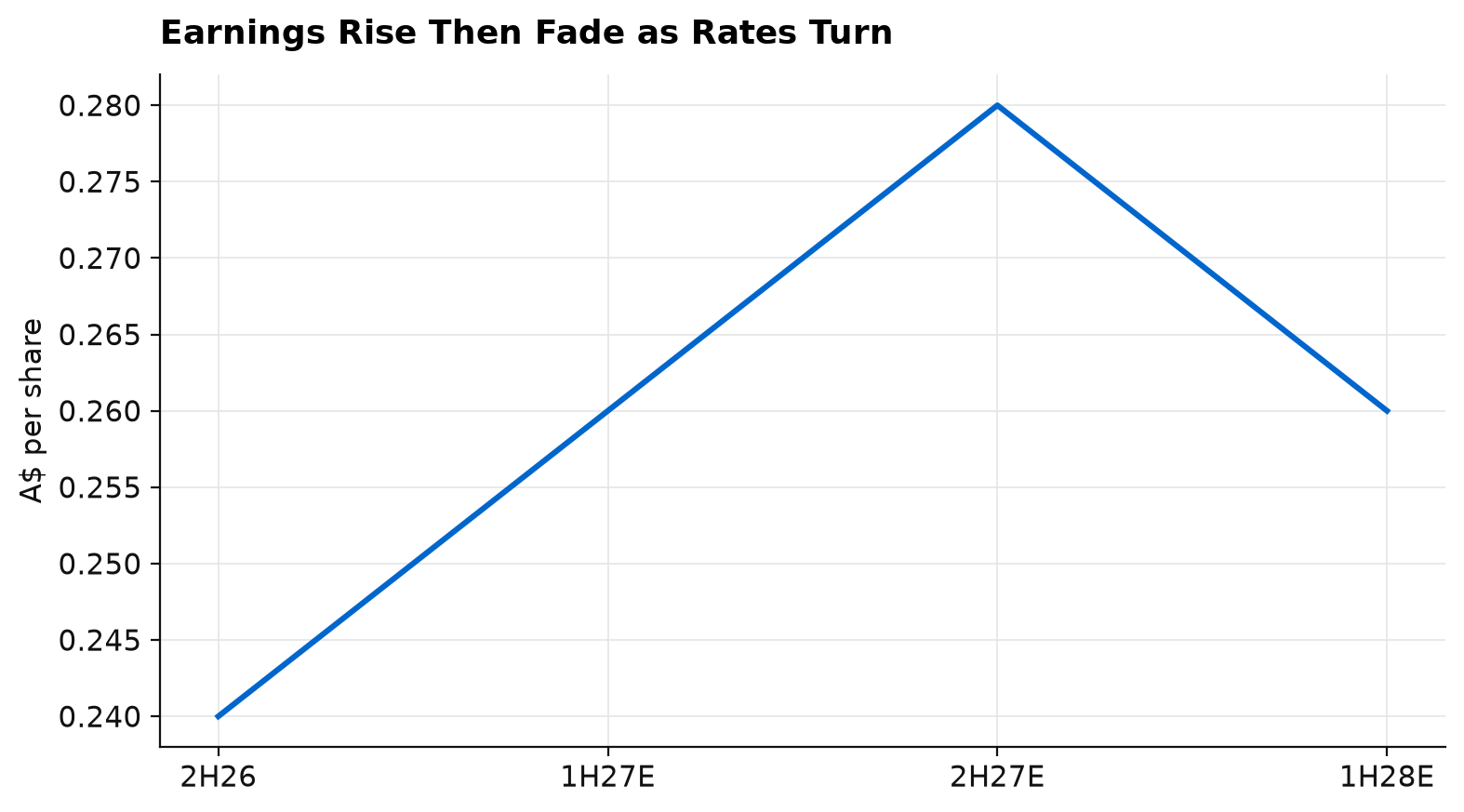
The Reserve Bank of Australia is approaching the end of its tightening cycle, and market pricing is contemplating rate cuts in late 2027. At the same time, deposit rates are already catching up. BOQ itself is pushing deposit rates higher to attract the fresh funding it needs to restart loan growth in the first half of FY27, or 1H27. The research expects the funding benefit to the margin to fall back to zero basis points in 1H27, and without a further unexpected upward shift in rates, it sees the benefit as transitory.
Banks also hold a replicating portfolio, a set of interest rate hedges that locks in rates over several years and rolls over gradually, so the income earned on deposits and capital adjusts slowly when rates change. Because those hedges reset over time, the recent sharp rise in the 90-day bank bill swap rate, a key short-term benchmark for bank funding, and in 3-year and 5-year swap rates should lift the portfolio’s contribution in 1H27, consistent with company commentary. That should temporarily offset pressure on asset spreads and steady the funding side of the margin. But the research expects this support to fade as well once rates start to fall.
A rules-based approach to leveraged ETFs
See how our quantitative strategy works and who it suits.
Explore the strategyBecome an authorised representative
Advise your clients under an established AFSL without building your own. Choose AR or CAR.
Become an AR or CARThe research expects margins to rise modestly in the next period and then decline as rates fall. Its FY27 margin forecast has gone up by 5 basis points, reflecting a favourable funding and asset mix and the replicating portfolio, partly offset by funding-side pressure emerging in the second half of FY27 as rates are forecast to fall. That leaves net interest income, the dollar profit from lending, 1 per cent higher in FY27 but 2 per cent lower in FY28. Total revenue forecasts are up 1 per cent in FY27 and down 1 per cent in FY28.
The research has also raised its bad debt assumptions by 5 basis points in FY27 and 4 basis points in FY28, toward more normal levels. Its FY27 forecast is in line with management’s guidance for a flat bad debt expense of A$54 million, and management has guided to a long-run bad debt expense of 8 to 9 basis points. Total provisions fell 11 per cent over the year, largely because of two portfolio sales. Collective provisions, the general buffer a bank holds against future losses across the whole loan book, fell 12 per cent after the sale of the ME unsecured lending portfolio and the whole-of-loan sale of equipment finance. Excluding those sales, collective provisions rose by just A$2 million. With bad debt charges guided flat while average loans are expected to grow, provision coverage is set to decline.
Together, these changes lower cash earnings per share forecasts by 1 per cent in FY27 and 6 per cent in FY28, and cash earnings by 1 per cent and 5 per cent respectively. Net income is now forecast at A$335.1 million in FY27, down from A$339.1 million previously, then A$321.7 million in FY28, down from A$339.9 million, before recovering to A$338.2 million in FY29. Earnings per share fell 18.5 per cent in FY26 and is forecast to rebound 14.5 per cent in FY27 to A$0.54, before slipping 2.3 per cent to A$0.52 in FY28 and edging up 3.3 per cent to A$0.54 in FY29. After the FY27 bounce, the research expects earnings to be roughly flat for the following two years.
The Retail Bank Is Still Shrinking
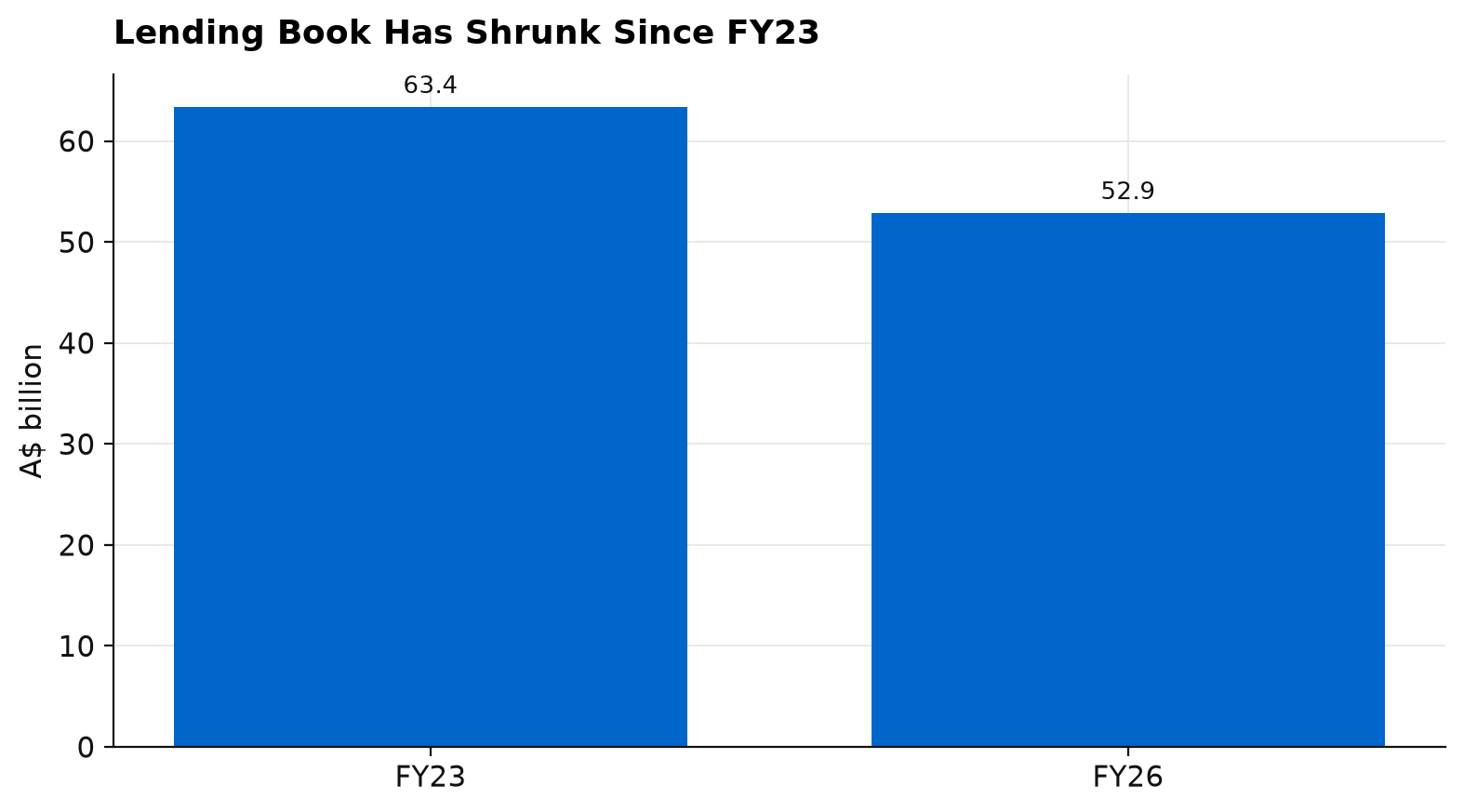
The core retail franchise holds most of the home loans and household deposits, and it has been shrinking for years. In FY26 the retail mortgage portfolio contracted by A$3.2 billion, alongside a A$2.1 billion runoff in customer deposits. The lending book has declined over the past four years, from A$63.4 billion in FY23 to A$52.9 billion in FY26. Retail deposits have kept falling too, reflecting a lower funding requirement and term deposits rolling off.
This is why group returns are weak. Return on equity, or ROE, measures how much profit a company earns for every dollar of shareholders’ capital it uses, and it tests whether a bank earns enough on the capital it ties up. BOQ’s group ROE, excluding notable items, fell from 6.4 per cent in FY25 to 6.1 per cent in FY26, even though rates were helping that year. Management remains committed to lifting ROE above its 8 per cent target, but the research notes little detail on how and when that will happen, so visibility is limited. Within the group, the Business division is faring better, while the Retail division’s returns continue to weigh on the whole.
The research’s broader concern is that several BOQ business segments are not earning a sufficient return on the equity they use. That raises the possibility of a more meaningful strategic change down the track, which could mean materially shrinking the balance sheet and the capital employed in favour of more capital-light income streams. The research also believes consolidating the three Retail brands would help simplify the business and improve the division’s returns.
For the first time in four years, BOQ intends to grow its housing lending in FY27, although at a slower pace than the overall market, which banks describe as below system growth. That growth needs deposits to fund it, and the recent investment in its digital platform should help it gather them. The research sees the key test as whether the bank can fund new lending with low-cost deposits. If it has to rely on expensive, rate-sensitive funding, the extra lending adds little to profit. Until there is evidence it can do this, the research does not expect group profitability to lift materially.
Average interest-earning assets, broadly the loans and other income-producing assets the bank holds over the year, have been cut by 2 per cent over the next two years on weaker housing credit, partly offset by stronger business lending. Other operating income has been cut 3 per cent in FY27 to reflect the run-rate of fee income from the Challenger partnership, then lifted 3 per cent in FY28. Operating expense forecasts are 2 per cent lower over the next two years, thanks to productivity gains from decommissioning the ME platform, the Capgemini partnership and other projects.
Valuation and Why the Target Sits Below the Share Price
Institutional sell-side research has lowered its 12 month price target to A$5.90, about 16.5 per cent below the share price of A$7.07 when this research was published. The cut reflects lower expected cash earnings over the longer term and lower earnings in FY28. In the research’s view, the strong second half was largely a product of rates moving sharply, and the funding benefit behind the margin beat should fade as deposit rates catch up and the rate cycle turns. It also notes that the retail bank continues to shrink, holding group ROE at 6.1 per cent, well short of the 8 per cent target, with little visibility on how the gap closes. As credit quality normalises, lifting ROE becomes harder, and bad debt charges are already moving back toward more normal levels.
Over the past twelve months BOQ has paid A$0.55 per share in dividends, which works out to a trailing dividend yield of 7.8 per cent, fully franked, at the A$7.07 share price. The research sees BOQ as more exposed to dividend cuts and capital raises if credit conditions deteriorate, with earnings forecast to go roughly sideways after FY27.
The research would want to see BOQ grow lending, fund that growth cheaply and lift returns toward its target, and the latest result showed lending and deposits still falling. It prefers to wait for tangible signs of an operational turnaround, and with the share price well above the A$5.90 target and the rate tailwind set to fade, institutional sell-side research rates BOQ a Sell.
Key Risks
The research would turn more positive, and the A$5.90 target could prove too low within the next 12 months, on faster progress in the business model and balance sheet transformation, such as a return to housing growth funded by low-cost deposits, on significantly improved pricing in key markets such as Retail Banking, or on a material positive change in key economic indicators, which would help credit quality and loan demand. A further unexpected rise in the yield curve would also extend the funding benefit that drove the second half. In our view, productivity gains from the ME platform decommissioning and the Capgemini partnership, along with fee income from the Challenger partnership, could also come in ahead of plan again.
Our View
In our view, this result mainly reflects the interest rate cycle. BOQ cut costs and earned more from the Challenger partnership than it had guided in FY26, but the 6 basis point margin gain came from deposit rates lagging the market, while retail lending and deposits kept falling.
To judge whether the 7.8 per cent fully franked trailing yield can hold, we would watch over the next two halves whether housing lending returns to growth in FY27, whether that growth is funded by low-cost deposits, and whether group ROE starts moving from 6.1 per cent toward the 8 per cent target.
If you would like to discuss Bank of Queensland, request a callback or call us on 1300 889 603.
Financial Summary
Become an authorised representative
Advise your clients under an established AFSL without building your own. Choose AR or CAR.
Become an AR or CAR