

Hold
Ramsay Health Care is the largest private hospital operator in Australia, with additional hospital, imaging and primary care operations in the United Kingdom, France and the Nordic countries.
Institutional sell-side research rates it Buy because margins at its European business have risen by around 80 basis points over two years despite tight French funding, while debt has come down. Group net debt to EBITDA is forecast to fall from 4.4 times in FY26 to 3.6 times by FY29. Most of the forecast earnings growth sits in FY28 and FY29, so delivery of that growth drives the Buy case.
- Sell-side rating
- Buy
- Sell-side target
- A$54.10
- Upside to target
- +1.0%
- Initial price
- A$54.706 Oct 2026
- Last close
- A$53.5818 Nov 2026
Initial Buy based on A$54.70. Now Hold since 30 Oct 2026: the price passed the A$54.10 target.
Ramsay Health Care has spent the last two years cutting costs and paying down debt, and Ramsay Sante, the group’s European business that runs its French hospitals and Swedish primary care, used its recent investor day to show what that work has delivered. The EBITDA margin, which measures earnings before interest, tax, depreciation and amortisation as a share of revenue, has expanded by around 80 basis points over that period once temporary grants are stripped out, despite tight French hospital funding, and the balance sheet has been deleveraged at the same time. Institutional sell-side research has Ramsay Health Care rated Buy with a 12 month price target of A$54.10, about 1.1 per cent below the share price of A$54.70 when this research was published. The research’s Buy case depends on earnings recovering over several years as margins widen and debt falls.
Research published 6 October 2026. Price target and upside based on prices at time of publication.
Table of contents [hideshow]
About Ramsay Health Care
Ramsay Health Care is the largest private hospital operator in Australia, and it also has operations in the United Kingdom, France and the Nordic countries. The Australian business generates around 70 per cent of group EBIT, or earnings before interest and tax, after adjusting for the minority stake in Ramsay Sante. Ramsay Sante’s own plans cover French hospitals, imaging and primary care in Sweden. The company is listed on the Australian Securities Exchange under the code RHC and reports on a financial year ending in June. Institutional sell-side research expects an ageing population and public hospital capacity investment that has lagged demand to support long-term organic growth for the private hospital sector. Overcapacity in the private sector has weighed on operator profitability, however, and the research forecasts margins to improve as that supply normalises.
Margins Are Rising in a Tight Funding Environment
Over the last two years, Ramsay Sante has lifted its EBITDA margin by around 80 basis points, excluding temporary grants, which are not expected to last. A basis point is one hundredth of a percentage point, so 80 basis points is close to a full percentage point. The gain came while funding was tight, with French private hospital tariffs failing to fully reflect inflationary costs.
Temporary staff costs, the extra a hospital pays to fill shifts with short-term workers who are not permanent staff, fell by around 62 per cent between FY24 and FY26. Medicine day care revenue grew about seven times between FY21 and FY26, including around 30 per cent growth over the last 12 months, and day cases in France rose about 30 per cent over the same 12 months. A day case is a treatment where the patient is admitted and discharged on the same day, without an overnight stay.
Management has guided to a flat EBITDA margin in FY27, mainly because it is cautious about tariff changes in France. That caution outweighs a full year of the improved St Goran contract and the ongoing rollout of higher margin growth initiatives, both of which would otherwise push margins higher.
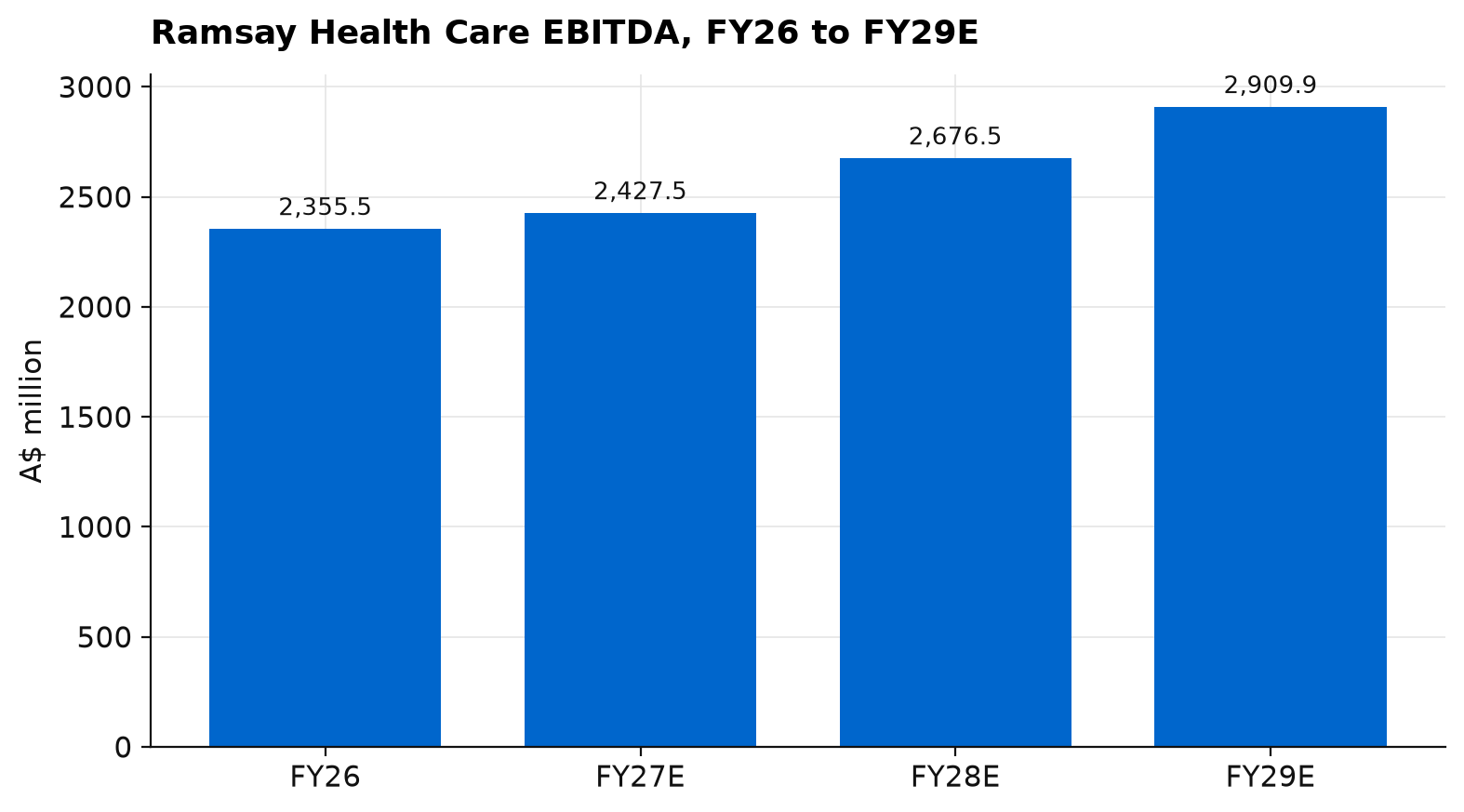
Further out, management’s longer-term guidance points to around 3 per cent revenue growth and gradual margin improvement in FY29, which institutional sell-side research describes as broadly in line with its forecasts, with the key initiatives largely building on progress to date. The research forecasts group EBITDA rising from A$2,355.5 million in FY26 to A$2,427.5 million in FY27, A$2,676.5 million in FY28 and A$2,909.9 million in FY29, on revenue climbing from A$18,690.3 million in FY26 to A$19,048.6 million, A$20,138.6 million and then A$21,166.1 million in FY29. In those forecasts FY27 is a year of modest progress while French tariffs are worked through, with most of the earnings growth expected in FY28 and FY29.
France Is Leaning Harder on Its Private Hospitals
France was the main focus of the investor day, and private hospitals there are paid DRG tariffs, which are set prices for each type of treatment, grouped by diagnosis. The company’s own data shows that private sector DRG tariff rates have not fully reflected inflationary costs.
Medicine, surgery and obstetrics activity, the core of what hospitals do and often shortened to MSO, continues to grow in volume terms according to company data. On the funding argument, management pointed to the growing importance of the private hospital sector, which delivers around 35 per cent of hospital activity in France while receiving around 18 per cent of total funding.
A rules-based approach to leveraged ETFs
See how our quantitative strategy works and who it suits.
Explore the strategyBecome an authorised representative
Advise your clients under an established AFSL without building your own. Choose AR or CAR.
Become an AR or CAR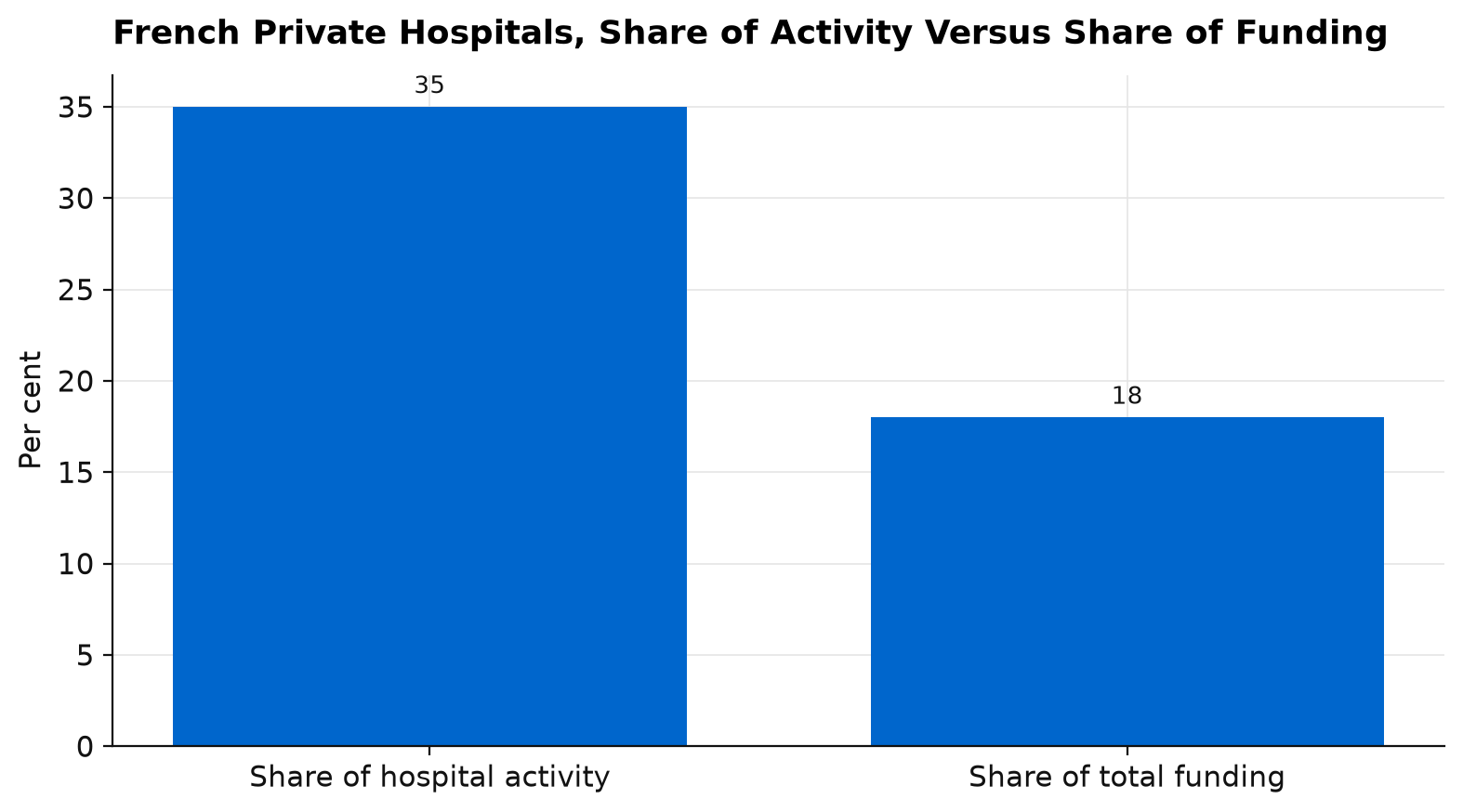
The company also pointed to the public hospital deficit, which it says has widened over the last few years. In our view, a growing public deficit alongside a private sector that delivers a large share of activity on a small share of funding strengthens the private operators’ hand in funding talks, although there is no guarantee this translates into better tariffs, and the timing of any change is not in the company’s hands.
The Australian business remains the main earnings driver, at around 70 per cent of group EBIT after the adjustment described earlier, while the French tariff outcome is the main swing factor in the near-term guidance. A better tariff outcome than management is assuming would be upside to the flat FY27 guide, and a worse one would delay the margin recovery.
A Cleaner Balance Sheet and a Road Map to 2030
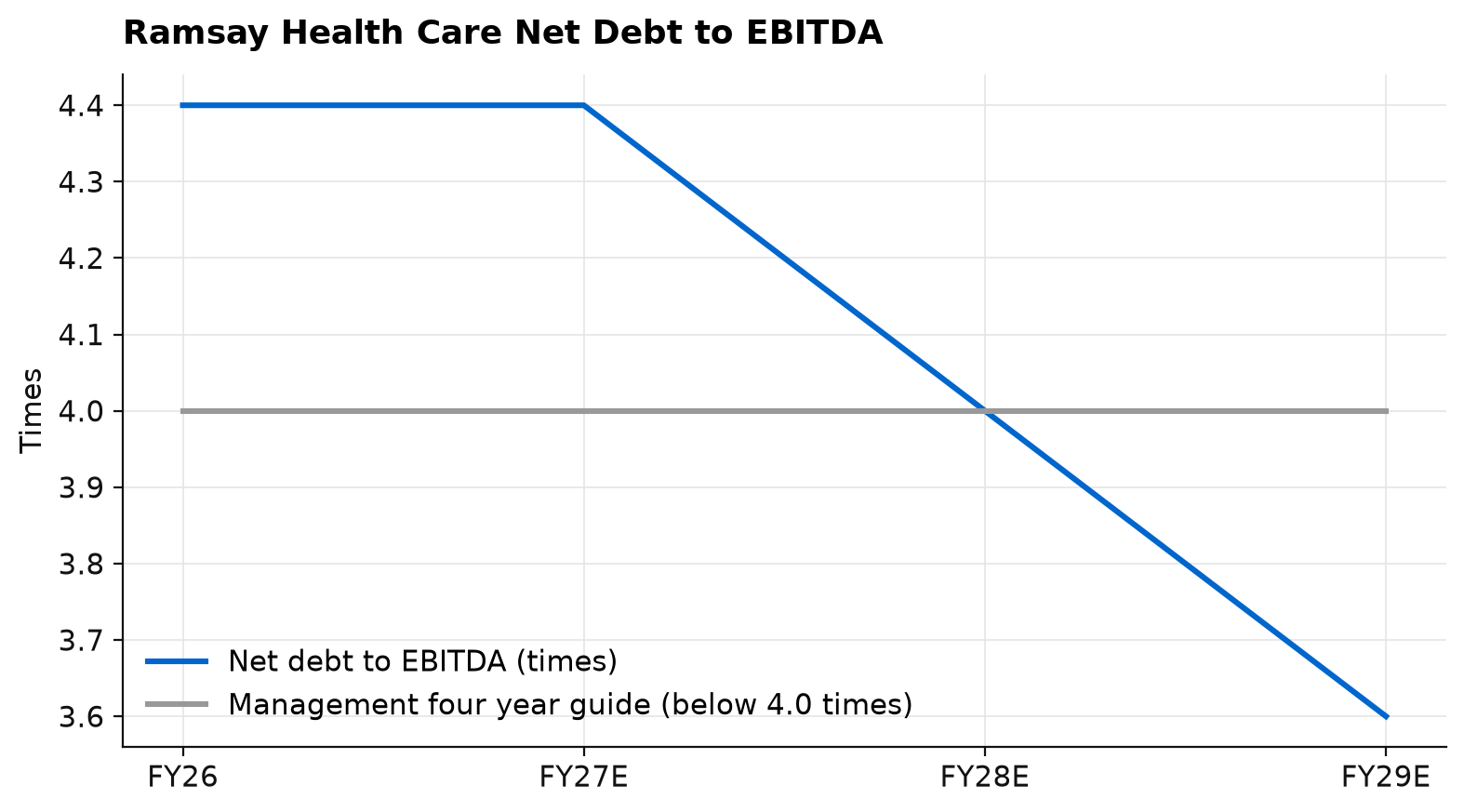
Ramsay Sante has also been deleveraging, meaning it is reducing debt relative to the earnings available to service it. The usual yardstick is net debt to EBITDA, which compares what the company owes, less its cash, with one year of operating earnings, so a lower number means the debt load is easier to manage. The group-level figure includes lease obligations, so it captures more than bank borrowing alone.
Ramsay Sante’s management has guided for its net debt to EBITDA to fall below 4.0 times as part of its four year outlook. For the group as a whole, institutional sell-side research has the ratio at 4.4 times in FY26 and FY27, easing to 4.0 times in FY28 and 3.6 times in FY29. Leverage holds steady in FY27 as margins stay flat, then the ratio improves as EBITDA grows in FY28 and FY29. The research reads this trajectory, together with the revenue and margin outlook, as a sign of limited appetite for large scale mergers and acquisitions.
Management’s 2030 road map extends work already under way and has three earnings drivers: further growth of day cases in France, the area that grew about 30 per cent over the last 12 months; accelerating imaging capabilities, meaning scans and diagnostic services; and scaling up primary care in Sweden, which management describes as capital light, meaning the business can grow without large upfront spending on buildings or equipment.
Management expects digital tools to support all three, and internal referrals, where a patient seen in one part of the group is referred to another part of it, rose from under 5 per cent in 2018 to around 20 per cent in 2025, which keeps more revenue in-house.
Valuation and Why the Case Rests on Earnings
The 12 month price target of A$54.10 compares with the A$54.70 close on 6 October 2026, leaving the target about 1.1 per cent below the share price.
Institutional sell-side research expects earnings per share, or EPS, of A$1.51 in FY26, rising to A$1.70 in FY27, A$2.25 in FY28 and A$2.67 in FY29. By half, EPS was A$0.71 in the December 2025 half and A$0.80 in the June 2026 half, and the research forecasts A$0.74 in the December 2026 half and A$0.96 in the June 2027 half.
Over the last 12 months Ramsay has paid A$0.91 per share in dividends, which works out to a 1.7 per cent trailing yield at the A$54.70 close, fully franked, so eligible investors receive a credit for the Australian tax the company has already paid on the profits behind it.
Margins improved by around 80 basis points despite tight French funding, with further initiatives still rolling out, and the research forecasts group leverage to fall to 3.6 times by FY29.
With the share price and the target this close, the case rests on the forecast EPS growth being delivered.
Key Risks
Pricing outcomes with insurers are a key risk across the group, and in France a weaker tariff settlement could hold margins down for longer than the flat FY27 guidance assumes. Industry capacity is another risk, as overcapacity in private hospitals has hurt operator profitability before, and the margin recovery depends on supply normalising. Wage inflation could absorb the savings from cutting temporary staff costs. Most of the forecast earnings growth sits in FY28 and FY29 and relies on day cases, imaging and Swedish primary care scaling as planned. Net debt was 4.4 times EBITDA in FY26, so an earnings shortfall would slow the deleveraging the research expects.
Our View
In our view, the investor day showed that the margin gains of the last two years were earned in a difficult funding environment, and that the 2030 plan extends work already under way. We will watch the next French tariff decision and whether the net debt to EBITDA ratio starts falling on schedule.
If you would like to discuss Ramsay Health Care, request a callback or call us on 1300 889 603.
Financial Summary
Become an authorised representative
Advise your clients under an established AFSL without building your own. Choose AR or CAR.
Become an AR or CAR