

Hold
Nick Scali is an ASX-listed furniture retailer with stores across Australia and New Zealand, and its sales tend to follow the housing market.
Institutional sell-side research rates it Hold because first quarter written orders fell 15 per cent and the key Black Friday to Boxing Day period faces tough comparisons. It expects a weaker housing market and has cut FY27 earnings per share to A$0.64 from A$0.88 in FY26. Forecasts sit below consensus and the valuation is above the ten-year average, though the fully franked dividend yield is about 5.7 per cent.
- Sell-side rating
- Hold
- Sell-side target
- A$15.30
- Upside to target
- +18.5%
- Initial price
- A$13.789 Nov 2026
- Last close
- A$12.9119 Nov 2026
Nick Scali‘s first quarter written orders across Australia and New Zealand fell 15 per cent, according to its 21 October trading update. Like-for-like sales were flat for the first five weeks of the quarter, so the last eight weeks or so imply a decline of around 24 per cent. The company now heads into Black Friday and Boxing Day, its most important selling weeks, against tough comparisons from strong promotional trading a year earlier, while institutional sell-side research expects the housing market to weaken further as interest rates rise and house prices fall. Earnings per share forecasts for FY27 to FY29 have been cut by 14 to 27 per cent as a result. Institutional sell-side research has Nick Scali rated Hold with a 12 month price target of A$15.30, about 11.0 per cent above the share price of A$13.78 when this research was published. The trailing dividend yield is about 5.7 per cent, fully franked.
Research published 9 November 2026. Price target and upside based on prices at time of publication.
Table of contents [hideshow]
About Nick Scali
Nick Scali is a furniture retailer listed on the Australian Securities Exchange under the code NCK, with stores across Australia and New Zealand. It tracks customer demand through written orders, and its financial year ends on 30 June. In FY26 it reported revenue of A$516.7 million. Management is targeting a gross margin of 65 to 66 per cent across Australia and New Zealand for FY27. The company updated the market on trading on 21 October and then held its annual general meeting. Over time, its like-for-like sales have moved closely with the Australian housing market, through house prices, housing turnover and mortgage rates.
Written Orders Have Lost Momentum Into the Busiest Weeks
Written orders are the sales customers commit to when they place an order. They become reported revenue later, once the goods are delivered, which makes them the earliest guide to revenue over the next few months. In the first quarter of FY27, written orders across Australia and New Zealand fell 15 per cent.
Like-for-like sales, which compare only stores that were trading in both periods so that new store openings do not flatter the number, were flat over the first five weeks of the quarter. For the full quarter to land at a 15 per cent decline after a flat start, the last eight weeks or so need to have run at around 24 per cent down, an exit rate the research describes as soft.
The research sees lower store traffic, down around 10 per cent, as the likely main driver, and thinks conversion, the share of visitors who go on to place an order, was probably softer as well. Furniture is a large purchase that households can put off when their budgets are under pressure.
Nick Scali now moves into the Black Friday to Boxing Day period, the key sales window of its year. It is lapping tough comparisons, or comps, meaning the same period a year earlier against which this year’s numbers are measured. The prior year included strong promotional trading, which makes growth harder to show this year.
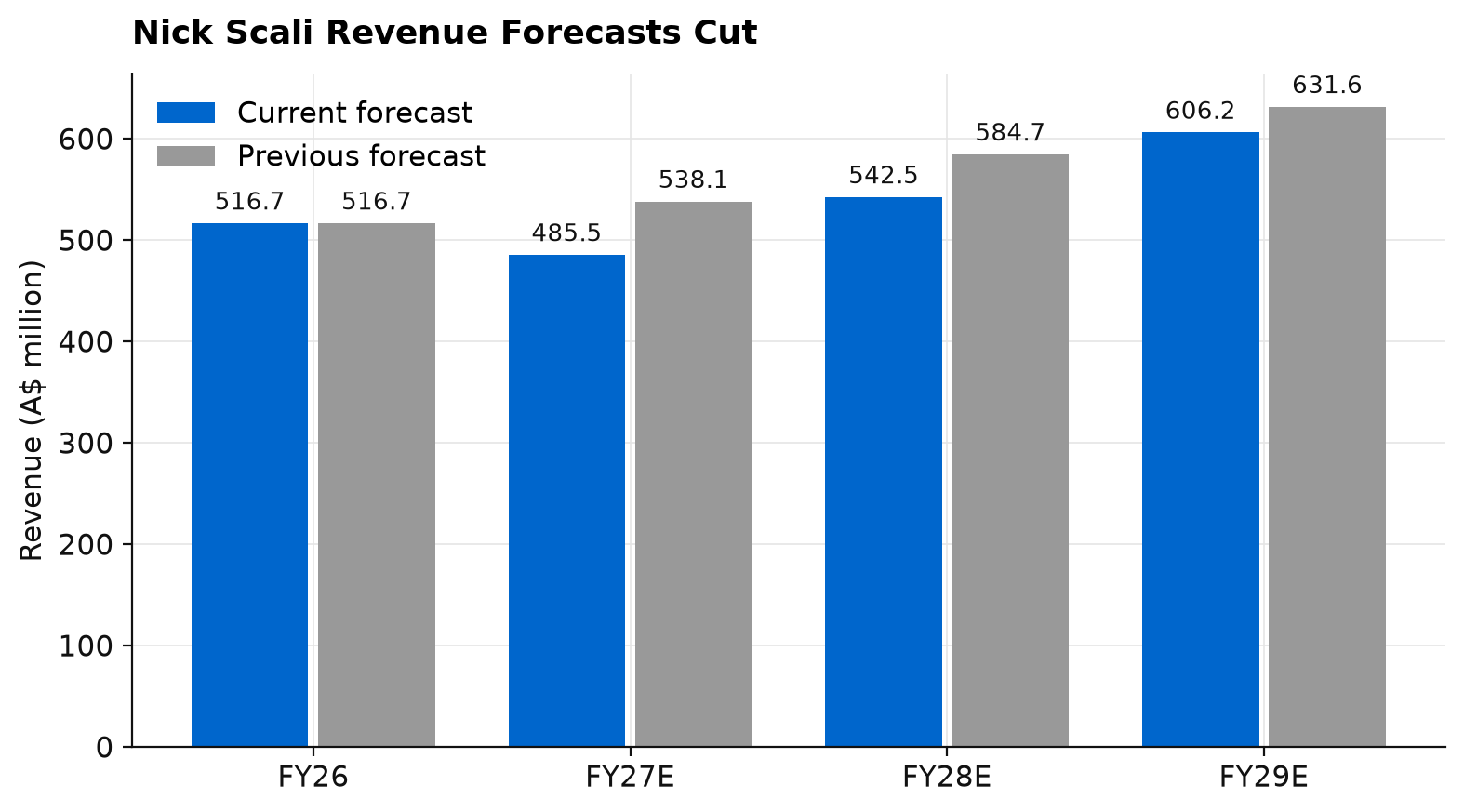
Revenue for FY27 is now forecast at A$485.5 million, down from A$538.1 million previously and below the A$516.7 million the company reported in FY26. Revenue is still forecast to grow to A$542.5 million in FY28 and A$606.2 million in FY29, although both figures sit below the previous forecasts of A$584.7 million and A$631.6 million.
Why Nick Scali Sales Follow the Housing Market
Households tend to buy furniture when they move house, renovate or see their home rise in value, which links furniture spending to the housing market. Spending has tended to rise with house prices and the number of homes changing hands, and to fall when those decline.
A rules-based approach to leveraged ETFs
See how our quantitative strategy works and who it suits.
Explore the strategyBecome an authorised representative
Advise your clients under an established AFSL without building your own. Choose AR or CAR.
Become an AR or CARThe research expresses the link as correlations, which measure how closely two things move together: the higher a positive figure, the more closely they rise and fall together, and a negative figure means they tend to move in opposite directions. Using half-yearly data from 1H07 to 2H19, it found that Nick Scali’s like-for-like sales growth had a 42 per cent correlation with house prices, a 46 per cent correlation with housing turnover, which is the number of homes bought and sold, and a negative 48 per cent correlation with mortgage rates.
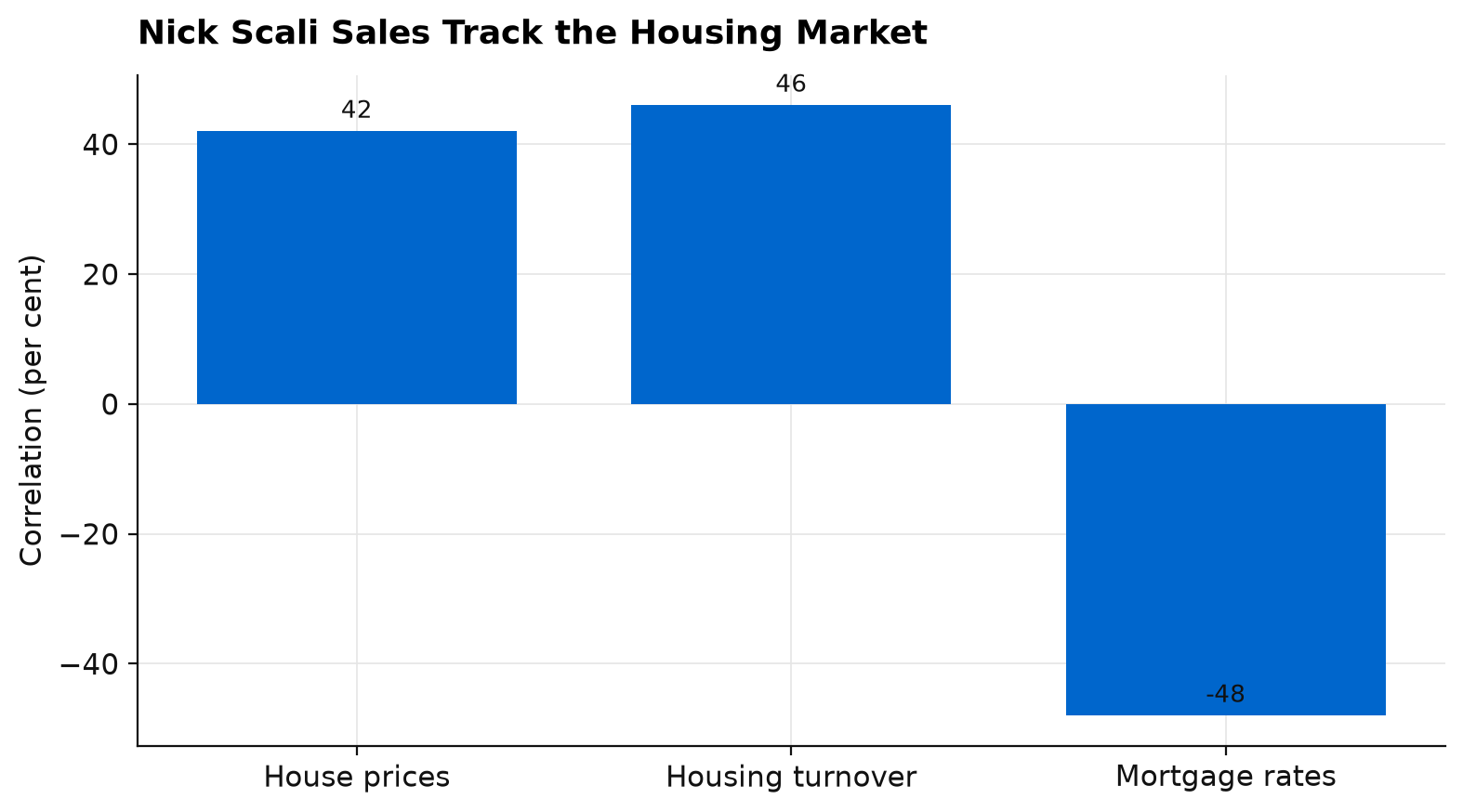
House prices, housing turnover and mortgage rates are all now moving in the direction that has historically gone with weaker sales. Recent capital-city dwelling price data has continued to be revised lower. The research expected a further rate rise in November, ahead of the key Black Friday period, and the Reserve Bank of Australia lifted the cash rate to 4.85 per cent at its November meeting. The research also expects Australian house prices to fall by 9 per cent.
The research argues that the market underestimates how much falling house prices can hurt Nick Scali’s retail sales, and it uses the company’s own New Zealand business as a case study. New Zealand house prices have fallen by around 15 per cent since December 2021. Over FY22 to FY25, Nick Scali’s New Zealand revenue underperformed its Australian revenue by around 15 per cent, which the research puts down in part to those house price falls.
Margins, Freight and Fixed Costs
Gross margin is the share of each dollar of sales left over after paying for the goods sold, before rent, wages and other running costs. The research understands that management has kept gross margin discipline through the period, protecting the profit on each sale while volumes fall, and management is targeting a gross margin of 65 to 66 per cent across Australia and New Zealand for FY27.
Freight costs have moved against the company, with Australia and New Zealand freight up around 50 per cent over the calendar year to date and sea freight rates into Australia and New Zealand up around 55 per cent over the financial year to date. The research’s analysis of the Covid period found a strong negative correlation between freight costs, measured as a share of total costs, and Nick Scali’s gross margins, so margins fell when freight took up more of the cost base, and the research sees the current rise as a modest risk to gross margin.
Operating deleverage has the larger effect on earnings: costs such as store rents, staff and head office do not move much with sales in the short term, so profit falls faster than sales when sales decline. The research says its earnings cuts largely reflect lower written order growth and this deleverage.
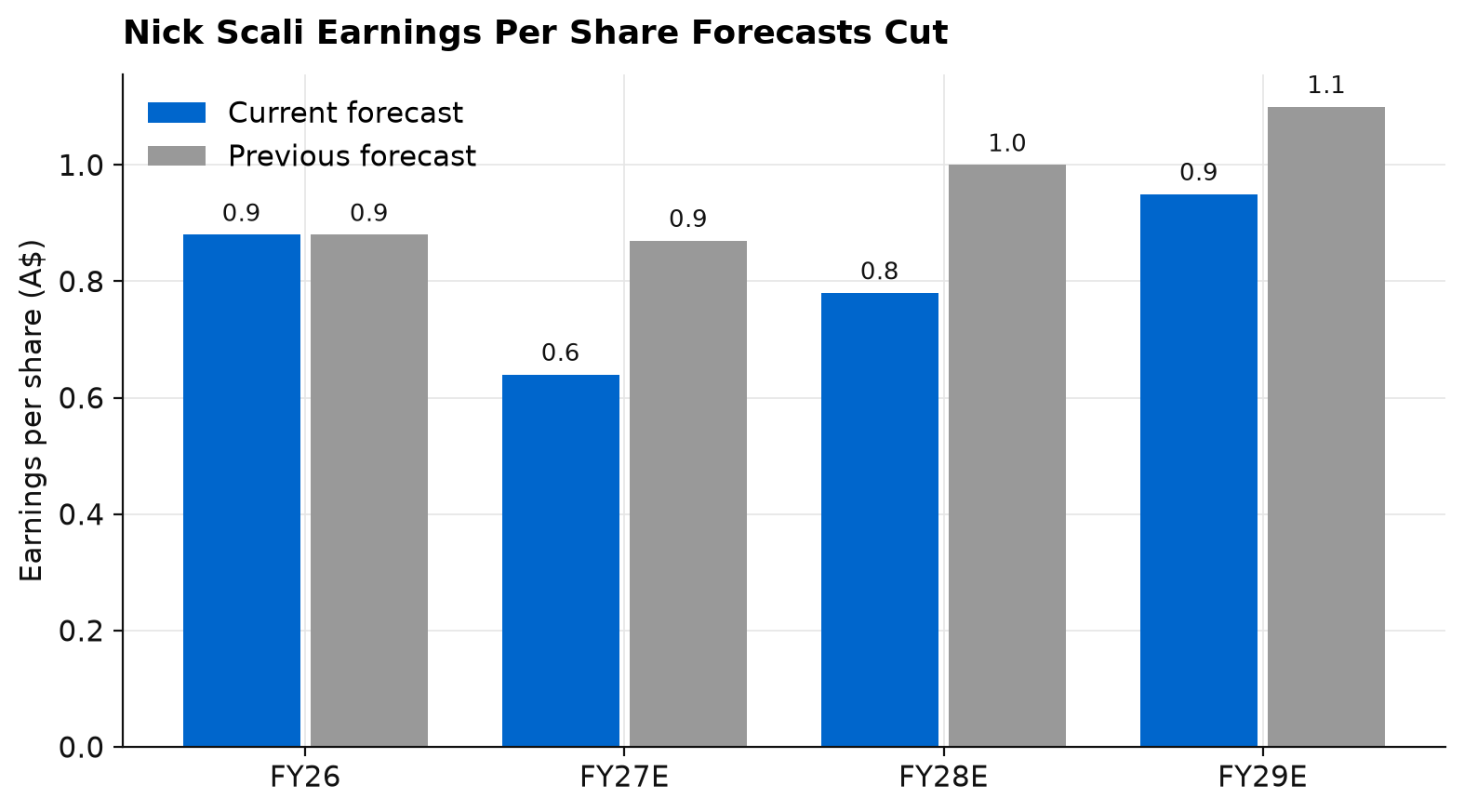
FY26 earnings per share were A$0.88, and FY27 is now forecast at A$0.64, down from A$0.87 previously. FY28 is forecast at A$0.78, down from A$1.00, and FY29 at A$0.95, down from A$1.10. Across FY27 to FY29 the cuts range from 14 to 27 per cent. By half year, the half to June 2026 delivered A$0.40 of earnings per share, and the research expects earnings per share to fall in each successive half, to A$0.33 in the half to December 2026, A$0.31 in the half to June 2027 and A$0.30 in the half to December 2027.
Valuation and Why the Target Came Down
The research lowered its 12 month price target to A$15.30 from A$17.90, in line with its earnings changes, which largely reflect lower written order growth and operating deleverage. The new target sits about 11.0 per cent above the share price of A$13.78 when this research was published.
The Hold rating reflects FY27 earnings per share forecast at A$0.64 against A$0.88 in FY26, forecasts that sit below the rest of the market, and a valuation above the shares’ long-run average. The research’s forecasts are around 8 per cent below consensus for FY27 earnings before interest and tax, or EBIT, and around 3 per cent below for FY28. EBIT is a measure of operating profit before interest costs and tax, and consensus is the average of the forecasts published across the market, so if the research is right, the market’s forecasts would need to come down. The shares trade on a higher price-to-earnings multiple than their average over the past ten years, a bigger premium than other high-quality retailers such as Wesfarmers, JB Hi-Fi and Breville.
The trailing dividend yield is about 5.7 per cent, fully franked, based on A$0.78 of dividends paid over the past 12 months at the share price of A$13.78. Fully franked means the dividends come with credits for company tax already paid, which can reduce the tax an Australian investor pays or be refunded to some investors on low tax rates. The forecasts also show earnings per share rising to A$0.78 in FY28 and A$0.95 in FY29, after the fall in FY27.
Key Risks
On the downside, higher interest rates or house prices falling by more than the expected 9 per cent would push written orders lower again and extend the fall in earnings. The company is also lapping strong promotional trading through the Black Friday to Boxing Day period, and freight costs up around 50 per cent over the calendar year to date are a modest risk to its gross margin target of 65 to 66 per cent. Because much of the cost base is fixed, any further fall in sales would hit profit harder. On the upside, the research’s forecasts already sit below consensus, so a housing market that holds up better than expected could see trading recover faster and earnings come in above these forecasts.
Our View
Nick Scali has held its gross margin through a weak period, which protects the profit on each sale. Its sales have followed the housing market closely, and in New Zealand its revenue lagged Australia over several years while house prices fell. The Hold rating reflects earnings forecasts that fall in FY27 before recovering in FY28 and FY29, a valuation above the shares’ ten-year average and a fully franked dividend.
If you would like to discuss Nick Scali, request a callback or call us on 1300 889 603.
Financial Summary
Become an authorised representative
Advise your clients under an established AFSL without building your own. Choose AR or CAR.
Become an AR or CAR