

Hold
Suncorp is an Australian-listed insurer selling home, motor, business and personal injury cover to households and companies across Australia and New Zealand.
Institutional sell-side research rates Suncorp Hold because the result was solid, with an underlying margin of 11.8 per cent and more capital returned, but home and motor policy numbers did not grow in the second half. Premium growth came from higher prices, which is harder to sustain if industry pricing softens. The FY27 margin is guided slightly lower, New Zealand is softening, and upside and downside look broadly balanced.
- Sell-side rating
- Hold
- Sell-side target
- A$20.50
- Upside to target
- −1.1%
- Initial price
- A$18.9210 Sep 2026
- Last close
- A$20.7318 Nov 2026
Suncorp delivered a full-year result with its core profit margin at the upper end of the company’s target range, guidance for premium growth next year ahead of what the market expected, and more capital going back to shareholders through a special dividend and a new on-market share buyback. Its home and motor policy count did not grow in the second half, though, so premium growth came from higher prices on the existing book. Price-led growth is harder to sustain if industry pricing softens. Institutional sell-side research has Suncorp rated Hold with a 12 month price target of A$20.50, about 8.4 per cent above the share price of A$18.92 when this research was published. Add trailing dividends of A$0.79 per share, a 4.2 per cent fully franked yield, and the total return on offer is fair for a large, mature insurer.
Research published 10 September 2026. Price target and upside based on prices at time of publication.
Table of contents [hideshow]
About Suncorp
Suncorp Group is an insurer operating across commercial and personal insurance in Australia and New Zealand. It is listed on the Australian Securities Exchange and has a June financial year end. The group reports through three divisions. Consumer covers home and motor insurance sold to households. Commercial and Personal Injury covers business insurance through units including Vero, Specialty, Fleet, NTI and a platforms business, along with personal injury lines such as compulsory third party motor insurance and workers compensation. New Zealand includes a direct consumer business under the AA brand and an intermediated business sold through brokers. Suncorp has previously sold its banking arm and has also sold its New Zealand life business, with those sale proceeds supporting its capital position.
Margins Are Holding Near the Top of the Target Range
Insurers are judged mainly on the insurance trading ratio, usually shortened to ITR, which is the profit Suncorp makes from insurance, expressed as a share of the premium it earns. The underlying version strips out swings that are largely outside management’s control in any one year, such as weather costs running above or below budget, so it gives a cleaner read on how the business itself is performing. Suncorp targets an underlying ITR of 10 to 12 per cent. For FY26 it delivered 11.8 per cent, in line with its guidance for the upper end of that range and only a touch below the 11.9 per cent it reported in FY25. The second half came in at 11.9 per cent, slightly ahead of the 11.7 per cent consensus had expected.
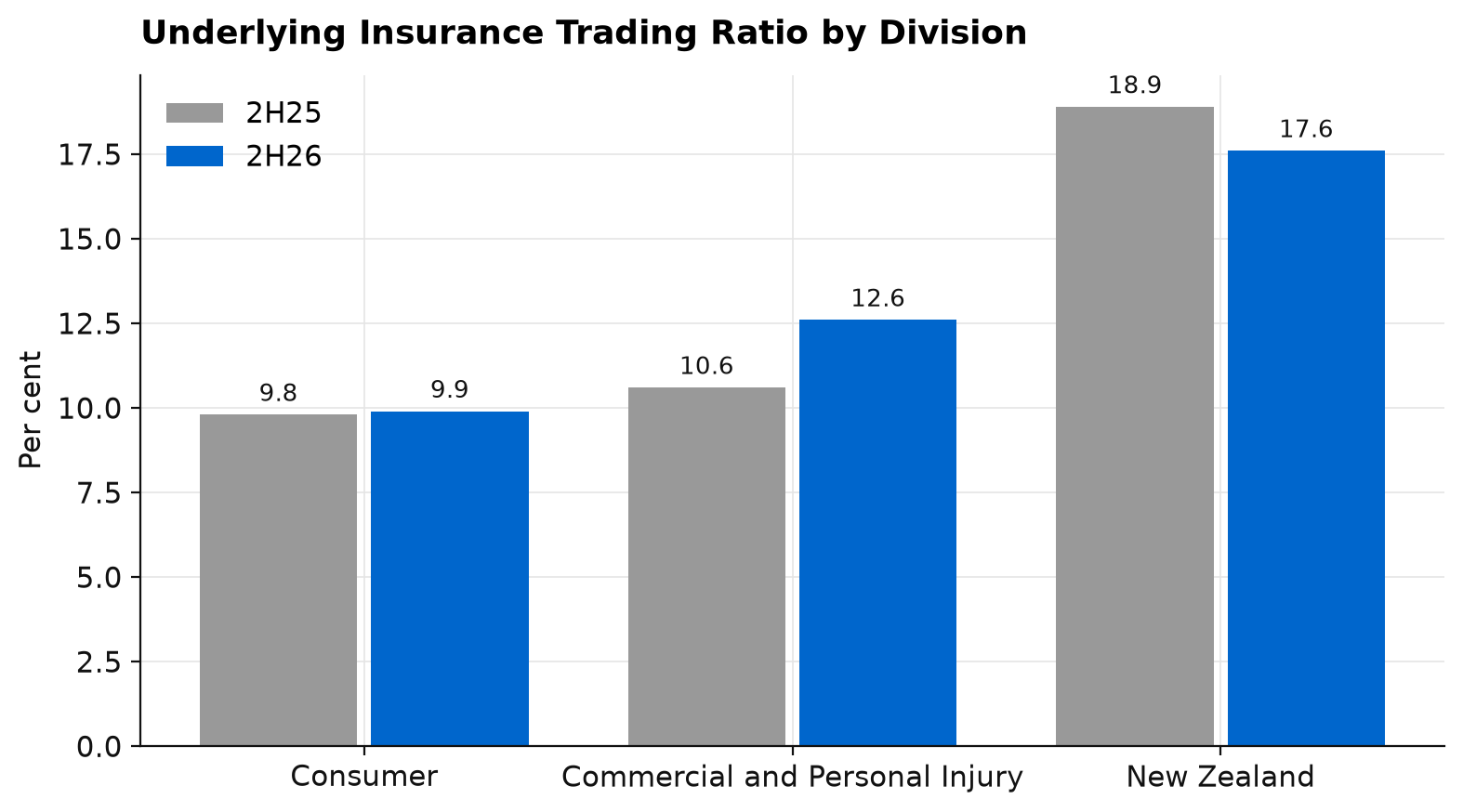
In Consumer, the underlying ITR edged up to 9.9 per cent in the second half from 9.8 per cent in the same period a year earlier, as earlier price increases flowed through the book. Commercial and Personal Injury contributed most of the improvement, with its second-half margin improving to 12.6 per cent from 10.6 per cent. Suncorp attributed the improvement in that division’s full-year margin, to 11 per cent from 10.3 per cent in FY25, to price rises in compulsory third party motor insurance and workers compensation working their way into earnings. New Zealand went the other way, with its second-half margin easing to 17.6 per cent from 18.9 per cent as lower rates from a softer market cycle earned through and internal reinsurance arrangements took effect.
For FY27, management expects the underlying ITR to land in the top half of the 10 to 12 per cent range, with the research pointing to around 11.5 per cent, a small step down from FY26. Consumer margins are expected to fall as Suncorp pays more for its reinsurance, in particular the premium for its aggregate cover, a type of protection that pays out once total catastrophe claims across the year pass an agreed level. New Zealand margins are expected to normalise as pricing cools. Higher margins in Commercial and Personal Injury should offset part of this, although within that division the commercial book is likely to be a drag. Management has also flagged that FY27 margins will be weighted toward the second half, reflecting the cost of the reinsurance aggregate. Against those headwinds, Suncorp pointed to pricing, a loss ratio initiative, profit commissions and savings on its catastrophe reinsurance program as offsetting benefits.
The research values the buffers in the guidance from the perils budget, meaning the money set aside each year for natural disaster claims, at 90 to 140 basis points of margin (a basis point is one hundredth of a percentage point), and from profit commissions at up to a maximum of an additional 80 basis points. Profit commissions are extra income that comes through in a benign perils year, when weather-related claims are light, which is why reported margins could run above underlying margins if the season is kind.
Across the full year, natural perils cost Suncorp A$2,024 million, A$254 million above its A$1,770 million allowance, in line with the miss of around A$250 million the company had already flagged. In the second half, perils came to A$705 million, A$199 million below the A$904 million allowance for that half. For FY27 the natural hazard allowance has been set at A$1,850 million including profit commissions and other items, or A$1,800 million excluding them, a 4.5 per cent increase on FY26. The reported ITR, which includes the actual weather outcome, was 14.4 per cent in the second half, a little short of the 14.5 per cent consensus expected.
The underlying loss ratio, which is claims as a share of premium, was around 75.2 per cent in the second half, up from around 74.0 per cent a year earlier, so claims took slightly more of each premium dollar and the margin leaned on investment income, lower costs and reserve releases. Insurers invest the premiums they hold until claims are paid, and Suncorp’s investment portfolio earned 5.1 per cent over FY26, finishing the year at a rate of 5.3 per cent. The total expense ratio, covering operating expenses and commissions, fell 50 basis points to 18.1 per cent in FY26 from 18.6 per cent in FY25, and is guided to be broadly flat in FY27 as savings are reinvested. Reserve releases added to profit as well, since money set aside for past claims that is no longer needed flows back into earnings. Suncorp released around A$91 million in the second half, made up of A$88 million in Commercial and Personal Injury and A$12 million in New Zealand, offset by A$9 million of strengthening in Consumer. That compares with A$65 million in the first half, and Suncorp expects releases of 0.4 per cent of net earned premium in FY27, up from 0.3 per cent in FY26.
Premium Growth Is Coming From Higher Prices on Existing Policies
Gross written premium, or GWP, is the total value of insurance policies Suncorp sells in a period before the cost of reinsurance, and it is the simplest gauge of top-line growth. GWP grew 2.7 per cent in FY26, in line with the company’s revised guidance, and 2.6 per cent in the second half, close to the 2.7 per cent consensus expected. Strip out currency movements in New Zealand and underlying growth for the year was 3.6 per cent. Net earned premium, the premium recognised as revenue over the life of each policy after reinsurance, grew 4.3 per cent, below the 4.7 per cent consensus had pencilled in.
Guidance for FY27 is firmer, with Suncorp expecting GWP growth of 3 to 5 per cent, ahead of the 3.3 per cent consensus figure. The drivers are price rises in home and motor insurance to keep pace with ongoing inflation, volume growth across commercial units including Vero, Specialty, Fleet and NTI, higher rates in the platforms business, and further price increases in personal injury. Management assumes New Zealand will be roughly flat, and the guidance assumes an average exchange rate of 0.85. Challenging conditions have been flagged in the New Zealand intermediated business, and softness in commercial partly offsets the gains elsewhere.
A rules-based approach to leveraged ETFs
See how our quantitative strategy works and who it suits.
Explore the strategyBecome an authorised representative
Advise your clients under an established AFSL without building your own. Choose AR or CAR.
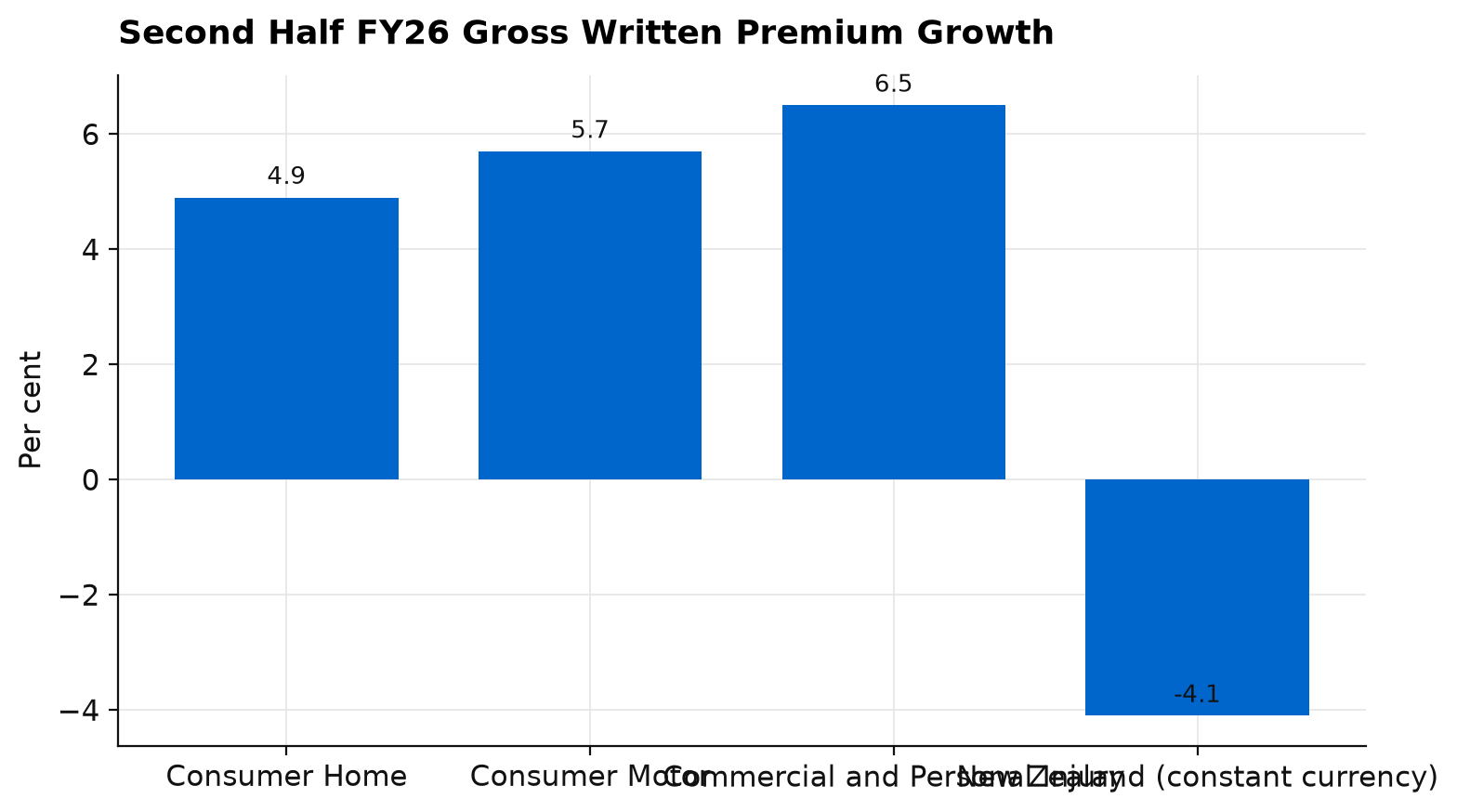
Become an AR or CARPolicy numbers, which the industry calls units, did not grow in Consumer, where home GWP grew 4.9 per cent and motor GWP grew 5.7 per cent over the second half. Average written premium, essentially the average price per policy, rose around 4.8 per cent for home and around 5.8 per cent for motor. Put those together and the implied unit growth in both home and motor was 0 per cent. The research links the soft unit trend to Suncorp pricing in the cost of its reinsurance aggregate cover while pricing across the market is softer, and that is when customers tend to shop around. Suncorp expects to keep pricing in response to input costs through FY27 and is looking for modest unit growth.
Commercial and Personal Injury grew GWP 6.5 per cent in the second half, the strongest of the three divisions. Fleet and NTI grew strongly, and price increases have been flagged in compulsory third party insurance in Queensland and New South Wales and in workers compensation. Management expects personal injury margins to keep improving into FY27, while noting ongoing pressure in commercial.
In New Zealand, GWP fell 4.1 per cent on a constant currency basis, which removes the effect of exchange rate movements, and 12.7 per cent at actual exchange rates. The decline came from currency, a soft commercial insurance cycle and the loss of a brokered book of business. Within the division, the direct consumer business under the AA brand grew GWP 5.2 per cent, helped by unit growth across home and motor, while the intermediated business contracted around 9 per cent amid elevated competition in commercial.
For shareholders, price-led growth holds up while claims costs are rising and customers accept that premiums have to follow. It becomes a problem if the industry starts competing harder on price, because an insurer that keeps lifting premiums faster than rivals can lose customers, and one that stops lifting them can see claims inflation eat into margins. Suncorp’s guidance suggests management is comfortable with that balance for now.
Capital Returns and an Earnings Rebound Support Income Investors
The earnings result itself came in modestly ahead of expectations. Second-half cash earnings were A$772 million, ahead of the A$756 million consensus expected, and group net profit after tax was A$764 million against a consensus figure of A$749 million. Cash earnings is the measure Suncorp’s dividend payout ratio is based on, so a beat there flows through to what shareholders receive.
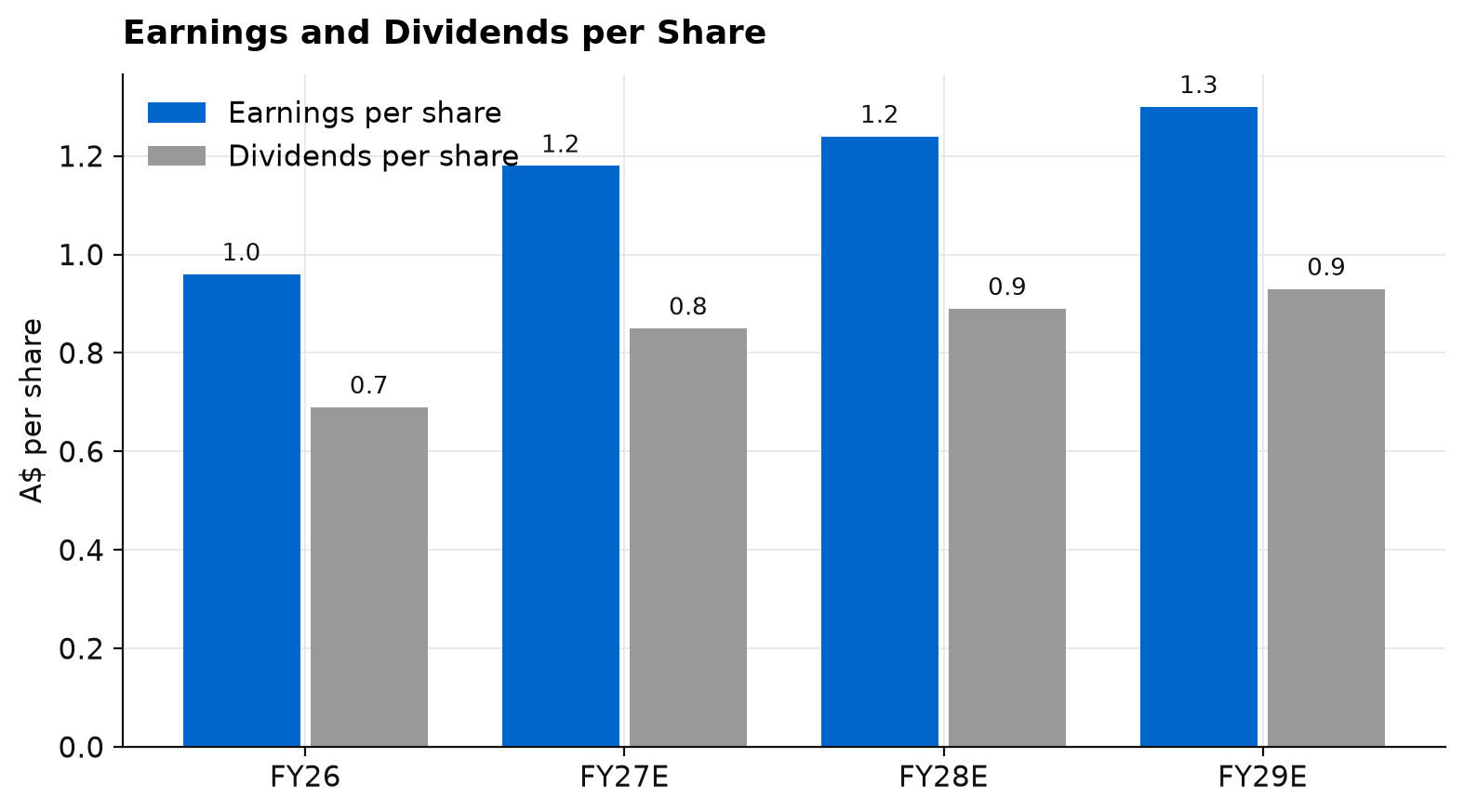
Looking forward, institutional sell-side research forecasts a strong rebound in FY27 followed by steadier growth. Net income is forecast to rise from A$1,042.0 million in FY26 to A$1,260.7 million in FY27, A$1,328.0 million in FY28 and A$1,392.8 million in FY29. Earnings per share are forecast at A$1.18 in FY27, A$1.24 in FY28 and A$1.30 in FY29, up from A$0.96 in FY26. That is growth of 22.4 per cent in FY27, slowing to 5.3 per cent and then 4.6 per cent, and the FY27 jump comes off a FY26 base in which earnings per share fell 29.0 per cent. After the result, the research made small changes to its forecasts, driven by slightly higher premium growth and a slightly more moderate underlying margin assumption, with FY27 earnings per share lifted from A$1.16 and FY28 from A$1.20.
The final dividend was slightly higher than consensus had expected. The payout ratio for the second half was 71.4 per cent of cash earnings, against a target range of 60 to 80 per cent. Suncorp also declared a special dividend of 10 cents. For FY27, the company is targeting a payout at the midpoint of its 60 to 80 per cent range, and the research forecasts dividends of A$0.85 per share in FY27, A$0.89 in FY28 and A$0.93 in FY29, up from A$0.69 in FY26. On the publish-day figures, trailing dividends total A$0.79 per share, which at the A$18.92 share price is a 4.2 per cent fully franked yield. For SMSF trustees in particular, full franking means the tax already paid by the company is passed through as a credit, which adds to the after-tax return.
Suncorp also announced an A$250 million on-market share buyback, targeted to be completed by the end of FY27, so a good part of the near-term return for shareholders arrives as cash. Its capital position was boosted by the reinsurance aggregate cover and the proceeds from the sale of its New Zealand life business. After the dividends and the buyback, the group’s core capital, measured as common equity tier 1 capital against the regulator’s prescribed capital amount, covers that requirement 1.15 times. That sits within a new target range of 1.0 to 1.3 times, and on a pro forma basis, meaning after the announced capital returns, the group still holds A$162 million above the midpoint of that range.
Valuation and Why the Call Is Hold
Institutional sell-side research lifted its 12 month price target to A$20.50 from A$20.00 after the result, reflecting the small earnings changes described above. At the A$18.92 share price, that target sits about 8.4 per cent above where the stock was when this research was published. Add the 4.2 per cent fully franked trailing yield and the total return on offer over a year is respectable for a large, mature insurer, but the gap is too small to suggest the market has mispriced the stock.
On margins, Suncorp delivered an underlying ITR of 11.8 per cent in FY26 and is guiding to the top half of its 10 to 12 per cent range for FY27, with buffers from the perils budget and profit commissions. FY27 premium growth guidance of 3 to 5 per cent sits ahead of consensus. On capital, there is a special dividend, A$250 million of on-market share repurchases and capital still sitting above the midpoint of the target range.
The call stays at Hold because home and motor unit growth was 0 per cent in the second half, the underlying loss ratio deteriorated, and part of the margin strength came from investment income and lower costs, while claims took a larger share of premium. The FY27 margin is guided slightly lower, New Zealand is softening and commercial is under pressure. Upside and downside look broadly balanced, since a benign weather year and firm pricing could lift margins, but a heavy storm season or a price war in home and motor could remove that gain just as fast.
Key Risks
The first risk is that commercial and personal insurance rate increases weaken faster than expected and fall below claims cost inflation, which would put margins under pressure, and persistent high claims inflation, a more severe catastrophe environment or lower investment yields would add to it. The second is competition, because continued premium increases could cost Suncorp significant volume to rivals, and flat home and motor unit numbers suggest this is already happening. The third is execution on FY27 guidance, which relies on pricing, the loss ratio initiative and reinsurance savings offsetting the higher cost of the aggregate cover, with margins weighted toward the second half. The fourth is New Zealand, where the intermediated business faces elevated competition in commercial and margins are normalising. On the other side, a re-acceleration in pricing, more benign claims inflation, a quieter catastrophe year, higher investment yields or favourable reinsurance markets would all be upside risks to the Hold call.
Our View
We see this as a solid result from an insurer using its capital sensibly, with margins near the top of the target range and more capital going back to shareholders. Our watch point is home and motor unit numbers over FY27, because a consumer book that grows only through price holds up while inflation keeps customers accepting higher premiums but leaves little room for error if the market becomes more competitive.
If you would like to discuss Suncorp, request a callback or call us on 1300 889 603.
Financial Summary
Become an authorised representative
Advise your clients under an established AFSL without building your own. Choose AR or CAR.
Become an AR or CAR