

Amcor has spent two years being judged on everything except its own volumes. The Berry Global merger, the exit from North America Beverage, a string of small divestments and a change of financial year have all crowded out the simpler question of whether the underlying business is growing again. The June quarter answered it. Comparable volumes turned positive for the first time in this cycle, both segments grew earnings at a double digit rate, and the balance sheet is now on a clear path back to three times. For income investors the practical point is that a forward yield of roughly 5.6 per cent is being paid by a business whose earnings are improving rather than one that is stretching to fund the cheque. Institutional sell-side research has Amcor rated Buy with a 12 month price target of A$81.40, implying around 24.4 per cent upside from the recent close of A$65.44.
Research published 17 August 2026. Price target and upside based on prices at time of publication.
About Amcor
Amcor is one of the largest packaging companies in the world, with a market capitalisation of about A$30.3 billion. It makes flexible packaging, rigid containers, closures and specialty cartons for the food, beverage, healthcare, home care and personal care industries, and it sells into more than 40 countries. The combination with Berry Global lifted annual revenue to roughly US$23 billion and materially deepened the North American footprint. Amcor trades on the ASX as a CHESS Depositary Interest, one for one against the New York listing, so Australian holders get local settlement and an Australian dollar dividend. Company disclosure is available through the investor centre and its ASX filings, including the most recent quarterly dividend declaration.
Volumes Turned Positive in the June Quarter
Comparable volumes across the group rose about 0.5 per cent in the June quarter. That is a small number in isolation and a meaningful one in context, because it is the first clear positive inflection after a long stretch of destocking and soft consumer demand across packaged goods. Flexibles volumes were up around 1 per cent excluding the non-core businesses being sold, and Rigids volumes were up about 0.5 per cent on the same basis. Neither figure is a boom. Both are the difference between a business that has to grow earnings purely on cost and one that has the volume line working with it again.
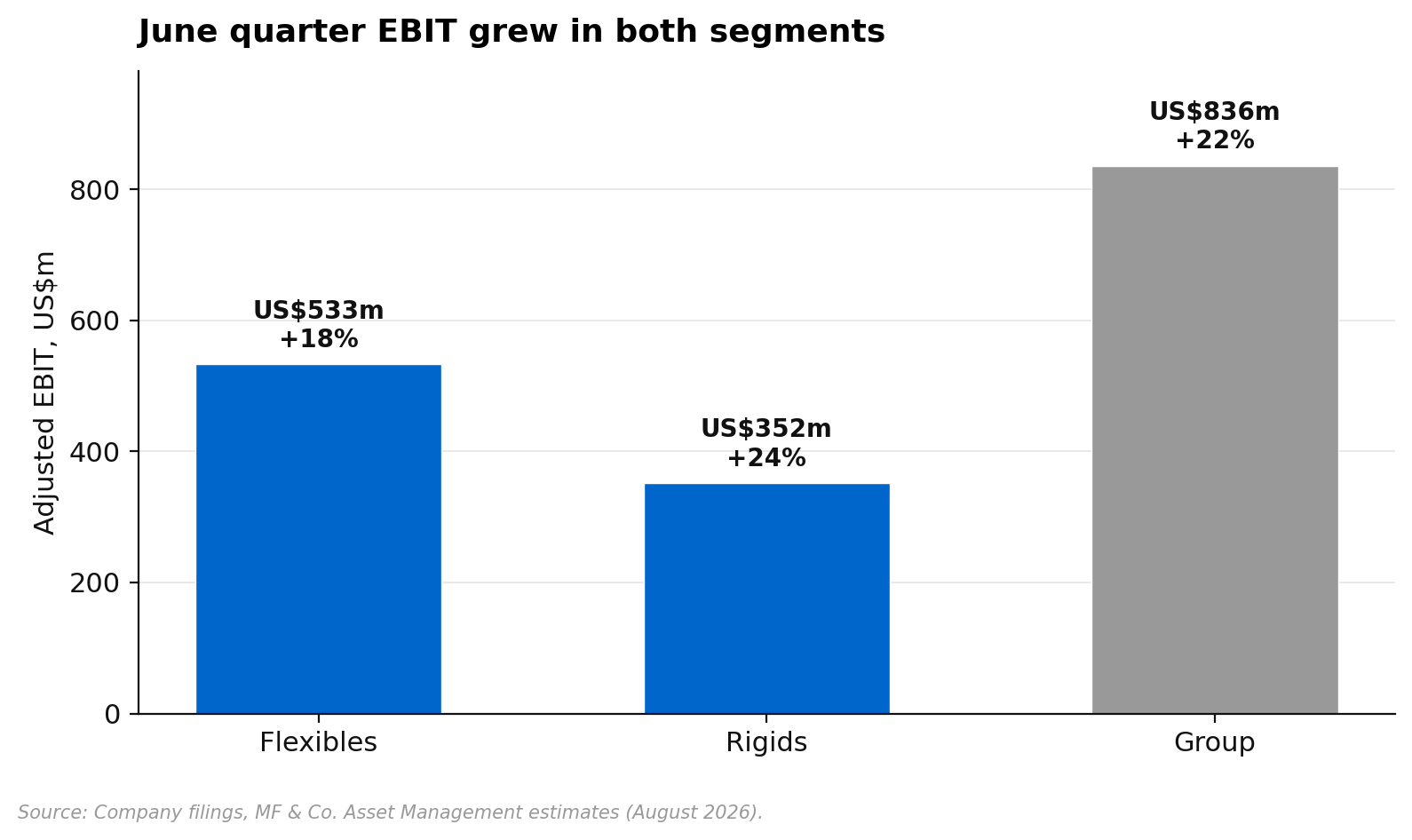
The earnings response was larger than the volume move, which is what you would expect from a business with this much fixed cost. Group adjusted earnings before interest and tax came in at US$836 million, up about 22 per cent on a comparable basis. Flexibles contributed US$533 million, up around 18 per cent, and Rigids contributed US$352 million, up around 24 per cent. Quarterly earnings per share of 123 US cents landed towards the top of the 119 to 124 cent range the company had guided to.
The read from elsewhere in the supply chain supports the demand picture rather than contradicting it. Ball Corporation, the largest maker of aluminium beverage cans, reported group volumes up about 4 per cent year on year in the same quarter, with energy drinks and non alcoholic beverages doing the heavy lifting. The caveat for Amcor is that some of that can growth is share taken from plastic, so the beverage data is a better guide to end demand than it is to Amcor’s own beverage volumes. On balance it says the consumer is buying, which is the part that matters most for a packaging supplier.
The Berry Synergies Are Running Ahead of Plan
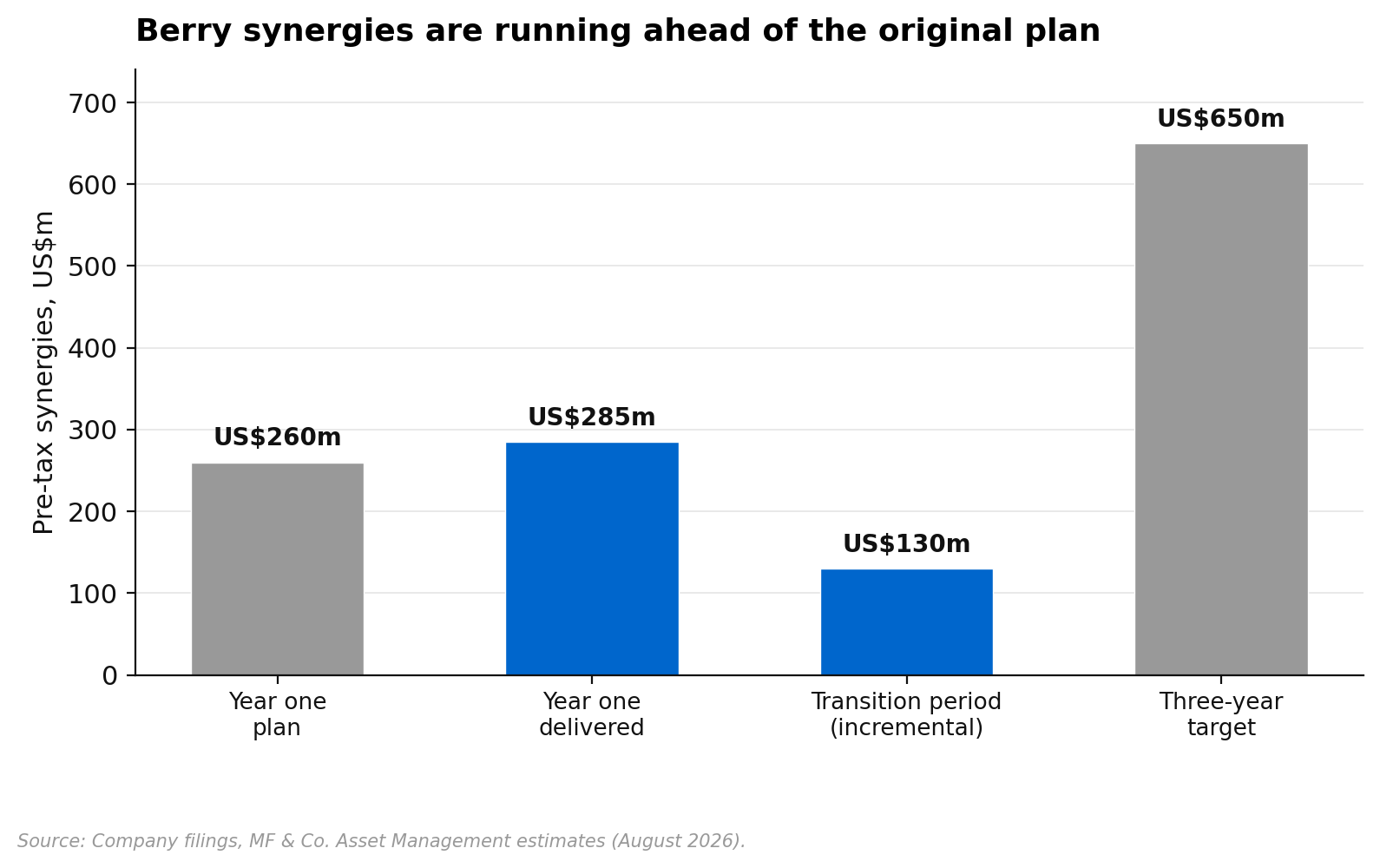
Cost synergies from the Berry Global combination are the single largest controllable driver of Amcor’s earnings over the next two years, and they are landing ahead of schedule. The company delivered about US$285 million of pre tax synergies in the year to June, roughly 10 per cent ahead of the US$260 million originally expected in year one. The June quarter alone contributed about US$115 million, ahead of the US$100 million management had guided to in May. A further US$130 million or so is expected in the six months to December, and the full three year target of about US$650 million has been reaffirmed.
The reason this matters more than a typical merger integration is the size of the combined purchasing base. Packaging economics are dominated by input costs, principally resins, aluminium and paper substrates, so consolidating procurement across a much larger volume of spend is one of the more reliable sources of value in a packaging merger. Amcor has done this before, having absorbed Bemis in 2019, and the fact that year one came in ahead of plan while the company was simultaneously selling businesses and changing its financial year suggests the integration is not consuming all of management’s attention.
The portfolio work sits alongside it. Amcor has agreed to sell six businesses for a combined transaction value of about US$500 million, and five of those have now closed. These are small individually and the point of them is not the proceeds. The company frames the programme as portfolio optimisation, and the non core businesses it is exiting improved their performance year on year on the way out the door.
The Dividend, and What Is Protecting It
Amcor pays quarterly. The most recent declaration was US$0.65 per CDI, converted to A$0.92 for Australian holders at an exchange rate of 0.7043, with an ex date of 3 September and payment on 24 September. Annualised, that is A$3.68 per share, or a forward yield of about 5.6 per cent at the current price. It is worth being clear that this is an unfranked dividend. Amcor is a foreign incorporated company paying out of offshore earnings, so there are no franking credits attached. Against a fully franked 5 per cent yield from a domestic industrial, Amcor’s 5.6 per cent is the lower number after tax for most Australian residents. It is still a large, quarterly, foreign currency income stream from a business with genuinely defensive end markets, which is a different thing again from a bank or an insurer.
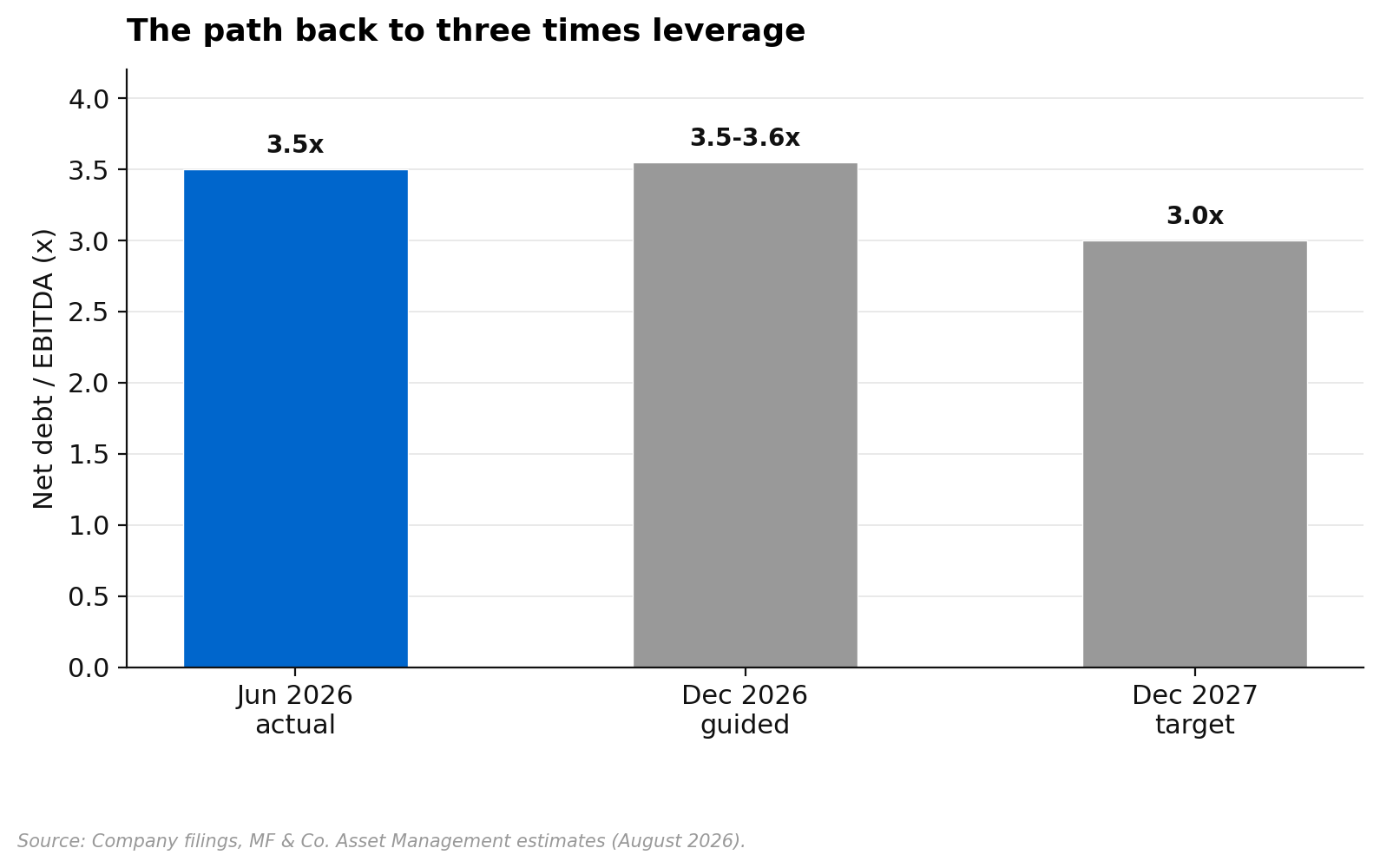
The question with any yield in the mid five per cent range is what happens to it if the business has a bad year. Here the answer runs through the balance sheet. Net debt finished the June quarter at US$12.9 billion and leverage at 3.5 times, which is high, and it is the legacy of paying for Berry. The company has guided to 3.5 to 3.6 times by December 2026 and is targeting three times by December 2027, and it reaffirmed that path at the same time as it reset guidance for the transition period. Management intends to fund it through the synergies, the divestment proceeds and improving cash generation. That is a plan rather than a guarantee, and the dividend stays discretionary either way. What can be said is that a business at three times leverage paying out somewhere in the mid sixties as a percentage of earnings has considerably more room than one at five times, which is why the deleveraging schedule is the thing income investors should watch rather than the yield itself.
The dividend is declared in US dollars, which means the Australian dollar amount moves with the exchange rate. The September payment converts at 0.7043, and a stronger Australian dollar would cut the local value of every future payment even if Amcor never changed the US dollar amount. Australian income investors should treat the Amcor yield as a US dollar yield with a currency conversion attached, and size it accordingly alongside franked domestic holdings.
The Messy Part: A Six Month Transition Period
The reason the stock has not already re-rated on a better quarter is that the outlook statement was genuinely hard to read. Amcor is moving its financial year end from June to December, which creates a six month transition period running from July to December 2026. Guidance for that six months is 180 to 190 US cents of earnings per share, and on the face of it that is below what the market was carrying. About 4 cents per share of the gap is the businesses that have now been sold, which consensus appears not to have stripped out yet. Adjusting for the divestments, the shortfall against consensus looks closer to 3 per cent than the headline suggests.
The more useful number is the one further out. Amcor has guided to double digit earnings per share growth for calendar 2027. Taking the bottom of that range and adjusting for the divested businesses implies roughly 440 US cents of earnings, which is at or slightly ahead of where consensus sits. So the shape of the guidance is a weaker six months followed by a year that is at least in line, with the leverage target intact through both. That is an awkward thing to put in a headline and a reasonable thing to own if you are being paid 5.6 per cent to wait.
Valuation
We rate Amcor a Buy with a 12 month price target of A$81.40, which implies about 24.4 per cent upside from A$65.44, before the dividend. Three things anchor that. The first is the volume inflection, because Amcor’s earnings are far more sensitive to volumes than to price and the quarter just reported was the first time in this cycle that volumes helped rather than hurt. The second is the synergy program, which is ahead of plan, has a reaffirmed three year target and does not depend on the economy cooperating. The third is the deleveraging path from 3.5 times to three times, which if delivered addresses the main bear argument on the stock and progressively transfers value from lenders to shareholders.
The risk and reward is asymmetric at this price mainly because you are paid to be wrong slowly. A forward yield of about 5.6 per cent covers a reasonable amount of time on its own while the operating case plays out. What the capital upside requires is that management hits the calendar 2027 earnings guidance and the December 2027 leverage target, and both of those remain exposed to demand, currency and raw material costs as well as to execution.
Key Risks
Currency is the first and most immediate risk for an Australian holder. Amcor earns and declares in US dollars, so a stronger Australian dollar reduces both the reported earnings translation and the Australian dollar value of every dividend, independent of how the business performs. The second is leverage. At 3.5 times, Amcor has less room than it had before the Berry deal, and a demand shock or a working capital blowout would put the deleveraging schedule under pressure before it put the dividend under pressure, but it would put both in the conversation. The third is execution on the synergy program, which is running ahead of plan today but still has more than half of the three year target left to deliver while the company simultaneously changes its financial year and closes the last of the divestments.
Beyond that, Amcor’s revenue is geographically concentrated, so a downturn in one of its major regions carries more weight than the size of the group would suggest. Regulatory and consumer pressure on single use plastics is a slow moving structural risk to parts of the rigid packaging portfolio, and the shift of beverage volume from plastic to aluminium is a live example of it. Raw material costs and trade policy remain the perennial swing factors for any global packaging manufacturer, and sustained economic weakness in North America or Europe would show up in volumes before it showed up anywhere else.
If you would like to discuss Amcor, request a callback or call us on 1300 889 603.