

Hold
Ansell is a global maker of protective gloves and other personal protective equipment, sold to healthcare and industrial customers and listed on the Australian Securities Exchange.
Institutional sell-side research rates it Hold because the earnings upgrade rests on price rises and cost savings the company has already delivered, and those gains could reverse if recent price rises have to be unwound. Organic volume growth is still the weak spot, and the growth that could justify a higher valuation under the new chief executive is mostly a FY28 and beyond story. Much of the upgrade already looks reflected in the shares.
- Sell-side rating
- Hold
- Sell-side target
- A$38.80
- Upside to target
- −16.4%
- Initial price
- A$42.7723 Sep 2026
- Last close
- A$46.4018 Nov 2026
Ansell delivered a solid FY26 result in August. The glove and protective equipment maker has been able to push price rises through to its customers, and that, together with tight cost control, has lifted forecast earnings well above where they sat before the result. Institutional sell-side research has Ansell rated Hold with a 12 month price target of A$38.80, about 9.3 per cent below the share price of A$42.77 when this research was published. The target was lifted by about 8 per cent after the result, and the shares have since risen above it. The research sees some risk to revenue if Ansell has to unwind its recent price rises, and organic volume growth is still the weak spot.
Research published 23 September 2026. Price target and upside based on prices at time of publication.
Table of contents [hideshow]
About Ansell
Ansell Limited is a global manufacturer of personal protective equipment, usually shortened to PPE, and its main product is gloves. It is listed on the Australian Securities Exchange under the code ANN. The business runs through two main segments. Healthcare, which made up about 55 per cent of FY25 revenue, covers Exam and Single Use gloves sold into scientific, medical and industrial settings, along with Surgical and Cleanroom products. Industrial, about 45 per cent of FY25 revenue, covers Mechanical and Chemical protection. Brands in the portfolio include HyFlex and KIMTECH. The company works to a June year end, has recently changed chief executive, and is continuing its share buyback into FY27. A key raw material for its gloves is nitrile butadiene rubber, known as NBR, a synthetic rubber whose price moves Ansell’s costs.
Pricing Power Drove a Solid FY26 Result
Price was the strongest part of the FY26 result. Ansell raised prices across its key products, passing rising costs on to customers, and the pricing it achieved came in stronger than the research had expected, even after a recent upgrade to its forecasts on exactly this point. The Exam and Single Use segment, the high-volume disposable glove business inside Healthcare, was the clear outperformer.
Pricing power means a company can lift what it charges without losing enough customers to cancel out the gain, and a price rise that holds drops largely straight through to profit. Rival gloves can look similar on the shelf, so Ansell making its price rises stick suggests customers value its products and are slow to switch.
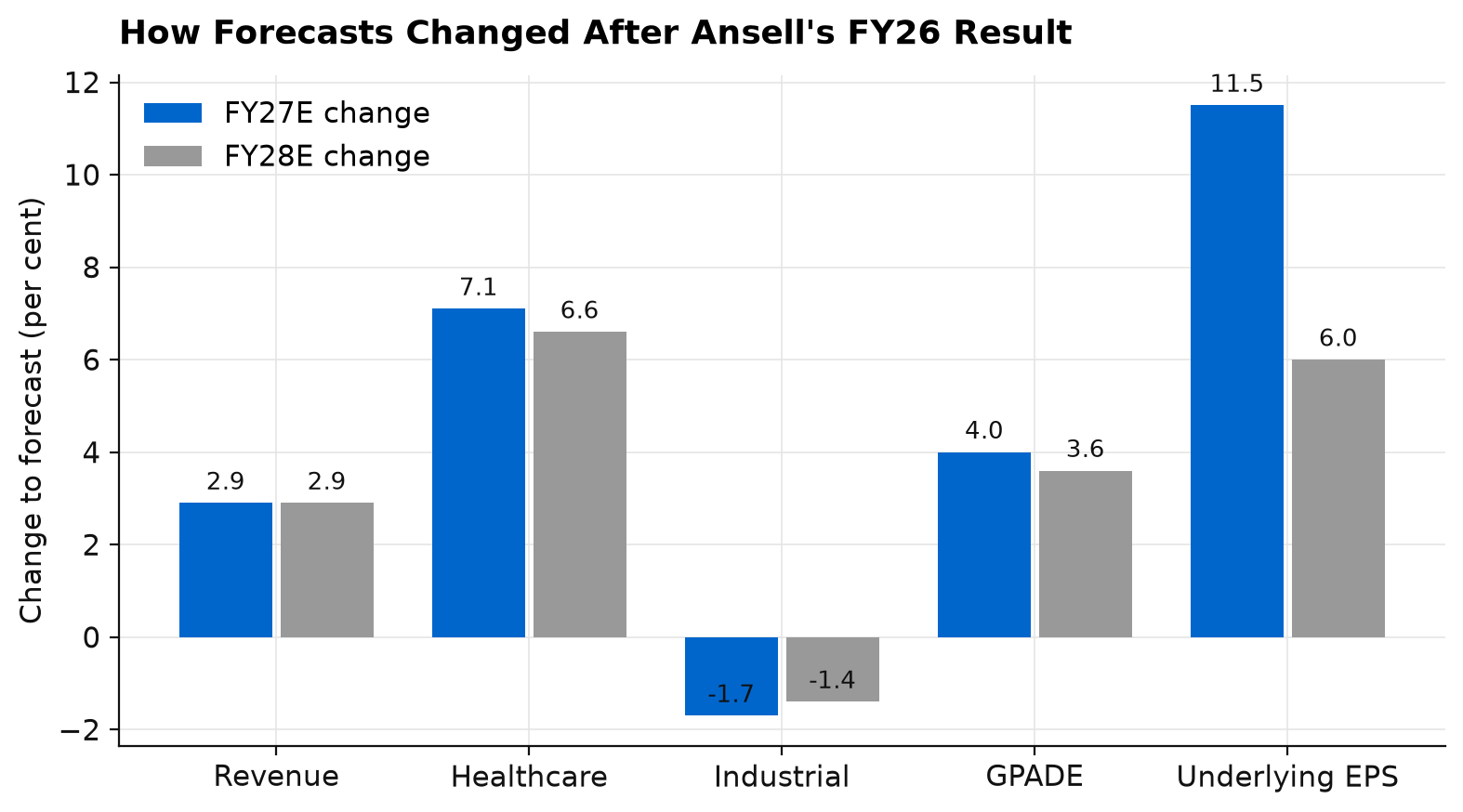
Following the result, the research made a set of changes to its forecasts. Revenue forecasts rose 2.9 per cent for both FY27 and FY28. Within that, Healthcare forecasts were lifted 7.1 per cent for FY27 and 6.6 per cent for FY28, reflecting the stronger pricing. Industrial went the other way, trimmed 1.7 per cent and 1.4 per cent, largely because that segment’s FY26 numbers fell short of the research’s estimates. GPADE, the gross profit measure Ansell reports after distribution expenses, was lifted 4.0 per cent for FY27 and 3.6 per cent for FY28. The biggest change was to underlying earnings per share, the profit attributable to each share, which was raised 11.5 per cent for FY27 and 6.0 per cent for FY28.
Over a longer period, the research estimates earnings per share growth of about 16 per cent a year across FY24 to FY27, measured as a compound annual growth rate, the steady yearly rate that links the start and end points. It puts that growth down largely to pricing power, passing on cost increases across key products, and to cost control, with GPADE margin expansion and overheads growing more slowly than sales.
The source of growth affects how long it can last. Customers eventually push back on higher prices, and at some point there is less cost left to take out, so lasting growth needs more product sold, which is where the FY26 result is weaker.
Cost Savings and the Buyback Support FY27 Guidance
Ansell has given guidance for FY27 earnings per share, and the research expects further cost saving initiatives to help the company deliver it. The guidance has a few moving parts, and not all of them reflect the underlying business getting better. One is a favourable foreign exchange tailwind. Currency movements change the value of overseas earnings when they are converted back, and in FY27 the research sees that working in Ansell’s favour. Another is the share buyback, which the company has announced will continue in FY27. A buyback reduces the number of shares on issue, so the same profit is spread across fewer shares and earnings per share rises even if total profit does not.
On the operating side, management has said several productivity initiatives across the supply chain and the commercial network, covering how gloves are made, moved and sold, should drive the GPADE margin higher, which is behind the higher GPADE forecasts noted above.
Overheads are the other half of the cost story. SG&A, which stands for selling, general and administrative expenses, is the cost of running the business outside the factory, such as sales teams, head office and systems. The research forecasts FY27 SG&A, excluding significant items, growing about 3 per cent on the prior year. That is in line with management’s outlook for growth at a similar level to FY26, which was about 2.7 per cent on an organic constant currency basis, a measure that strips out acquisitions and currency swings. For FY28, the research has SG&A growth closer to 5 per cent, because the One ERP project, a single company-wide business software system, has been delayed.
A rules-based approach to leveraged ETFs
See how our quantitative strategy works and who it suits.
Explore the strategyBecome an authorised representative
Advise your clients under an established AFSL without building your own. Choose AR or CAR.
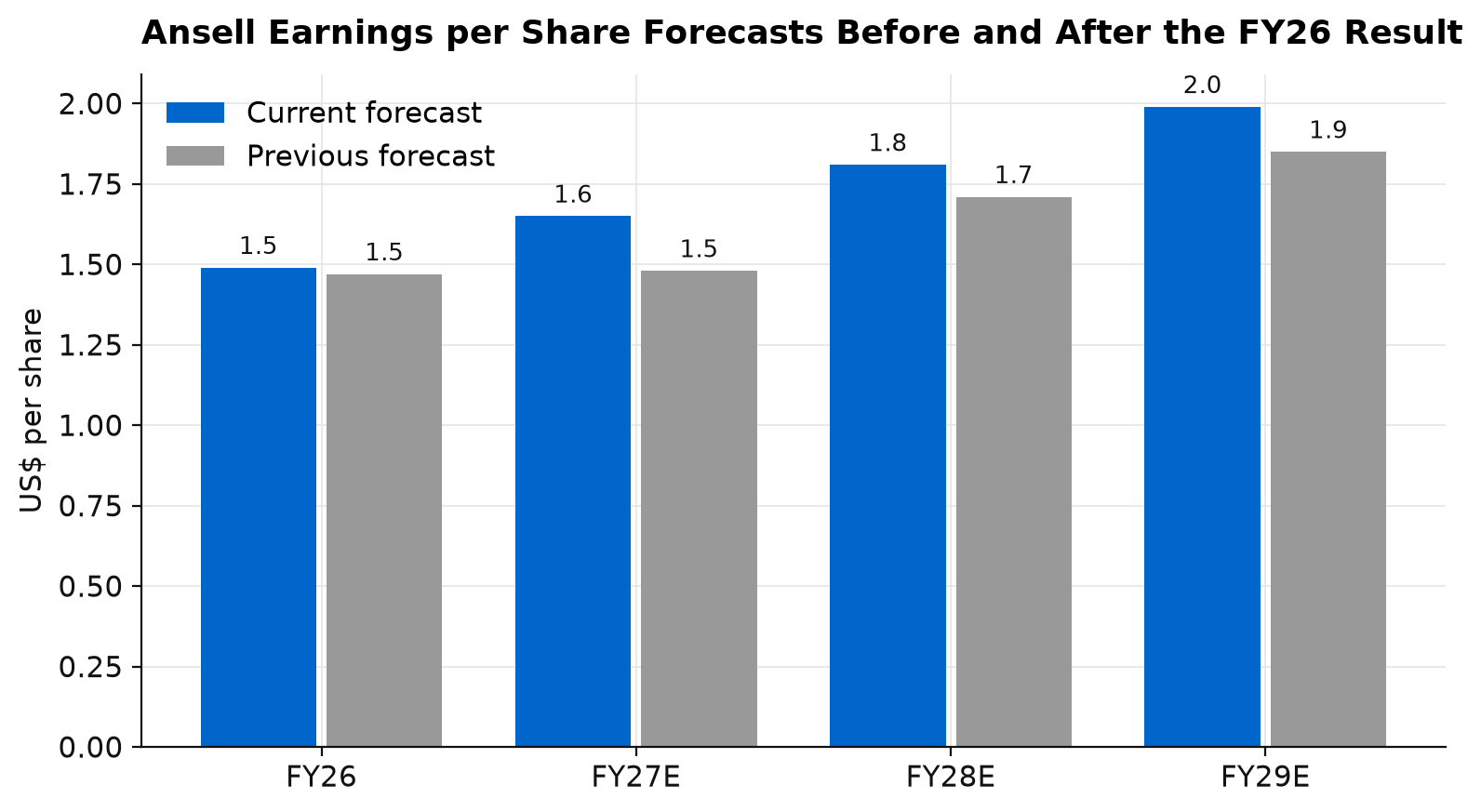
Become an AR or CAROn the new forecasts, underlying earnings per share rises from US$1.49 in FY26 to US$1.65 in FY27, US$1.81 in FY28 and US$1.99 in FY29. Before the result, the FY27 forecast had been US$1.48, so the FY27 upgrade turns what had looked like a flat year into one of solid growth. On a half-year basis, the research has earnings per share of US$0.75 in the December 2026 half and US$0.90 in the June 2027 half, against US$0.82 in the June 2026 half.
The research also flags a near-term headwind, with the recent spike in oil prices likely to weigh on gross margin in FY27. It views this as transitory, expecting Ansell to recover the cost through higher prices. Given the company’s recent record that is a reasonable expectation, though it leans on the same ability to keep lifting prices that drives the earnings upgrade.
Volume Growth and a New Chief Executive Are the Open Questions
Organic volume growth, the growth in units sold leaving aside price and acquisitions, remains an area for improvement, and the research expects the market to focus on it more once the pricing environment settles. While prices are rising, revenue can grow even if volumes are flat, but once prices stop rising, volume growth is what remains.
The FY26 result showed a mixed portfolio. Growth in the Mechanical and Cleanroom businesses stepped up in the second half, reflecting solid momentum in the HyFlex and KIMTECH brands. Other parts of the portfolio slowed, including Surgical. The research believes end user demand in surgical has been cyclically affected, meaning it has dipped for reasons that should pass with time. But it also notes that Ansell’s impairment of its facility in India likely signals a change in longer run expectations. An impairment is a write-down of the value of an asset on the balance sheet, and companies generally take one when they no longer expect that asset to earn what they once thought.
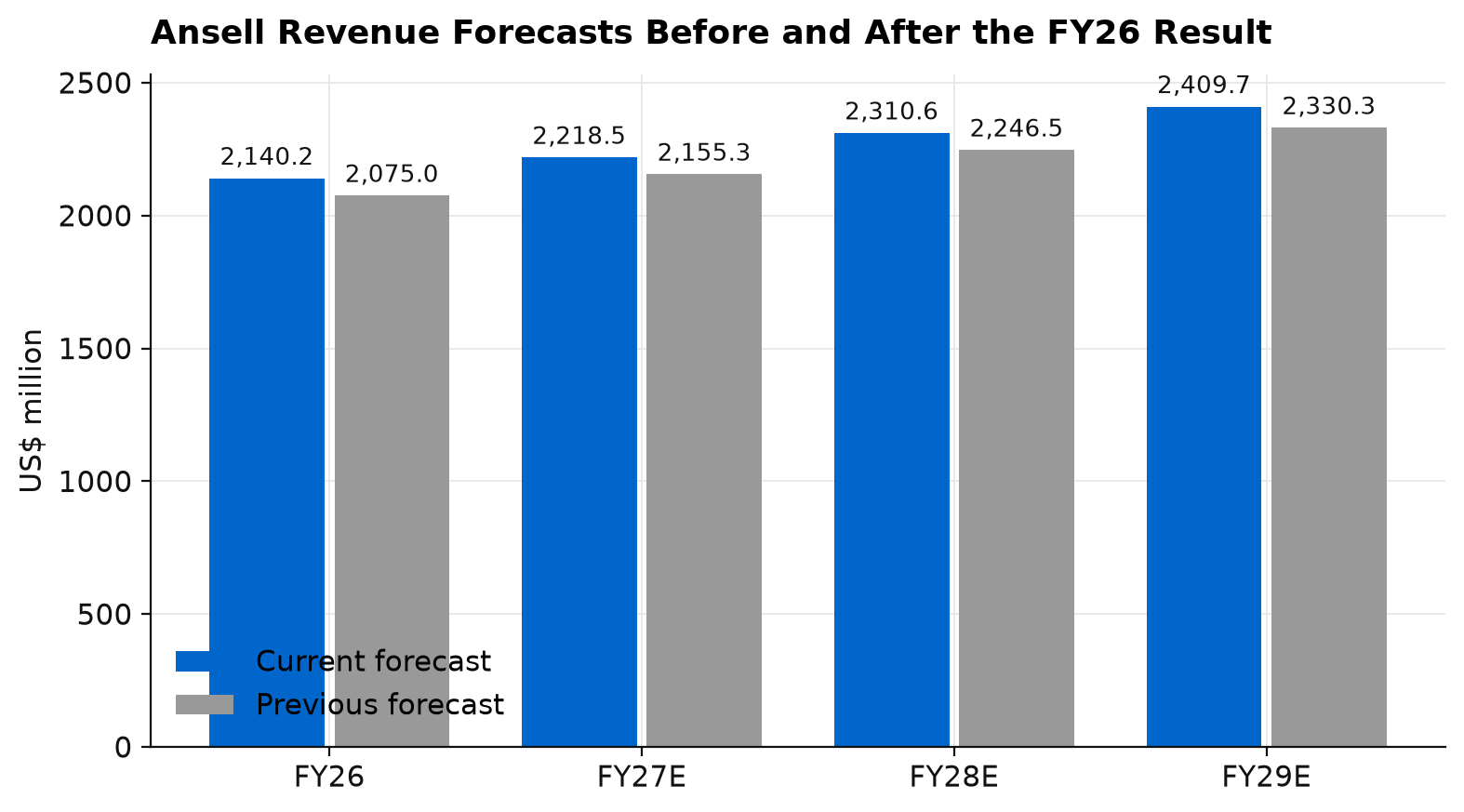
Revenue was US$2,140.2 million in FY26, and the research forecasts US$2,218.5 million in FY27, US$2,310.6 million in FY28 and US$2,409.7 million in FY29. The forecasts were lifted at every point after the result, from US$2,155.3 million to US$2,218.5 million in FY27 for example. Even so, top-line growth is steady but modest, and much of the recent lift has come from price.
The research expects the new chief executive’s initiatives to show up mostly in FY28 and beyond, and it reads the gap between the stronger and weaker brands as room to improve. It finds the idea of reshaping the product portfolio for higher and more consistent growth appealing, but it is waiting for more detail on the strategy, and for more colour on Ansell’s organic growth target as the company sharpens its focus on its key brands. Until then, it has valued the business assuming limited change to its product mix, so the target allows little for a better portfolio.
Cleanroom is closely linked to the KBU acquisition, which the research describes as material, and management’s strategy is to grow in this space, so the research sees cleanroom performance as a key swing factor in either direction. The second-half pickup in Cleanroom and the KIMTECH brand was encouraging, and the coming halves will show whether it lasts.
Valuation and Why the Shares Look Fully Priced
Institutional sell-side research lifted its 12 month price target by about 8 per cent to A$38.80 after the FY26 result. That target reflects the business being fairly valued on its current strategy, with limited change to the product mix assumed. With the shares at A$42.77 when this research was published, the target sits about 9.3 per cent below the share price. When the research set the target, the shares were close to it, and they have since risen above it.
The Hold view weighs an earnings upgrade built on pricing and cost savings the company has already delivered against the risk that those same drivers reverse if the pricing environment turns and recent price rises have to be unwound. The growth that could justify a higher valuation, from volumes and a reshaped portfolio under the new chief executive, is mostly a FY28 and beyond story, and the detail is not yet on the table.
The trailing dividend yield is 2.2 per cent, and the dividend is unfranked, meaning it carries no franking credits.
At A$42.77, much of the earnings upgrade is already in the share price, which leaves it exposed if the recent price rises have to be unwound.
Key Risks
The first risk is tariffs and pricing, since the introduction or removal of US import tariffs, and the industry’s response to US tariff refunds, could change PPE pricing after the FY26 increase. The second is competition, because updates from Ansell’s key competitors and customers over FY27 will show whether the recent price rises hold or have to be unwound, which would hit the top line. The third is raw materials, where NBR costs staying elevated would weigh on forecasts, while a rapid fall would be an upside risk. The fourth is execution, as the APIP productivity programme could run longer and cost more to finish than forecast, diluting the savings achieved to date, though larger than forecast SG&A savings would be a positive. Finally, the chief executive transition and the cleanroom business tied to the KBU acquisition could surprise in either direction, and if management meets its organic sales growth target the shares could do better than the research’s Hold rating implies.
Our View
The FY26 result showed management can protect margins in a tough cost environment, and the FY27 guidance looks well supported by cost savings, a favourable currency backdrop and the continuing buyback. Where the next growth comes from is less clear. We would like to see a stretch of steady volume growth, because price rises eventually meet customer resistance while volume growth can keep building. The new chief executive may well find that growth, and the second-half pickup in HyFlex and KIMTECH hints at where it could come from, but the strategy has yet to be spelt out. The things we would watch are the competitor and customer updates on PPE pricing, the direction of NBR costs and any detail on the organic growth target.
If you would like to discuss Ansell, request a callback or call us on 1300 889 603.
Financial Summary
Become an authorised representative
Advise your clients under an established AFSL without building your own. Choose AR or CAR.
Become an AR or CAR