

Buy
Codan is an Australian-listed technology company that makes radio technology for drones and emergency call centres, plus Minelab metal detectors for hobbyists and gold miners.
Institutional sell-side research rates Codan a Buy because near-term demand for unmanned systems radios has lifted FY27 guidance, with further upside if conflict-region orders persist. It also expects growth from non-conflict nations building sovereign drone programmes, from the NG911 emergency call upgrade in the United States, and from Minelab's new products and markets. The research forecasts earnings per share growth of about 26 per cent a year over three years.
- Sell-side rating
- Buy
- Sell-side target
- A$68.10
- Upside to target
- +36.3%
- Initial price
- A$54.498 Nov 2026
- Last close
- A$49.9619 Nov 2026
Codan held its Investor Day in Adelaide, where the heads of each of its core business units outlined the demand drivers Codan sees beyond the current conflicts. The event followed a trading update on 29 September 2026, when Codan lifted its FY27 guidance on continued orders for the radio technology used in unmanned systems. Institutional sell-side research rates Codan a Buy, with a 12 month price target of A$68.10, about 25.0 per cent above the share price of A$54.49 when this research was published. The research sees upside to guidance if conditions in conflict regions persist, and further growth as non-conflict nations expand defence funding and build their own procurement capability.
Research published 8 November 2026. Price target and upside based on prices at time of publication.
Table of contents [hideshow]
About Codan
Codan is a technology company listed on the Australian Securities Exchange under the code CDA, and it reports on a June financial year. It runs two segments. Communications includes DTC, which supplies radio technology used in unmanned systems such as drones, and Zetron, which supplies technology for emergency call handling and dispatch. In May 2026 Codan acquired Adaptive Dynamics (ADI), a technology business that sits within Communications and that Codan plans to integrate and commercialise through DTC over the next 24 months. Metal Detection is Minelab, which sells detectors into the recreational market and the gold market, including to artisanal miners in Africa. Minelab is now building out markets in Latin America and China, where it has a local distribution partner. Codan is also an active acquirer, and the Investor Day included a session on its acquisition strategy.
Unmanned Demand Lifts the FY27 Outlook
Codan lifted its FY27 guidance in its trading update on 29 September 2026, citing continued demand for unmanned systems in conflict regions. The company now expects net profit after tax, or NPAT, the profit left for shareholders once every cost including tax has been paid, of at least A$162 million for first-half FY27, up from A$160 million previously. Institutional sell-side research had been forecasting A$163 million for that half, so the new guidance sits close to that estimate.
For the Communications segment as a whole, Codan now expects FY27 growth at the upper end of its 30 to 40 per cent range. The research forecast sits above that range, at 45 per cent. Codan also flagged further upside risk to guidance if the elevated sales order momentum from conflict regions continues into the second half of FY27.
The Investor Day added detail on why demand has held up. Warfare in conflict zones keeps changing, and Codan pointed to evidence that the cost and availability of fibre-optic cable are moving buyers back toward radio. Some drones, which the industry groups as Category 1, are guided through a fibre-optic cable in place of a radio link. When that cable becomes harder to get or more expensive, radio technology of the kind DTC supplies comes back into favour. Some regions are also making greater use of maritime uncrewed surface vehicles, or USVs, which are drone boats.
The scale of activity in Ukraine shows how big the market is that DTC sells into. On 11 October 2026, Ukraine’s defence procurement agency said it had ordered 54 per cent more first-person-view attack drones so far in 2026 than in all of 2025. The agency also said contracting across all drone types in recent months had run well ahead of the same period in 2025, and officials credited international support and the scaling up of Ukraine’s own defence industry for the increase. Codan itself says it has little visibility into conflict regions.
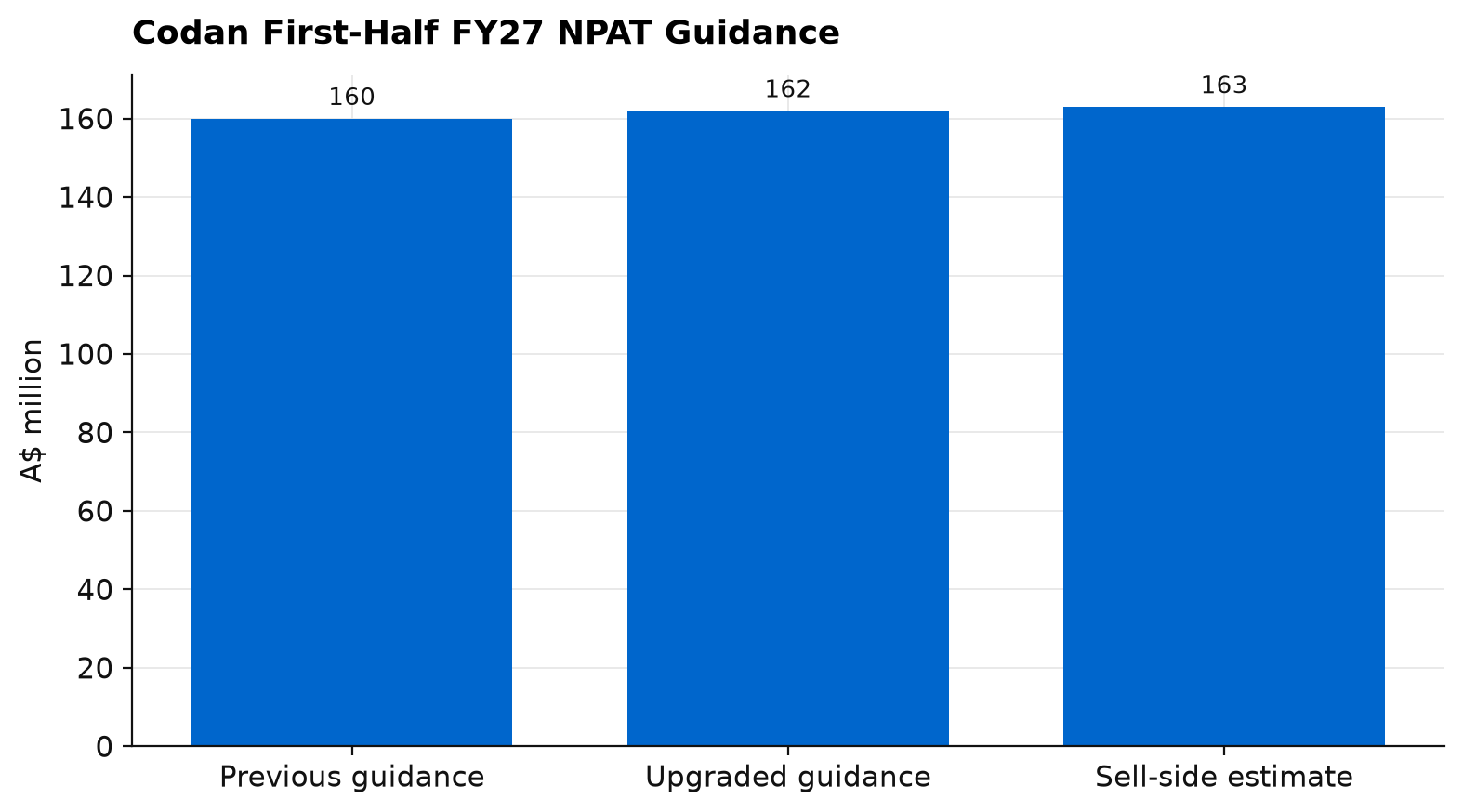
The upgraded guidance covers the first half of FY27, while the second half rests on whether conflict-region orders keep running at today’s pace.
Communications Growth Outside the Conflict Zones
The longer-term case for DTC rests on countries that are not at war. Many governments now want sovereign drone capability, so they can design, build and operate drones within their own borders and supply chains. Codan sees this driving significant long-term investment from non-conflict regions, and it named the Asia Pacific as an expansionary region. DTC takes part in these sovereign programmes where the revenue potential justifies it.
Equipment proven in the field during conflicts creates export opportunities, and Codan expects this to support growth after the fighting ends. The company said that end volumes may not immediately match current conflict levels, because partner nations and NATO countries are still expanding their funding commitments and building the procurement capability needed to spend that money.
Reported downtime of the Starlink satellite network has been a positive for DTC and for high-frequency (HF) radio, a long-range radio technology, because these products give users independence from satellite links and reduce the risk of relying on a single technology. Separately, feedback from AUSA 2026, a major US defence conference, as summarised by institutional sell-side research, found that industry participants expect further growth beyond FY27 given capability requirements. There was also a high degree of focus on drone and defence technology and on the ability to increase production sustainably to meet demand, and the research expects higher growth and margins for defence technology given its exposure to the priority areas of defence spending.
Codan is also adding capability through ADI, acquired in May 2026, whose technology Codan and DTC plan to commercialise. Product integration and commercialisation are expected over the next 24 months, so ADI should start to contribute in the medium term.
A rules-based approach to leveraged ETFs
See how our quantitative strategy works and who it suits.
Explore the strategyBecome an authorised representative
Advise your clients under an established AFSL without building your own. Choose AR or CAR.
Become an AR or CARZetron, the second Communications business, sells to emergency call centres in the United States, which are moving to NG911, a next-generation upgrade of the emergency call system. States and counties have been given the mandate to upgrade their infrastructure. Codan expects the transition and the investment that comes with it to happen, with timing the only uncertainty. Any federal funding would be a positive catalyst that speeds up spending across the industry.
Zetron and Motorola are the only two businesses offering a complete end-to-end product set in this market. Zetron is now releasing products from its newly developed SALUS platform, and Codan expects the pace of releases to accelerate. At the larger end of the industry, Axon is investing heavily and making headway against Motorola, and Zetron has been less affected by that contest. Its orderbook, the value of contracted work still to be delivered, was up 25 per cent at the end of June 2026.
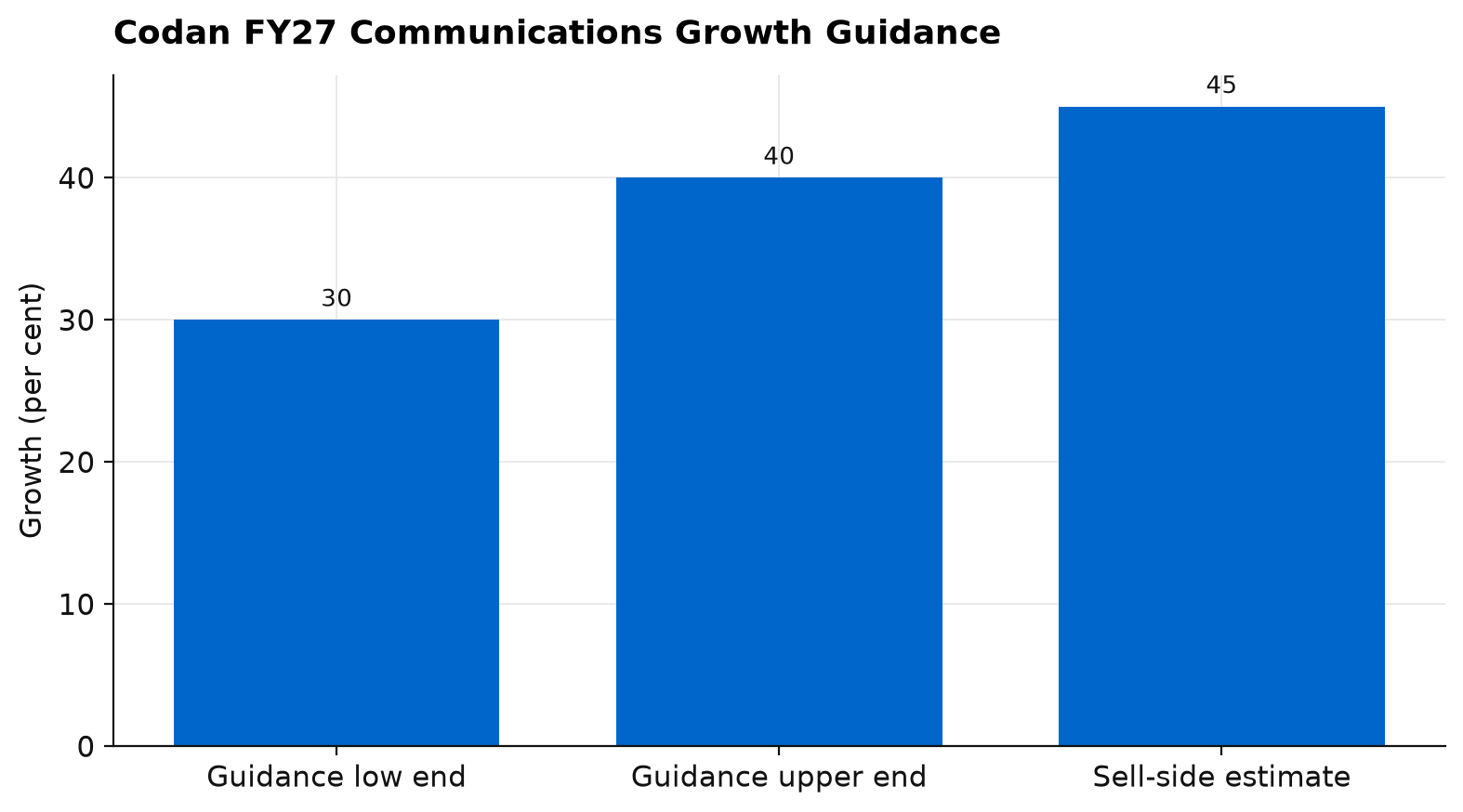
In Communications, DTC is tied to defence spending and drone adoption, while Zetron is tied to a mandated upgrade of emergency call infrastructure in the United States.
Minelab and Acquisitions
Minelab, the Metal Detection business, sells into markets that do not rely on defence budgets. Among its newer products, the Gold Monster 2000 has exceeded expectations in each market, helped by the reach of its predecessor, the Gold Monster 1000, and by the similarities between the two. The GPZ8000 is showing initial positive signs in developed markets, Australia and the United States, and Codan expects improvement in Africa over the next 6 to 12 months as buyers learn what the detector can do.
Minelab is also opening up new markets. In Latin America it is training existing artisanal miners, the small-scale and often informal gold miners who work with basic equipment, using the best practice it developed in Africa. In China it has a local distribution partner for both the recreational market and the gold market. Its consumer strategy is to keep Minelab products front of mind for people already in the hobby and to let customers trade up from entry-level detectors to professional ones over time. Customers who trade up spend more over time, and the strategy also brings new people into the industry.
Minelab sees engineering, backed by a dedicated product development team, as its main advantage over competitors, and despite the recent run of product releases it sees no immediate engineering limit on its ability to keep improving the technology and the product set.
On acquisitions, Codan said its recent performance means it can now consider larger transactions. Its test for any deal is whether a technology or function can be built in-house or has to be bought, and it favours deals that complement existing products or support market share growth. Counter-UAS, the technology used to detect and defeat hostile drones, was named as a possible focus because of high growth expectations and industry demand, though Codan also noted that margins in that area are typically less attractive. The company says it remains disciplined as acquisition prices rise across its focus sectors, and that deal structures giving founders incentives through earn-outs, extra payments made only if the acquired business hits agreed targets, have produced positive results.
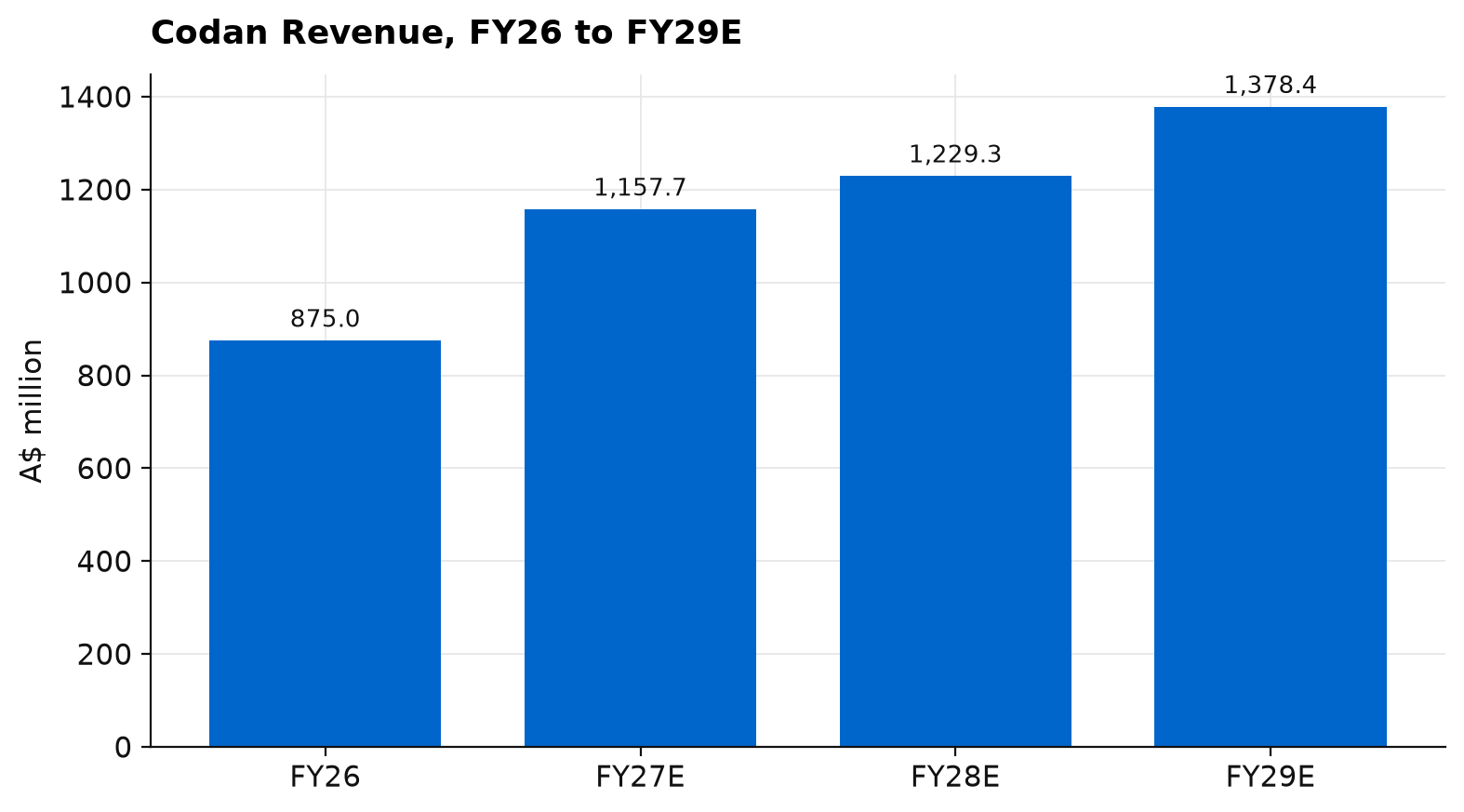
Institutional sell-side research expects revenue to grow from A$875.0 million in FY26 to A$1,157.7 million in FY27, A$1,229.3 million in FY28 and A$1,378.4 million in FY29.
Valuation and the Research View
Institutional sell-side research puts its 12 month price target for Codan at A$68.10, about 25.0 per cent above the A$54.49 share price when this research was published. The research points to near-term momentum in unmanned systems, with upside to FY27 guidance if conditions in conflict regions persist. It also expects growth in non-conflict regions as sovereign drone programmes are funded and NATO and partner nations build their procurement capability, along with growth from Zetron’s NG911 opportunity and from Minelab’s new products and new markets.
The research expects EBITDA, short for earnings before interest, tax, depreciation and amortisation and a common measure of operating profit, to rise from A$288.9 million in FY26 to A$436.3 million in FY27, A$463.1 million in FY28 and A$535.4 million in FY29. Earnings per share are forecast at A$1.59 in FY27, A$1.68 in FY28 and A$1.96 in FY29, up from A$0.96 in FY26, which the research frames as earnings growth of about 26 per cent a year over three years. The research forecasts the balance sheet moving from no net debt in FY26 to a growing net cash position, which leaves Codan room for the larger acquisitions it described.
Codan paid A$0.485 per share in dividends over the past 12 months, a trailing yield of about 0.9 per cent, fully franked.
The research target rests on conflict-region orders holding up and on growth from sovereign drone programmes, NG911 and Minelab, and it sits 25.0 per cent above the share price. Earnings tied to defence spending can also make the share price volatile.
Key Risks
The first risk is the conflict itself, because Codan says it has low visibility into conflict regions, and a ceasefire or a change in how armies fight could cut demand, with the company already acknowledging that post-conflict volumes may not immediately match today’s elevated levels. A fall in the gold price would weigh on the metal detection industry, and geopolitical uncertainty or civil unrest in Africa could disrupt Minelab’s distribution there. In Communications, growth depends on securing contracts, and at the larger end of Zetron’s market Axon is investing heavily against Motorola, so competitive pressure could reach Zetron over time. Acquisitions add risk, both in integrating ADI over the next 24 months and in any larger deal Codan pursues while prices across its focus sectors rise. Finally, Minelab needs consumers to keep buying its new products, and the GPZ8000 still has to win over buyers in Africa once they have seen it in use.
Our View
Codan’s Investor Day pointed to growth beyond the current conflicts: sovereign drone programmes in the Asia Pacific and NATO countries, export demand for equipment proven in conflict, a mandated NG911 upgrade cycle in the United States and a detection business still opening new markets. Codan says it is staying disciplined on acquisition prices and noted that counter-drone deals typically come with thinner margins. Results for the second half of FY27 will show whether conflict-region orders stay at elevated levels.
If you would like to discuss Codan, request a callback or call us on 1300 889 603.
Financial Summary
Become an authorised representative
Advise your clients under an established AFSL without building your own. Choose AR or CAR.
Become an AR or CAR