

Hold
Coles is one of Australia's major supermarket operators, with a large store network, a growing online business and a liquor arm.
Institutional sell-side research rates Coles Hold, with a target close to the share price when the research was published. Management says its focus on cost has brought margins level with Woolworths and that GLP-1 medicines are weighing on liquor demand, while Aldi and Woolworths are both very active on price.
- Sell-side rating
- Hold
- Sell-side target
- A$23.00
- Upside to target
- +4.9%
- Initial price
- A$22.8923 Sep 2026
- Last close
- A$21.9218 Nov 2026
Coles held a briefing for analysts after its FY26 result. Management called the current environment highly competitive, with Aldi and Woolworths both very active on price, and set out how it plans to keep winning customers through faster store growth, convenience food, loyalty programs and a stronger online offer. It also flagged three bigger shifts that will shape Australian grocery over the coming years. Online penetration may reach more than 30 per cent within five to ten years, the liquor market is being reshaped by GLP-1 medicines, the newer class of drugs now widely used for weight loss, and AI shopping tools are starting to change how families compare prices. Institutional sell-side research has Coles rated Hold with a 12 month price target of A$23.00, about 0.5 per cent above the share price of A$22.89 when this research was published, and the shares pay a fully franked dividend.
Research published 23 September 2026. Price target and upside based on prices at time of publication.
Table of contents [hideshow]
About Coles
Coles is one of Australia’s major supermarket operators and is listed on the Australian Securities Exchange under the code COL. Its core business is its supermarket network, supported by a large own brand range, customer loyalty and continuity programs, and a growing e-commerce operation. Online orders are delivered from dedicated customer fulfilment centres, known as CFCs, which are large warehouses built to pick and pack online orders, and Coles has recently added a delivery partnership with UberEats. The group also runs a liquor business. Coles reports on a financial year ending in June, and institutional sell-side research estimates FY26 revenue at A$45,722.0 million, up from A$44,487.0 million in FY25. Management says its focus on cost across the business has delivered margin parity with Woolworths, its main listed rival, despite Woolworths’ greater scale.
Competition Is Intense, but Coles Has Clear Levers for Share
Aldi and Woolworths are both very active on price investment, meaning they are cutting shelf prices and funding the cuts from their own margins. The contest is sharpest in meat, which Coles called an inflationary category, meaning one where prices have been rising.
A second front is opening in health and beauty. Coles noted that The Reject Shop store resets completed to date have significantly improved that retailer’s customer proposition. A store reset is a refresh of a store’s range, layout and presentation. Coles flagged that a sharper Reject Shop could further increase competition in health and beauty in particular.
Against that backdrop, Coles laid out four opportunities it sees to grow market share. The first is store growth, with the company planning to accelerate new stores to around twice its normal cadence across FY27 and FY28. New stores put a Coles closer to households that currently shop elsewhere. The second is greater customer activity, including continuity programs, promotions that reward shoppers for returning over a set period. The third is convenience food, where Coles is targeting spending that currently goes to quick service restaurants, the fast food and takeaway outlets known in the industry as QSR, with sushi singled out as a particular opportunity. The fourth is e-commerce. Delivery from the company’s customer fulfilment centres has the highest net promoter score across the business, a measure of how likely customers are to recommend a service, and it is growing faster than e-commerce overall. Coles also said its new UberEats partnership is performing strongly.
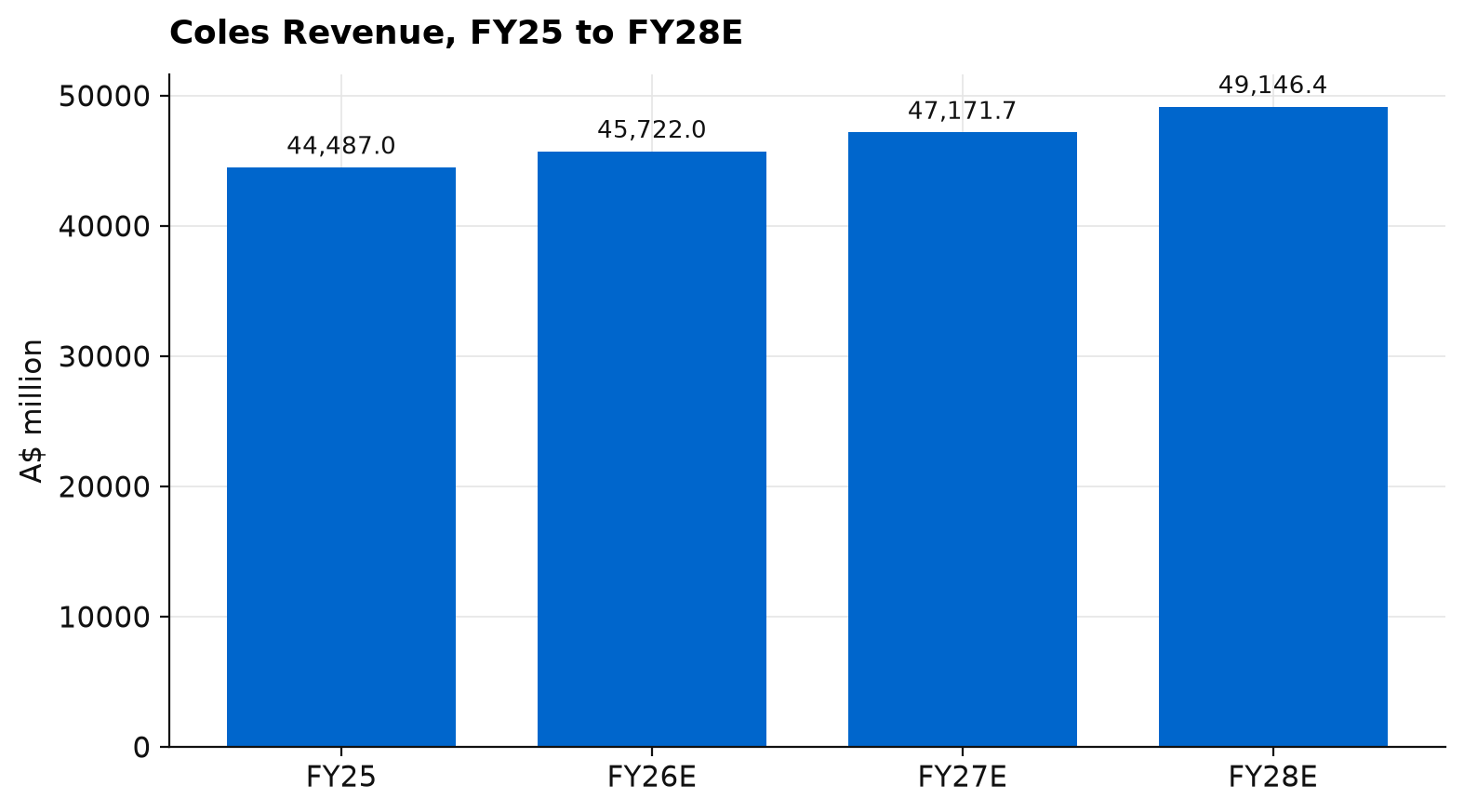
Institutional sell-side research estimates have revenue rising steadily from A$44,487.0 million in FY25 to A$45,722.0 million in FY26, A$47,171.7 million in FY27 and A$49,146.4 million in FY28. We think the store rollout is the lever most within Coles’ control, while convenience food and loyalty are more exposed to competitors’ moves.
Online, AI and the Store of the Future
Online penetration, the share of sales made through online orders, currently sits at around 15 to 16 per cent. Coles is now considering how its store fleet should be configured for a world where that figure may reach more than 30 per cent within a five to ten year horizon. If a much larger share of customers order online, stores may also need to serve online orders, and the right number, size and location of stores may change.
The company’s aspiration is to lift e-commerce margins to in-store levels. Online orders cost more to fill, because someone has to pick, pack and deliver each one. Coles is also being selective about where it builds, and management said the Brisbane market is not dense enough to warrant its own customer fulfilment centre. Utilisation, meaning how fully those centres are used, is one of the swing factors institutional sell-side research flags in both directions.
Alongside the online plans, Coles is trialling changes to its store management operating model in Western Australia and Queensland. The new model is designed to put more focus on online and simplify the overall management structure.
Management believes its focus on cost across the business has enabled margin parity with Woolworths, despite Woolworths’ greater scale. A larger rival usually has more buying power, so matching Woolworths on margin suggests tight cost control. EBITDA, which is earnings before interest, tax, depreciation and amortisation and a rough measure of operating profit, is estimated at A$3,941.0 million in FY25, rising to A$4,220.0 million in FY26, A$4,450.5 million in FY27 and A$4,709.8 million in FY28. That is faster growth than revenue over the same period, which points to modestly improving profitability if the forecasts hold.
A rules-based approach to leveraged ETFs
See how our quantitative strategy works and who it suits.
Explore the strategyBecome an authorised representative
Advise your clients under an established AFSL without building your own. Choose AR or CAR.
Become an AR or CAR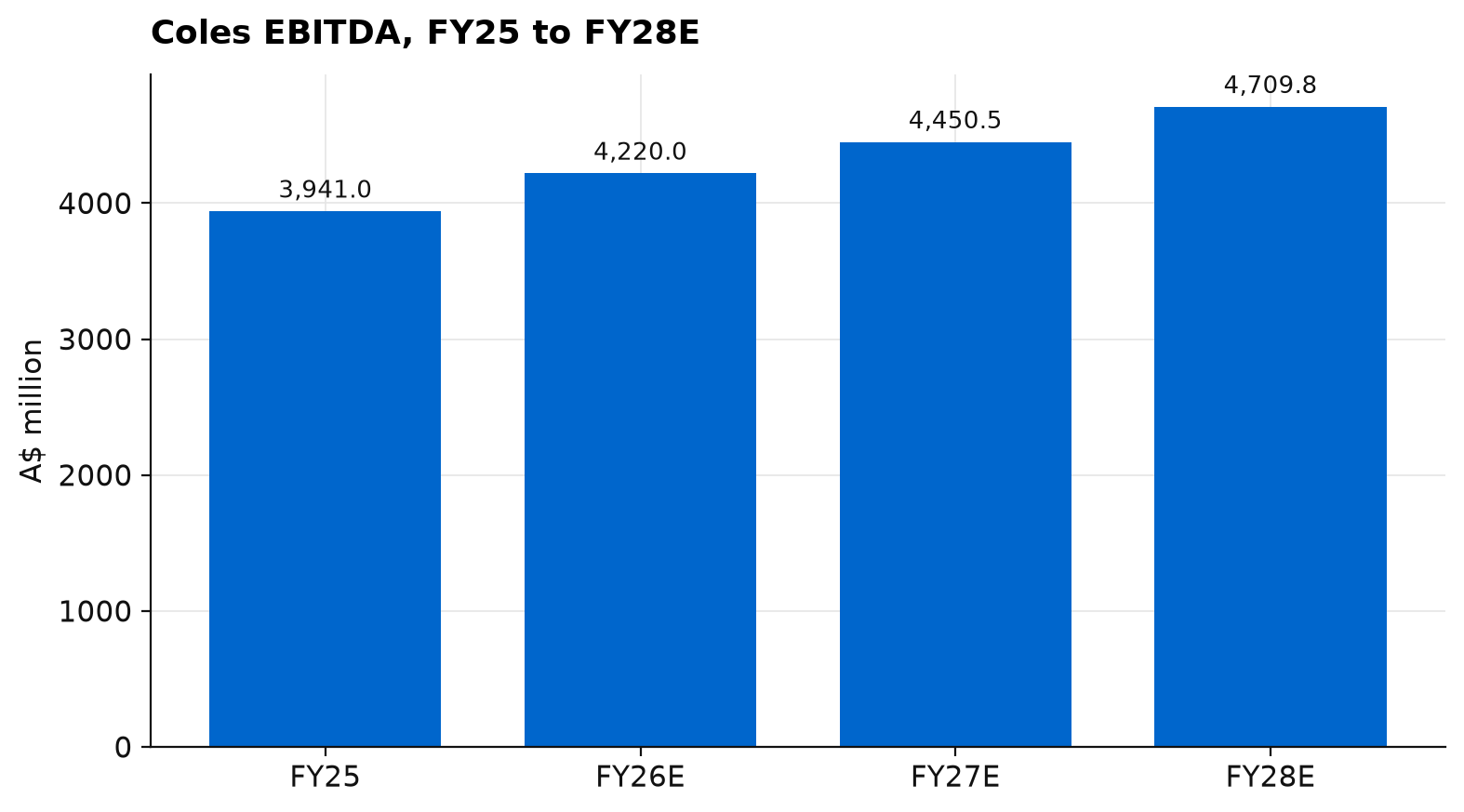
Coles also expects to launch a consumer AI tool in the near future, which it says will have greater functionality than Woolworths’ Olive and Bunnings Buddy. According to management, young families and pre-family couples are increasingly using AI to check prices and create meal and recipe plans for the week. As adoption grows, Coles expects a greater focus on price and a likely shift from the current high-low model towards everyday low pricing, often called EDLP. EDLP means keeping prices consistently low on most items, while high-low means charging a higher regular price and running frequent deep promotions. When an AI agent can compare every price instantly, a model built on occasional specials becomes harder to sustain.
Coles also expects its own brand offerings to become increasingly important and differentiating, and it believes AI shopping agents will have a greater appreciation for the work it has done on sourcing its own brand range, because significant amounts of quality information can be instantly relayed to an agent. In our view, greater price transparency could squeeze promotional margins across the industry, but a retailer with a well-documented own brand range may be better placed than one that relies mainly on branded products and specials.
Tough Portfolio Calls in Liquor and Pet Care
Liquor is the part of the business where the outlook has clearly changed. Coles now holds a much more conservative view of liquor market growth, and it pointed to the rise of GLP-1s as the key change over the last few years. Coles sees GLP-1 users consuming around 60 per cent less alcohol. If use of these medicines keeps spreading, that is a lasting drag on demand for alcohol.
Coles has undertaken a store by store analysis and will continue to close stores that are not economic, or that will not be in the future given its weaker market growth assumptions. There are no plans to close a whole format, with decisions made one store at a time. We think that is sensible, since it closes uneconomic stores while keeping each format in place. Even so, institutional sell-side research lists a further decline in liquor earnings as one of the key risks, which is a fair concern while the size of the GLP-1 effect remains uncertain.
Coles remains attracted to pet care for three reasons. First, 70 per cent of households have a pet. Second, growing pet humanisation, the trend of owners treating pets more like members of the family, is leading customers to focus on pet nutrition, which in turn drives faster growth in specialty retailers and higher margins than supermarket pet food. Third, Coles believes it can add value through its digital and loyalty expertise.
Coles noted that entering the category organically would take years, but it could not agree an acceptable price for Greencross, so it walked away. Coles also said its balance sheet remains strong, with capital management a decision for the board.
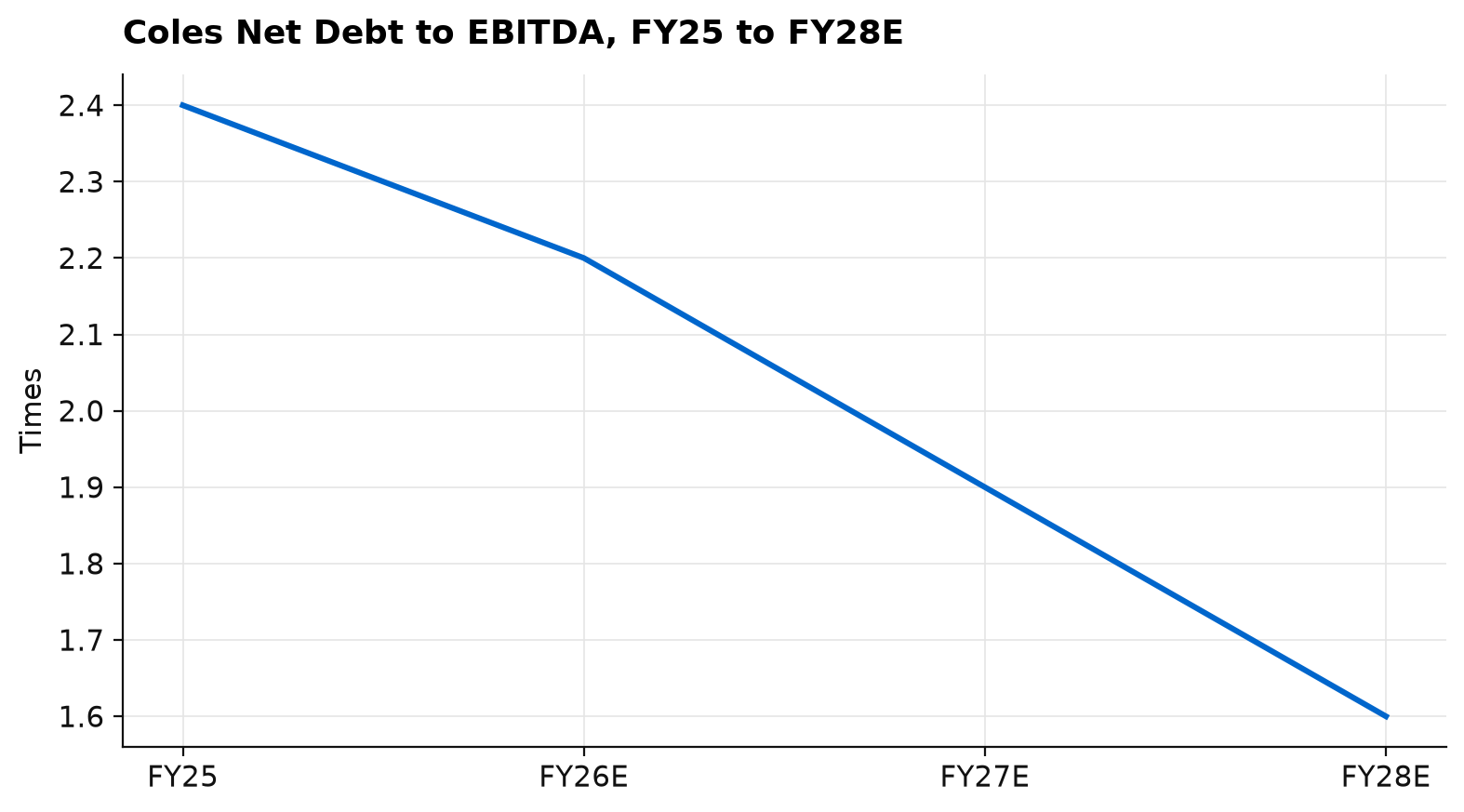
Net debt to EBITDA compares total borrowings, less cash, with a year of operating profit, and it gives a sense of how many years of earnings would be needed to clear the debt. In Coles’ case net debt includes lease liabilities. The ratio is estimated to fall from 2.4 times in FY25 to 2.2 times in FY26 and 1.9 times in FY27, with a further decline estimated for FY28. A falling ratio gives the board more flexibility over time.
Valuation and Why the Call Is Hold
Institutional sell-side research has a 12 month price target of A$23.00 on Coles, about 0.5 per cent above the share price of A$22.89 when this research was published. Earnings per share are estimated at A$0.82 in FY25, A$0.94 in FY26, A$0.99 in FY27 and A$1.07 in FY28, so profits are forecast to keep growing, while the price target sits close to the share price.
In the stock’s favour are cost discipline, which management says has delivered margin parity with Woolworths despite its larger rival’s scale, a clear set of growth levers, from faster store openings to convenience food and an online business whose best-rated service is also its fastest growing, and a strengthening balance sheet, with net debt to EBITDA estimated to keep falling through FY28. Against those sit intense price competition from Aldi and Woolworths, a liquor market under structural pressure, and AI shopping tools that Coles expects to push the industry towards everyday low pricing.
Coles paid A$0.78 per share in dividends over the trailing twelve months, which is a trailing dividend yield of 3.4 per cent, fully franked. Fully franked means Coles has already paid Australian company tax on the profits behind those dividends, and eligible shareholders receive franking credits for that tax, which can reduce the tax they pay. That adds to the value of the dividend for eligible Australian investors, including SMSF trustees.
The research sees risks in both directions. On the upside, Coles could outperform on like-for-like sales or deliver a margin surprise. On the downside, a sharper price war or a further fall in liquor earnings could push profits below forecasts. With the share price already close to the target, institutional sell-side research rates Coles a Hold.
Key Risks
The first risk is pricing, where a larger than expected competitive response from Woolworths, on top of continued price investment from Aldi, would put pressure on margins in the categories shoppers watch most closely. The second is market share, where sharper rivals such as a reset Reject Shop in health and beauty could take trips, although this risk also runs the other way if Coles outperforms on like-for-like sales growth, meaning sales growth from stores open in both periods. The third is execution, particularly online, where customer fulfilment centres that are used less than expected would weigh on returns, while stronger use, or a margin surprise to the upside, would help. The fourth is regulatory and reputational risk, which institutional sell-side research lists among the key risks for the company. Liquor earnings could also decline further if the GLP-1 effect on drinking proves larger or longer lasting than Coles now assumes.
Our View
We think Coles is handling a difficult market well. Management is planning openly for a much more online world, including rethinking the store fleet and the store management model, and showed discipline on capital by walking away from Greencross when the price did not work, even though it likes the pet category. Over the next twelve months, though, we expect the price contest with Aldi and Woolworths to matter more than these longer-term plans, and nothing in the briefing suggested it is easing. The milestones we would watch are progress on online margins, a stabilising liquor business and a smooth store rollout.
If you would like to discuss Coles, request a callback or call us on 1300 889 603.
Financial Summary
Become an authorised representative
Advise your clients under an established AFSL without building your own. Choose AR or CAR.
Become an AR or CAR