

Sell
Fortescue is an Australian iron ore miner that digs, rails and ships ore from the Pilbara region and sells most of it to steel makers in China.
Institutional sell-side research rates it Sell because a sales standoff with China's state-owned iron ore buyer is piling up unsold ore, while costs are running above guidance and net debt has climbed. It also sees a weak near-term iron ore price outlook and high capital spending as the Pilbara mines age. That points to a dividend sliding toward the bottom of the company's 50 to 80 per cent payout range.
- Sell-side rating
- Sell
- Sell-side target
- A$13.30
- Upside to target
- −1.4%
- Initial price
- A$15.188 Nov 2026
- Last close
- A$13.4918 Nov 2026
Fortescue is in a sales standoff with China’s state-owned iron ore buyer. Negotiations with China Mineral Resources Group, known as CMRG, have restricted sales of some of its iron ore products. Unsold ore is piling up, and management now says operations may be affected, potentially including adjustments to production, if a deal is not concluded by calendar year-end. At the same time, unit costs are rising, cash flow went negative in the September quarter and net debt has climbed. Institutional sell-side research has Fortescue rated Sell with a 12 month price target of A$13.30, about 12.4 per cent below the share price of A$15.18 when this research was published. The target was trimmed by 6 per cent from A$14.10 after the quarterly result, largely because of the higher net debt. The Sell rating rests on a weak near-term iron ore price outlook, rising costs and capital spending as the Pilbara mines age, and a dividend likely to slide toward the bottom of the company’s payout range.
Research published 8 November 2026. Price target and upside based on prices at time of publication.
Table of contents [hideshow]
- 1. About Fortescue
- 2. A China Sales Standoff Is Filling the Stockpiles
- 3. Costs Are Running Above the Guidance Range
- 4. Cash Flow Turned Negative and the Dividend Is Exposed
- 5. Mine Replacement Keeps the Capital Bill High
- 6. Valuation and Why the Target Sits Below the Price
- 7. Key Risks
- 8. Our View
- 9. Financial Summary
About Fortescue
Fortescue is an iron ore producer listed on the Australian Securities Exchange, with its mining operations concentrated in the Pilbara. Most of its output is hematite ore, mined across several hubs including Cloud Break, the Chichesters, Solomon and Eliwana, then railed to the coast and shipped through Port Hedland, where its outload capacity is currently restricted to 200 to 205 million tonnes a year. It also runs Iron Bridge, a concentrate operation that is still ramping up and whose product sells at a premium to the benchmark index. Some ore is sold through FMG Trading, which holds inventory at Chinese ports. Beyond the Pilbara, Fortescue is studying the Belinga iron ore project in Gabon and Alta Copper in Peru, holds a renewable energy portfolio and is running a decarbonisation program of roughly US$7 billion. Its financial year ends in June.
A China Sales Standoff Is Filling the Stockpiles
The headline numbers for the September quarter had largely been flagged earlier in October. Fortescue shipped about 46.8Mt of iron ore in the quarter, where Mt is shorthand for million tonnes. It received about 82 per cent of the benchmark price for its hematite, and finished the quarter with net debt of about US$2.8 billion. Sales were only about 42.9Mt, because restrictions linked to the CMRG negotiations began to bite on some products midway through the quarter, leaving sales roughly 3.9 million tonnes below shipments.
Unsold ore tied to CMRG was about 4 million tonnes at the end of the September quarter, and the company expects a further 4 to 5 million tonnes to build in October alone. Management declined to speculate on November and December, but described October as more representative of the run rate than the September quarter, since the restrictions only applied for part of that period. The research notes that a build of 4 to 5 million tonnes a month equates to about 24 to 30 per cent of the monthly run rate implied by FY27 shipment guidance, which is about 17 million tonnes a month at the midpoint. The research estimates unsold inventory could reach about 16-19Mt by the end of December if the October pace persists. Its base case assumes sales run 15 million tonnes below shipments in the December quarter.
FY27 guidance was left unchanged, but it is now explicitly subject to the outcome of the CMRG talks. Management said it can absorb the inventory build with no real impact on operations over the next couple of months. It also said it prefers to leave ore in the ground than to mine it and pay to rehandle it later, so any cut would probably come from mining first. The research suggests a curtailment could include closing Cloud Break, a hub of about 30 million tonnes a year that produces most of the company’s SSF product and is its highest-cost operation because of its strip ratio, grades, haul distances and water. The strip ratio is the number of tonnes of waste rock moved for each tonne of ore, so a higher ratio makes each tonne more expensive.
According to news reports, Rio Tinto may have settled with CMRG, BHP will start negotiating again in November, and Hancock is still negotiating, while Vale does not have to. That could leave three major miners negotiating with the same buyer at the same time. Even when a deal is reached, Fortescue intends to unwind the inventory as efficiently as possible without disrupting the market, and it favours holding stock at Chinese ports so it can be sold down faster. The research expects the unwind to take several quarters. Any curtailment would also hurt fixed-cost absorption, meaning the costs that do not change with volume get spread across fewer tonnes, pushing up the cost of each one.
Costs Are Running Above the Guidance Range
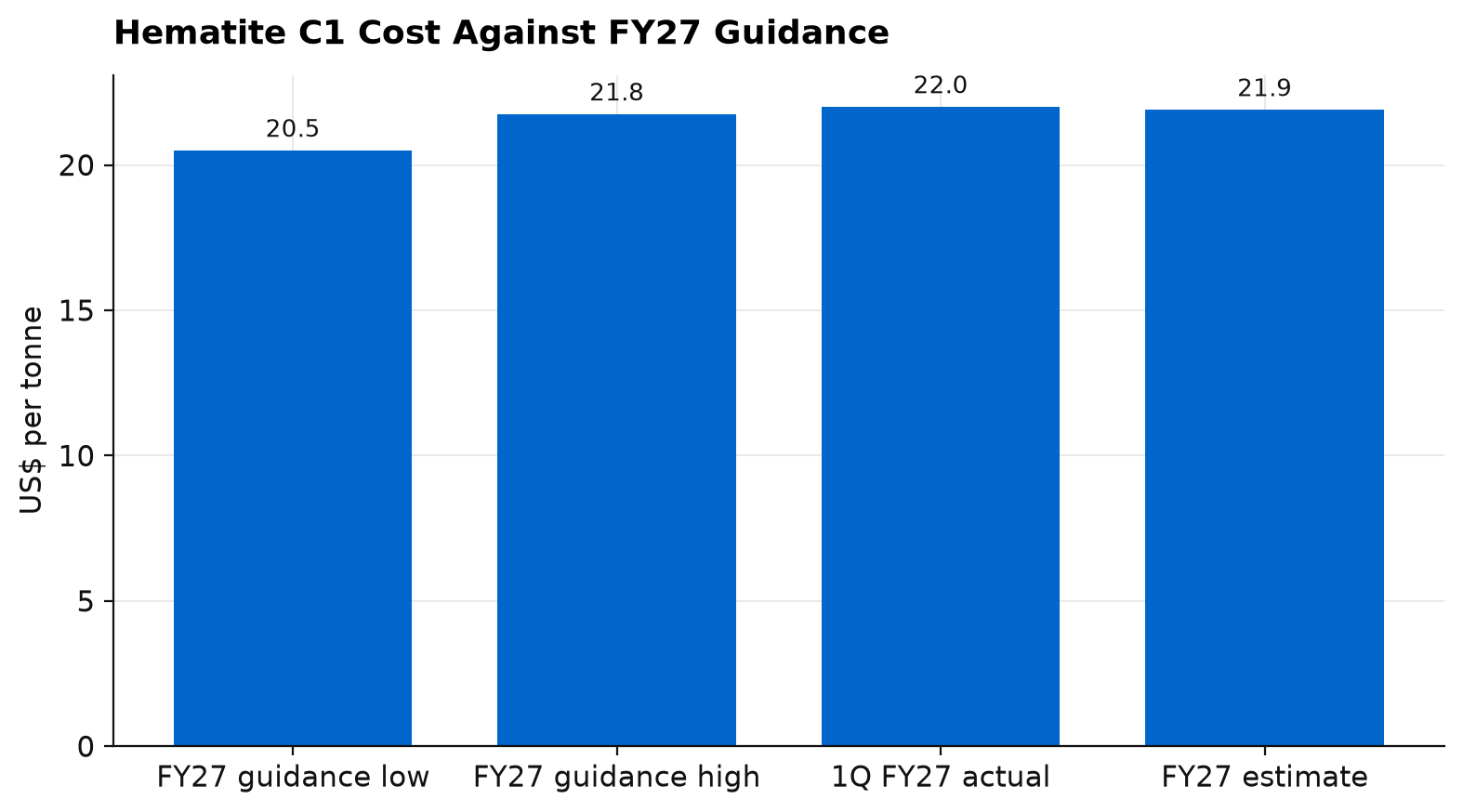
The C1 cost is the basic cash cost of mining and processing a tonne of ore before items such as royalties and shipping. Fortescue’s hematite C1 cost came in at about US$22 a tonne, up 13 per cent on the previous quarter and 21 per cent on the same quarter a year earlier. Management pointed to higher diesel prices, more waste stripping and lower volumes. That figure was a little better than the research had expected, but it still sits above the top of FY27 guidance of US$20.50 to US$21.75 a tonne.
The research thinks the better-than-expected number mostly reflects accounting timing. C1 is a cost of sales measure, so when ore is mined but not sold, part of the cost of producing it is held on the balance sheet as inventory until the ore is sold. This quarter, hematite ore mined was about 8 million tonnes higher than ore processed, against about 2.4Mt a year earlier, which points to a material build in the run-of-mine stockpile. The strip ratio was 18 per cent above what the research had expected. Management attributed this to timing and reiterated a life-of-mine strip ratio of about 1.6 times. Elevated diesel prices added about US$1.4 a tonne compared with the first quarter of FY26, and management’s own sensitivity is about US$0.20 a tonne a year for each US$10 a barrel move in oil. The research expects the capitalised costs to flow back through C1 as the inventory unwinds, and it now models FY27 hematite C1 costs of about US$21.9 a tonne.
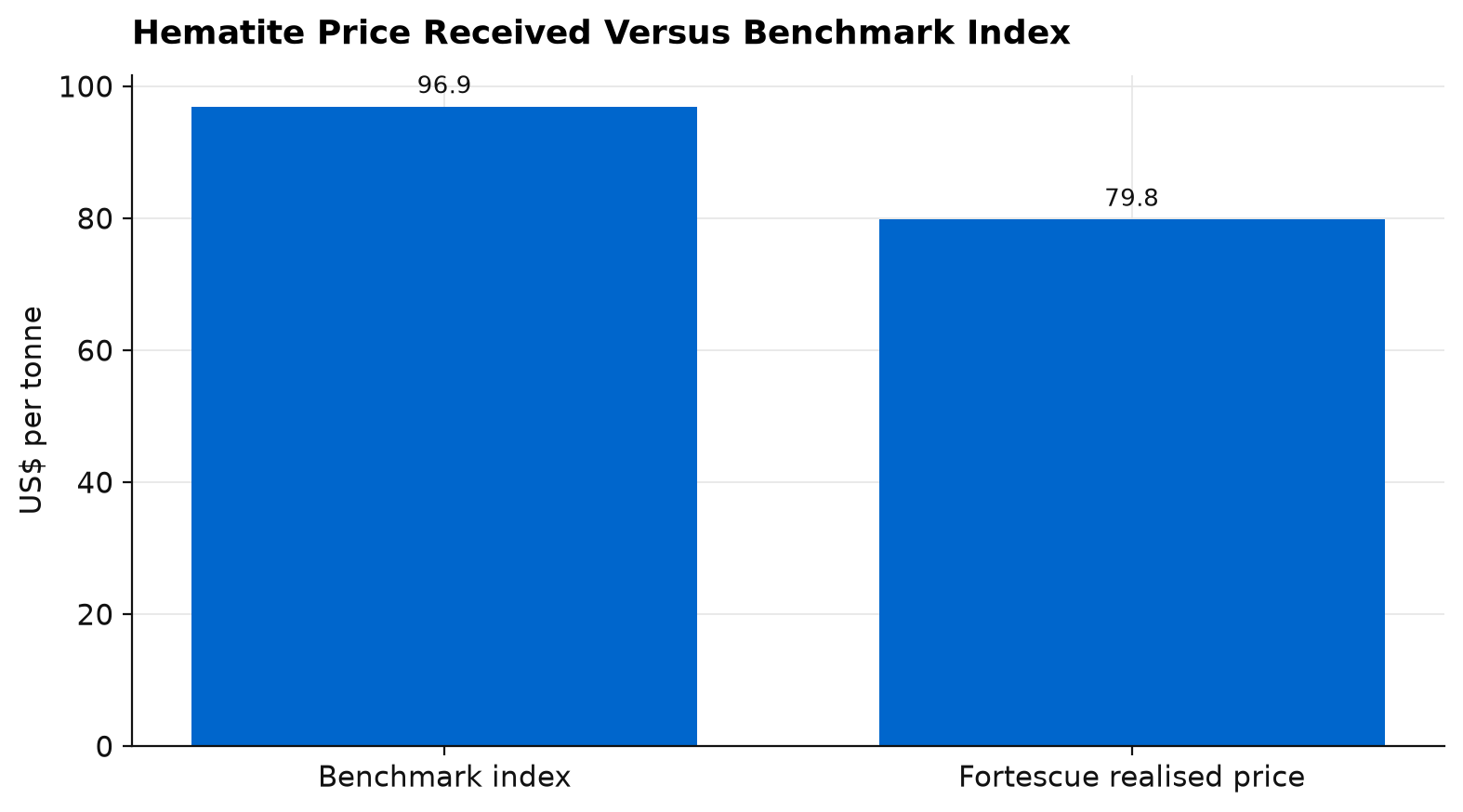
Prices received were also weaker. Fortescue’s hematite realisation, which is the price it actually receives as a share of the benchmark index, was about 82 per cent, or about US$79.8 a tonne against an index of about US$96.9 a tonne. That was 10 per cent lower than in the same quarter a year earlier. Management cited product mix and wider discounts on lower grade products, but would not split out any impact from CMRG. The mix included no West Pilbara Fines, against about 4 million tonnes a year earlier, and about 1.5Mt of the new Fortune Fines product.
A rules-based approach to leveraged ETFs
See how our quantitative strategy works and who it suits.
Explore the strategyBecome an authorised representative
Advise your clients under an established AFSL without building your own. Choose AR or CAR.
Become an AR or CARFY27 shipment guidance of 197-207Mt also looks hard to meet. The research puts the pace needed over the remaining three quarters at about 50-53Mt a quarter, or about 200 to 214 million tonnes annualised, against a first quarter run rate of about 187 million tonnes a year. Shipments include tonnes moved into FMG Trading inventory at Chinese ports, so the company could meet its shipment guidance while actual sales and cash lag behind. The research sees more risk of shipments landing at the low end of guidance and costs at the high end, and models total FY27 shipments of about 197 million tonnes and FY27 hematite shipments of about 186Mt.
Cash Flow Turned Negative and the Dividend Is Exposed
Cash fell to about US$3.2 billion from about US$5.1 billion, lifting net debt, which is borrowings minus cash, by about US$1.9 billion over the quarter to about US$2.8 billion. Three things drove that: the final dividend of about US$1 billion, capital spending of about US$920 million and the cash tied up in the growing inventory. The research’s rough reconciliation of cash and gross debt implies broadly nil operating cash flow and about US$1.0 billion of negative free cash flow before dividends in the September quarter. Free cash flow is the cash left after running the business and paying for investment, and it is what ultimately funds dividends.
First quarter capital spending and investments of about US$920 million annualise to about US$3.7 billion, the low end of metals capital spending guidance of US$3.7 billion to US$4.7 billion, and the company is reviewing controllable operating and capital costs, including the scope, timing and sequencing of projects, to preserve cash. With negative free cash flow in the first quarter and a further inventory build in October, the research thinks the first half FY27 dividend is at risk of sitting toward the lower end of the company’s policy of paying out 50 to 80 per cent of profit as dividends.
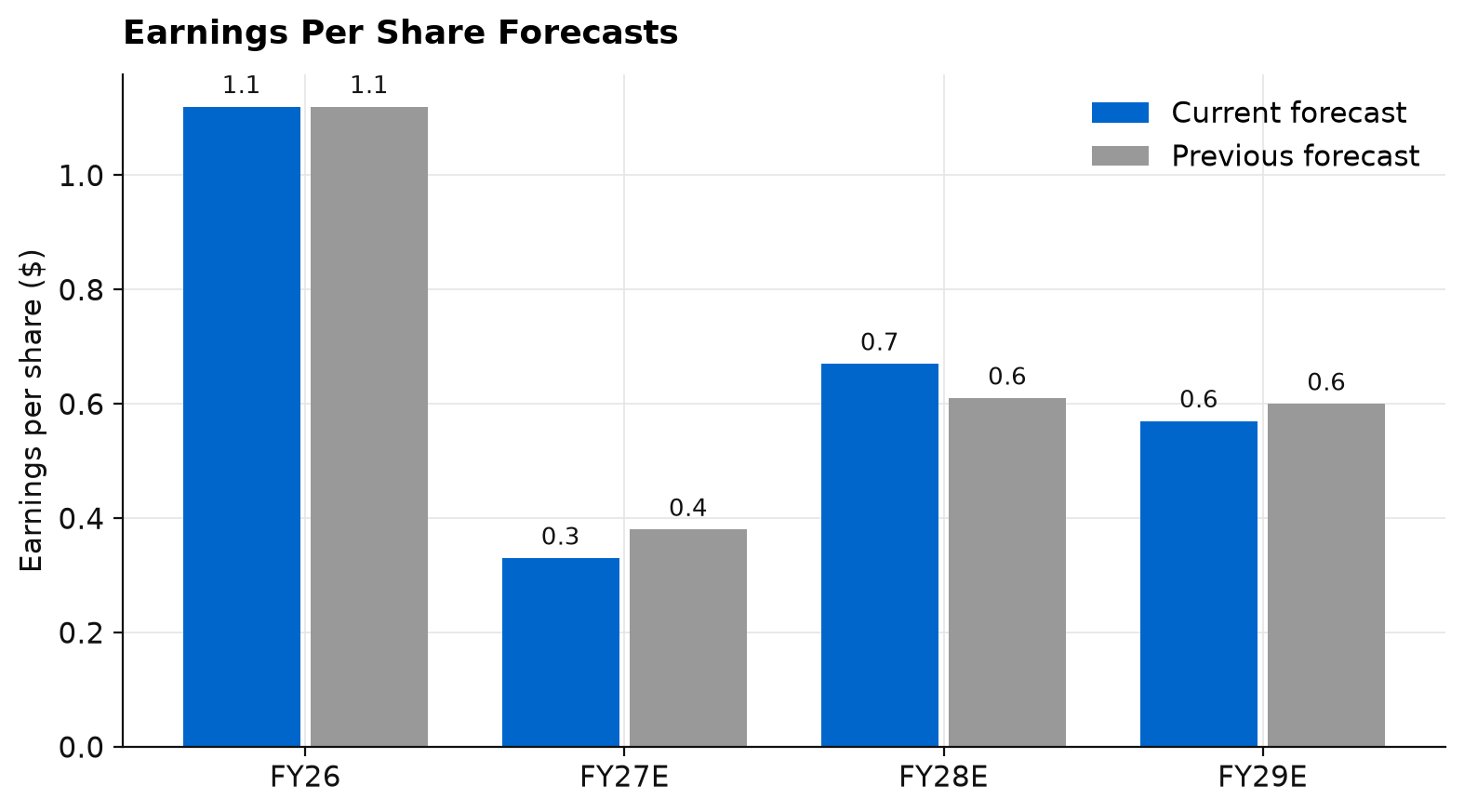
Fortescue paid A$1.08 per share over the past twelve months, a trailing yield of 7.1 per cent, fully franked, at the share price of A$15.18. The research forecasts earnings per share falling from $1.12 in FY26 to $0.33 in FY27, cut from a previous $0.38, before recovering to $0.67 in FY28 and $0.57 in FY29. It also forecasts a loss of $0.09 per share for the half year to December 2026. Revenue is forecast to drop from $16,966.0 million in FY26 to $14,208.8 million in FY27, then reach $15,751.3 million in FY28 and $15,324.7 million in FY29. Lower earnings and a lower payout ratio together point to smaller dividends ahead than the trailing yield suggests.
Iron Bridge shipped about 2.5 million tonnes of concentrate, up 17 per cent on a year earlier, but that annualises to only about 10 million tonnes a year against nameplate capacity of about 22 million tonnes. FY27 guidance for Iron Bridge is 11 to 14 million tonnes. The research puts the pace needed at about 3.2-4.2Mt for each remaining quarter, with the March quarter usually hit by weather. Realisations were 115 per cent of the benchmark index, and management attributed the softer pricing to the timing of sales.
Mine Replacement Keeps the Capital Bill High
The research’s view is that Fortescue’s cost base and capital intensity are structurally rising as its Pilbara hubs mature, and the September quarter reaffirmed that view. Sustaining capital spending, the money needed just to keep existing operations running, is now expected to step up further to about US$2.5 billion a year in the Pilbara, driven by mining fleet replacement and upgrades to rail and fixed plant. Combined with the roughly US$7 billion decarbonisation program, the research expects total capital spending to stay above US$4.5 billion a year to the end of the decade, up from its previous expectation of more than US$4 billion.
Then, around 2028 to 2030, spending on the replacement iron ore mines at Blacksmith, Wyloo North, Mindy South and Nyidinghu is expected to step up, and there could be further spending on Belinga and Alta Copper. Together that could keep group capital spending above US$4 billion a year into the next decade. The research lists seven practical obstacles for the replacement program. Mindy South and Nyidinghu are landlocked by BHP’s rail line, with no means of access unless an agreement is reached over that line. Mindy Gorge on Mindy Mindy Creek is highly culturally significant for the Nyiyaparli people. Water management and high phosphorus levels appear to be challenges at Nyidinghu. Eliwana needs its reserve and mine replacement earlier than expected. Depletion is accelerating at both the Chichesters and Solomon. Port constraints at Port Hedland currently restrict Fortescue’s outload capacity to 200 to 205 million tonnes a year. Iron Bridge also remains free cash flow negative.
The new Pilbara product strategy is expected to offset some of this, adding value of around US$2.5 billion to US$3 billion, or about US$1 a share or about A$1.3 a share, and the research already includes that in its base case. With capital spending this high, the research expects the dividend payout ratio to stay broadly around 60 per cent, toward the bottom of the 50 to 80 per cent range, with gross gearing averaging about 20 to 30 per cent by FY30, against the company’s target range of 30 to 40 per cent. Gearing is a measure of how much of the business is funded by debt.
Valuation and Why the Target Sits Below the Price
The 12 month price target of A$13.30 sits about 12.4 per cent below the share price of A$15.18 when this research was published. The target was cut by 6 per cent from A$14.10 after the result, mainly because of the higher net debt, while the research cut its sales assumption for the December quarter and now models the inventory unwind in the June and September quarters of 2027.
The research sees a difficult near-term outlook for the iron ore price, with the potential for the 61 per cent benchmark index to fall below US$90 a dry metric tonne and for lower grade products to fall further, amid high coking coal prices and the ongoing CMRG negotiations, and Fortescue’s lower grade mix and the wider discounts it already absorbs leave it more exposed than higher grade producers. It also sees Fortescue as more expensive than its two largest Pilbara peers, BHP and Rio Tinto, while generating little or no free cash flow over the next two years. Sustaining capital, decarbonisation and mine replacement all draw on cash that would otherwise fund dividends.
The fully franked trailing yield of 7.1 per cent reflects payments from a stronger period. With earnings per share forecast to fall sharply in FY27, a forecast loss in the December half and a payout ratio heading toward the bottom of the range, the research expects the next few dividends to be noticeably smaller. It sees the balance of risk and reward as poor over the next twelve months, with upside relying on a fast CMRG deal and a rebound in iron ore.
Key Risks
The biggest risk to the Sell call is the iron ore price itself, since a rebound on improved global steel demand would lift realisations and cash flow quickly. A fast resolution with CMRG, an orderly inventory unwind or lower diesel prices would ease pressure on volumes, costs and the balance sheet. On the operating side, stronger hematite production and better outcomes from the new Pilbara product strategy could surprise, and a life-of-mine rethink, including ceasing operations at or divesting Iron Bridge and using the spare 10 to 15 million tonnes a year of shiploading capacity for higher margin hematite tonnes, would improve returns. Higher than expected free cash flow and dividends would also work against the Sell rating. Positive economic studies on Belinga in Gabon or Alta Copper in Peru, or value emerging from the renewable energy portfolio, could change how the market values the company.
Our View
Management prefers to leave unsold ore in the ground. The quarter still showed shipments and sales diverging, costs above guidance once the inventory accounting is stripped out, and net debt rising sharply in a single quarter. The next few quarters will show whether a CMRG deal arrives, sales catch up with shipments and C1 costs return inside the guidance range.
If you would like to discuss Fortescue, request a callback or call us on 1300 889 603.
Financial Summary
Become an authorised representative
Advise your clients under an established AFSL without building your own. Choose AR or CAR.
Become an AR or CAR