

Hold
Medibank is one of Australia's largest private health insurers, selling cover under the Medibank and ahm brands and running health services and hospital investments alongside.
Institutional sell-side research rates it Hold on valuation and prefers another listed health insurer. It likes the defensive exposure, a flat resident gross margin of 16.3 per cent guided for FY27 and strong capital, but resident policyholders grew only 0.4 per cent annualised in the second half and growth spending is lifting expenses.
- Sell-side rating
- Hold
- Sell-side target
- A$5.00
- Upside to target
- −4.8%
- Initial price
- A$4.5720 Sep 2026
- Last close
- A$5.2519 Nov 2026
Medibank reported underlying net profit after tax, its preferred profit measure with one-off items stripped out, of A$339.0 million for the second half of FY26, in line with market consensus, the average of analyst forecasts. Over the same six months, resident policyholder numbers grew at an annualised rate of 0.4 per cent. Medibank cut back its presence on comparison websites during the year to protect margins, which slowed sales through its lower-cost ahm brand. For FY27 it guides to a resident gross margin broadly consistent with the 16.3 per cent earned in FY26, alongside more spending on direct marketing and artificial intelligence to lift growth. Institutional sell-side research has Medibank rated Hold with a 12 month price target of A$5.00, about 9.4 per cent above the share price of A$4.57 when this research was published. The research made small earnings downgrades after the result and kept the target at A$5.00. The trailing dividend yield is 4.2 per cent, fully franked.
Research published 20 September 2026. Price target and upside based on prices at time of publication.
Table of contents [hideshow]
About Medibank
Medibank Private is one of the largest private health insurers in Australia and is listed on the Australian Securities Exchange under the code MPL. It sells resident health cover through two brands, Medibank and the lower-cost ahm, and held about 26.3 per cent of the resident market at March 2026. A separate non-resident business covers international students, overseas workers and visitors. Alongside insurance, the Medibank Health segment runs wellbeing, primary care, and community and acute care services, including the Better Medical business it acquired, and holds a portfolio of joint venture hospitals. The company reports on a 30 June financial year. Its earnings come from three places: the margin on health insurance premiums, investment income, and the profit from Medibank Health.
Policyholder Growth Has Slowed as Switching Rises
Net resident policyholder growth was 1.1 per cent in FY26. The Medibank brand grew 0.6 per cent and ahm grew 2.4 per cent, while the wider industry grew 2.2 per cent over the year to March 2026. Policyholder numbers count customers, so they are the clearest read on whether the business is winning or losing people. Over the second half alone, resident growth ran at an annualised 0.4 per cent.
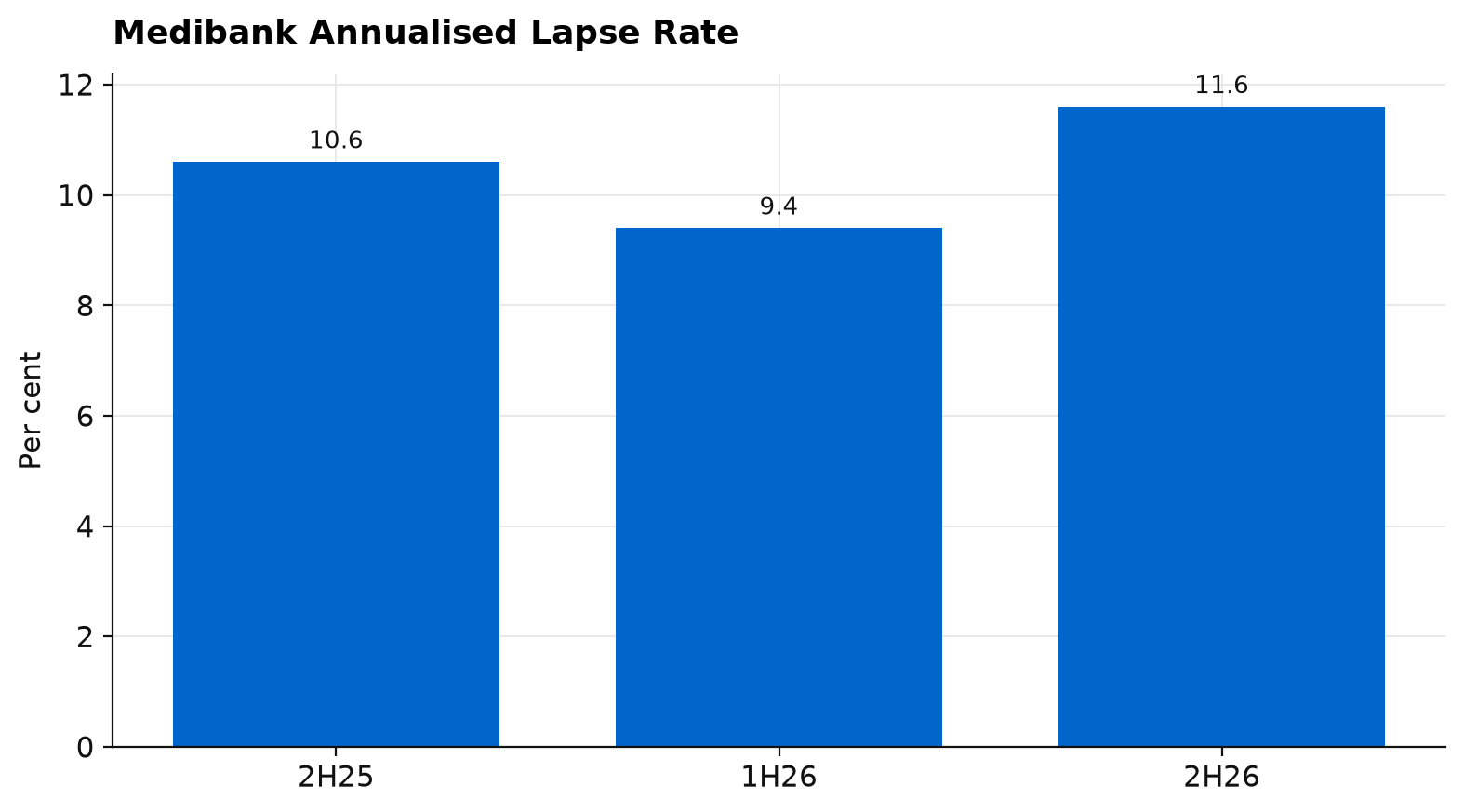
The annualised lapse rate, which is the share of customers who leave over a year, rose to 11.6 per cent in the second half of FY26. That compares with 9.4 per cent in the first half and 10.6 per cent in the second half of FY25. For the full year the lapse rate reached 10.5 per cent, against 10.1 per cent in FY25. The Medibank brand’s lapse rate worsened by 40 basis points to 9.3 per cent, and ahm’s worsened by 60 basis points to 15 per cent, where one basis point is a hundredth of a percentage point.
The annualised acquisition rate, which measures new customers joining as a share of the book, fell to 12.0 per cent in the second half from 12.7 per cent a year earlier. Over the full year it edged up to 11.6 per cent from 11.5 per cent in FY25. By brand, the ahm acquisition rate fell to 17.3 per cent from 18.6 per cent, while the Medibank brand’s rose to 9.9 per cent from 9.3 per cent.
Cost of living pressure, premium rate increases flowing through, heavier marketing by comparison websites and aggressive growth tactics by competitors all pushed churn higher, according to the company. Comparison websites, known in the industry as aggregators, earn a commission on every policy they sell. Competition intensified in the fourth quarter of FY26, as industry growth tilted towards lower-tier products and aggregators won a larger share of new joins. The company said this is pushing people to move between insurers, with few leaving private health cover altogether. It again reported strong growth among customers aged 25 to 30.
Medibank cut back its aggregator presence through FY26, and ahm sales fell as a result. For FY27 it plans to reinvest the commission savings into direct marketing, grow the Medibank brand and use artificial intelligence to improve retention and acquisition. Management would not rule out stepping back up on aggregators to support growth, but says disciplined growth and margin protection remain the focus. The medium-term goal of more than 26.8 per cent resident market share by FY30, up from about 26.3 per cent at March 2026, is still in place. Institutional sell-side research says it remains slightly unclear how Medibank gets back to the industry’s growth rate while also reducing its aggregator presence and keeping margins strong.
Non-resident policy units fell 2.3 per cent in FY26 and declined 1.7 per cent annualised over the second half. Tighter migration settings reduced student numbers, and large groups of students who joined after the borders reopened are now rolling off. Worker growth was strong, and workers make up the higher-margin part of that book.
Resident Margins Are Holding Into FY27
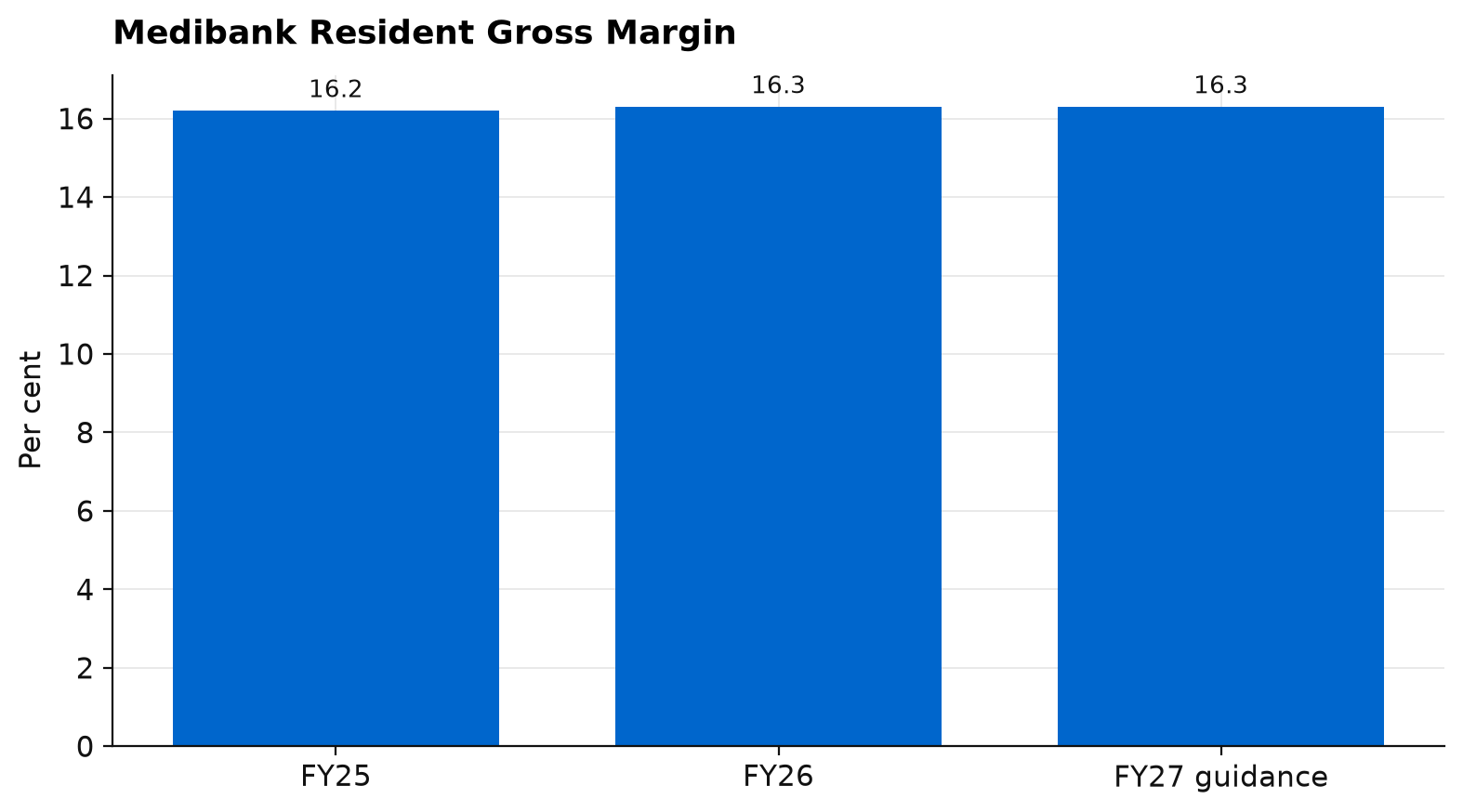
Resident gross margin, the share of premium revenue left after paying claims, was 16.3 per cent in FY26, up from 16.2 per cent in FY25. In the second half it was 17.1 per cent, up from 17.0 per cent a year earlier and in line with market consensus. Group net margin, what remains after management expenses as well as claims, was 9.4 per cent for the half and broadly in line. Health insurance operating profit for the half was A$408.3 million against consensus of A$412.5 million, and group operating profit was A$431.8 million against consensus of A$438.3 million. A lower tax charge brought the bottom line back in line.
Average premium rate increases across FY26 were 4.27 per cent, and after downgrading, where customers move to cheaper cover with fewer benefits, the effective increase was 2.7 per cent. Downgrading came in at 1.5 per cent for FY26 and did not ease in the second half, even though the company had guided for it to. The company links it to investment in Live Better and growth in lower-tier products, and expects FY27 downgrading to be similar at 1.5 per cent. With claims inflation of 2.6 per cent against that 2.7 per cent net rate, gross margin rose 10 basis points.
Claims inflation, the rise in claims paid per policy, was 2.6 per cent in FY26, at the bottom of the guided range of 2.6 to 2.9 per cent. It ran at about 2.8 per cent in the second half after 2.5 per cent in the first. Hospital claims per policy unit grew 2.1 per cent. Extras claims per policy unit grew 3.4 per cent, up 400 basis points, as utilisation, a measure of how often members use their cover, rose 410 basis points.
FY26 hospital claims included A$74.8 million of non-recurring COVID-19 benefit, worth 150 basis points, which will not repeat in FY27. Without it, underlying hospital claims per policy unit grew closer to 3.6 per cent, and underlying utilisation was about minus 0.6 per cent against minus 2.1 per cent headline. The company expects hospital utilisation to keep falling into FY27. It points to members moving away from gold-tier cover, surgery shifting to short-stay models, and a claims mix weighted to younger customers and lower tiers. It also expects extras claims growth per policy to come in below the 3.4 per cent of FY26, reflecting lower indexation and benefit investment. Indexation is the agreed annual increase in what insurers pay hospitals and providers, and private hospital indexation is expected to be stable.
A rules-based approach to leveraged ETFs
See how our quantitative strategy works and who it suits.
Explore the strategyBecome an authorised representative
Advise your clients under an established AFSL without building your own. Choose AR or CAR.
Become an AR or CARInstitutional sell-side research sees the flat FY27 resident gross margin as the product of about a 5 per cent average premium rate increase, revenue mix downgrading of 1.5 per cent and claims inflation of about 3.5 per cent. The guidance is subject to the premium rate increases due on 1 April 2027 and already allows for the unwind of the COVID-19 benefit. The research also sees some room in gross margin to support net margins if growth spending puts pressure on expenses.
Non-resident gross margin fell about 500 basis points to 34 per cent in the second half, as claims per policy unit grew 14.3 per cent against revenue per policy unit growth of 5.9 per cent. Tenure and mix effects in the student portfolio drove most of that, and the company expects them to be less significant in FY27. For the full year, non-resident gross margin dropped to 34.8 per cent from 36.9 per cent and gross profit fell 1.2 per cent, missing guidance for solid profit growth. The company has built the higher second-half claims into premium rate increases from May 2026. It expects solid gross profit growth in FY27, with more stable margins, supported by student retention and repricing, growth in workers and new visitor products.
The management expense ratio, or MER, which is operating costs as a share of premium revenue, came in at 8.0 per cent for FY26, in line with FY25 and with guidance, and about 8.3 per cent in the second half. Management expenses were A$690.2 million for the year, within guidance of A$690 million to A$695 million. The company delivered A$10 million of productivity savings in FY26 and is targeting a further A$10 million in FY27. It expects FY27 expense growth to be not too dissimilar to the 5.4 per cent of FY26, as it spends on marketing and AI. The company targets a stable to modestly improving MER over time, which institutional sell-side research sees at some risk from the growth investment and softer volume.
Medibank Health and Surplus Capital Add Options
Medibank Health segment profit was A$52.4 million in the second half, up 34.0 per cent on a year earlier and including a A$6.2 million contribution from Better Medical. Market consensus had expected A$55.7 million. The company guides to 25 per cent segment profit growth in FY27 and still targets more than A$200 million of segment profit by FY30. That target assumes about A$700 million of capital employed, against A$559.8 million today.
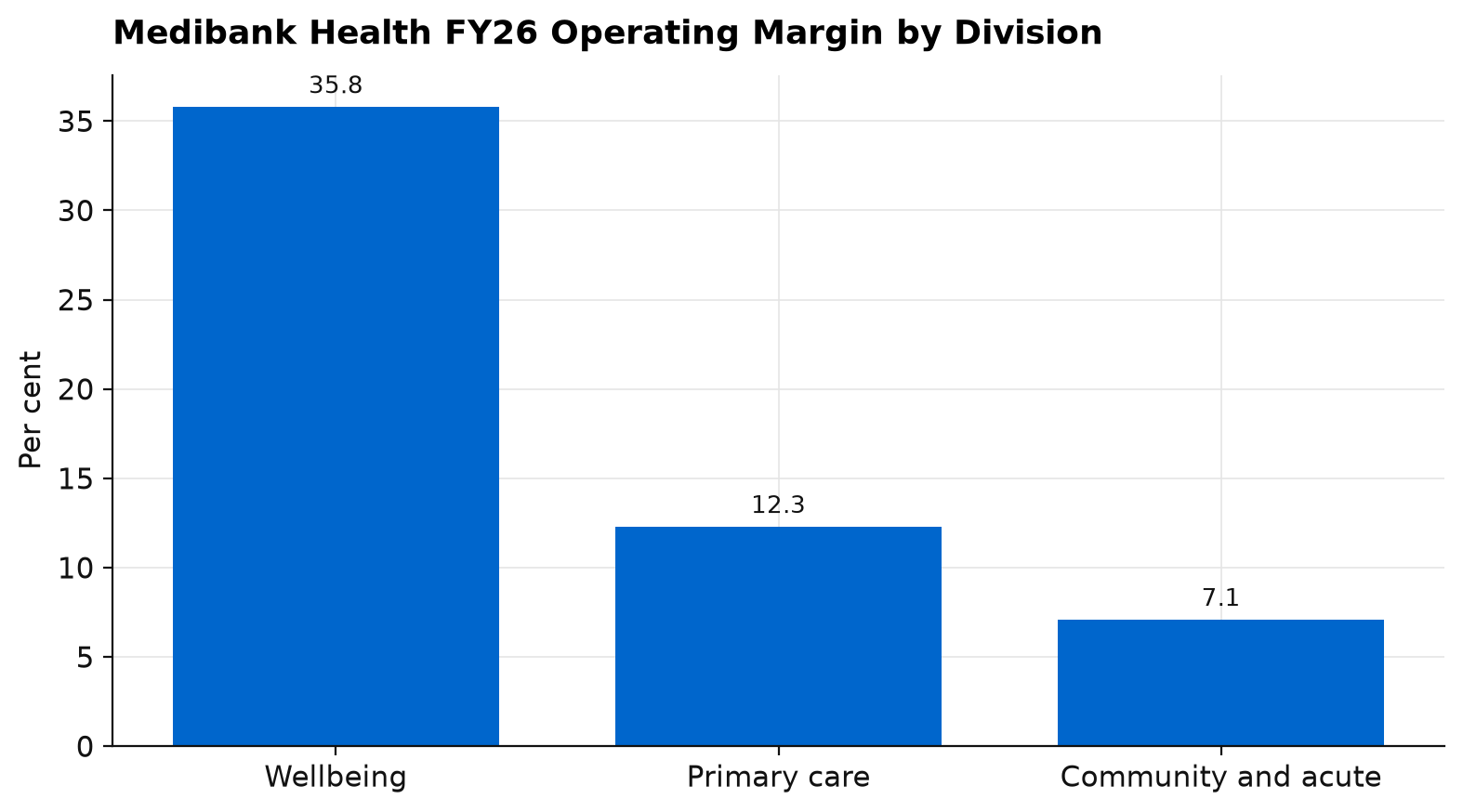
Segment gross margin fell 180 basis points to 51.5 per cent in FY26, driven by extra investment in Live Better and mix effects, while net margin fell only 50 basis points thanks to scale. Second-half net margin was 16.1 per cent, down from 17.2 per cent a year earlier. By division, the Wellbeing operating margin fell 310 basis points to 35.8 per cent, Primary care rose 40 basis points to 12.3 per cent, and Community and acute rose 720 basis points to 7.1 per cent. The joint venture hospital portfolio lost A$6.6 million in FY26, with second-half losses narrowing to A$3.5 million from A$4.9 million. The company still targets breakeven for FY28. It also expects Medibank Health to lift private health insurance operating profit by about 5 per cent between FY25 and FY30, worth about A$37 million.
The PCA ratio, a regulatory measure of capital held against the insurer’s minimum requirement, stood at 1.9 times. The capital ratio was 13.3 per cent, above the target range of 10 to 12 per cent, with extra capital held to offset a A$250 million supervisory adjustment from APRA, the Australian Prudential Regulation Authority. Unallocated capital rose to A$182.9 million from A$80.5 million at the first half on strong capital generation.
Management has flagged capacity to raise Tier 2 debt, a type of subordinated borrowing that counts towards regulatory capital, should attractive opportunities arise. The company wants to add growth through further mergers and acquisitions, often shortened to M&A. If suitable M&A does not turn up in a reasonable timeframe, it will look at capital management, which means returning surplus capital to shareholders.
Investment income was A$84.0 million in the second half, ahead of consensus of A$83.1 million, with underlying investment income of A$88.6 million. The underlying spread to the RBA cash rate was 177 basis points, inside the 150 to 200 basis point range the company targets. The company reported an A$6.4 million benefit to underlying income for each 25 basis points added to the cash rate.
The second-half dividend was in line with expectations, with a payout ratio, the share of underlying profit paid out as dividends, of 88.6 per cent for the half and 83.0 per cent for FY26. The full-year figure sits inside the 75 to 85 per cent target range, which is maintained for FY27.
Non-recurring cybercrime costs were A$34.9 million in FY26, in line with guidance of about A$35 million, and A$19.9 million of that fell in the second half. The IT security uplift program is now largely embedded. FY27 costs are expected to be below A$20 million, mostly tied to ongoing regulatory investigations and litigation, and that figure excludes any findings or outcomes from them.
Valuation and the Hold Rating
The 12 month price target of A$5.00 sits about 9.4 per cent above the share price of A$4.57 when this research was published. Institutional sell-side research left the target unchanged after the result, made small earnings downgrades, and forecasts stable net margins into FY27. Its estimates have net income of A$636.8 million in FY26, A$698.6 million in FY27 and A$755.0 million in FY28. Earnings per share are forecast at A$0.23, A$0.25 and A$0.27 across those three years.
Forecast dividends are A$0.19 per share for FY26, A$0.20 for FY27 and A$0.22 for FY28, all fully franked. Over the last twelve months Medibank paid A$0.192 per share, a trailing dividend yield of 4.2 per cent, fully franked, meaning the dividend carries credits for the company tax already paid on those profits.
The research likes the business for its defensive exposure to private health insurance, a broadly benign claims environment and strong organic growth in Medibank Health. Its Hold rating comes down to valuation, with a relative preference for another listed health insurer in the sector.
On the research’s numbers, resident gross margin holds broadly flat at 16.3 per cent, in line with guidance, earnings per share climb from A$0.23 to A$0.27 by FY28, and the capital position stays above target, which leaves room for acquisitions or capital management. Against those sits a book that grew at an annualised 0.4 per cent in the second half and an expense line rising to fund growth. Weighing both, the research’s target sits about 9.4 per cent above the share price at publication. The FY27 policyholder numbers are the next test of whether the marketing spend is lifting growth.
Key Risks
Pricing is the first risk. Approved premium rate increases that come in lower than expected would squeeze margins, and the 1 April 2027 increase is built into the FY27 margin guidance. The second is claims, since a return of claims inflation through normalising utilisation would erode the gross margin once the A$74.8 million COVID-19 benefit drops out. The third is competition, with slower resident policyholder growth likely if rivals and aggregators keep pressing and the lapse rate stays near the 11.6 per cent of the second half of FY26. The fourth is execution, as higher spending on marketing and AI has to deliver growth or the stable MER target comes under pressure. The fifth is specific to Medibank, with FY27 cybercrime costs guided below A$20 million but excluding any outcomes from ongoing regulatory investigations and litigation.
Our View
Medibank finished FY26 with a resident gross margin of 16.3 per cent and a second-half lapse rate of 11.6 per cent, and FY27 depends on improving the second number without giving up the first. We like the decision to put aggregator commission savings into Medibank’s own brands, since customers won through comparison websites can switch again at the next renewal. That route is slower to show in policyholder numbers, and competitors are spending hard in the meantime. The capital ratio of 13.3 per cent and A$182.9 million of unallocated capital give the board room to fund acquisitions in Medibank Health or return capital, and either would put the surplus to work. Until resident growth moves closer to the industry rate of 2.2 per cent, we see the fully franked dividend as the main attraction of the shares.
If you would like to discuss Medibank, request a callback or call us on 1300 889 603.
Financial Summary
Become an authorised representative
Advise your clients under an established AFSL without building your own. Choose AR or CAR.
Become an AR or CAR