

Hold
Mineral Resources is an ASX-listed mining and mining services company that mines iron ore, part-owns two lithium mines and digs, crushes and hauls for other miners.
Institutional sell-side research rates it Hold because strong cash generation, falling debt and growing mining services are balanced against softer expected iron ore and lithium prices. Net debt fell to A$4.3 billion and leverage is forecast below 1.5 times in FY27. Earnings are forecast to dip in FY28 as lithium prices retrace, and spare cash may go to new growth projects.
- Sell-side rating
- Hold
- Sell-side target
- A$59.00
- Upside to target
- +46.0%
- Initial price
- A$52.8319 Sep 2026
- Last close
- A$40.4218 Nov 2026
Mineral Resources returned to profit in FY26. Its result, covered by institutional sell-side research in late August, showed underlying earnings before interest, tax, depreciation and amortisation (EBITDA, a rough measure of the cash profit the operations generate) of A$2.55 billion and underlying net profit after tax of A$0.8 billion, slightly ahead of consensus forecasts thanks to a small beat from iron ore and lithium. Net debt is down to A$4.3 billion, and the board declared a final dividend of 83 cents a share when consensus had expected zero. Iron ore and lithium, which drive much of the business, both face softer prices over the next year or two, and spare cash will now be split between dividends and new growth projects. Institutional sell-side research has Mineral Resources rated Hold with a 12 month price target of A$59.00, about 11.7 per cent above the share price of A$52.83 when this research was published. The target was trimmed 2 per cent from A$60.00.
Research published 19 September 2026. Price target and upside based on prices at time of publication.
Table of contents [hideshow]
About Mineral Resources
Mineral Resources is a mining and mining services company listed on the Australian Securities Exchange under the code MIN, with a financial year that ends in June. The company was founded on mining services, the business of mining, crushing and haulage for other miners. That division works for traditional customers such as the Pilbara iron ore majors as well as for the company’s own operations, with around 80 per cent of planned FY27 volumes coming from external clients. On the commodity side, Mineral Resources runs the Onslow iron ore operation, which has ramped up to around 37 million tonnes a year, and owns 50 per cent of two lithium mines, Wodgina and Mt Marion. It has agreed to sell 30 per cent of that 50 per cent ownership to POSCO, with completion due in the first half of FY27.
Project Ramp-Ups Are Turning Into Cash and Paying Down Debt
For several years Mineral Resources was building and then ramping up large projects with the balance sheet under strain, and in FY26 those projects began to generate cash. Onslow iron ore has now ramped up to around 37 million tonnes a year, with potential to creep up to 40 million tonnes a year as the operation is refined. At Wodgina, the third processing train is ramping up over FY27. The FY27 outlook for volumes, costs and capital spending implies further growth from both Wodgina and Onslow, and institutional sell-side research describes that outlook as broadly in line with its own estimates, noting that the company continues to execute strongly on these ramp-ups.
Net debt, which is borrowings less cash, fell to around A$4.3 billion, down by more than A$1 billion on a year earlier. Liquidity, meaning the cash and committed funding the company can call on, strengthened to A$2.4 billion, including A$1.6 billion of cash. Institutional sell-side research estimates the business is now generating free cash flow, the cash left over after running costs and capital spending, of around A$700 million. On those estimates leverage, a measure of debt against earnings, falls below 1.5 times during FY27. The company’s own through-the-cycle target is below 2 times.
Those forecasts leave out the agreed sale of 30 per cent of the company’s 50 per cent ownership of the Wodgina and Mt Marion lithium mines to POSCO. The sale price is US$765 million, about A$1.2 billion, or around A$1 billion after tax on the company’s own estimate. The deal is due to close in the first half of FY27, and when it does it will reduce debt further.
The research describes the final dividend of 83 cents a share, declared when consensus had expected zero, as a vote of confidence in the balance sheet. At the share price of A$52.83 the trailing dividend yield is 1.6 per cent, fully franked, meaning it carries credits for company tax already paid.
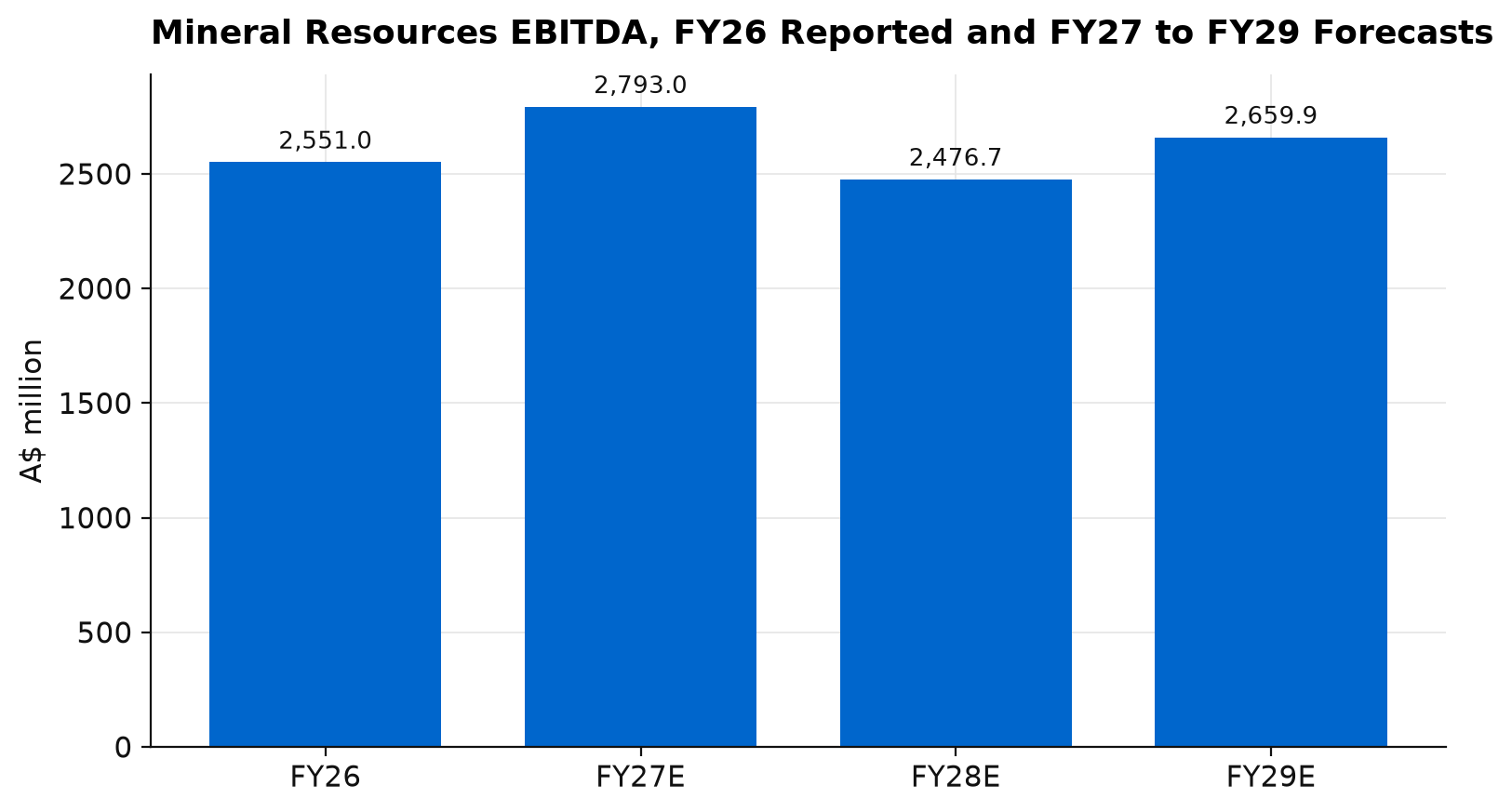
Looking further ahead, institutional sell-side research forecasts revenue of A$7,199.2 million in FY27, A$6,947.6 million in FY28 and A$7,249.1 million in FY29, against A$7,103.0 million in FY26. EBITDA is forecast to rise to A$2,793.0 million in FY27, ease to A$2,476.7 million in FY28 and recover to A$2,659.9 million in FY29. Earnings per share are forecast at A$3.15 in FY27, A$1.82 in FY28 and A$3.71 in FY29. The dip in FY28 lines up with the period in which lithium prices are expected to retrace, even as volumes keep growing.
Mining Services Growth
Institutional sell-side research describes mining services, the contract mining, crushing and haulage business the company was founded on, as high returning. The research estimates mining services will make up around 50 per cent of group EBITDA from FY27 to FY30. Its margins are measured per tonne handled, so its growth comes mainly from moving more tonnes.
A rules-based approach to leveraged ETFs
See how our quantitative strategy works and who it suits.
Explore the strategyBecome an authorised representative
Advise your clients under an established AFSL without building your own. Choose AR or CAR.
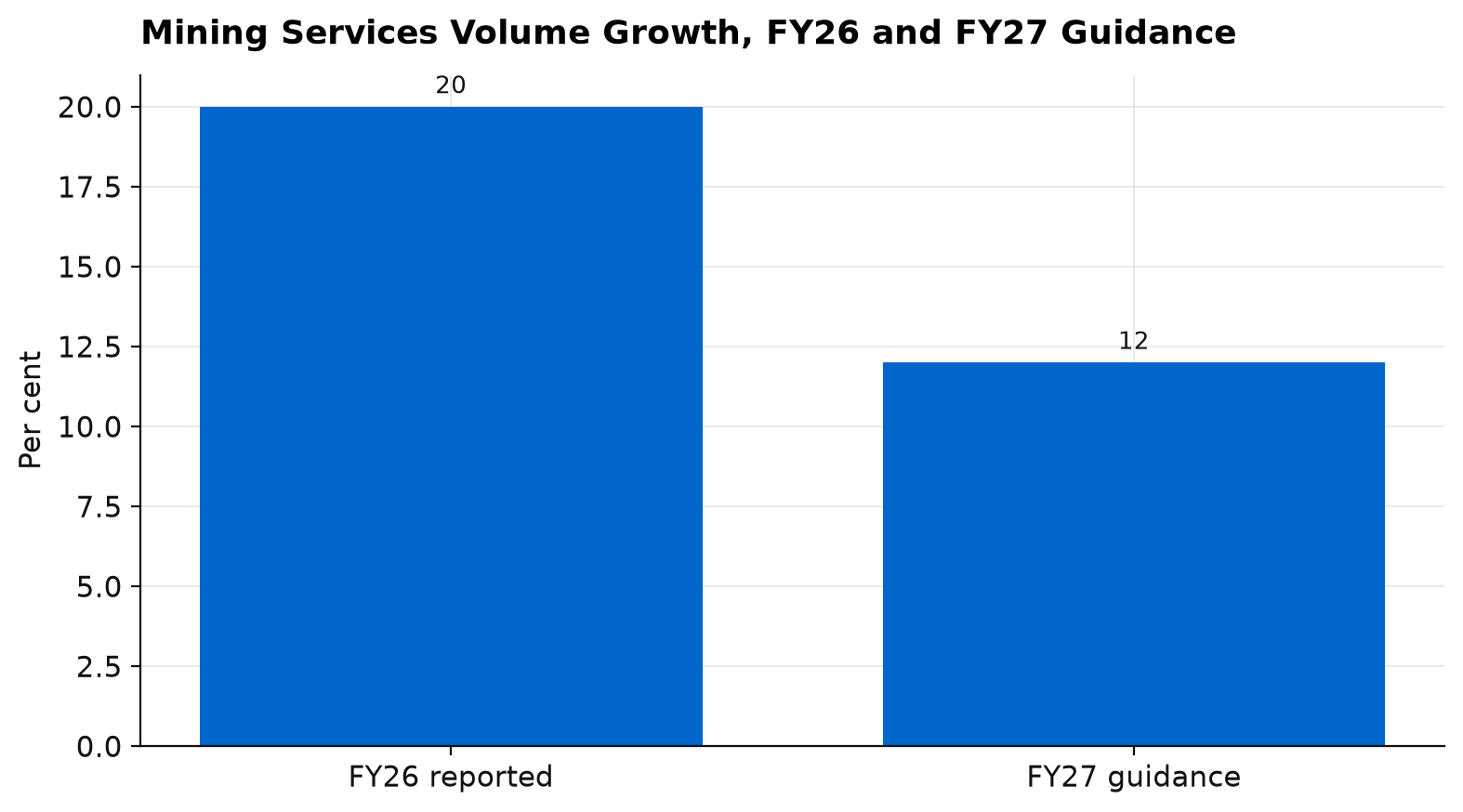
Become an AR or CARMining services volumes rose 20 per cent in FY26, mostly driven by the Onslow project, and that result beat the company’s own guidance. For FY27 the company has guided to a further increase in volumes of around 12 per cent on the year. Around 80 per cent of those volumes are expected to come from external customers and around 20 per cent from the company’s own mines. Institutional sell-side research had forecast 395 million tonnes, slightly above the top of the company’s guidance range, and notes that FY26 volumes beat guidance. Margins are expected to be maintained at around A$2 a tonne, which the company frames as a 20 to 25 per cent margin.
With the balance sheet now stronger, institutional sell-side research believes the company has started investing in and growing its higher margin external volumes with traditional customers, such as the Pilbara iron ore majors, at a faster pace. External work fits what the research calls a capital light model, where the business ties up relatively little of its own money to earn its returns.
The company has said additional external mining services work could come from a copper project on another continent, and that it might take an equity stake in that project. Institutional sell-side research notes there are several shovel ready offshore copper projects, with approvals and planning done, held by single asset companies that might suit this capital light services model. Nothing has been announced, but the research flags mining services growth in copper and iron ore as the key source of upside.
Iron Ore and Lithium Price Risks
Iron ore and lithium prices are the main swing factors in the Hold case. The FY27 guidance was mixed: guided Wodgina lithium unit costs, meaning the cost to produce each tonne, were lower than expected, while Onslow iron ore unit costs were higher than expected and capital expenditure, the money spent on building and maintaining equipment and plant, was higher at Mt Marion. The company also outlined more lithium growth projects on its May investor tour, including a further plant expansion at Wodgina and an underground mine and flotation plant at Mt Marion.
For iron ore, the benchmark most often quoted is the 61 per cent index, the price for iron ore containing 61 per cent iron. Recent industry feedback from Singapore Ferrous Week suggested that index could drop below US$95 per dry metric tonne in the third quarter of 2026. The reasons given were higher seasonal iron ore shipments, a seasonal slowdown in Chinese construction and steel production over the next few months, and shortages of coking coal in Shanxi, which add to the pressure on steel output. A lower iron ore price hits the Onslow operation directly, and it comes at the same time as Onslow unit costs are running higher than expected.
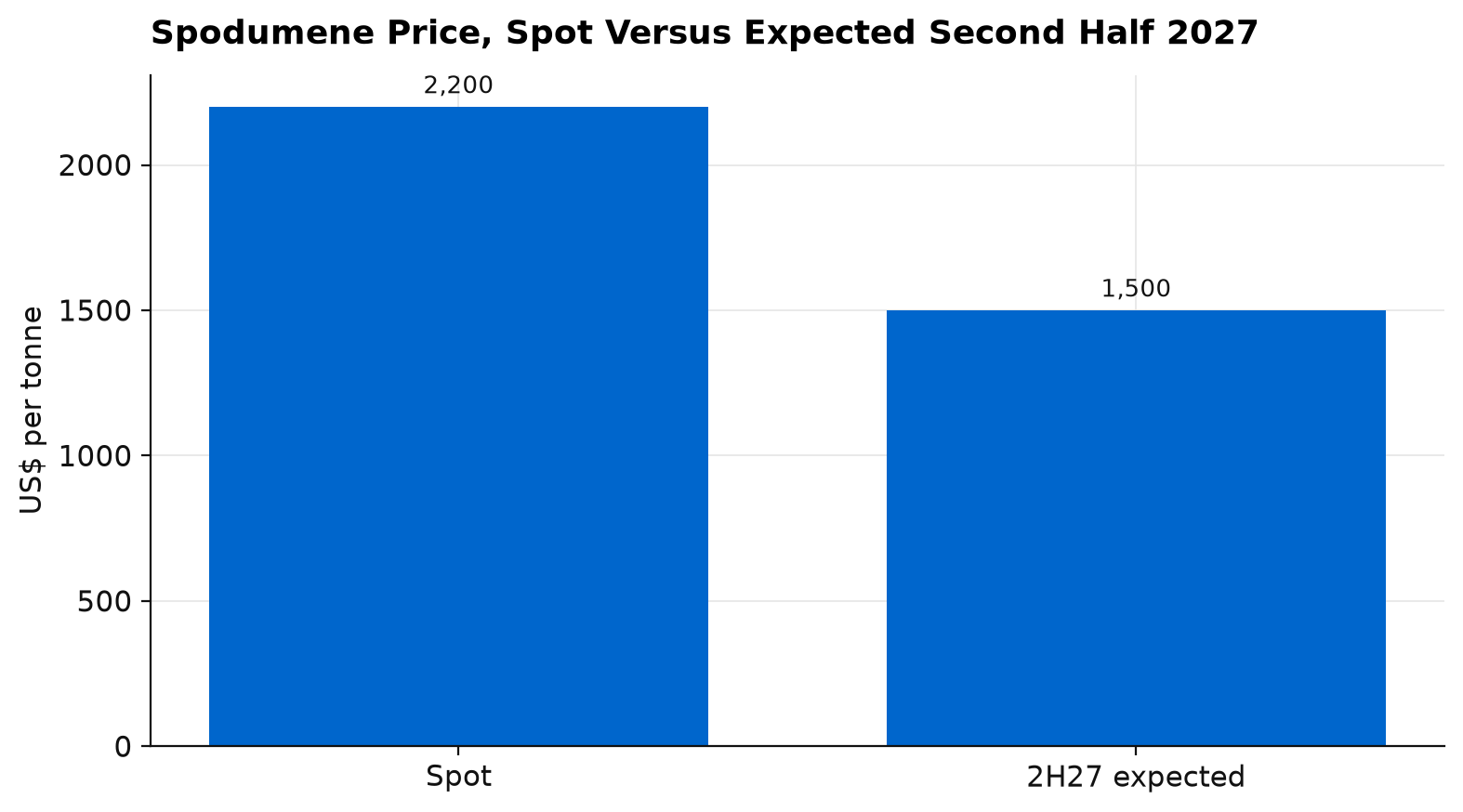
Mineral Resources also sells spodumene, the lithium-bearing mineral concentrate that is processed further into battery chemicals. Institutional sell-side research expects spodumene prices to retrace to around US$1,500 a tonne in the second half of 2027, against a spot price of around US$2,200 a tonne, driven by an expected market surplus. Current prices are encouraging swing supply in Australia, meaning mines that restart or lift output when prices are high, as well as new supply, mostly from African hard rock mines.
These price forecasts are behind the dip in forecast earnings in FY28, since iron ore and lithium still make up roughly half of group earnings.
Valuation and Why the Call Is Hold
After the result, institutional sell-side research lifted its EBITDA forecasts by 3 per cent for FY27 and 1 per cent for FY28, with FY29 unchanged. Those changes came from aligning to company guidance, increasing Wodgina FY27 production slightly and lowering costs. Its valuation still came down, on higher assumed long run iron ore unit costs, higher capital spending, an increase in provisions, which are amounts set aside for future obligations, and slightly lower long run mining services margins. The net result was a 2 per cent cut to the 12 month price target, to A$59.00 from A$60.00.
The research describes the valuation as supportive, meaning the shares are not stretched against what the business is expected to earn. It also points to robust free cash flow and falling debt, with leverage forecast below 1.5 times in FY27 even before the POSCO sale adds roughly A$1 billion after tax, and to strong volume and earnings growth in mining services, with around 12 per cent volume growth guided for FY27 and a possible copper opportunity on top. It weighs these against iron ore and lithium prices, which it expects to weaken.
At the share price of A$52.83, the target sits about 11.7 per cent above where the stock was trading, and the trailing dividend yield of 1.6 per cent is fully franked. Lithium staying firm, iron ore holding in the US$95 to US$100 range or high margin external services contract wins could lift the shares, while a weaker iron ore price and a lithium retracement could pull them the other way.
Key Risks
The biggest risk is commodity prices, because a fall in iron ore below US$95 per dry metric tonne or a retracement in spodumene toward US$1,500 a tonne would cut earnings faster than volume growth can add to them. The second is competition, with new lithium supply, mostly from African hard rock, and Australian swing supply being encouraged by current prices, while growth in external mining services depends on continuing to win contracts at high margins. The third is execution, as the further ramp-up of Wodgina and the Ashburton projects could run into operational challenges, and capital and operating costs could come in higher than expected, particularly the ongoing high waste stripping spend at the lithium operations, which is the cost of removing rock to reach the ore. The fourth is capital allocation, because with debt under control the company is free to chase new growth projects, including a possible equity stake in an offshore copper project, and those could absorb cash that would otherwise return to shareholders. Finally, the POSCO sale has not yet completed, so the extra debt reduction it brings is not yet banked. On the other side, continued lithium strength, high margin external contract wins or new mining projects added to the portfolio would all push results above current forecasts.
Our View
In our view, Mineral Resources has moved from building and borrowing to generating cash, cutting debt and paying a dividend again. The open question is how management spends its new flexibility, because a board that paid 83 cents when consensus expected zero wants to reward shareholders, but it is also looking at a copper project on another continent. We prefer growth through the capital light services model, which the research describes as high returning and which is less tied to commodity prices. We will watch which path the company takes, and where iron ore and lithium prices settle.
If you would like to discuss Mineral Resources, request a callback or call us on 1300 889 603.
Financial Summary
Become an authorised representative
Advise your clients under an established AFSL without building your own. Choose AR or CAR.
Become an AR or CAR