
Buy
Rio Tinto is a diversified miner listed on the ASX, with iron ore and copper as its two biggest businesses, plus aluminium and lithium operations.
Institutional sell-side research rates it Buy because the two projects carrying the growth case, Oyu Tolgoi and Simandou, are on or ahead of schedule, and all 2026 guidance was left unchanged. It forecasts copper equivalent production to grow by around 10 per cent and EBITDA by around 30 per cent from 2025 to 2030, while releasing capital from non-core assets. It also offers a fully franked yield of 4.5 per cent.
- Sell-side rating
- Buy
- Sell-side target
- A$176.30
- Upside to target
- +17.8%
- Initial price
- A$146.2726 Oct 2026
- Last close
- A$149.6929 Oct 2026
Rio Tinto delivered a September quarter in line with expectations. Oyu Tolgoi, the copper and gold mine in Mongolia, beat expectations on recoveries and ramp-up, offsetting a furnace rebuild at Kennecott and bad weather at Escondida. Iron ore sales rose 3 per cent on a year earlier, the new Simandou mine in Guinea reached an annualised production rate of around 10Mtpa, and all 2026 production, sales and unit cost guidance was left unchanged. Institutional sell-side research has Rio Tinto rated Buy with a 12 month price target of A$176.30, about 20.5 per cent above the recent close of A$146.27. The target was trimmed by about 1 per cent after the result and the rating is unchanged. The shares also carry a trailing dividend of about A$6.63 per share, a yield of 4.5 per cent, fully franked.
Research published 26 October 2026. Price target and upside based on prices at time of publication.
Table of contents [hideshow]
About Rio Tinto
Rio Tinto is a diversified miner listed on the Australian Securities Exchange, and its two biggest businesses are iron ore and copper. In iron ore it runs the Pilbara system in Western Australia, with Rhodes Ridge among the next mines in development, and the newer Simandou operation in Guinea. In copper its key assets are Oyu Tolgoi in Mongolia and Kennecott, and it also reports production from Escondida. Copper is forecast to deliver around 45 to 50 per cent of group EBITDA (earnings before interest, tax, depreciation and amortisation, a rough guide to operating cash profit) in 2026. The group also runs bauxite, alumina and aluminium operations, including the Kitimat, Boyne, Tomago and Bell Bay smelters, and a lithium business in Argentina. Its strategy is framed as ‘stronger, sharper, simpler’.
Oyu Tolgoi Copper Production
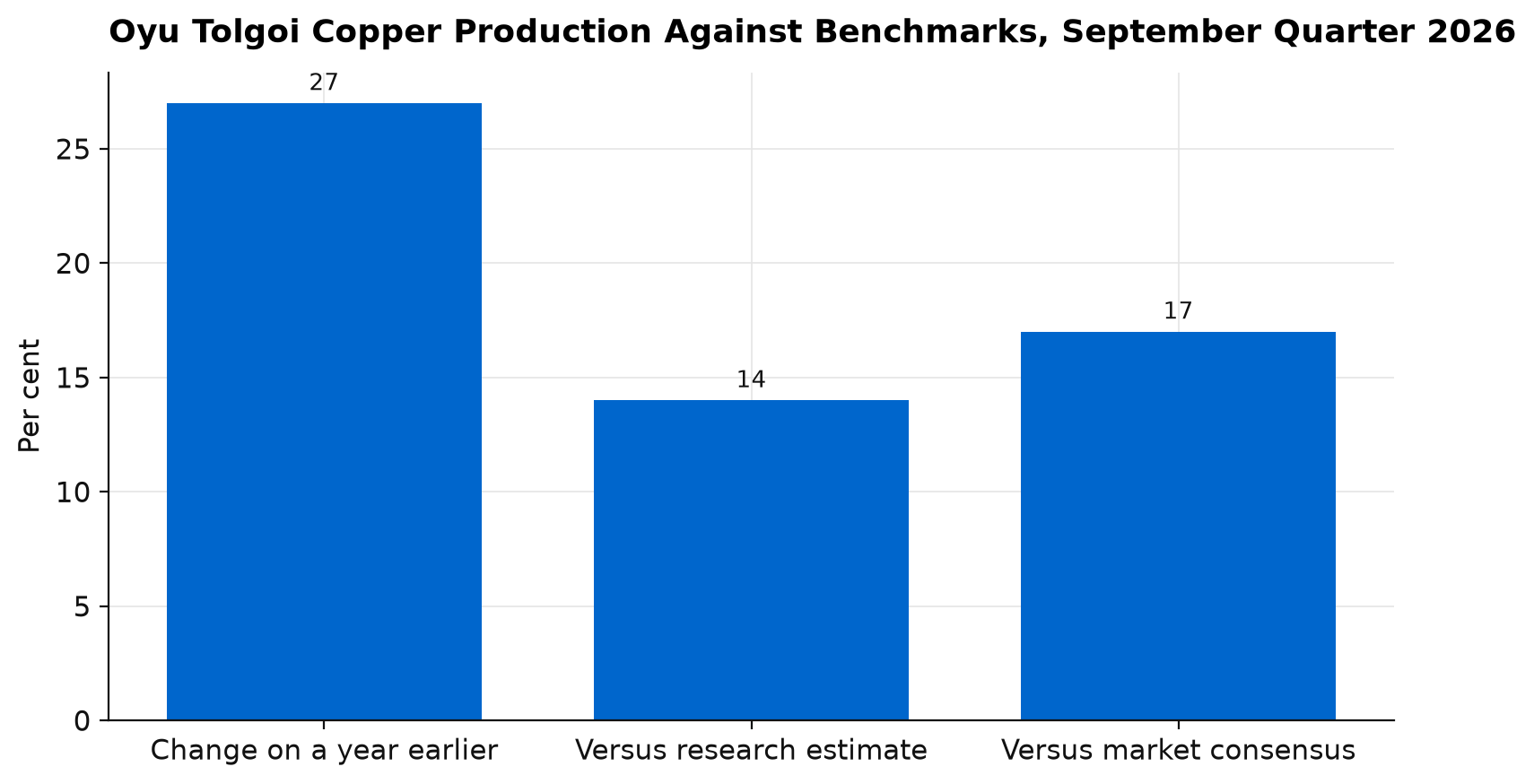
Group copper production came in at 205kt (thousand tonnes), in line with the research’s own estimate. Oyu Tolgoi produced 114kt, up 27 per cent on a year earlier, beating the research’s estimate by 14 per cent and market consensus by 17 per cent. It ran at an annualised rate of around 450ktpa, or thousand tonnes a year, during the quarter, which keeps the ramp-up on track for around 500ktpa on a 100 per cent basis from 2028 to 2036.
Kennecott refined copper of 11.7kt was down 10 per cent on a year earlier and down 43 per cent on the June quarter because the flash converting furnace, part of the smelter that turns copper concentrate into metal, was offline for a rebuild. The rebuild finished at the end of August in about 70 days, against the roughly 75 days guided in July, and the furnace is back at normal capacity. Mined copper rose to 33.7kt, up 67 per cent on the June quarter, on higher throughput, grades and recoveries. Matte, the partly processed copper that built up ahead of the converter while it was down, should now be turned into cathode, the finished copper product, during 2027.
Escondida was soft at 79kt, mostly as expected, because of severe weather, scheduled maintenance, a fatal incident and lower feed grades in line with the mine sequence. There is also a risk of industrial action that could affect production in the December quarter. Across the group, guidance of 800 to 870kt of consolidated copper production was kept, and C1 net unit cost guidance of 30 to 50 US cents per pound was unchanged. C1 is the cash cost of producing each pound of copper after crediting revenue from by-products such as gold. The research already sits at the low end of that cost range.
At Oyu Tolgoi, the next open pit phases carry lower gold grades through the rest of 2026 and into 2027 after a high gold-grade phase was completed, so the gold by-product credit that helps hold copper costs down will be smaller into 2027. At Kennecott, molybdenum production is expected to fall through the rest of 2026 and into 2027 on mine sequencing, with September quarter output of 0.9kt down 31 per cent on a year earlier, partly offset by rising gold grades and recoveries. A seismic event also occurred at the North Rim Skarn underground on 10 September, and the mine plan sequence and potential impacts are under assessment following an external geotechnical review.
Pilbara and Simandou Iron Ore
Global iron ore production was 89.7Mt, or million tonnes, up 2 per cent on a year earlier, and global sales were 90.8Mt, up 3 per cent. Pilbara shipments of 85.7Mt matched the research’s estimate and came in ahead of market consensus. Full-year sales guidance of 343 to 366Mt on a 100 per cent basis was maintained.
Management reiterated that Pilbara port outload capacity, the rate at which ore can be loaded onto ships, will be affected in some quarters of 2027 and 2028 while major capital projects are underway, including new reclaimers at Parker Point. The company’s medium-term guide is 345 to 360Mtpa, while the research takes a more cautious near-term view of around 340Mtpa.
Simandou, in Guinea, is the group’s newest iron ore mine. Production ramped to 2.5Mt in the quarter on a 100 per cent basis, an annualised run-rate of around 10Mtpa. Of that, 2.2Mt was shipped and only 1.3Mt of sales were recognised. The gap comes from a mine-to-sale cycle of around 75 to 90 days, plus up to 30 days for customers to collect.
A rules-based approach to leveraged ETFs
See how our quantitative strategy works and who it suits.
Explore the strategyBecome an authorised representative
Advise your clients under an established AFSL without building your own. Choose AR or CAR.
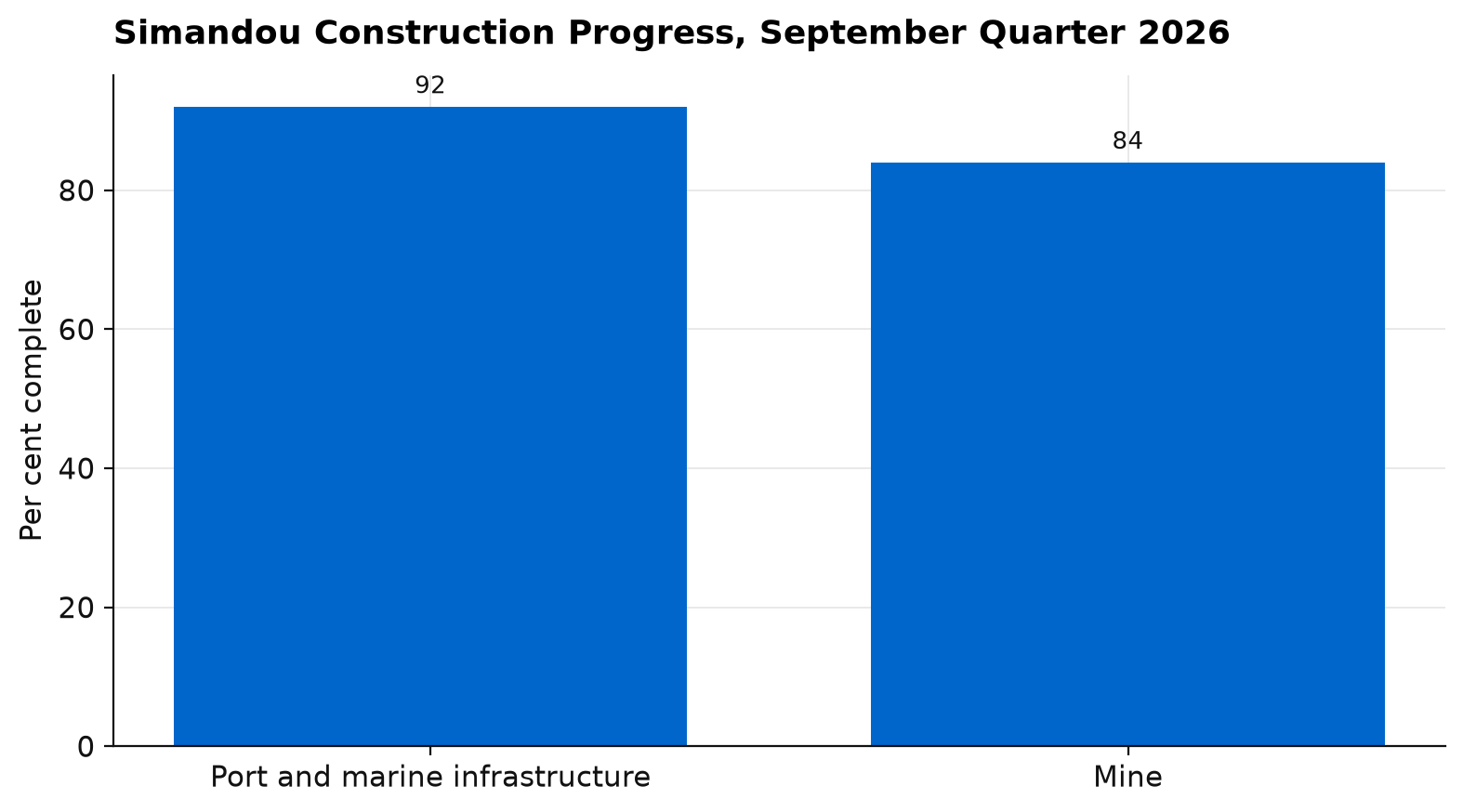
Become an AR or CARPort and marine infrastructure is 92 per cent complete and the mine around 84 per cent complete. Load commissioning and first ore through one of the two primary crushers are expected in 4Q26, as is first ore through the SimFer port. Stockpiles are substantial, with 7.9Mt of uncrushed ore at the mine and 11.1Mt across the system. The 60Mtpa run-rate during the second half of 2028 was reaffirmed.
Growth Forecasts, Simplification and Capital Release
The research forecasts copper equivalent production to grow by around 10 per cent and EBITDA by around 30 per cent from 2025 to 2030. Copper equivalent, often shortened to CuEq, adds the group’s different products together by converting each into the amount of copper it is worth, giving a single measure of total output. The drivers are the Oyu Tolgoi underground ramp-up, higher grades at Bingham Canyon copper from 2027, the Simandou ramp-up, higher Pilbara shipments and free cash flow per tonne as new mines such as Rhodes Ridge come on, expanding aluminium margins and lithium growth in Argentina. CuEq growth is forecast at just around 1 per cent in 2026, then an average of 3 per cent a year from 2027 to 2030, and copper is forecast to rise to around 60 per cent of group EBITDA by 2030.
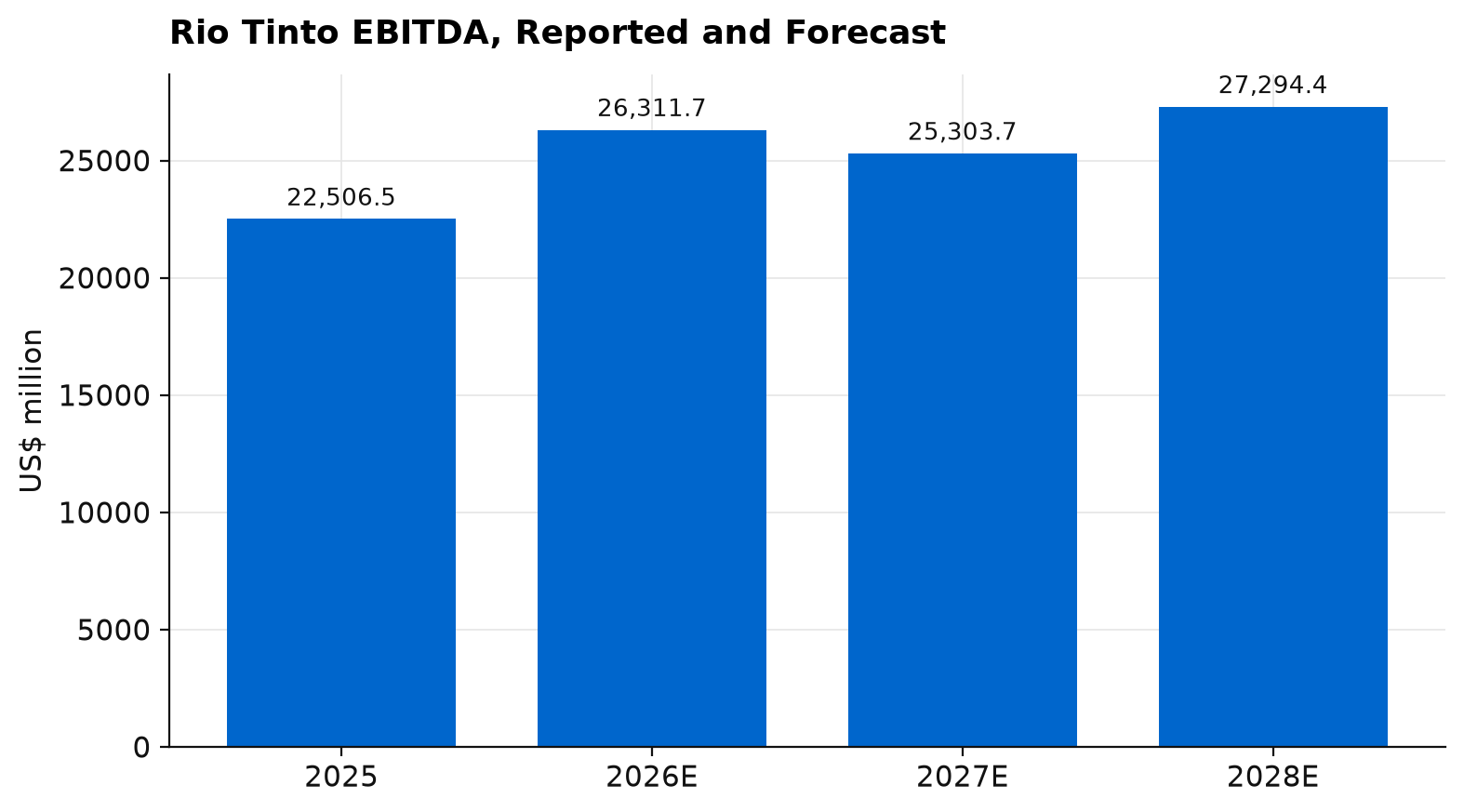
EBITDA is forecast at US$26,311.7 million in 2026, up from US$22,506.5 million in 2025, then easing to US$25,303.7 million in 2027 before rising to US$27,294.4 million in 2028. The lower gold grades, falling molybdenum output and Pilbara port works discussed above also land in 2027.
The company’s strategy, set out at its recent capital markets day, includes US$5 to 10 billion of non-core divestments and cost out, and the research expects around US$10 billion. So far this year Rio Tinto has announced more than US$2 billion of capital release, and it remains on track to announce around US$5 billion in total by the end of 2026. That includes the Dampier desalination plant, the Kitimat land sale, which is expected to complete in 4Q26, a non-binding lithium pre-payment sales contract and smaller non-core disposals. The market is being actively tested for the Borates business and options are being evaluated for Iron and Titanium. Management also reiterated its target of a US$1.8 billion annualised productivity benefit run-rate by the end of 2026. Cash from disposals can go toward paying down debt, which the research identifies as one aim of the strategy alongside lower costs.
Primary aluminium production of around 0.8Mt was down 2 per cent on a year earlier, with the Arvida closure offset by Kitimat, Boyne and the AP60 ramp-up, while alumina of 2.1Mt rose 10 per cent. The average realised US tariff cost rose to US$1,685 per tonne from US$1,322 per tonne in the first half, on 255kt of shipments to the United States, partly offset by an average Midwest premium, the extra price US buyers pay on top of the global aluminium price, of US$2,420 per tonne duty paid. The Tomago and Bell Bay power agreements struck in the quarter advanced repowering of the Pacific smelters.
In lithium, production of 13kt of LCE (lithium carbonate equivalent, the standard unit for lithium output) was up 4 per cent on a year earlier but down 11 per cent on the June quarter, after planned maintenance and severe weather at Fenix and Olaroz. Sal de Vida is ramping more slowly than expected because of equipment availability, so full-year output is now expected at the low end of the 61 to 64kt range. The US$2.5 billion, 60ktpa Rincon expansion remains on track for first production in 2028, while construction at Nemaska stays at reduced levels pending a strategic review decision on Whabouchi and Galaxy expected in 4Q26.
At Resolution copper, a challenge to the land exchange was declined on 29 September, although a further Supreme Court appeal remains possible, and underground cover-hole drilling began on 31 August, two months ahead of plan. At Winu, the Traditional Owners Project Agreement was signed on 8 September and the mining lease was granted on 22 September, with the feasibility study for around 10Mtpa on track for around the end of 2026. Exploration and evaluation expense of US$692 million so far this year is up from US$537 million, with around 50 per cent of it on copper.
Valuation and Price Target
The 12 month price target of A$176.30 sits about 20.5 per cent above the recent close of A$146.27. It was trimmed by about 1 per cent from A$178.60 after the research lowered its 2026 to 2028 EBITDA forecasts by 1 per cent to reflect the result and its latest lithium price forecasts, and to account for higher net debt. Earnings per share forecasts eased slightly as well, to US$7.87 for 2026 from US$8.01, to US$6.97 for 2027 from US$7.06, and to US$7.38 for 2028 from US$7.50, against US$6.70 in 2025. The rating is unchanged.
The research views the stock as attractively valued and expects solid free cash flow, the cash left over after running the business and paying for new investment, helped by a positive view on aluminium and a bullish view on copper. On growth, copper equivalent output is forecast to rise around 10 per cent and EBITDA around 30 per cent between 2025 and 2030 as Oyu Tolgoi, Simandou and the Pilbara replacement mines ramp up. The trailing dividend of about A$6.63 per share is a yield of 4.5 per cent at the recent close, fully franked.
Investors without exposure could build a position gradually, with the target about 20.5 per cent above the recent close. Existing holders can keep their position, with guidance held and the Buy rating unchanged.
Key Risks
The first risk is commodity prices, because weaker demand could push down the prices of iron ore, copper and aluminium, and those prices flow straight through to earnings and free cash flow. The second is heritage and permitting in Western Australia, where delays to heritage approvals could affect permitting timelines, production, product grade, costs and capital spending in the Pilbara, which the research estimates accounts for around 50 per cent of the group’s value. The third is delays to growth, with the Oyu Tolgoi underground ramp-up and the Mongolia tax dispute, Pilbara replacement mines including Rhodes Ridge, the Simandou ramp-up, lithium, Escondida and decarbonisation projects all carrying timing risk. The fourth is cost inflation, since the company spends around US$10 to 11 billion a year on capital projects and higher input costs across both capital and operating spending would erode free cash flow and shareholder returns. The North Rim Skarn seismic event at Kennecott, possible industrial action at Escondida and lower gold grades at Oyu Tolgoi into 2027 could all weigh on near-term numbers. Finally, the Sal de Vida delay shows new lithium operations can ramp more slowly than planned, and the Nemaska decision and a possible Supreme Court appeal on Resolution remain open.
Our View
We like this result. A miner with this many moving parts will almost always have a weak asset in any given quarter, and this time it was Kennecott and Escondida. The planned furnace outage finished early, guidance held, and the two projects carrying the growth case, Oyu Tolgoi and Simandou, are on or ahead of schedule. We would rather see a company releasing capital from assets it no longer needs, such as the Dampier desalination plant and the Kitimat land sale, than one borrowing to chase growth. The trade-off is that the earnings growth is back-end loaded, with 2027 forecast to be a softer year for EBITDA, so this suits investors willing to look several years out. For them, a fully franked yield of 4.5 per cent pays income in the meantime.
If you would like to discuss Rio Tinto, request a callback or call us on 1300 889 603.
Financial Summary
Learn to trade with a plan
Our free 5-day course covers entries, exits and risk management.
Start the free courseBecome an authorised representative
Advise your clients under an established AFSL without building your own. Choose AR or CAR.
Become an AR or CAR