

Hold
Treasury Wine Estates is an Australian-listed wine company best known for Penfolds, with a group of US brands that includes DAOU, FFV and Matua.
Institutional sell-side research rates it Hold because the plan is on track but the shares already sit at the level the research sees as fair for the next year. Guidance was reiterated, de-stocking is on track and leverage of 2.7 times is heading toward a target below 2 times by the end of FY28. With earnings growth pencilled in for FY28 and the first-quarter commentary unquantified, the research sees risk and reward as fairly balanced.
- Sell-side rating
- Hold
- Sell-side target
- A$5.90
- Upside to target
- −6.9%
- Initial price
- A$5.9329 Oct 2026
- Last close
- A$6.3418 Nov 2026
Treasury Wine Estates has used its annual general meeting update to tell the market that its plan is working. Guidance for FY27 was reiterated, trading in the first quarter of the year is in line with the company’s operating plan across all regions, de-stocking in both China and the United States is on track, and the program to sell brands and reduce debt is moving in the right direction. The share price has already reached the level the research sees as fair over the next year. Institutional sell-side research has Treasury Wine Estates rated Hold with a 12 month price target of A$5.90, about 0.5 per cent below the share price of A$5.93 when this research was published.
Research published 29 October 2026. Price target and upside based on prices at time of publication.
Table of contents [hideshow]
About Treasury Wine Estates
Treasury Wine Estates is a wine company listed on the Australian Securities Exchange under the code TWE. It reports in Australian dollars on a financial year that ends in June. Its best-known brand is Penfolds, which led depletion growth in Australia and ran slightly ahead of plan in China in the latest update. In the United States, the company focuses on a group of power brands that includes DAOU, FFV and Matua. Its three key regions in the latest update were China, the United States and Australia. The company is part-way through a reset that combines de-stocking, cost reduction and the sale of brands and assets. It has confirmed about $50 million of proceeds to date from the sale of Seppelt and Rosemount, with additional divestments expected by the end of the first half of FY27. Reported revenue was A$2,626.0 million in FY26.
Guidance Reiterated and the First Quarter Running to Plan
The headline from the update is that FY27 EBITS guidance was reiterated, at a level at least equivalent to FY26. EBITS is the operating profit measure the company uses in its guidance, a version of earnings before interest and tax that strips out some accounting items. In plain terms, management is telling investors that operating profit this year should at least match last year. It sets a minimum for the year and is a public commitment, which matters for a business working through a reset.
The company also said first-quarter trading was in line with its operating plan across all regions, without giving numbers.
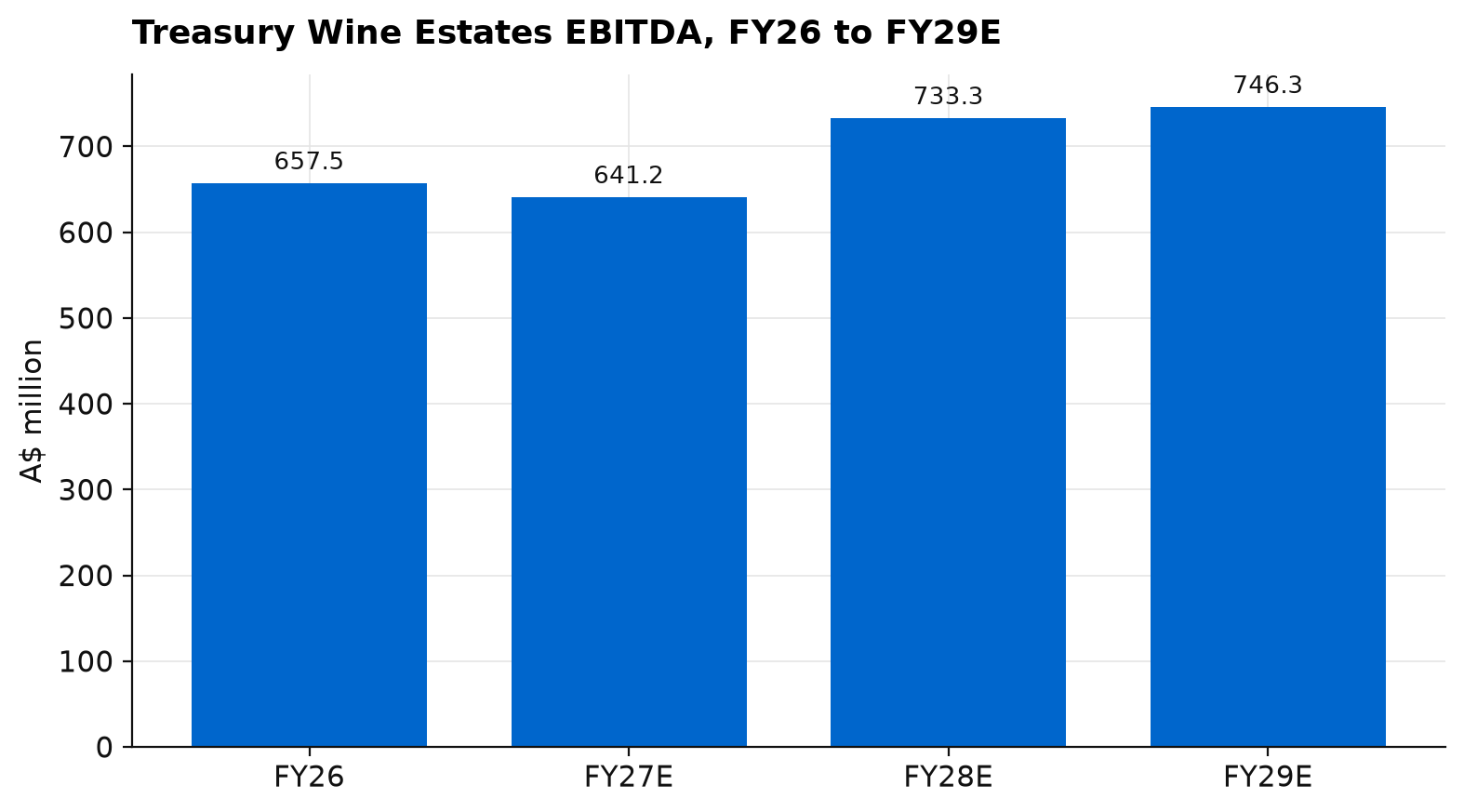
The research’s own forecasts line up with that picture of a flat year followed by a recovery. EBITDA, which is earnings before interest, tax, depreciation and amortisation and a rough guide to the cash profit a business generates from its operations, was A$657.5 million in FY26. The research expects A$641.2 million in FY27, a small dip, before a jump to A$733.3 million in FY28 and A$746.3 million in FY29. EBITS and EBITDA are different measures, so the two will not move in lockstep. Both point to FY27 as a holding year while the reset does its work, with earnings growth pencilled in for FY28 and beyond.
The near-term earnings path is flat, which means the investment case rests on the recovery arriving on schedule in FY28. If it does, the forecasts point to a meaningful step up in earnings. If it slips, investors may wait longer than expected for growth to return.
Penfolds and the US Power Brands Lead Depletion Growth
Depletions are the volume of wine that distributors and retailers sell on toward the consumer, in other words how much is leaving the warehouse and heading to a shelf or a table. Shipments are what the company itself sells into those distributors. When the channel is holding too much stock, the company has to ship less than is being depleted for a period so the excess can run down. That process is called de-stocking, and it lowers reported sales in the short term. Once that is done, shipments can follow what consumers are buying.
The update confirmed that de-stocking occurred in both China and the US and is on track. Excess channel inventory in China and the US is one of the key risks the research identifies. Until the excess stock is cleared, reported sales understate what consumers are actually drinking, and the market has no clean read on the true level of demand.
In China, Penfolds depletion growth was slightly ahead of plan, although again the company did not quantify it. The company cited strong consumer demand, better market conditions than in the same period a year earlier, and ongoing action to divert parallel product into authorised channels, with further action taken in the first quarter of FY27. Parallel product is genuine wine that reaches a market through unofficial routes, outside the company’s appointed distributors. It can undercut official pricing and blur how much demand is really there. Pulling that product back into authorised channels gives the company more control over price and a clearer view of what consumers are actually buying.
In the US, depletions for the power brands strengthened during the quarter, with DAOU, FFV and Matua named. The research lists Americas margin headwinds and supply chain restructuring among its key risks, so firmer depletions there are an encouraging sign, as stronger sell-through gives the company more room on pricing and production.
A rules-based approach to leveraged ETFs
See how our quantitative strategy works and who it suits.
Explore the strategyBecome an authorised representative
Advise your clients under an established AFSL without building your own. Choose AR or CAR.
Become an AR or CARIn Australia, Penfolds led depletion growth, and independent retail (bottle shops and liquor stores outside the large chains) was called out as a key highlight.
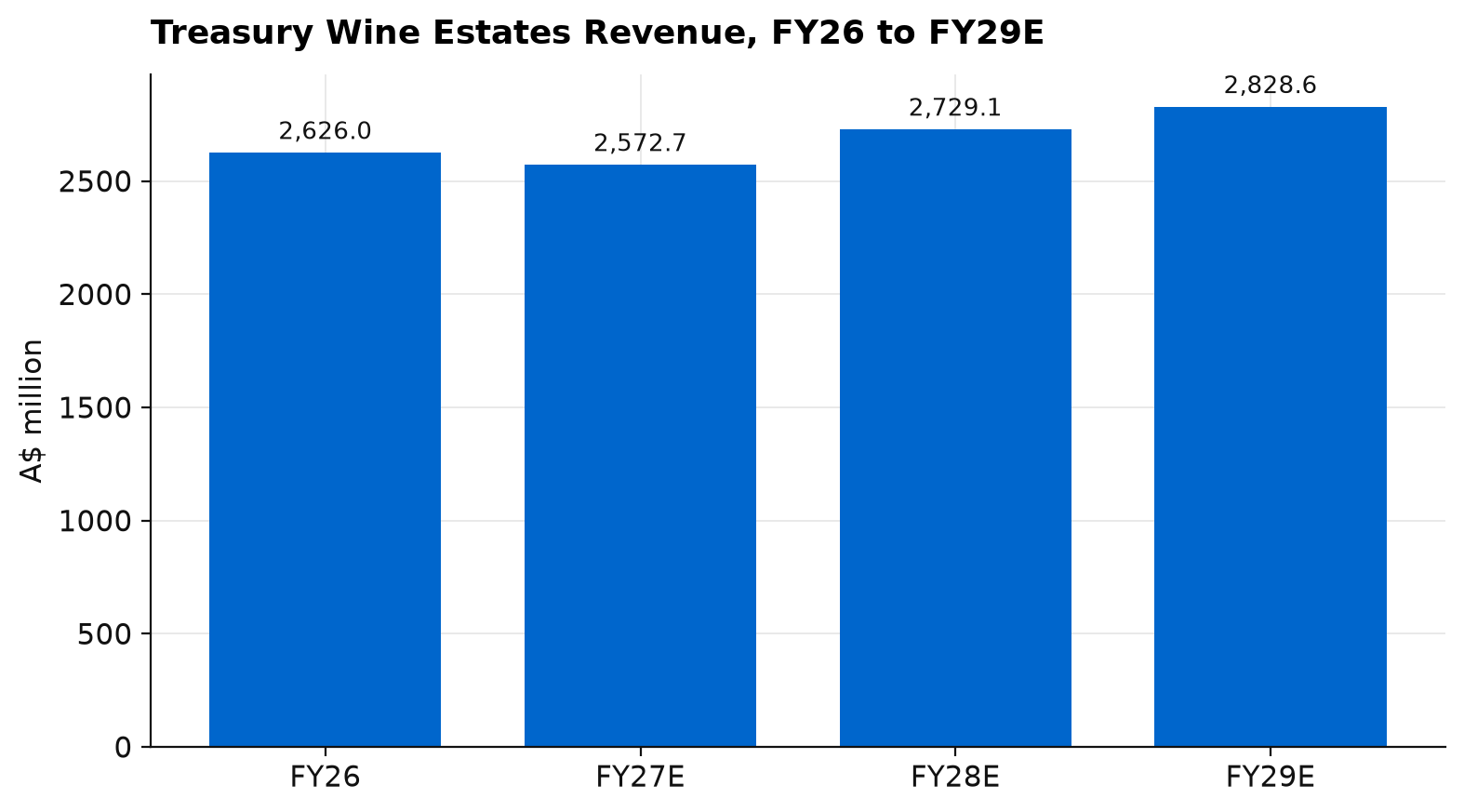
Revenue was A$2,626.0 million in FY26. The research expects it to ease to A$2,572.7 million in FY27, a pattern that fits a year in which de-stocking is still running, before rising to A$2,729.1 million in FY28 and A$2,828.6 million in FY29. The depletion trends reported this quarter are early support for the FY28 forecasts, but the company still has to show that better sell-through turns into higher shipments once the excess stock has cleared.
Divestments and Cost Out Are Bringing Debt Down
The third part of the story is the balance sheet. Leverage, in this context, is a measure of how much net debt the company carries relative to its annual operating earnings. A reading of 2.7 times means net debt is a little under three years of those earnings. A lower number leaves a company more room to absorb a weak year without pressure from its lenders, and more freedom to invest in its brands.
Treasury Wine Estates ended the first quarter of FY27 with leverage of 2.7 times. Its target, reiterated at the update, is below 2 times by the end of FY28. The company stressed that this target excludes any benefit from brand and asset divestments, so it is meant to be reachable without sale proceeds, with any money from brand sales coming on top.
On that front, about $50 million of proceeds has been confirmed to date from the sale of Seppelt and Rosemount, and additional divestments are expected by the end of the first half of FY27. Selling brands turns assets into cash that can be used to reduce debt. Because these proceeds sit outside the leverage target, every dollar raised gives the company more headroom than its own plan assumes.
Cost out, the program to take costs out of the business, remains on track, though the update gave no figure for it. Even so, lower costs are one of the levers that should help the company hold its guidance floor in a year when revenue is still working through de-stocking.
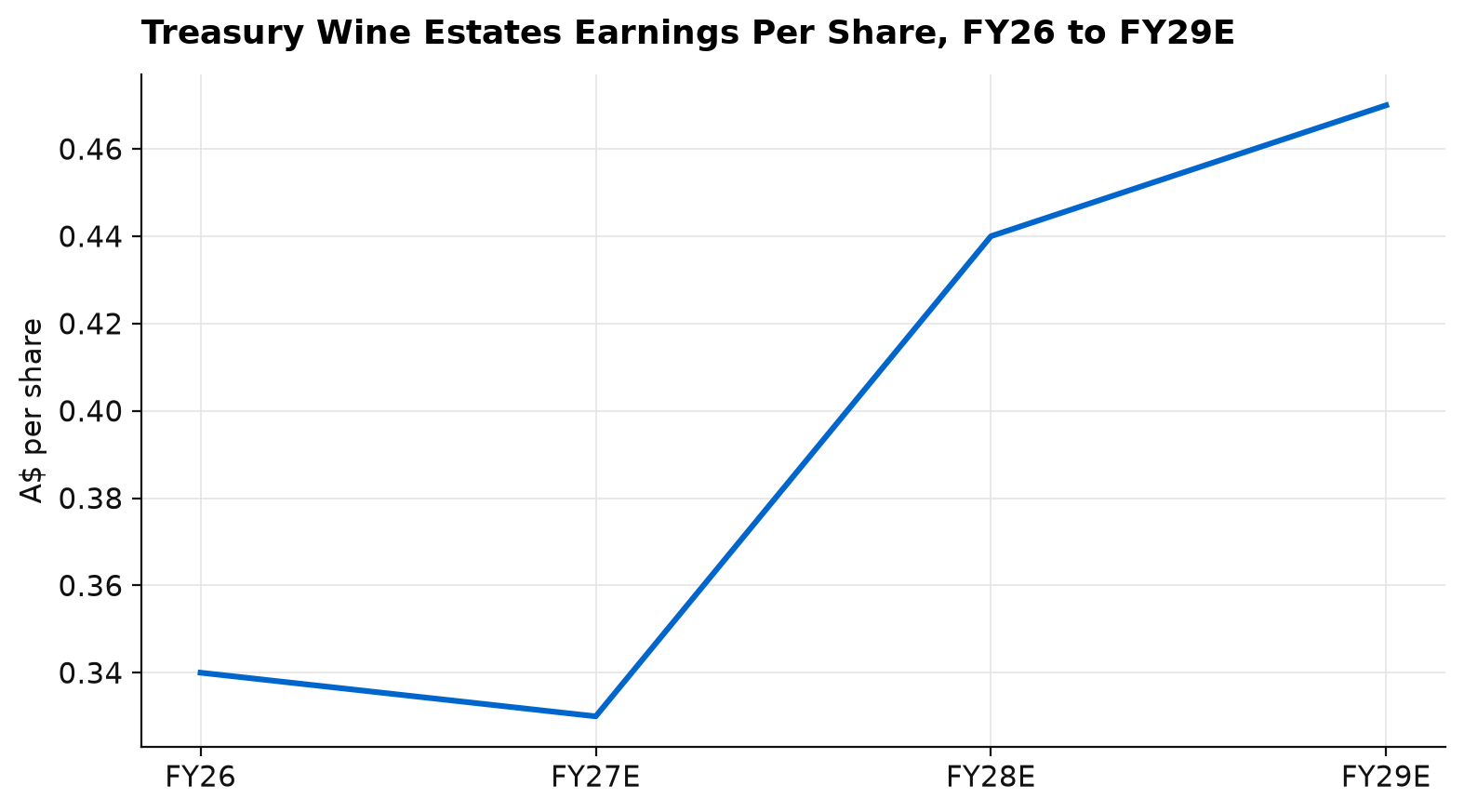
Put together, lower debt and lower costs should flow through to earnings per share over time, since less debt means less interest to pay and lower costs mean more of each sales dollar reaches the bottom line. The research’s forecasts show earnings per share of A$0.34 in FY26, easing to A$0.33 in FY27, then lifting to A$0.44 in FY28 and A$0.47 in FY29. As with revenue and EBITDA, FY27 is the flat year and FY28 is where the step change sits.
The research also notes that short interest in the stock was about 11 per cent as at 9 October. Short interest is the proportion of shares that investors have borrowed and sold in the expectation that the price will fall. At that level, a sizeable group of investors is betting the reset falls short. If the company keeps hitting its milestones, some of those positions may need to be closed, which can support the price. If it stumbles, that same group is positioned to add pressure.
Valuation and Why the Price Already Reflects the Plan
The 12 month price target of A$5.90 sits about 0.5 per cent below the share price of A$5.93 when this research was published. The share price is already at the level the research sees as fair for the next year. The update confirmed the plan, and the market had already priced that in.
The target rests on three things. First is the guidance floor, with FY27 EBITS at least equivalent to FY26, which limits how far near-term earnings should fall if the plan holds. The second is the recovery the research expects from FY28, with earnings per share forecast to rise from A$0.33 in FY27 to A$0.44 in FY28. The third is the deleveraging path from 2.7 times toward below 2 times by the end of FY28, before any benefit from divestments. All three are on track, and none is running ahead of plan.
That leaves the risk and reward fairly balanced. China depletions running slightly ahead of plan, stronger US power brands and further divestment proceeds all give the company room to beat its own targets. Against that, the balance sheet is still carrying more debt than the company wants, the first-quarter commentary was not quantified, and the earnings recovery is an FY28 story, which is a long wait for a stock that has already reached its target. At the current price, the shares offer no upside to the target to compensate for the execution risk of the reset.
Institutional sell-side research rates the stock Hold. The company has earned some credibility at this update, but at A$5.93 the shares already sit at the A$5.90 target. We would want to see evidence that the recovery is running ahead of plan, ideally in figures at the half-year result, before the case for further upside firms up.
Key Risks
Pricing and brand momentum come first. The research flags the trajectory of Penfolds depletions and net sales revenue (the revenue the company keeps after discounts and duties) as a risk that can cut either way, and Penfolds is the brand the recovery leans on most. The second is channel inventory, because excess stock in China or the US would mean de-stocking takes longer than planned and would push out the revenue recovery the research expects from FY28. The third is execution in the Americas, where the research points to margin headwinds and supply chain restructuring that could weigh on profit even if depletions keep improving. The fourth is the balance sheet itself, which the research frames in terms of fragility and valuation, and with leverage at 2.7 times against a target below 2 times, any slip in earnings would slow the path to lower debt.
Our View
We think this was a good update for a company that needed one. Reiterated guidance, de-stocking on track, Penfolds ahead of plan in China and firmer US power brands are all the right signals, and setting the leverage target without counting on divestments is prudent. Selling brands and cutting costs is the right way to bring debt down. The problem is price. The shares sit at the target, the earnings recovery is an FY28 story, and the most important operating comments in the update came without numbers. The next test is the half-year result, where the company will have to put numbers behind the progress it described. If those numbers show Penfolds and the US power brands running ahead of plan, there is a case for a better outcome than the target implies. If they only confirm the plan, the shares look fairly priced where they are.
If you would like to discuss Treasury Wine Estates, request a callback or call us on 1300 889 603.
Financial Summary
Become an authorised representative
Advise your clients under an established AFSL without building your own. Choose AR or CAR.
Become an AR or CAR