

On Holding‘s own market capitalisation is bigger than its listed share count alone implies. The Zurich-based running brand trades a single class of shares on the New York Stock Exchange, but a second, unlisted class of shares carries real economic entitlement under the company’s own dividend rules, and accounting for it adds roughly US$1 billion to the market value implied by the listed share count alone. That is a detail buried in the filings rather than a reason to buy on its own, but it sits alongside a results run that has been genuinely strong: gross margin reached 65.4 per cent and adjusted EBITDA margin reached 19.8 per cent in the second quarter of 2026, both up year on year even while the company fully absorbed a 20 per cent US tariff on its Vietnam-sourced shoes and before any tariff refund was booked. In September 2026 the company set out new targets through 2029 built on the same mix shift that has been running since 2024: net sales of at least CHF 5.6 billion, a gross margin held at 65 per cent or above, and an adjusted EBITDA margin of at least 22 per cent. Institutional sell-side research has On Holding rated Buy with a 12-month price target of US$44.00, about 45.7 per cent above the recent close of US$30.20.
Research published 2 October 2026. Price target and upside based on prices at time of publication.
About On Holding
On Holding AG is a Swiss performance footwear, apparel and accessories brand founded in 2010 and headquartered in Zurich, present in more than 90 countries. It designs running, outdoor, training, all-day and tennis products and sells through two channels, wholesale (58.2 per cent of FY2025 net sales) and direct-to-consumer (41.8 per cent and growing), across three reporting regions: the Americas, Europe Middle East and Africa, and Asia-Pacific. The group reports its financial statements in Swiss francs and listed its Class A ordinary shares on the New York Stock Exchange under the ticker ONON in 2021; the stock itself trades in US dollars. FY2025 net sales were CHF 3,014.0 million, up 30.0 per cent on FY2024, valuing the company at about US$10.1 billion on the full economic share count (Class A and Class B combined). Investor presentations are on the investor relations site, and SEC filings are on EDGAR.
Net Sales Has Compounded While the Company Keeps Raising Its Own Bar
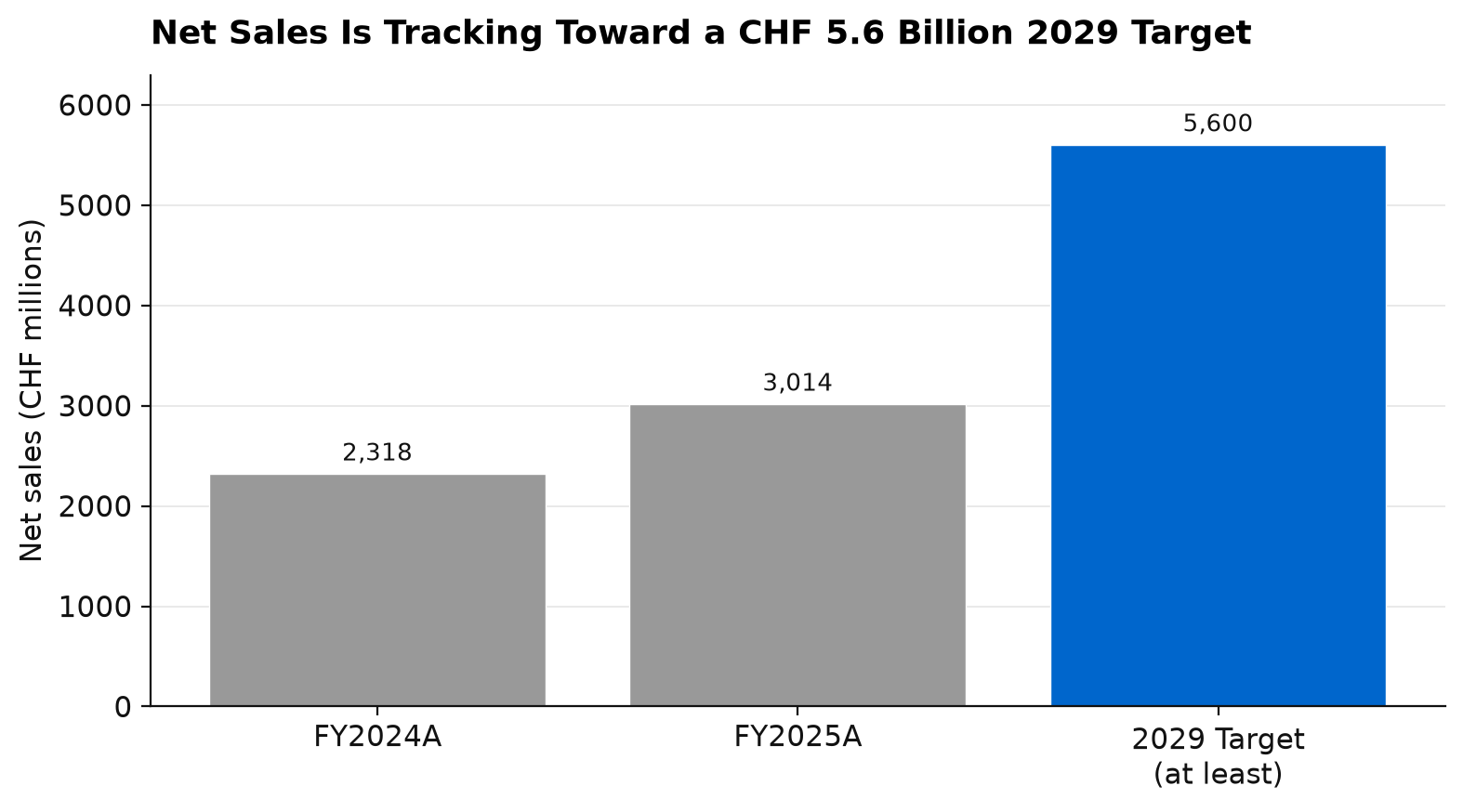
Net sales grew from CHF 1,792.1 million in 2023 to CHF 2,318.3 million in 2024 to CHF 3,014.0 million in 2025, up 30.0 per cent in the most recent year, or 35.6 per cent on a constant currency basis. That pace continued into 2026: second quarter net sales were CHF 850.3 million, up 13.5 per cent as reported and 21.6 per cent in constant currency, and management guides full-year 2026 constant currency growth to the low-20 per cent range, a figure that excludes any benefit from the tariff refunds expected later in the year. The ambition set out at the September 2026 Investor Day calls for net sales to reach at least CHF 5.6 billion by 2029, described by the company as approaching USD 7 billion at current exchange rates, on a high-teens constant currency compound annual growth rate. Measured against the CHF 3,014.0 million the business already did in FY2025, that is a target the recent growth rate would clear with room to spare rather than a stretch assumption. By product, shoes remain the large majority of sales at CHF 2,804.4 million in FY2025, up 27.5 per cent on FY2024, while apparel grew faster off a smaller base, up 68.2 per cent to CHF 169.9 million, and accessories more than doubled to CHF 39.6 million. Shoes still made up 93.0 per cent of FY2025 net sales, so the apparel and accessories growth is an early-stage diversification story rather than a material shift in the revenue mix today.
Asia-Pacific and Direct-to-Consumer Are Where the Growth Is Concentrating
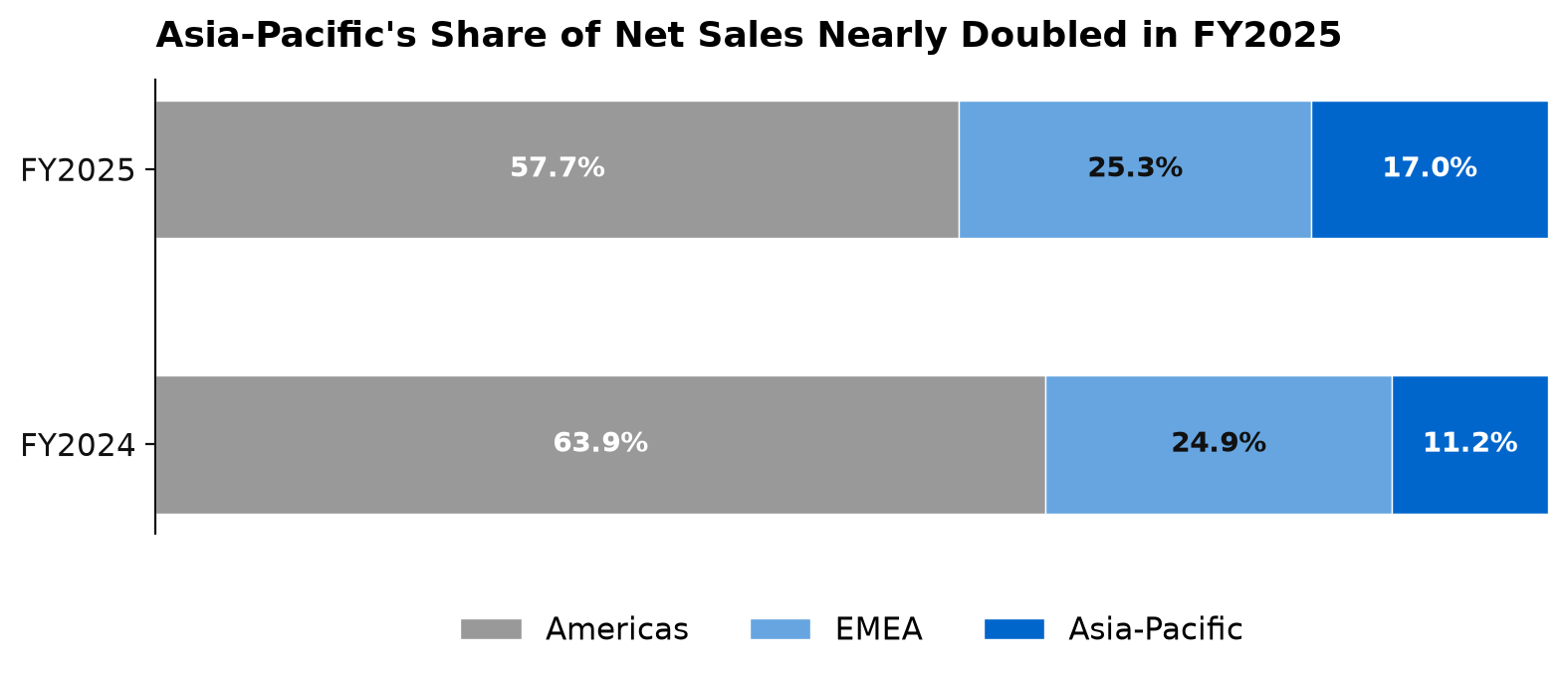
The regional mix has moved sharply over the past two years. Asia-Pacific went from 11.2 per cent of FY2024 net sales to 17.0 per cent in FY2025, while the Americas slipped from 63.9 per cent to 57.7 per cent and EMEA held roughly flat at 25.3 per cent. The same pattern showed up in the second quarter of 2026: Asia-Pacific net sales rose 43.1 per cent to CHF 170.5 million, more than three times the 4.5 per cent growth in the Americas and faster than the 15.4 per cent growth in EMEA, with the company citing particular momentum in Japan, South Korea and Greater China. Direct-to-consumer is moving the same way. The channel was 41.8 per cent of FY2025 net sales, up from 40.7 per cent in FY2024, and reached a second-quarter record of 45.7 per cent of net sales in Q2 2026, growing 26.0 per cent (34.3 per cent in constant currency) against 4.8 per cent wholesale growth (12.7 per cent in constant currency) over the same quarter. Both shifts matter for the same reason: a store On owns and runs itself, and a region where the brand is earlier in its adoption curve, both tend to carry a better margin than a mature wholesale account, which is the mechanical link between this mix shift and the margin expansion covered next.
Margins Are Expanding Before Any Tariff Refund Has Been Booked
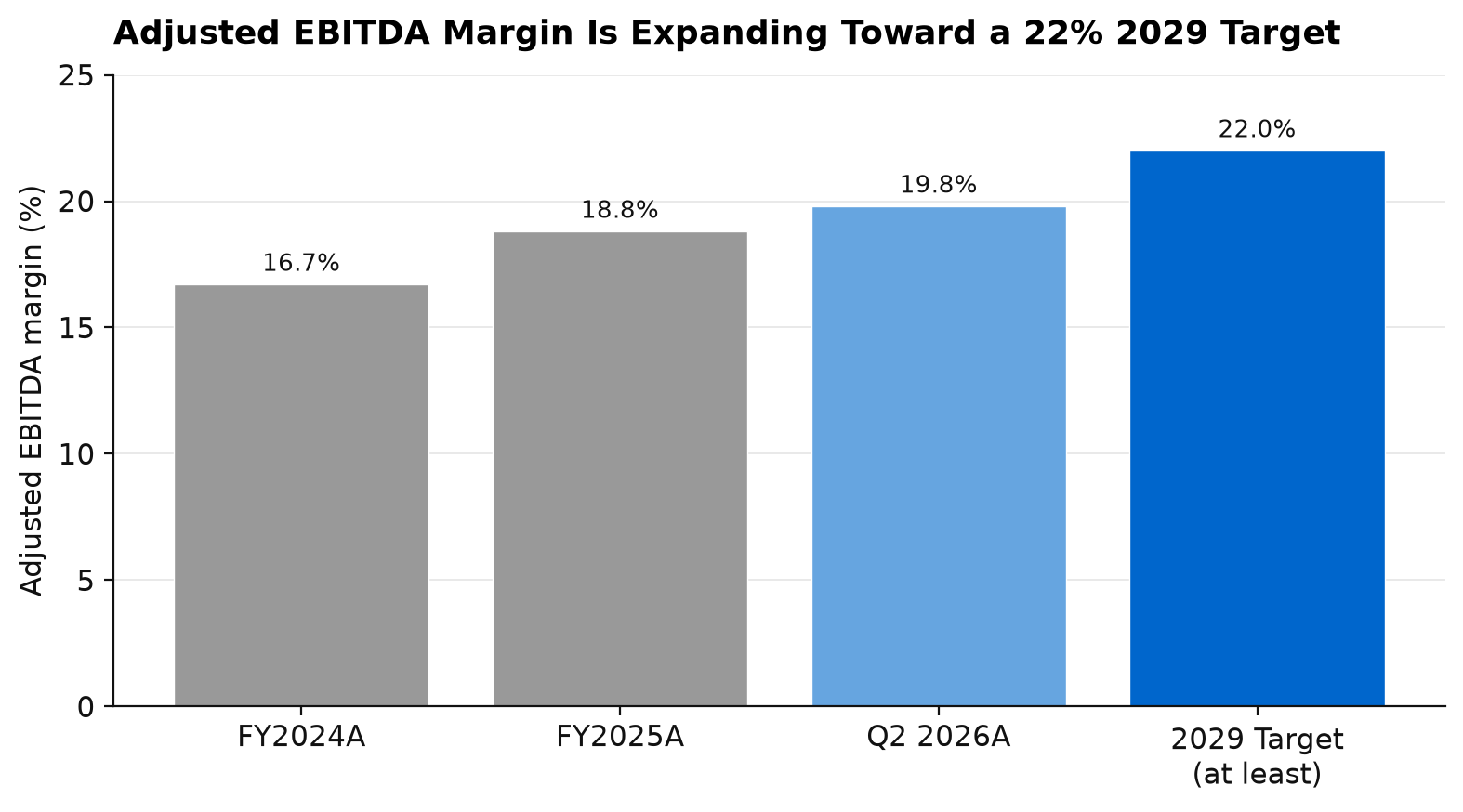
Margin expansion has been the more consistent story than revenue growth. Adjusted EBITDA margin rose from 16.7 per cent in FY2024 to 18.8 per cent in FY2025, then to 19.8 per cent in the second quarter of 2026, up from 18.2 per cent a year earlier. Gross margin in that same quarter reached 65.4 per cent, up 3.9 percentage points year on year, and the company has raised its full-year 2026 gross margin guidance to at least 65.0 per cent. None of that includes any tariff refund. Approximately 90 per cent of On’s footwear was produced in Vietnam in 2025, and a 20 per cent US reciprocal import tariff on goods from Vietnam took effect in August 2025, on top of an existing 20 per cent Vietnamese import tariff, adding directly to the cost of goods the company has been selling. As of 30 June 2026 the company had paid CHF 55.6 million in these IEEPA tariffs, submitted CHF 52.7 million of that through the US Customs refund process, and had not recognised any of it in its results because recovery was not yet considered virtually certain. By 11 August 2026 it had received CHF 27.9 million of refunds, to be recognised in the third quarter of 2026; the company’s Investor Day guidance six weeks later put total tariff refunds of up to USD 65 million (up to CHF 53 million at current exchange rates) as expected in the third quarter of 2026. The bottom line moved the same way: second-quarter 2026 net income was CHF 105.0 million, up 356.5 per cent, a swing of CHF 145.9 million, from CHF (40.9) million a year earlier, net income margin reached 12.3 per cent against negative 5.5 per cent in the prior-year quarter, and basic earnings per Class A share were CHF 0.31 against a loss of CHF 0.12. The balance sheet funding the capital return programme described below has strengthened alongside it: cash and cash equivalents were CHF 1,205.6 million at 30 June 2026, up 18 per cent from CHF 1,019.9 million at 31 December 2025, and net working capital was CHF 635.9 million, up 11.5 per cent over the same six months. The 2029 target is an adjusted EBITDA margin of at least 22 per cent, a gross margin held at 65.0 per cent or higher throughout the period, and an adjusted EBITDA compound annual growth rate above 20 per cent for 2026 to 2029, run alongside a Class A share buyback of up to USD 1 billion through the end of 2029 that the board authorised in September 2026. Margin already expanding on an ex-refund basis is the clearest line from the current result to the 2029 margin target; the buyback works on a separate, per-share lever, shrinking the count earnings are divided by rather than changing the margin itself.
On Holding has two classes of shares, and only one of them trades. The Class A ordinary shares (par value CHF 0.10) are the shares listed on the New York Stock Exchange under ONON. The Class B voting rights shares (par value CHF 0.01) are unlisted and held only by members of the company’s extended founder team. Each share in either class carries one vote at the shareholder meeting regardless of par value, but because a Class B share represents a tenth of the capital of a Class A share, on a capital-invested basis it carries ten times the voting power. The company’s own annual report is specific about economics as well as votes: entitlements to dividends and other distributions are calculated based on par value, so each Class B share carries one-tenth of the economic claim of a Class A share, the same ten-to-one ratio as the par values themselves. As of 30 June 2026, the most recent filed count, there were 301,715,535 Class A shares and 324,991,680 Class B shares outstanding. Converting the Class B count to its Class A-equivalent economic claim (324,991,680 divided by ten) and adding it to the Class A count gives an economic share count of 334,214,703. At the US$30.20 close on 1 October 2026, the Class A-only share count values the company at about US$9.11 billion. The full economic share count values it at about US$10.09 billion, roughly US$1 billion higher.
Valuation
Institutional sell-side research has On Holding rated Buy with a 12-month price target of US$44.00, about 45.7 per cent above the recent close of US$30.20. Three things anchor that view. The first is that margin expansion is running ahead of the tariff relief still to come, with gross margin at 65.4 per cent and adjusted EBITDA margin at 19.8 per cent in the second quarter of 2026 before any of the up to USD 65 million of tariff refunds expected in the third quarter has been booked. The second is the mix shift toward Asia-Pacific and direct-to-consumer, both of which grew faster than the rest of the business in FY2025 and again in the second quarter of 2026, and both of which tend to carry a better margin than a mature wholesale account in an established region. The third is the capital return now layered on top of that, a Class A buyback of up to USD 1 billion through the end of 2029 that reduces the share count earnings are divided by, running alongside the 2029 targets of at least CHF 5.6 billion of net sales, a gross margin held at 65.0 per cent or above, and an adjusted EBITDA margin of at least 22 per cent. The risk and reward favour the Buy call on the numbers already in hand: margin has expanded on an ex-refund basis, and the refund itself, the Asia-Pacific and direct-to-consumer mix shift, and the buyback are all still to compound from here.
Key Risks
Trade policy is the nearest-term risk. The 20 per cent US reciprocal tariff on Vietnam that took effect in August 2025 applies to the large majority of On’s footwear production, and the company itself has said recovery of the CHF 52.7 million in refunds it had submitted as of 30 June 2026 was not virtually certain, meaning the up to USD 65 million expected in the third quarter of 2026 is guidance, not a booked number, and further tariff changes could add cost rather than return it. On the competitive side, the premium running and sportswear category is crowded, and the direct-to-consumer and Asia-Pacific growth this piece is built around could slow if larger, better-capitalised competitors respond with their own pricing or marketing. On execution, the 2029 targets are management’s own ambition rather than a guarantee, full-year 2026 guidance already excludes the tariff refund benefit, and a shortfall against the high-teens net sales growth or the 22 per cent EBITDA margin ambition would be a genuine miss against the thesis, not just noise. On governance, the dual-class structure that this piece values at a higher market cap than the Class A share count alone also means the extended founder team, together with the company’s other executive officers and directors, held about 57.1 per cent of total voting power as of 31 December 2025 against about 16.8 per cent of the economic interest, so minority shareholders have limited ability to influence board composition or major corporate decisions regardless of how the stock performs. Finally, the group reports its financial statements in Swiss francs while the large majority of its sales and costs are earned in other currencies, so reported growth and margin figures carry currency translation effects on top of the underlying trading performance, which is why this piece has quoted constant currency growth alongside the reported figures throughout.
Our View
A buyback over a dividend looks like the right call for where this company is in its growth cycle. On Holding has not paid a dividend since listing in 2021 and is instead putting up to USD 1 billion, close to a tenth of its own market capitalisation on the full economic share count, into repurchasing Class A shares rather than starting a payout it would likely need to build up from a standing start. That only pays off if management buys opportunistically rather than on a fixed schedule regardless of price, something that can only be judged after a few quarters of actual repurchase activity rather than from the announcement itself, and there is no track record of this specific programme to point to yet. The dual-class structure is the trade-off for that founder-led discipline: the same ownership concentration that keeps management focused on a multi-year plan rather than a quarterly share price is also what caps how much influence an outside Class A holder actually has over the company’s direction.
If you would like to discuss On Holding, request a callback or call us on 1300 889 603.