

Last updated: 9 October 2026. Outlook refreshed when new sell-side notes or material market moves warrant, not on a fixed cadence.
Healthcare is often described as a slow, defensive corner of the share market. Underneath the sector index, though, a large part of the growth story now rests on new medicines and how quickly doctors start prescribing them. A sector note from institutional sell-side research, published on 2 October 2026, tracks weekly US prescription data across major drug launches, and the picture is mixed in an instructive way. Scripts for Biogen’s Leqembi IQLIK in early Alzheimer’s disease rose 7 per cent week on week, Vertex’s acute pain medicine Journavx rose 2 per cent, and Moderna’s COVID-19 vaccines rose 21 per cent and 20 per cent. Alnylam’s Amvuttra, used in a heart condition called ATTR-cardiomyopathy, fell 20 per cent and 29 per cent on IQVIA and Bloomberg data respectively.
This outlook explains what that launch data says about healthcare as a theme, why week-to-week swings matter less than the shape of the uptake curve, and how a retail investor can take broad or tactical exposure to the sector through exchange-traded funds. Throughout, the data interpretation and forecasts belong to institutional sell-side research. Where we offer a view of our own, we say so.
About the Biotech Launch Cycle
The note behind this outlook is a launch tracker. It follows weekly and monthly US prescription counts, known as scripts, for newly launched medicines at large US biotechnology companies, and compares what those scripts imply for third-quarter sales with consensus, meaning the average of published analyst forecasts. The launches covered span early Alzheimer’s disease (Leqembi and Leqembi IQLIK), ATTR-cardiomyopathy (Amvuttra), HIV pre-exposure prevention, known as PrEP (Yeztugo), acute pain (Journavx), COVID-19 vaccination (Spikevax and mNEXSPIKE), and IgG4-related disease, generalized myasthenia gravis and NMOSD (Uplizna). The data comes from prescription trackers including IQVIA, Bloomberg and Symphony, and the note is explicit that each source has blind spots, which is a useful reminder that script data is an early read on demand, not the final word.
Launches Are Where Healthcare Growth Gets Proven
Regulatory approval is only the starting line for a new medicine. What decides whether it moves a company’s revenue is uptake: how many doctors prescribe it, how many patients stay on it, and how quickly insurers agree to pay for it. Weekly script data is the earliest public read on all of those, which is why institutional sell-side research tracks it closely rather than waiting for quarterly results.
On the latest read, institutional sell-side research finds that script trends imply third-quarter sales tracking ahead of consensus for Journavx and for Amgen’s Uplizna, and in line with consensus for Amvuttra and Gilead’s Yeztugo. For Journavx, the note points to the trajectory of prescriptions, physician feedback and improving market access, which means more insurers and hospital formularies agreeing to cover the drug. For Uplizna, it points to strong uptake in IgG4-related disease and generalized myasthenia gravis.
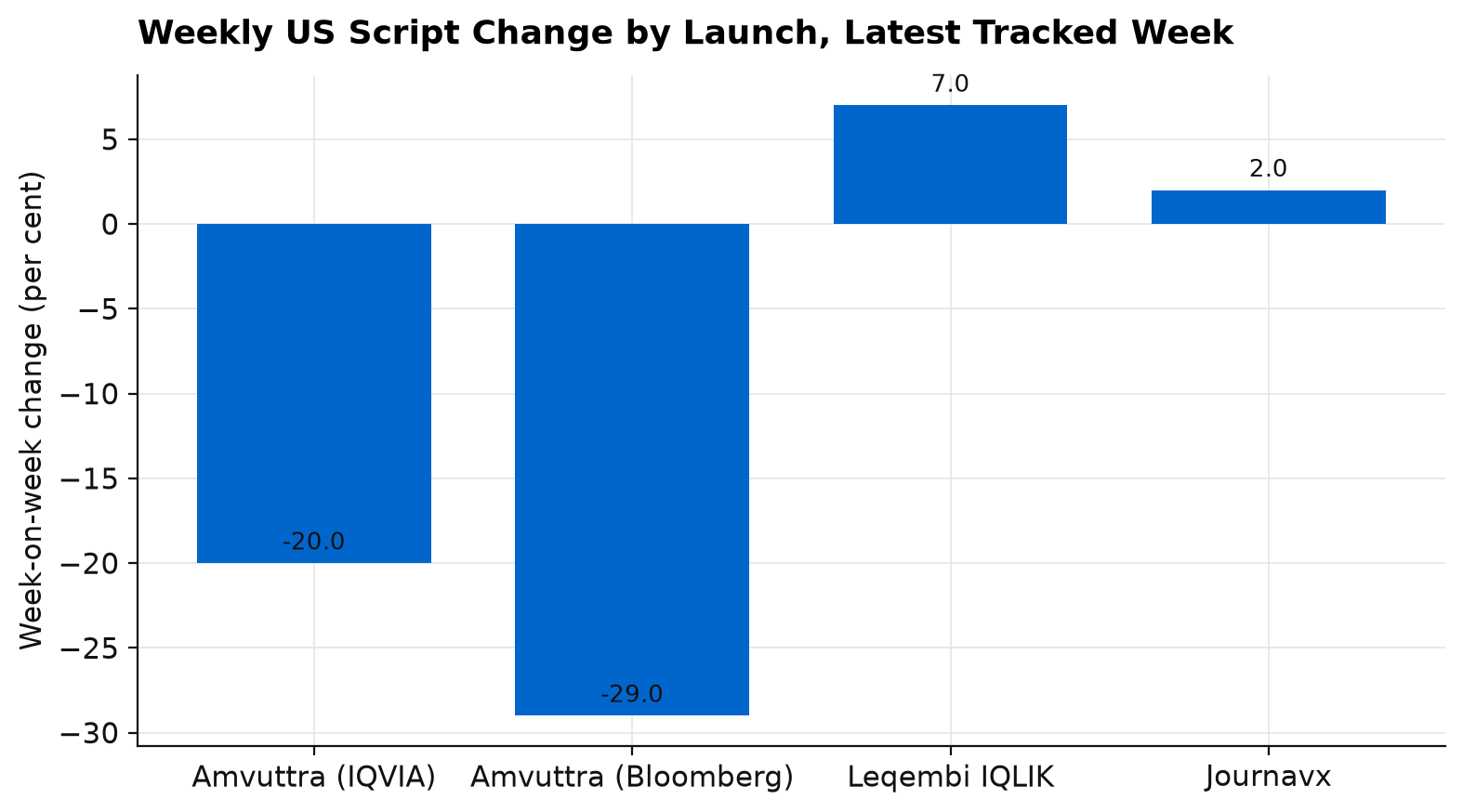
The point for a sector investor is not any single drug. Healthcare growth is increasingly a basket of launch curves, and those curves rarely move in a straight line. A week where one product falls sharply can sit alongside a week where another product climbs, and a broad sector exposure absorbs both. That is a different proposition from betting on the outcome of a single launch, where a weak month can dominate the result.
Persistency Is the Quiet Metric That Matters
Persistency is the share of patients who stay on a treatment over time. For a medicine that has to be given repeatedly, it matters as much as how many new patients start, because a drug that patients abandon has to keep winning new users just to stand still, while a drug that keeps its patients adds to its revenue base with every new start.
Yeztugo, Gilead’s injectable HIV prevention medicine, is the clearest example in the note. Weekly scripts were close to flat, down 3 per cent and 1 per cent on the note’s paired data series. The more telling figure comes from management, which has said more than 70 per cent of users came back for re-injection at six months. Institutional sell-side research reads that as implying an annual persistency rate above other PrEP options, with daily oral pills and Apretude at about 50 per cent. The note also cautions that weekly scripts may not fully capture injections that are administered and billed through a clinic rather than filled at a pharmacy, and that scripts are adjusted by a factor of 2 to avoid double counting an oral loading dose.
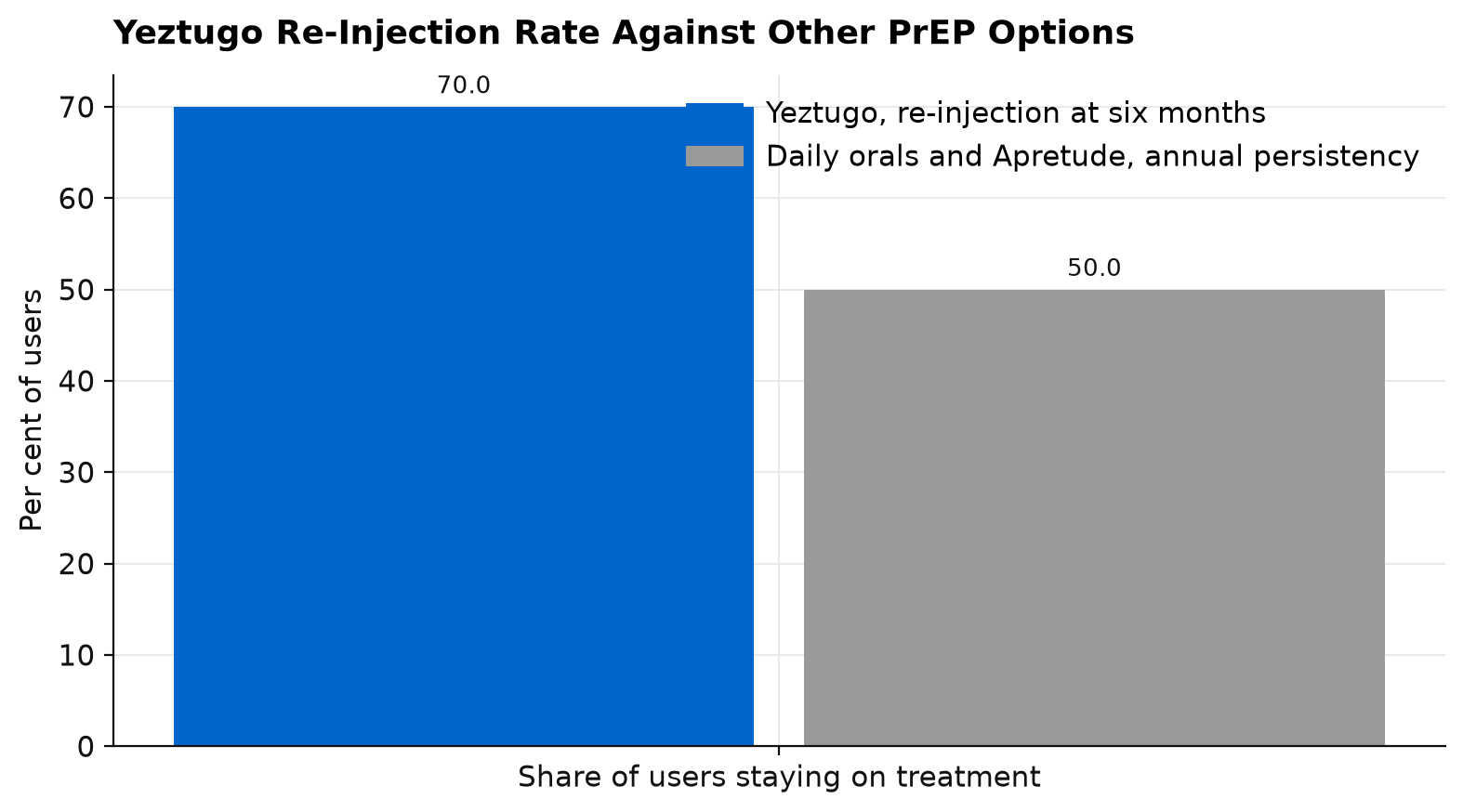
We think this is the kind of data point retail investors tend to overlook. Headline script growth gets the attention, but a medicine that keeps patients for longer quietly compounds its revenue base. Across the healthcare theme, launches with strong persistency are what turn a good first year into a durable franchise.
Diagnostics and Reimbursement Set the Pace in Alzheimer’s
Leqembi IQLIK is the subcutaneous, or under-the-skin, version of Biogen’s early Alzheimer’s treatment, and its scripts rose 7 per cent week on week on Bloomberg data. Institutional sell-side research expects steady growth in 2026, supported by blood-based diagnostics. These biomarker blood tests are being used as a triaging tool, meaning a simpler first step to sort which patients need further assessment before treatment.
The bigger step is expected in 2027, when the note looks for full reimbursement of Leqembi IQLIK for both subcutaneous induction, the start of treatment, and maintenance, the ongoing doses. Until then, the note is awaiting evidence of sustained acceleration. For the intravenous version, the note tracks monthly institutional volumes on an assumption of 1400mg per month per patient, and Bloomberg has flagged some blocking of data in the non-retail segment, so the picture there is less complete.
The lesson is broader than Alzheimer’s. In healthcare, approval and patient demand are not enough on their own. The diagnostic test, the insurer and the payment arrangements all have to line up, and that plumbing often sets the pace of a launch more than the science does.
Weekly Numbers Need Context
Amvuttra had the weakest week in the tracker, with scripts down 20 per cent and 29 per cent week on week per IQVIA and Bloomberg. Institutional sell-side research expects further US growth to come mainly from first-line patients, those receiving their first treatment for the condition, given company guidance that second-line demand, from patients moving across from an earlier therapy, is normalising. Outside the US, the note looks to volume growth. Implied third-quarter sales remain in line with consensus, a reminder that a single sharp weekly drop does not by itself rewrite a quarter.
The COVID-19 vaccines show the opposite trap. Scripts for Spikevax and mNEXSPIKE rose 21 per cent and 20 per cent, but this is a seasonal product, with visibility into demand emerging in late summer and early autumn in the US. Moderna has reiterated expectations for up to 10 per cent year-on-year growth, and institutional sell-side research flags mNEXSPIKE market share and vaccination rates as the variables to watch. The note adds that pharmacy-based script data does not capture shipping and inventory for the vaccines.
Data quirks matter elsewhere too. For Uplizna, the institutional data counts volume units, and each patient dose reflects 30 volume units, so raw counts need translating before they mean anything. We would rather see investors treat any single week of script data as noise and the trend across a quarter as the information that matters.
Tools for Healthcare Exposure
XLV, the State Street Health Care Select Sector SPDR ETF, is the plain 1x option. It tracks the Health Care Select Sector Index without leverage, so it moves with the index rather than a multiple of it. For an investor who wants exposure to the healthcare theme over a longer horizon, rather than a bet on how any single launch unfolds, this is the straightforward way to express it, because a sector index spreads exposure across the sector instead of concentrating it in one company’s launch curve.
CURE, the Direxion Daily Healthcare Bull 3X ETF, is a very different instrument. It aims to deliver 3x the daily move of the same Health Care Select Sector Index, and it resets every day. Over a single day the multiple behaves broadly as described, but over several days in a choppy market the daily reset erodes value, even if the index ends near where it started. That effect is called volatility decay, and it is why CURE suits short, tactical use with clear rules rather than being put away for years. MFAM trades CURE inside its systematic equity strategy, where entries and exits follow rules set in advance.
Catalysts to Watch
- Third-quarter results. The note’s script-implied third-quarter sales give a scorecard to compare against reported figures for Amvuttra, Yeztugo, Journavx and Uplizna.
- Weekly script data. The coming weeks will show whether Amvuttra’s weak week was a blip or the start of a slower phase as second-line demand normalises, and whether Leqembi IQLIK keeps climbing.
- The COVID-19 vaccination season. Late summer and early autumn is when the note expects visibility on mNEXSPIKE market share and vaccination rates, against Moderna’s expectation of up to 10 per cent year-on-year growth.
- Leqembi IQLIK reimbursement in 2027. Full reimbursement for subcutaneous induction and maintenance is the milestone the note looks to for sustained acceleration.
- Adoption of blood-based biomarker tests in Alzheimer’s, which the note sees supporting steady growth through 2026.
Key Risks
The first risk is policy and reimbursement. Several launches in the note depend on insurers and payment decisions, most clearly Leqembi IQLIK, where full reimbursement is not expected until 2027. Any slippage pushes growth further out, and improving market access is part of the Journavx story as well, so a reversal there would matter.
The second is competition within each treatment area. Amvuttra’s growth now depends on first-line patients as second-line demand normalises, Yeztugo competes with daily oral pills and Apretude in HIV prevention, and the COVID-19 vaccine outcome turns on market share and vaccination rates that only become clear with the season.
The third is expectations and data quality. Where implied sales are only in line with consensus, much of the good news may already be reflected in share prices. The script data itself has gaps the note openly flags, including pharmacy-only capture for vaccines, clinic-billed injections, blocked non-retail data and dosing assumptions, so a sector read built on it can be wrong in either direction.
Where We Land
We are constructive on healthcare as a theme, with the caveat that its growth now flows through launch curves that are uneven from week to week. The tracker shows launches tracking in line with or ahead of consensus, persistency data that supports durable revenue, and reimbursement milestones that stretch into 2027. For a longer horizon, broad 1x sector exposure fits that profile best, while the leveraged fund is a tactical, daily-reset tool for a rules-based framework rather than something to put away.
If you would like to discuss Healthcare exposure, request a callback or call us on 1300 889 603.
ETF Universe
- XLV · State Street Health Care Select Sector SPDR ETF · 1x Health Care Select Sector Index, long, vanilla
- CURE · Direxion Daily Healthcare Bull 3X ETF · 3x daily long Health Care Select Sector Index
Note. Leveraged ETFs are designed for daily directional exposure and exhibit volatility decay over multi-day holding periods. They are appropriate inside a systematic trading framework with defined entry, sizing, and exit rules, not as buy-and-hold instruments.