

Life360 delivered one of the more contradictory quarterly results of the year on 11 August, growing revenue 38% to US$159m and adjusted EBITDA 53% to US$31.1m, yet its ASX-listed CDIs fell 19.4% on the day, from A$29.48 to A$23.75, on volume more than six times the normal run rate. The headline beat was real but partly borrowed from a one-off tariff benefit, and beneath the strong subscription and advertising growth sat a monthly active user print that matched consensus but ran below the pace guidance now needs for the second half. Paying circles grew a Q2-record 185,000 and advertising revenue more than quadrupled, so the engines that matter most to the multi-year story are working, even as the market fixated on the one number raising questions about how fast the user funnel is refilling. Institutional sell-side research has Life360 rated a Buy with a 12-month price target of approximately A$30.95 per CDI, implying around 34% upside from the recent price of A$23.06. Getting to grips with that gap means separating what the company actually delivered in the quarter from what the market decided to worry about.
Research published 12 August 2026. Price target and upside based on prices at time of publication.
About Life360
Life360 is a family safety and location-sharing platform built around the Circle, which shares live location between family and friend groups and layers in driving safety scoring, crash detection and SOS alerts. The company also owns Tile, the Bluetooth tracker brand, and Jiobit, a wearable GPS device for children, pets and seniors. Revenue comes from four engines: subscription, by far the largest, advertising built through Nativo, hardware, and a smaller other category of partnership and data revenue. Incorporated in the US and headquartered in San Mateo, California, Life360 reports in US dollars. It is dual-listed, with its primary listing on the Nasdaq under LIF and CHESS Depositary Interests trading on the ASX under 360 in Australian dollars, three CDIs to one US share. Market capitalisation is approximately A$5.8bn, with net cash and no debt. More detail sits with the company’s investor relations page and its ASX announcements.
A Result That Beat the Headline Numbers, With a Catch
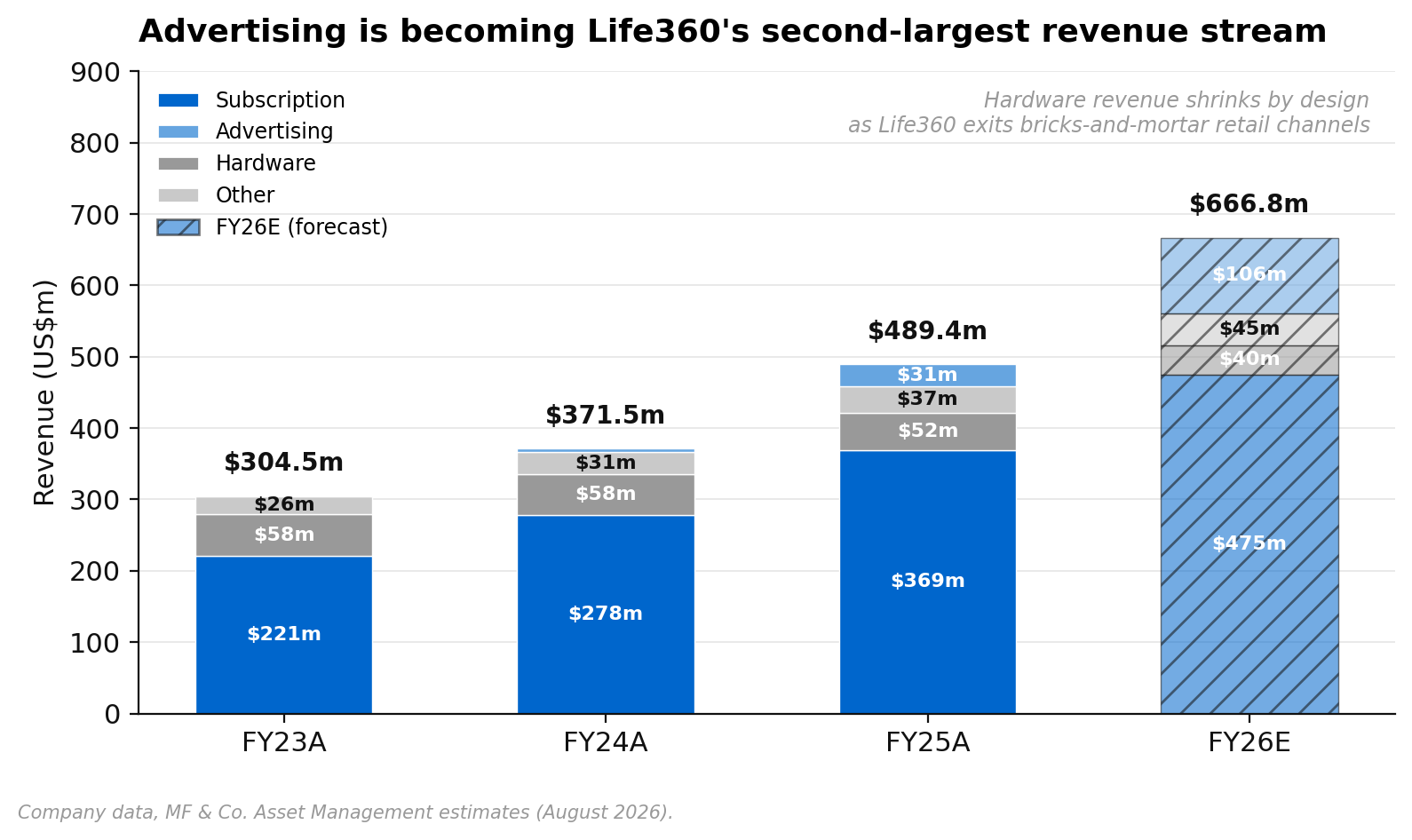
Revenue rose 38% to US$159m, in line with consensus, and the mix inside that number matters as much as the growth rate. Subscription, still the core of the business, grew 31% to US$115.6m, broadly as expected. Advertising more than quadrupled, up 314% to US$22m, a step up from roughly US$20m in the first quarter even though it landed modestly below what the market wanted. Other revenue grew 26% to US$11.6m and beat expectations, while hardware fell 20% to US$9.8m as unit shipments dropped 18% year on year, reflecting the deliberate and previously flagged exit from bricks-and-mortar retail channels.
Adjusted EBITDA rose 53% to US$31.1m, a 20% margin and roughly 20% ahead of consensus, with incremental margin of 25% as opex grew 36% against 38% revenue growth. That headline beat needs a caveat: it was flattered by a one-off US$3.6m tariff benefit already folded into guidance, and stripping it out, adjusted EBITDA was closer to US$27.5m, about 5% ahead of consensus and a 17% margin rather than 20%. The underlying beat is real, just smaller than it looks, which matters before asking why the stock still fell so hard on the day.
FY26 revenue guidance held at US$650-685m, but the mix inside it shifted further toward subscription: its guide edged up about 0.5% at the midpoint, while the hardware guide was cut about 11%. That continues a trend visible across the forecast years, hardware made up about a fifth of group revenue in FY23 and is forecast to fall to a 5-6% share by FY28, while subscription is forecast to grow from US$369.3m in FY25 to US$655.7m in FY28 and advertising, which barely existed before FY24, is forecast to grow from US$31.1m to US$162.0m over the same stretch. Subscription still supplies most of the dollars, but advertising is now the fastest-growing piece of the mix and hardware is fading toward a rounding error rather than a swing factor.
The Monthly Active User Number Is Where the Argument Lives
Group MAUs reached 102.4m, up 4.6m in net adds (US 2.2m, International 2.4m), in line with consensus but below the run rate the full-year guidance implies. FY26 guidance calls for MAU growth of 17-20%, and hitting the midpoint now requires net adds averaging more than 5m a quarter across Q3 and Q4, against the 4.6m just delivered and a record quarterly print of 6.3m in the third quarter of calendar 2024. That is a genuine step-up, not guidance filler, and whether Life360 can deliver it is the single biggest swing factor in the stock from here.
Management points to a technical error early in the year that depressed April’s user additions, and notes the exit MAU run-rate through the end of the second quarter ran above the quarterly average, which it reads as evidence the trend is already accelerating. That is plausible, but it is management’s framing rather than a result the market has seen, and the scale of the single-day fall is a fair indication of how much conviction investors currently have that the acceleration shows up. We would want at least one more quarter of net adds back above 5m before treating the guidance range as more likely than not.
Conversion Improved and Paying Circles Had a Record Quarter
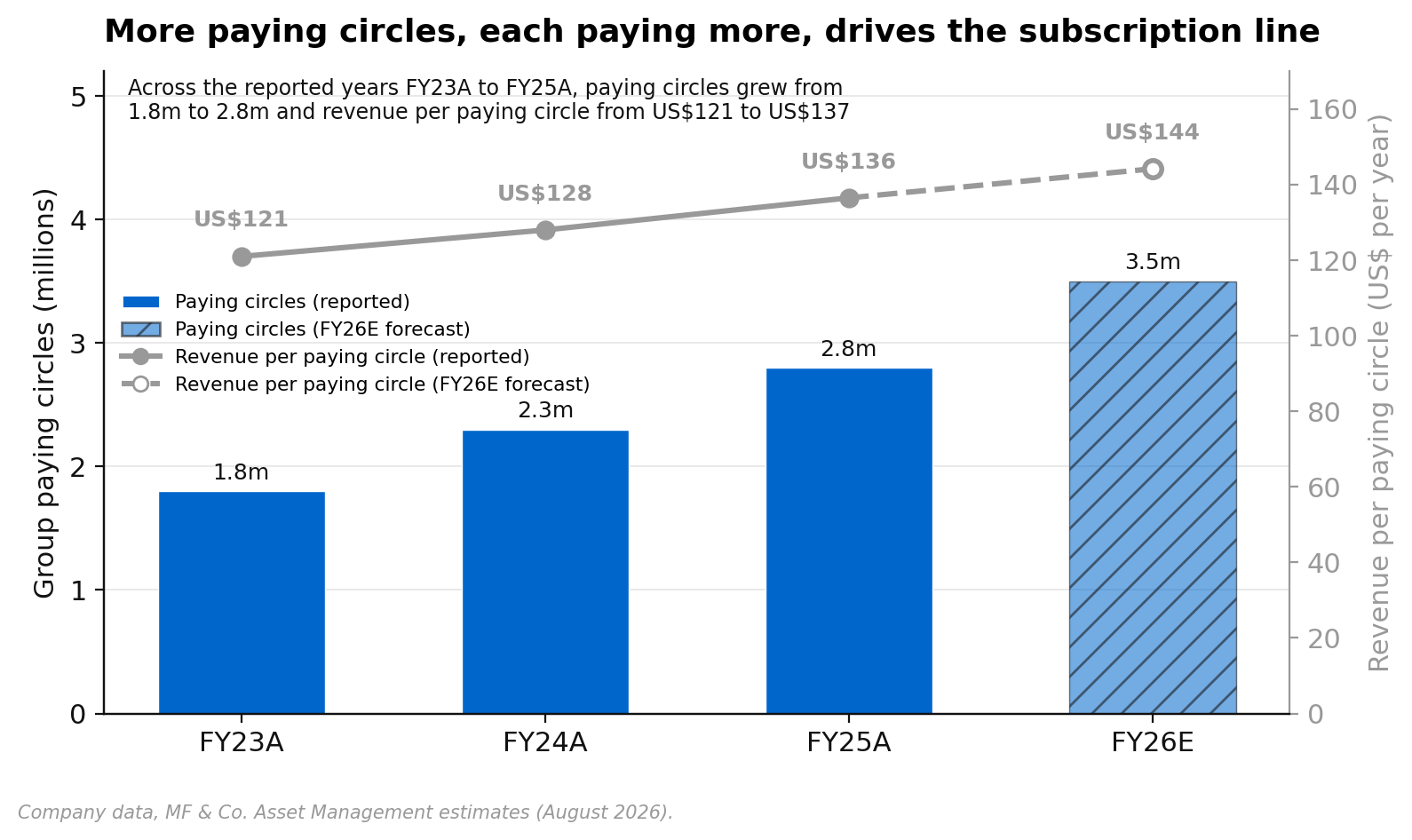
Set against the MAU debate, the parts of the funnel Life360 already controls looked strong. Paying circles grew 185,000, a second-quarter record and the second-best quarter the company has ever reported, with the US alone adding 128,000 against an expected roughly 85,000. US conversion improved from 13.6% in the first quarter to 13.8% in the second, and US paying circles grew 6% quarter on quarter. Even with MAU growth below the guided pace, more of the existing user base is converting into paying subscribers, the more controllable half of the equation.
Pricing adds a further lever. Silver and Gold tiers were raised US$2 a month, a 25% increase for Silver and 13% for Gold, but only for new US subscribers. Management expects a modest near-term contribution to average revenue per paying circle, and repricing the existing base, the larger opportunity, remains undecided rather than a stated plan. Group ARPPC is forecast to grow from around US$137 a year in FY25 to around US$148 by FY28, a gradual build consistent with rolling the increase out to a small slice of the base first. That funnel, from users through conversion to what each paying circle is worth, is ultimately what has to hold together for the second-half guidance to work.
Advertising Is Becoming a Second Growth Engine
The advertising line, built on the Nativo acquisition, is young enough that a 314% growth rate flatters it, but the absolute numbers are now large enough to matter to the group result. On the forecast path underlying current guidance, advertising is projected to grow from US$31.1m in FY25 to US$105.8m in FY26 and on to US$162.0m by FY28, taking it from a rounding error in the revenue base to a genuine second growth engine alongside subscription within a few years, assuming that trajectory holds. Guidance is explicit that both advertising revenue and profit are weighted to the second half, so the trajectory through the third and fourth quarters matters more than the second-quarter print alone.
One detail worth being precise about is the gross margin guide. Management now guides advertising gross margin to 65-70% in Q4, an improvement on the roughly 60% achieved in Q2, but that range is itself a step down from the roughly 70% previously guided. The trajectory is still improving quarter on quarter, just toward a lower ceiling than originally flagged, a distinction worth holding onto rather than reading the gain as an unambiguous positive.
The Full-Year Profit Guide Leans Heavily on the Fourth Quarter
FY26 adjusted EBITDA guidance was retained at US$130-140m, and the midpoint of US$135m implies growth of about 45% for the year and a margin near 20%, up from 12% in the first quarter and 17% in the second once the tariff benefit is stripped out. Getting there depends on a pronounced step up in the second half: guidance points to a sequential improvement to around an 18% margin in the third quarter and above 22% in the fourth, driven by MAU net adds reaccelerating and by advertising, itself weighted to the second half, becoming a meaningful tailwind. On the current forecast path, quarterly adjusted EBITDA runs to around US$31.0m in Q3 before jumping to around US$54.7m in Q4, a far larger step than anything in recent history and the clearest sign of how much of the year sits in the last three months.
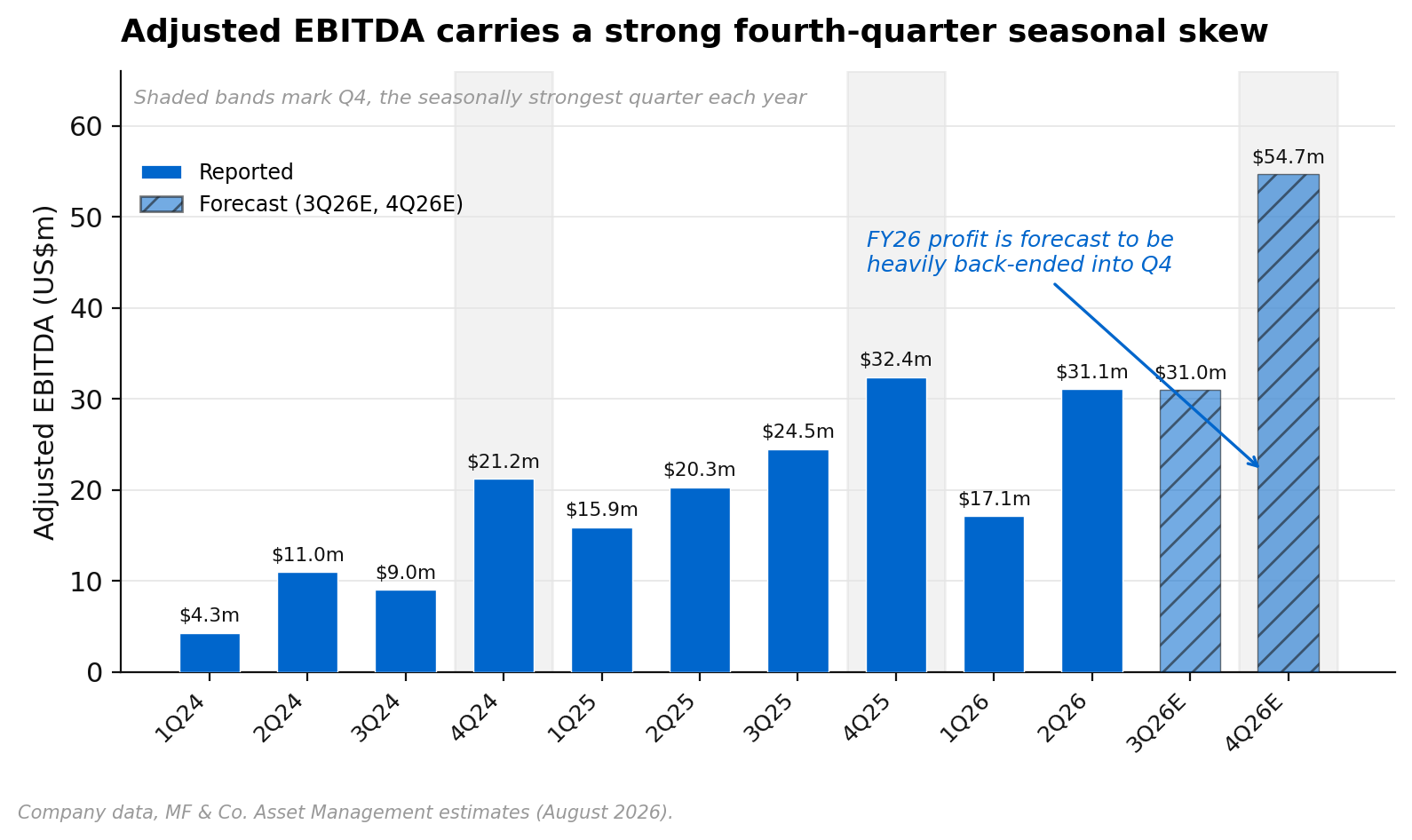
That shape cuts both ways. If the MAU reacceleration and the advertising ramp show up on schedule, the fourth quarter could look very strong against easy prior-year comparisons. But a soft third quarter would leave little runway to recover, since so much of the guided profit growth sits in a single quarter not yet delivered. Investors underwriting the FY26 guidance are, in effect, underwriting that fourth-quarter step, and the quarterly cadence from here is the number to watch most closely.
Valuation
Institutional sell-side research has Life360 rated a Buy with a 12-month price target of approximately A$30.95 per CDI, cut from A$32.85 previously, implying around 34% upside from the recent price of A$23.06. We would not treat the size of that gap as the argument in itself. What matters is whether the operating case holds together, and on our reading it rests on three things. The first pillar is the FY26 adjusted EBITDA guidance of US$130-140m, retained through this result and implying growth of roughly 45% for the year even after the market’s reaction to the quarter. The second is the paying circle and conversion trend, a record second quarter for paying circles alongside US conversion improving from 13.6% to 13.8%, evidence the part of the funnel Life360 controls most directly keeps strengthening even while MAU growth is under scrutiny. The third is advertising’s build from close to nothing before FY24 to a business forecast to be worth over US$100m in FY26 and around US$162m by FY28, a genuine second growth engine layering onto a subscription base still growing above 30% year on year.
Set against that, the near-term risk is real: if the MAU net adds needed for the second-half guidance do not materialise, the earnings trajectory this case depends on slows, and the 19.4% single-day fall shows how quickly the market can re-price that risk. Context matters here too, because this is not a stock the market has been rewarding. The CDIs are down roughly 37% over the past twelve months, so the market has already marked it down materially, and the target itself was cut on the back of this result rather than raised. We think the risk-reward still leans favourably given the breadth of what is working, subscription, paying circles, conversion and advertising, against one well-flagged metric not yet confirmed, but the next one or two quarters of MAU data are likely to matter more than the current print.
Key Risks
A pull-back in consumer spending would hit Life360 directly, since a subscription costing a modest sum a month is an easy expense to cancel when budgets tighten. Competition in family safety, location-sharing and wellbeing apps has been increasing, and any material loss of share to a well-funded rival would pressure both user growth and pricing power. Higher churn or slower subscriber growth than guided would flow straight through the paying circle and ARPPC numbers this thesis leans on, and the second-half MAU run-rate needed to hit guidance has not yet been demonstrated. Platform risk from Apple and Google is structural, since Life360 distributes almost entirely through their app stores and pays their fees, so any change to store policy, discovery or take rates sits outside its control. FY26 guidance is also heavily back-ended into the fourth quarter, so a soft third quarter would leave very little room to recover, leaving the thesis more exposed to one weak quarter than the smooth annual growth numbers suggest.
If you would like to discuss Life360, request a callback or call us on 1300 889 603.