

Buy
Nanosonics is an ASX-listed company that makes infection control products for healthcare, led by Trophon, which disinfects ultrasound probes, and is launching CORIS for endoscopes.
Institutional sell-side research rates it Buy because Trophon is the standard of care and still growing at a mid-single-digit rate, with upgrades driving FY27 and consumables providing repeat income. It sees CORIS as capable of meeting FY27 guidance, with a pipeline in the UK, Ireland and Australia. Margins and earnings are soft near term, but the research argues the market gives CORIS very little value.
- Sell-side rating
- Buy
- Sell-side target
- A$3.80
- Upside to target
- +34.3%
- Initial price
- A$3.0123 Sep 2026
- Last close
- A$2.8312 Nov 2026
Nanosonics reported a mixed FY26 result. The core Trophon business, which disinfects ultrasound probes and has become the standard of care in that job, is still growing at a mid-single-digit rate. Gross margins went backwards, though, and the near-term earnings outlook has been cut as freight costs, US tariffs and an inventory build weigh on FY27. CORIS, the company’s new system for cleaning endoscopes, looks capable of meeting management’s FY27 guidance, with a sales pipeline in the UK, Ireland and Australia. Institutional sell-side research has Nanosonics rated Buy with a 12 month price target of A$3.80, about 26.2 per cent above the share price of A$3.01 when this research was published. The target was lowered by about 10 per cent from A$4.20 to reflect softer forecasts, but the Buy call stands because the research sees CORIS as a growth option the market gives very little value.
Research published 23 September 2026. Price target and upside based on prices at time of publication.
Table of contents [hideshow]
About Nanosonics
Nanosonics designs and manufactures infection control products for the healthcare sector, and is listed on the ASX. Its core product is Trophon, a system for the high-level disinfection of ultrasound probes. High-level disinfection, often shortened to HLD, means a thorough cleaning process for reusable medical equipment, and Trophon is the standard of care for doing it on ultrasound probes. The Trophon business earns money in two ways. Capital revenue comes from selling the devices themselves, including upgrades from older units to newer models such as the T2 Plus and T3. Consumables revenue comes from the supplies each installed device uses on an ongoing basis. After several years of development, the company is preparing to launch CORIS, a product for endoscope reprocessing. Nanosonics reports in Australian dollars on a 30 June financial year.
Trophon Keeps Growing at a Steady Pace
Institutional sell-side research forecasts Trophon revenue growth of about 7 per cent in FY27 on a constant currency basis, lifting from about 4 per cent across the second half of FY26. Constant currency means the growth figure strips out the effect of exchange rate movements.
The main driver for FY27 is capital revenue, and in particular upgrades. The research expects stronger capital upgrade units, meaning more existing customers replacing older Trophon devices with newer ones, along with a lift in average selling price from growing sales of the T3 and upgrades to the T2 Plus. Average selling price, or ASP, is the average amount the company receives for each unit sold, and it rises as more customers buy the T3 or upgrade to the T2 Plus.
Consumables, the supplies each Trophon device uses in daily operation, are the second driver. The research forecasts consumables growth of about 5 per cent on a constant currency basis, assisted by new installed base placements. The installed base is the total number of Trophon devices out in the field, and every new device placed adds to the pool of customers buying consumables. The research has tempered its FY27 and FY28 growth forecasts to reflect slower procedural growth, meaning fewer medical procedures than previously expected, and expects ecosystem and services revenue to help lift growth from the second half of FY26.
One issue investors will hear about is the end of support for Trophon EPR, an older version of the device. Whenever a company stops supporting an old product, there is a risk that some customers move to a competitor’s product. The research’s view is that this risk of product displacement is likely to be well navigated, with management focused on preserving what is described as the annuity revenue stream. An annuity in this sense is income that keeps arriving year after year, which is what the consumables business looks like once a device is installed. The research also expects the discontinuation of support for Trophon EPR to support upgrade sales, with capital revenue expected to lead growth in FY27.
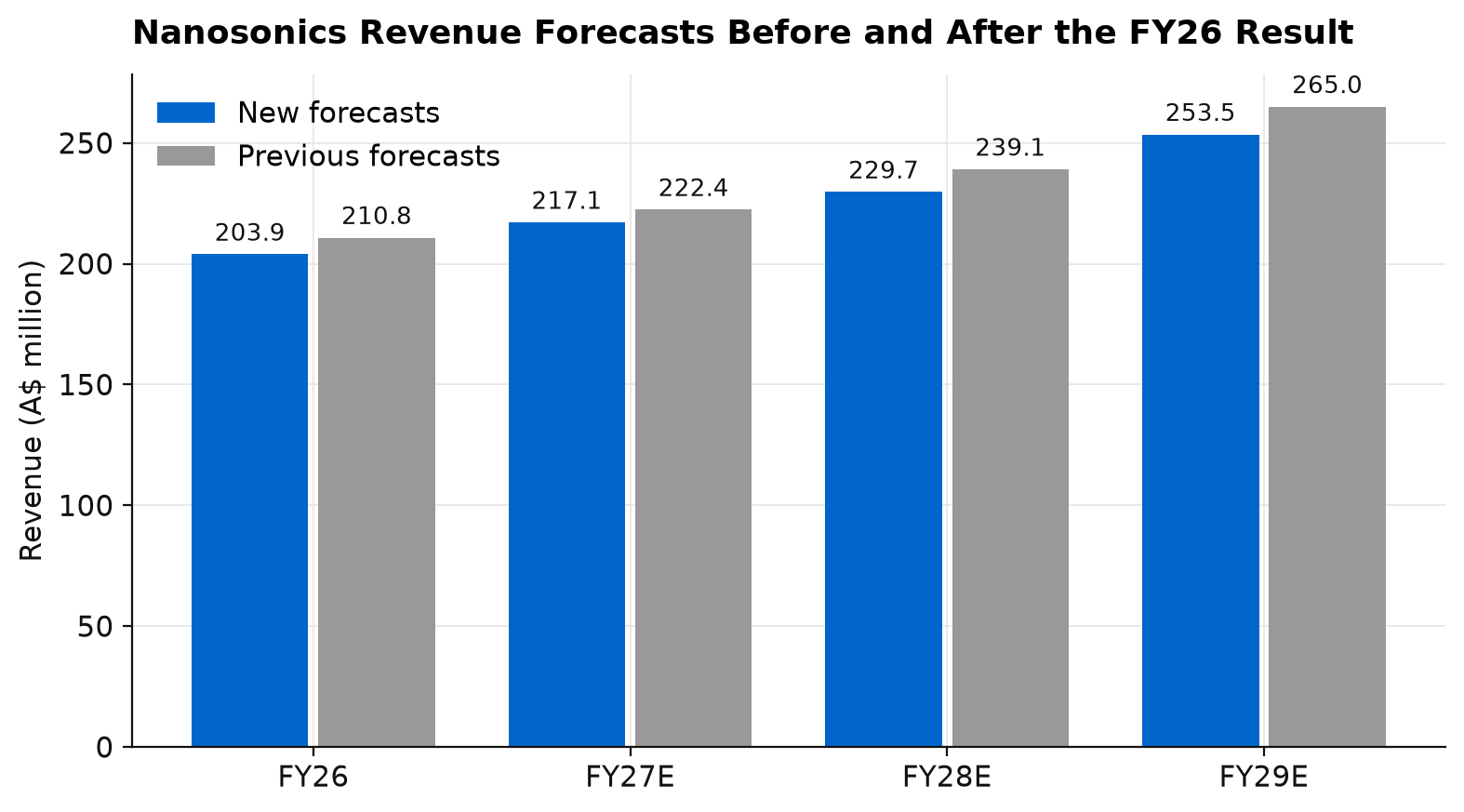
The chart below shows how revenue forecasts have moved after the FY26 result. Reported FY26 revenue came in at A$203.9 million, below the A$210.8 million that had been expected beforehand. Revenue is now forecast at A$217.1 million in FY27, A$229.7 million in FY28 and A$253.5 million in FY29, compared with A$222.4 million, A$239.1 million and A$265.0 million previously. Forecasts were trimmed in each year but still rise every year.
US Volumes and Gross Margins Are the Soft Spot
The weaker part of the result was US consumables, where growth slowed during the year. Weather events in the US during the third quarter of FY26 restricted patient mobility and likely played a part, but the research also sees a tougher volume backdrop in healthcare utilisation. Healthcare utilisation is a measure of how much patients are actually using health services, such as appointments and procedures. When it softens, there is less demand for the supplies that go with each procedure.
Margins also went backwards. Gross margin is the share of each dollar of sales left over after paying the direct cost of making the product. Once a US tariff refund is stripped out, the company’s gross margin contracted by about 250 basis points. Basis points are the standard unit for measuring small changes in a percentage such as a margin.
The research does not expect a quick recovery in FY27. As the business works through an inventory build, meaning it is holding more stock on hand, and absorbs inflationary pressure from freight costs and US tariffs, the research forecasts gross margin towards the bottom end of management’s guidance. On costs below the gross profit line, it forecasts FY27 reported operating expenses of $158 million, which sits within management’s guidance of $156 million to $163 million on a constant currency basis. Putting this together, gross profit forecasts have been cut by 5 per cent and 6 per cent for FY27 and FY28.
A rules-based approach to leveraged ETFs
See how our quantitative strategy works and who it suits.
Explore the strategyBecome an authorised representative
Advise your clients under an established AFSL without building your own. Choose AR or CAR.
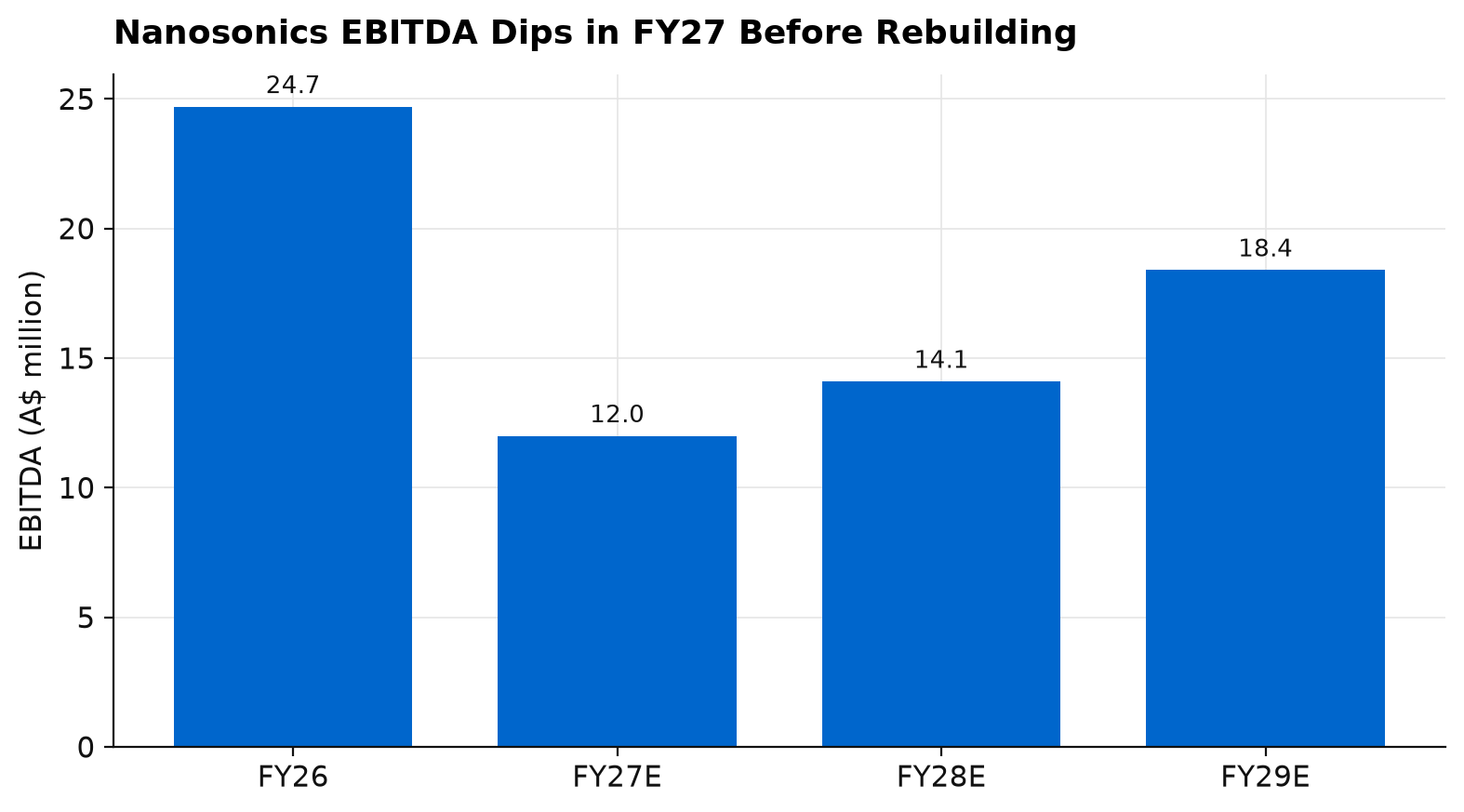
Become an AR or CARThe effect on earnings is clear in the chart below. EBITDA, which stands for earnings before interest, tax, depreciation and amortisation and is a rough measure of operating profit, was A$24.7 million in FY26. It is forecast to fall to A$12.0 million in FY27 before rebuilding to A$14.1 million in FY28 and A$18.4 million in FY29. Revenue is still forecast to grow over the same years, so the fall in EBITDA comes from margins and costs.
Beyond FY27, the research expects the ramp of CORIS sales to help gross margin, because CORIS consumables have a higher average selling price than Trophon consumables.
CORIS Is the Growth Option Behind the Buy Call
CORIS is Nanosonics’ next key product, and it works in endoscope reprocessing. An endoscope is a flexible instrument with a camera that doctors use to look inside the body, and reprocessing is the cleaning and disinfecting needed before it can be used again. The research sees a large unmet need in infection control that CORIS is designed to meet. Trophon became the standard of care for ultrasound probes, and the hope is that CORIS can build something similar for endoscopes, although that outcome is far from assured at this early stage.
The building blocks for commercialisation have been in place for several years, and management has recruited key personnel in regions like the UK who are experienced in endoscope reprocessing. On that basis the research believes the customer pipeline is likely in place, and it considers CORIS capable of meeting management’s FY27 guidance, given the sales pipeline in regions such as the UK, Ireland and Australia.
The research lists further regulatory approvals for CORIS as a catalyst, meaning an event that could prompt the market to reassess the stock, and each approval widens the markets where CORIS can be sold.
The research thinks market consensus forecasts are optimistic on CORIS profitability across FY27 and FY28. At the same time, it argues that the valuation de-rate over the last 5 years reflects minimal value being ascribed to CORIS. A de-rate is when the market becomes willing to pay less for each dollar of a company’s earnings.
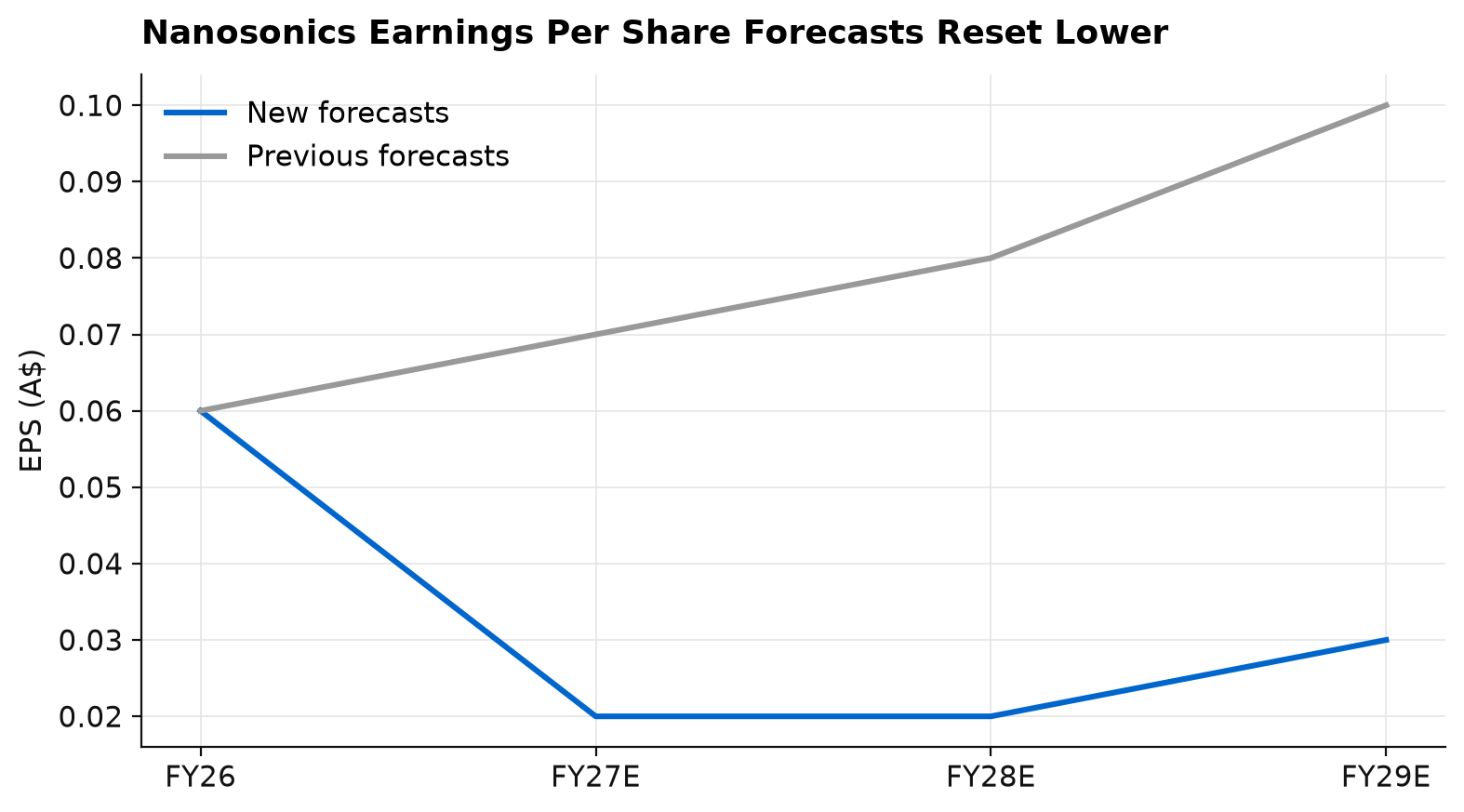
Earnings per share, or EPS, is the company’s profit divided by the number of shares on issue. EPS was A$0.06 in FY26 and is now forecast at A$0.02 in FY27, A$0.02 in FY28 and A$0.03 in FY29, against previous forecasts of A$0.07, A$0.08 and A$0.10. The new figures reflect the earnings revision described above and the inclusion of the new share buyback. The earnings cut is the main reason the price target came down, while the research’s case still rests on a growing Trophon business funding the CORIS launch.
Valuation and the Buy Case
The 12 month price target is A$3.80, lowered by about 10 per cent from A$4.20, largely because of the earnings reduction. The target is built as a sum of the parts, meaning Trophon and CORIS are valued separately and then added together. CORIS is still pre-revenue, so the research treats it differently from the more mature Trophon. Trophon contributes about A$3.0 per share of the target and CORIS about A$0.8 per share.
At the share price of A$3.01, the stock trades close to the research’s value for Trophon alone, which fits its view that the market gives CORIS minimal value.
The research’s Buy rating rests on the defensive Trophon franchise, with steady mid-single-digit growth, upgrades driving FY27 and a repeat consumables stream, on CORIS, which it considers capable of meeting FY27 guidance, and on a valuation that has de-rated over the last 5 years and gives the new product little credit. The A$3.80 target implies about 26.2 per cent upside.
Nanosonics pays no dividend, so the case rests on growth in Trophon and CORIS after a soft FY27 for margins and earnings.
Key Risks
The first risk is the operating backdrop, where a tougher volume environment in healthcare utilisation, slower procedural growth and further inflationary pressure from freight and US tariffs could keep consumables growth and gross margins under pressure for longer than forecast. The second is competition for Trophon, and the end of support for Trophon EPR creates a moment when some customers may consider alternatives instead of upgrading. The third is execution on the launch of CORIS, which is still at a pre-revenue stage, and with market consensus already appearing optimistic on its profitability across FY27 and FY28, delays in sales or regulatory approvals would weigh on the investment case. The fourth is specific to the company, covering the departure of key management personnel and the possibility of product recalls for either Trophon or CORIS. Any of these could keep the share price below the A$3.80 target.
Our View
We think the FY26 result was weaker than the Buy rating alone would suggest. Margins slipped, US consumables slowed and the earnings forecasts for the next two years have been cut hard. A quick recovery in profit looks unlikely, but Trophon is still growing, remains the standard of care for disinfecting ultrasound probes, and funds the CORIS launch.
At A$3.01 the share price sits close to the research’s value for Trophon, so CORIS appears to count for little in it. We like that Nanosonics is putting Trophon’s cash into a new product. The milestones we would watch are CORIS sales against FY27 guidance, further regulatory approvals and any sign that US consumables growth is recovering.
If you would like to discuss Nanosonics, request a callback or call us on 1300 889 603.
Financial Summary
Become an authorised representative
Advise your clients under an established AFSL without building your own. Choose AR or CAR.
Become an AR or CAR