

Buy
Supply Network distributes replacement parts for trucks and buses to fleets and independent repairers across Australia and now New Zealand, and is listed on the ASX as SNL.
Institutional sell-side research rates it Buy because sales growth is broad based and driven by volume, and the company is guiding to another A$50 million of extra sales in FY27, in line with its recent record. The research also expects it to keep taking share from the truck makers, as independent repairers grow and the makers consolidate. New branches such as Penrith add capacity one site at a time, and net debt is forecast to fall close to zero.
- Sell-side rating
- Buy
- Sell-side target
- A$40.00
- Upside to target
- +12.4%
- Initial price
- A$34.7922 Sep 2026
- Last close
- A$35.6013 Nov 2026
Supply Network has just delivered another year of earnings growth of about 20 per cent while opening a new branch in New Zealand, switching over its core business system and absorbing the cost shocks of the Middle East conflict. Institutional sell-side research has Supply Network rated Buy with a 12 month price target of A$40.00, about 15.0 per cent above the share price of A$34.79 when this research was published. The research points to structural trends in its favour and new capacity coming online one branch at a time, and the company is guiding to another year of roughly A$50 million in extra sales.
Research published 22 September 2026. Price target and upside based on prices at time of publication.
Table of contents [hideshow]
About Supply Network
Supply Network is a distributor of truck and bus parts listed on the Australian Securities Exchange under the code SNL. It sells replacement parts into the commercial vehicle aftermarket, which is the parts and repair work that keeps trucks and buses on the road once they have left the dealer. Its customers include truck fleets of every size, a wide mix of owner types and truck models, and a growing network of independent repairers, the workshops that service vehicles outside the manufacturers’ own dealer networks. Bus is a meaningful second line, accounting for about 13 per cent of revenue in FY26. The company runs a branch network that includes a branch at Pemulwuy, a newly opened branch in New Zealand and a planned new branch at Penrith. It reports on a 30 June financial year and employed about 600 people at the end of FY26.
Where the Growth Came From
The FY26 growth was broad based. At a recent investor session, managing director Geoff Stewart and chief financial officer Robert Coleman said revenue growth was supported by truck fleets of all sizes, by every type of owner, across truck models and through independent repairers. Bus, a smaller part of the business at about 13 per cent of revenue, also grew solidly.
Most of that growth came from volume, with sales growing well ahead of price inflation, which ran at about 3.5 to 4 per cent across the range in FY26 including the cost effects of the Middle East conflict.
Management said the Middle East conflict had limited operational impact on the truck part distribution industry. Higher costs were largely passed through to end customers, with some absorbed within cost of goods sold, the direct cost of buying the parts Supply Network resells. Management also described government backing for temporary levies as supportive.
Gross margin, the share of each sales dollar left after paying for the parts themselves, was 42.7 per cent in FY26, flat on the year before. The comparison is like for like, because A$4.1 million of costs previously reported across various FY25 operating expense lines was restated into cost of goods sold. The second half of FY26 ran at a slightly higher gross margin than the first, helped by product sourcing and seasonal rebates from suppliers. As and when the Middle East conflict abates, the costs that manufacturers pushed into the price of parts, and that Supply Network partly absorbed, should unwind. Management expects that to have a positive impact on gross margin.
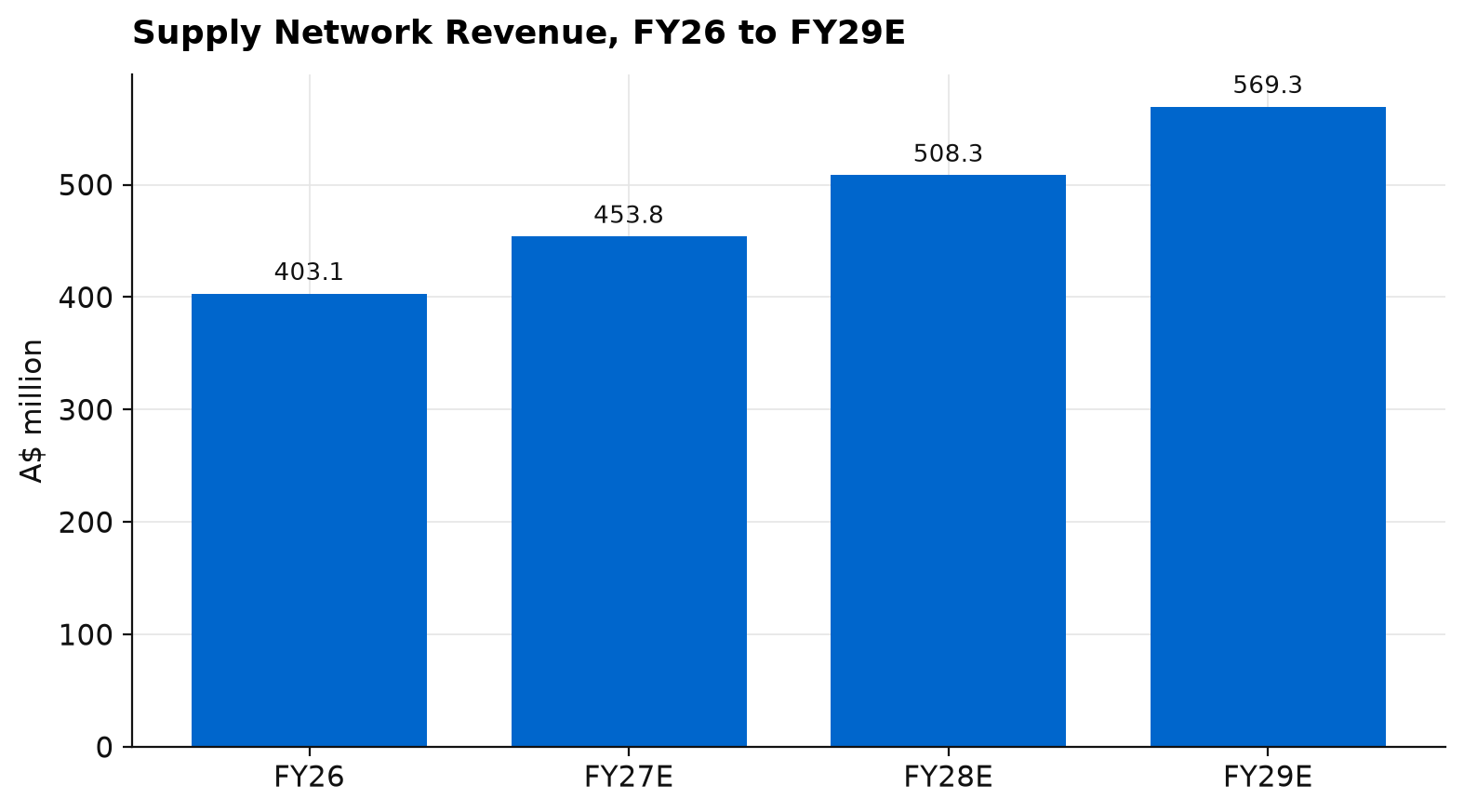
Institutional sell-side research forecasts revenue rising from A$403.1 million in FY26 to A$453.8 million in FY27, A$508.3 million in FY28 and A$569.3 million in FY29.
Guidance and New Capacity
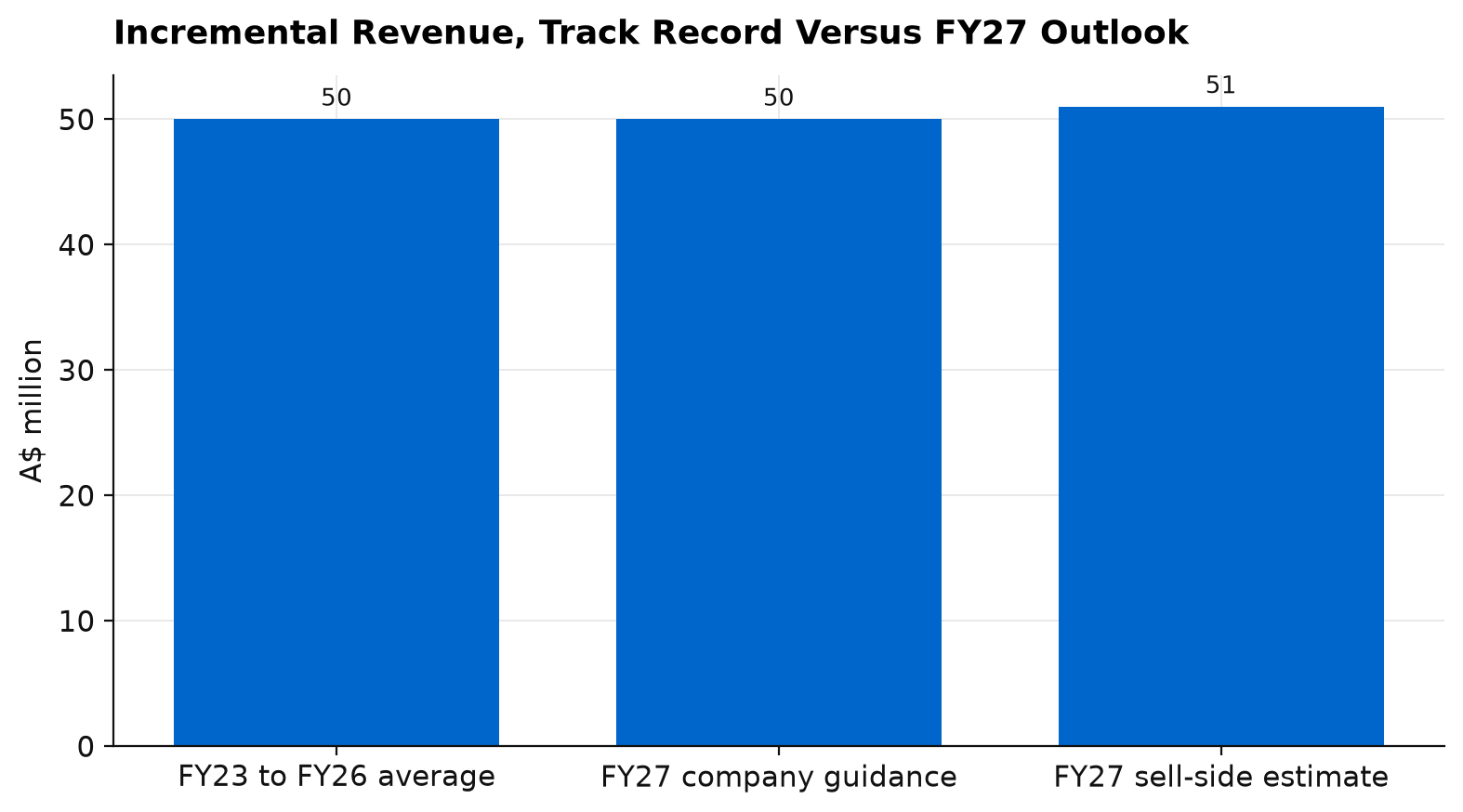
Supply Network’s FY27 guidance is for another A$50 million of incremental revenue, meaning additional sales in dollar terms on top of the FY26 base. Between FY23 and FY26 the company averaged about A$50 million of incremental revenue each year, so the guidance matches its recent run rate. Institutional sell-side research sits slightly above guidance at A$51 million for FY27, pointing to the company’s history of reaching and exceeding its guidance. Management also said the first two months of FY27 trading were on track.
Adding about A$50 million of extra sales again in FY27 would extend that record.
The FY26 result also came during heavy internal project work. The company opened a new branch in New Zealand, carried out a major upgrade of its ERP system, the enterprise resource planning software that runs ordering, stock and invoicing, and completed further IT project work. Management said the new system is still working through some minor issues and should be fully operational in two to three months, after which it should improve the speed of transactions, scanning and invoicing. No material financial impact was noted from the rollout, with the main cost being management’s time and attention.
A rules-based approach to leveraged ETFs
See how our quantitative strategy works and who it suits.
Explore the strategyBecome an authorised representative
Advise your clients under an established AFSL without building your own. Choose AR or CAR.
Become an AR or CAREmployee numbers grew 7 per cent to 600 in FY26, and management expects growth of about 5 per cent to 630 in FY27 to support several branch expansions. Having secured a site at Penrith, its most visible project, the company expects the branch to be built by the end of FY27 and operational in the first quarter of FY28. The site sits in an important growth corridor that is already taking deliveries and is currently serviced from the Pemulwuy branch.
Beyond Penrith, management said it is not actively looking to build at any specific locations.
Taking Share From the Truck Makers
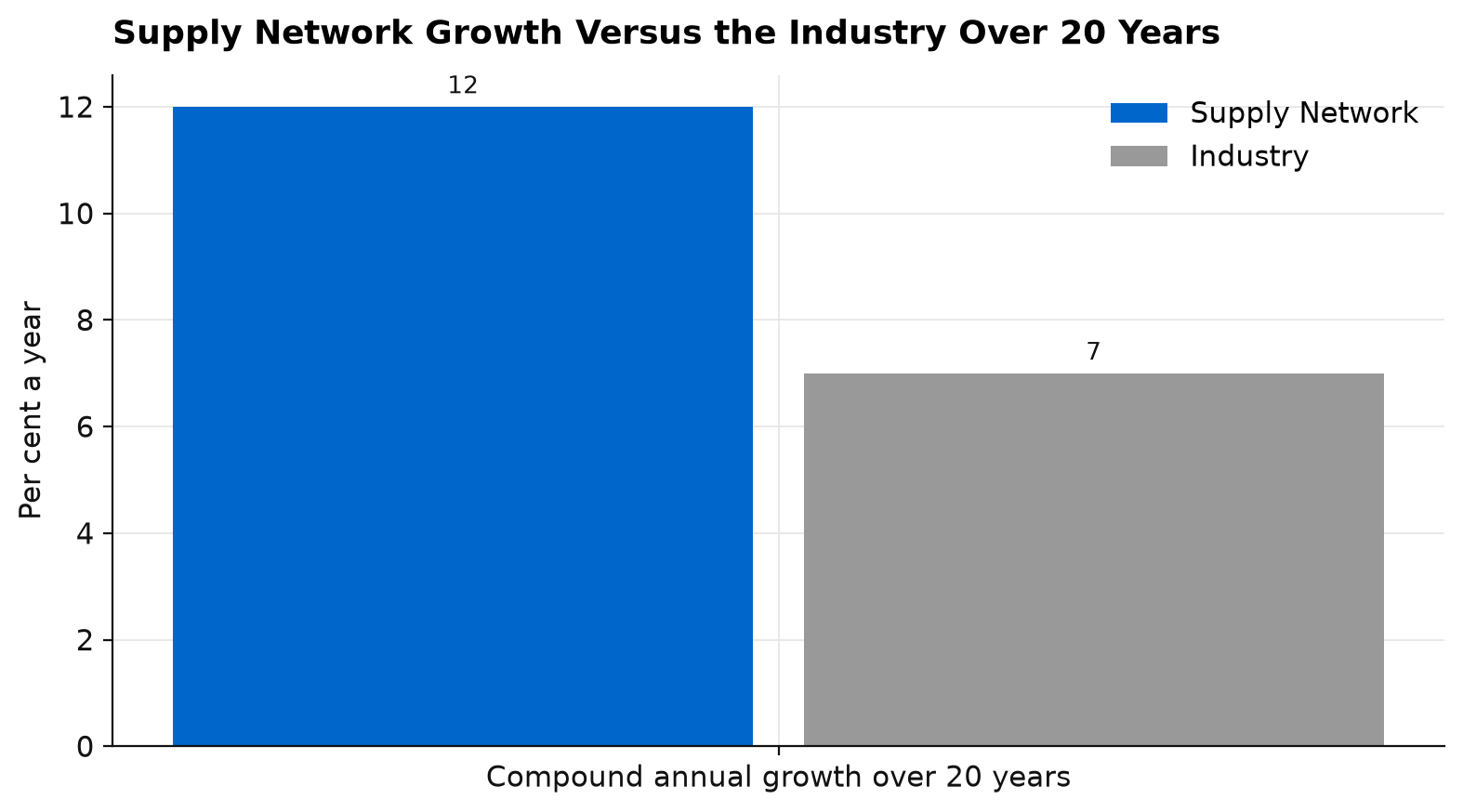
Supply Network competes in the aftermarket against the OEMs, the original equipment manufacturers that build the trucks and also sell parts and servicing through their own dealer networks. Management said that over the past 20 years Supply Network has grown at a compound annual growth rate of about 12 per cent, against about 7 per cent for the industry. A compound annual growth rate is the steady yearly growth that would get you from the starting point to the end point. The research attributes much of that gap to share taken from the OEMs.
The research expects that trend to continue. The new truck market is becoming more competitive, with new Chinese entrants arriving, and that pressure may distract the OEMs from their parts and service operations. At the same time, the OEMs are consolidating. The merger of Hino and Fuso in April 2026 is one example of a continuing trend, as manufacturers look to rationalise componentry and operating costs.
The second structural trend is the rise of independent repairers. Management said the independent repairer base is growing as fast as the truck fleet itself. As these workshops become more efficient and more sophisticated, larger fleets are increasingly willing to outsource their maintenance work to them. That shift is positive for Supply Network because it already has broad exposure to the independent repairer network. Each job that moves from a fleet’s own workshop to an independent workshop is a job where Supply Network has a real chance to supply the parts.
The share shift away from the OEMs has been running for two decades, and the move toward independent repairers reflects how fleets choose to run their maintenance.
Valuation and Forecasts
Institutional sell-side research has a 12 month price target of A$40.00 on Supply Network, about 15.0 per cent above the A$34.79 share price when this research was published. The target combines a long-term cash flow valuation with a multiple of near-term earnings, and the research forecasts earnings per share rising from A$1.09 in FY26 to A$1.29 in FY27, A$1.50 in FY28 and A$1.74 in FY29. On a half-yearly view, the research expects A$0.60 for the first half of FY27 and A$0.69 for the second half, against A$0.56 in the second half of FY26, and A$0.70 for the first half of FY28.
Earnings before interest, tax, depreciation and amortisation, a common measure of operating profit before financing and accounting charges, is forecast to grow from A$81.1 million in FY26 to A$91.8 million in FY27, A$105.2 million in FY28 and A$120.3 million in FY29. Net debt is forecast to fall to close to zero relative to those earnings over the period.
The shares have paid A$0.80 in dividends over the past 12 months, a trailing dividend yield of 2.3 per cent, fully franked. Franking credits represent tax the company has already paid, which eligible Australian shareholders can use to offset their own tax.
The research case rests on broad, volume-led sales growth, a guidance track record that supports the FY27 target of another A$50 million of sales, and a structural share shift away from the truck makers, helped by OEM consolidation and the rise of independent repairers.
Beyond the forecasts, gross margin could lift as Middle East related costs unwind, and the new system should speed up transactions once it is bedded in. With the target 15.0 per cent above the share price, the upside depends on Supply Network continuing to meet its guidance.
Key Risks
A weaker economy or softer price inflation could slow sales growth, and the company’s pricing power could be tested if competitors chase volume. Competition could also come from other parts distributors, and from OEMs that may sharpen their own parts and service operations once their consolidation settles. The growth plan also leans on the network expansion strategy including Penrith, on completing the ERP rollout and on growing headcount to 630 at a time when labour shortages can make skilled staff hard to find. The industry itself could change, whether through shifts in how parts and servicing are bought or through vehicle trends that reduce demand for the parts Supply Network stocks. Any slip in service quality could also damage its reputation with customers.
Our View
Earnings grew about 20 per cent in a year of heavy project work, and the research expects net debt to fall close to zero while the company adds capacity one branch at a time. Results over the coming year will show whether sales keep growing in line with guidance while Penrith is built and the new system beds in.
On succession, management said it has built depth in its management team over the last 10 years and has no near-term plans to change senior management.
If you would like to discuss Supply Network, request a callback or call us on 1300 889 603.
Financial Summary
Become an authorised representative
Advise your clients under an established AFSL without building your own. Choose AR or CAR.
Become an AR or CAR