

Pinnacle Investment Management has just shown that its growth engine is still running close to plan, even as one corner of the business goes through a rough patch. Its first-quarter update for fiscal 2027, released alongside its annual general meeting presentation, showed affiliate funds under management rising A$8.7 billion over the quarter to A$238.1 billion, with net flows of A$5.9 billion doing most of the work. That is broadly what the market had expected, and it keeps half-year expectations on track. The soft spot is private credit and real estate, where the company has flagged short-term pressure on flows, and earnings forecasts have been trimmed by around 4 to 5 per cent to reflect it. Over this financial year the shares have fallen further than the broader small-cap market. Institutional sell-side research has Pinnacle Investment Management rated Buy with a 12 month price target of A$18.64, about 17.8 per cent above the share price of A$15.83 when this research was published. The target was cut from A$21.55, but the core thesis, a scalable multi-affiliate platform with plenty of spare capacity, is intact.
Research published 10 November 2026. Price target and upside based on prices at time of publication.
Table of contents [hideshow]
About Pinnacle Investment Management
Pinnacle Investment Management is an Australian multi-affiliate investment manager. Pinnacle holds stakes in a group of specialist fund managers, known as affiliates, and earns its share of their earnings and distributions. Many of these affiliates are entities Pinnacle does not control, which keeps the business capital-light, meaning it does not need a large balance sheet to grow. The affiliates gather money through three channels, retail, institutional and international. Named affiliates include Antipodes, Metrics, Resolution and PAM, with Metrics and Resolution giving the group its exposure to private credit and real estate. Affiliate funds under management stood at A$238.1 billion at the end of the first quarter of fiscal 2027, and the company reports on a financial year ending in June. Pinnacle is listed on the Australian Securities Exchange under the code PNI.
A Quarter That Landed Close to Plan
Funds under management, usually shortened to FUM, is the total pool of money a manager looks after for its clients. For a business like Pinnacle it is the key number, because the fees its affiliates earn, and therefore the profits Pinnacle shares in, rise and fall with it. The first-quarter update showed affiliate FUM of A$238.1 billion, up A$8.7 billion on the previous quarter. That increase came from three sources. Net flows, meaning new money invested by clients less money withdrawn, contributed A$5.9 billion. A further A$2.4 billion was FUM acquired by Antipodes, relating to Bennelong. Investment performance added roughly A$0.4 billion more. The net flow figure was close to the A$6.1 billion that institutional sell-side research had forecast.
Looking across the three channels, retail FUM grew A$4.1 billion in the quarter, or A$2.2 billion once acquisitions are stripped out. Institutional FUM grew A$5.1 billion, or A$4.6 billion excluding acquisitions. International FUM went the other way, falling A$0.5 billion. The domestic business drove most of the quarter, through both organic flows and acquisitions.
The more important question for the share price is whether Pinnacle can reach the half-year FUM level the market is expecting. The A$8.7 billion of growth was slightly below the roughly A$9.5 billion a quarter, excluding the AVI acquisition, that the research’s earlier half-year estimate of A$252 billion had required. Measured against market consensus, though, which implied half-year FUM of A$250 billion, the quarter was in line or even modestly ahead. PAM then completed its acquisition of AVI in early October, which adds around A$4 billion of FUM on a pro-rata basis. Put those together and Pinnacle needs only around A$9 billion of growth in the second quarter to reach the research’s updated half-year estimate of A$251 billion, and around A$8 billion to meet the A$250 billion consensus figure. For context, the two-year average quarterly growth has been more than A$10 billion. The bar for the half is therefore set below what the business has typically delivered, and the research regards it as achievable.
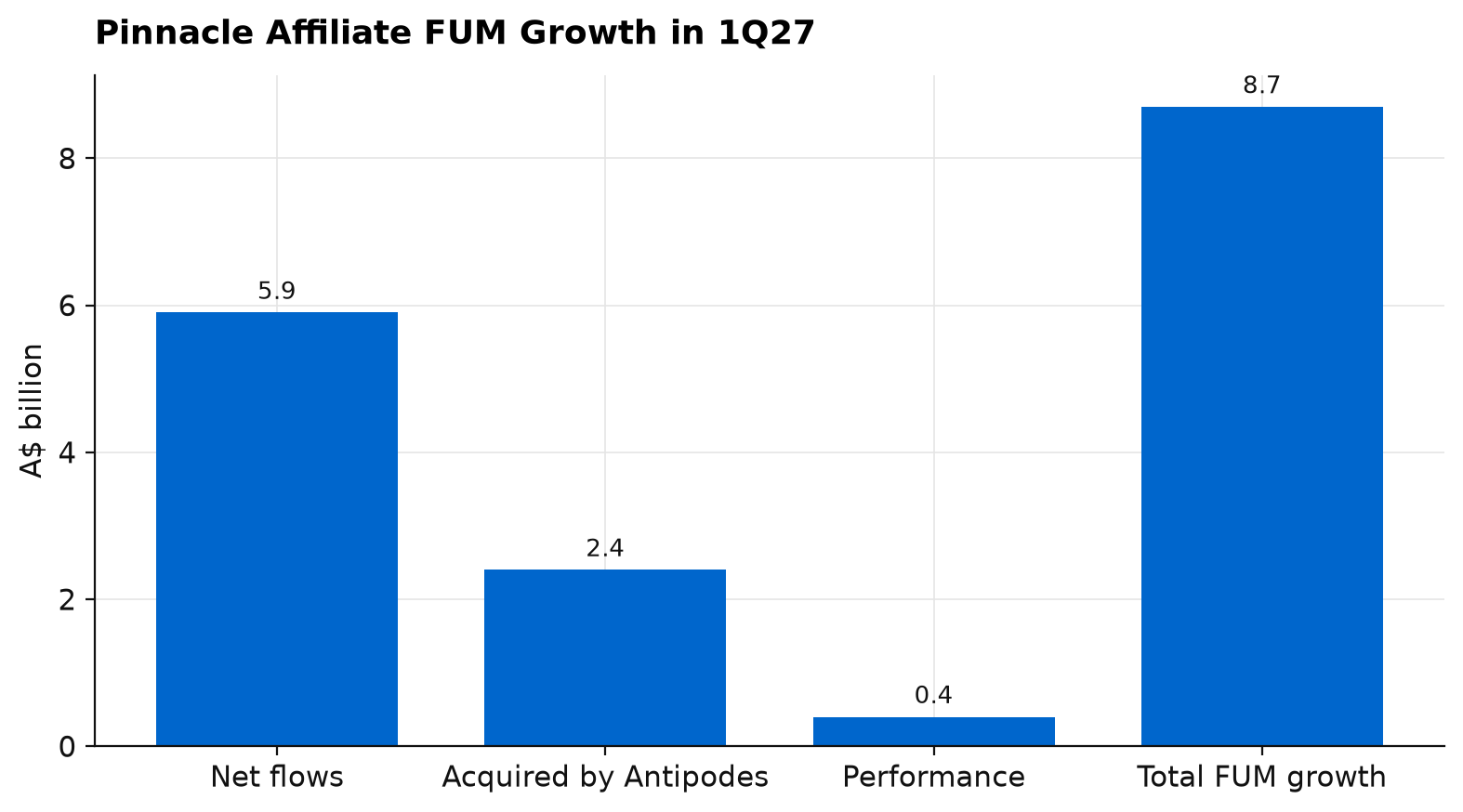
If flows and markets hold up even reasonably well, a decent second quarter would put the half-year number close to where both the research and the broader market expect. Earnings expectations for a fund manager are built on FUM, so meeting the FUM number removes one of the more obvious risks to near-term earnings.
Flows Are Steady Even as International Cools
Net flows of A$5.9 billion imply an annual run-rate of around A$24 billion, which is about 10 per cent of the FUM Pinnacle started the quarter with. That is a solid organic growth rate for a fund manager. It is below the faster pace seen in fiscal 2025 and fiscal 2026, but it is broadly consistent with what institutional sell-side research expected, which models organic growth of around 9 per cent in fiscal 2027.
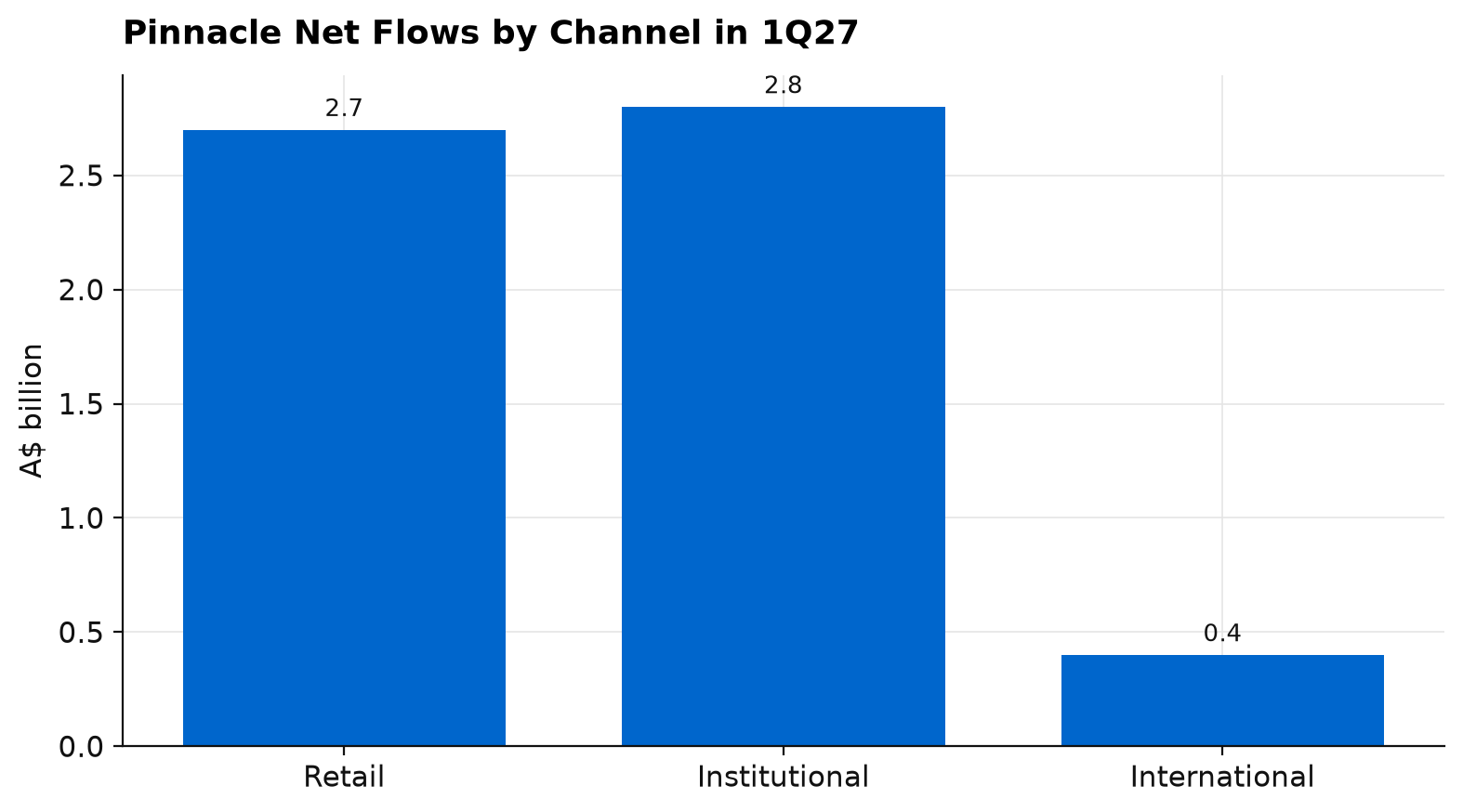
The flows were driven mainly by two channels. Retail clients, meaning individual investors, contributed A$2.7 billion. Institutional clients, meaning large professional investors, contributed A$2.8 billion. International flows were just A$0.4 billion, the softest result since the first quarter of fiscal 2025 and well below the two-year average of around A$2.4 billion a quarter.
The international number needs a closer look. It included around A$0.8 billion from PAM, of which around A$0.7 billion went into model portfolios. Take PAM out and international flows would have gone backwards, with roughly A$0.4 billion flowing out, driven by institutional outflows. One quarter does not make a trend, and institutional mandates can be large, so a single win or loss can swing the total in any given quarter. But international is an important growth area for the group, so it is the channel to watch in coming updates.
In its annual general meeting release, Pinnacle updated its estimate of platform capacity, which it now puts at around A$850 billion, of which around A$600 billion is unused. Capacity here means how much money the affiliates’ strategies can manage before size starts to get in the way of performance. Some investment strategies become harder to run well as they get bigger, so managers often close funds to new money once they reach a ceiling. Having around A$600 billion of unused capacity against A$238.1 billion of FUM today means the existing affiliates have plenty of headroom before that becomes a constraint. This supports the research view that group FUM can keep rising at a solid double-digit rate for years to come, with a forecast compound annual growth rate of 13 per cent over the three years to fiscal 2029. A compound annual growth rate is simply the steady yearly rate that would take you from the starting figure to the ending one.
A rules-based approach to leveraged ETFs
See how our quantitative strategy works and who it suits.
Explore the strategyBecome an authorised representative
Advise your clients under an established AFSL without building your own. Choose AR or CAR.
Become an AR or CARPerformance Fees Intact, Forecasts Trimmed for Private Markets
Pinnacle’s affiliates can earn performance fees on top of their base management fees. A performance fee is an extra fee paid when a fund beats its target, and it usually only applies once the fund is above its high watermark. A high watermark is the highest value the fund has previously reached. The manager has to recover any losses and climb back above that peak before it can charge a performance fee again. That protects investors from paying twice for the same gains, but it also means the closer a fund sits to its high watermark, the more readily it can earn performance fees when returns are good.
The update showed around 80 per cent of Pinnacle’s FUM at or within 2 per cent of its high watermark, unchanged from fiscal 2026 and in line with the two-year average of around 79 per cent. The mix has shifted slightly, with 65 per cent now at the high watermark and 15 per cent near it, against 67 per cent and 13 per cent previously. Performance fees are hard to forecast and are not something to count on, but with most of the FUM base in position to earn them, a good stretch of investment returns could flow through to profits relatively quickly.
Private markets are the weak spot, as Pinnacle gave no new detail on performance or flows at Metrics but did note that the backdrop for private credit and real estate in Australia has been challenging and that it expects short-term pressure on flows. Private credit means loans made directly by investment funds to borrowers, without a bank in between, and the company remains confident about the long-term outlook for these asset classes. Institutional sell-side research has been more cautious, though. It has reduced its affiliate FUM forecasts by 2, 3 and 4 per cent across fiscal 2027, 2028 and 2029, driven mostly by more modest expectations for private credit and real estate flows and performance at Metrics and Resolution. Those FUM cuts flow through to reductions of around 4 to 5 per cent in underlying net profit after tax.
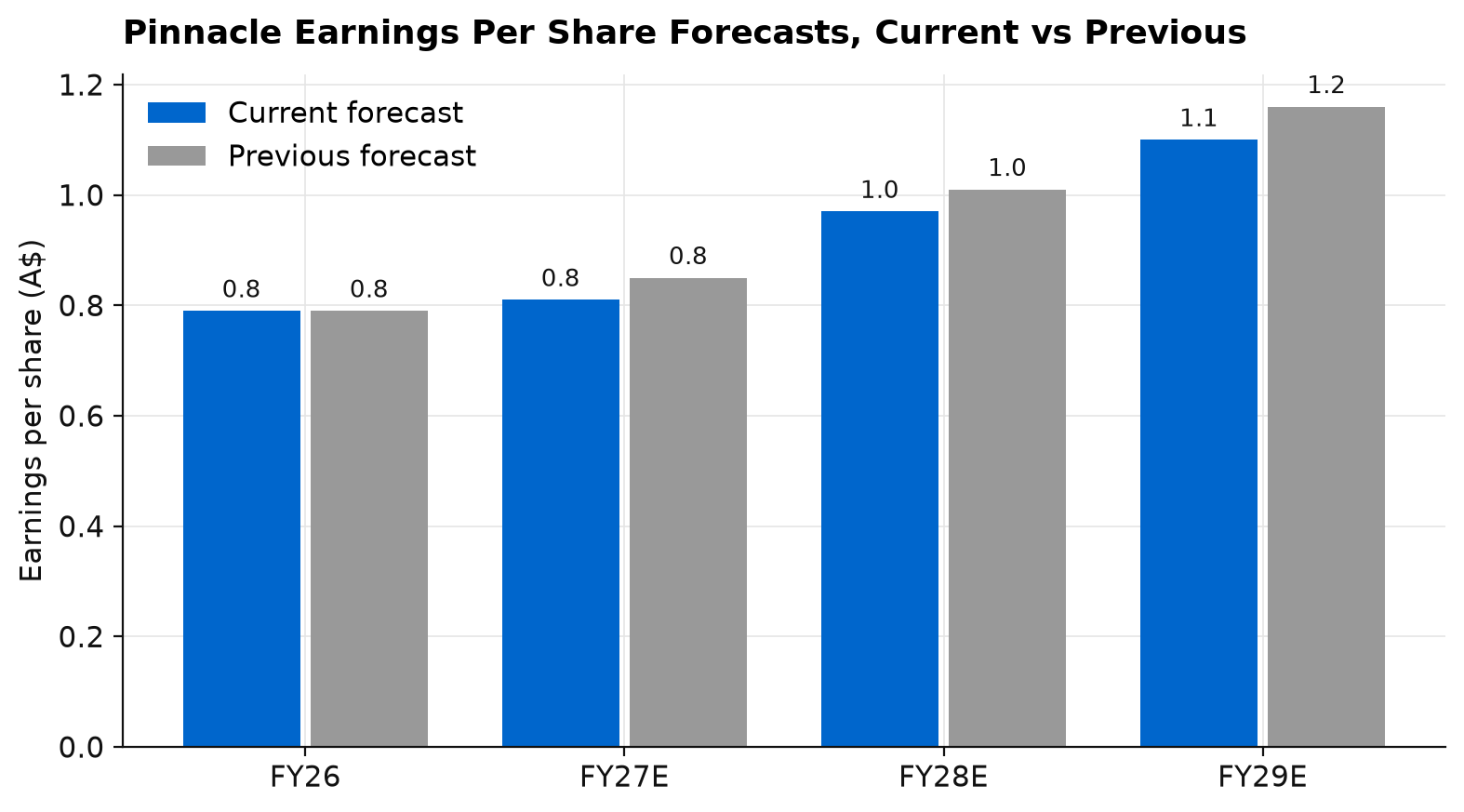
Earnings per share were A$0.79 in fiscal 2026, and even after those cuts the research forecasts A$0.81 in fiscal 2027, A$0.97 in fiscal 2028 and A$1.10 in fiscal 2029, against A$0.85, A$1.01 and A$1.16 previously. Revenue is forecast at A$385.1 million in fiscal 2027, rising to A$452.4 million in fiscal 2028 and A$510.9 million in fiscal 2029, after A$245.7 million in fiscal 2026. The previous revenue forecasts were A$403.3 million, A$482.8 million and A$551.0 million. Earnings per share are forecast at A$0.38 for the half to December 2026, down from A$0.48 in the half to June 2026, before recovering to A$0.43 and then A$0.47 in the following two halves.
Valuation and the Buy Case
The 12 month price target of A$18.64 sits about 17.8 per cent above the A$15.83 share price when this research was published. That target is down from A$21.55, cut to reflect the trimmed earnings estimates, recent developments at Metrics and a roll-forward of the valuation in time. On top of the price upside, Pinnacle has paid A$0.60 per share in dividends over the past twelve months, which equates to a trailing dividend yield of 3.8 per cent, partly franked at 65 per cent. Franked dividends carry credits for company tax already paid, which suits investors who can use them, including SMSF trustees.
Net flows of A$5.9 billion in the quarter were close to forecast, and the half-year FUM number needs only an ordinary second quarter to land. With around A$600 billion of unused capacity, the existing affiliates can keep growing for years before size becomes a problem, which supports the forecast 13 per cent compound annual growth in FUM to fiscal 2029. Because the model is capital-light, rising FUM can lift earnings per share from A$0.79 in fiscal 2026 toward A$1.10 in fiscal 2029 on the research’s numbers, and with around 80 per cent of FUM at or near its high watermark, stronger investment returns could also lift performance fees.
The shares have fallen further than the broader small-cap market this financial year, and the bad news on Metrics is now reflected in lower forecasts and a lower target. The parts of the business that drive most of the growth, domestic retail and institutional flows, are tracking to plan. For investors with a 12 month or longer horizon, the pullback offers a lower entry point into a growing, capital-light manager, with about 17.8 per cent upside to the target and a partly franked dividend on top. The next couple of quarterly flow updates, particularly on international and private markets, will show whether the soft patch is as short-lived as the company expects.
Key Risks
The first risk is global market conditions, because Pinnacle’s earnings are tied to FUM, so a sharp fall in equity or credit markets would cut FUM, base fees and the chance of earning performance fees all at once. The second is portfolio concentration and competition, since a meaningful share of earnings can rest on a smaller number of affiliates and strategies, and poor performance at one of them could trigger outflows as clients move money elsewhere. The third is execution, covering capacity constraints at popular strategies, the risk that new affiliates fail to scale and the risk that acquisitions do not deliver what was paid for. The fourth is specific to private markets, where the company already expects short-term pressure on flows after a challenging period for private credit and real estate in Australia, and a longer downturn would weigh further on Metrics and Resolution. The fifth is key personnel, since the departure of a senior portfolio manager could hurt an individual affiliate quickly. Finally, fund managers are subject to regulation, and a change in rules could affect fees, products or flows.
Our View
The core flow engine delivered close to forecast and the half-year FUM number is within reach, despite the cut to the price target. The trimmed forecasts look like a sensible response to a tough patch in private credit and real estate. We like that Pinnacle grows by adding money and affiliates to a platform that still has around A$600 billion of spare capacity, without needing a large balance sheet. The part we would watch most closely is international flows, which were soft this quarter and went backwards once PAM is excluded. If those recover and Metrics stabilises, the earnings path in the research looks achievable. If they do not, the next round of forecast cuts would most likely come from there. Overall, with about 17.8 per cent upside to the A$18.64 target plus a partly franked dividend, the numbers support the Buy rating.
If you would like to discuss Pinnacle Investment Management, request a callback or call us on 1300 889 603.
Financial Summary
Become an authorised representative
Advise your clients under an established AFSL without building your own. Choose AR or CAR.
Become an AR or CAR