

New Zealand’s 7 November election was billed as too close to call, and the preliminary count bore that out. National and Labour finished almost level on the party vote, and the governing coalition sits just clear of a majority before special votes, which have historically favoured the left, are counted. Institutional sell-side research says investors should focus on how long it takes to learn who governs and what the final coalition deal contains. The official result is not declared until 27 November and coalition talks follow, so the research does not expect a new government before the Reserve Bank of New Zealand’s 9 December meeting, and it sees the political backdrop as neutral for New Zealand interest rates in the near term.
Labour has campaigned on a 28 per cent capital gains tax on investment property, echoing the housing tax overhaul the Australian government legislated in mid-2026, which abolished negative gearing for established dwellings and replaced the 50 per cent capital gains discount with a tax on inflation-adjusted gains at a minimum rate of 30 per cent. The research expects a smaller house price effect in New Zealand than it estimated for Australia, but a broad hit to property investors all the same. For ASX-listed businesses with New Zealand operations, the coalition agreement will set the tax and housing policy they face.
Table of contents [hideshow]
A Close Race Under Proportional Voting
New Zealand elects its Parliament under a mixed member proportional system, known as MMP. Each voter casts an electorate vote and a party vote, and the party vote largely decides how the normally 120 seats are shared out, with a 5 per cent threshold unless a party wins an electorate. Since MMP arrived in 1996, ten governments have been formed and only one of them was a single-party majority.
The polls cited in the research had both National, led by Prime Minister Christopher Luxon, and Labour, led by Chris Hipkins, on a little under 30 per cent of the party vote, with the Greens around 15 per cent and every other minor party on 10 per cent or less. Luxon’s standing as preferred prime minister has declined over the past two years against a weak economy.
The research sees two likely blocs, the current centre-right National-ACT-NZ First coalition and a centre-left Labour-Green bloc that would also need The Opportunity Party, a self-described centrist party, and Te Pāti Māori. Polling pointed to The Opportunity Party as a possible kingmaker, meaning its support could decide which side governs, and the preliminary count has it entering Parliament for the first time. Te Pāti Māori’s campaign also raised the chance of overhang seats, which push Parliament beyond 120 seats.
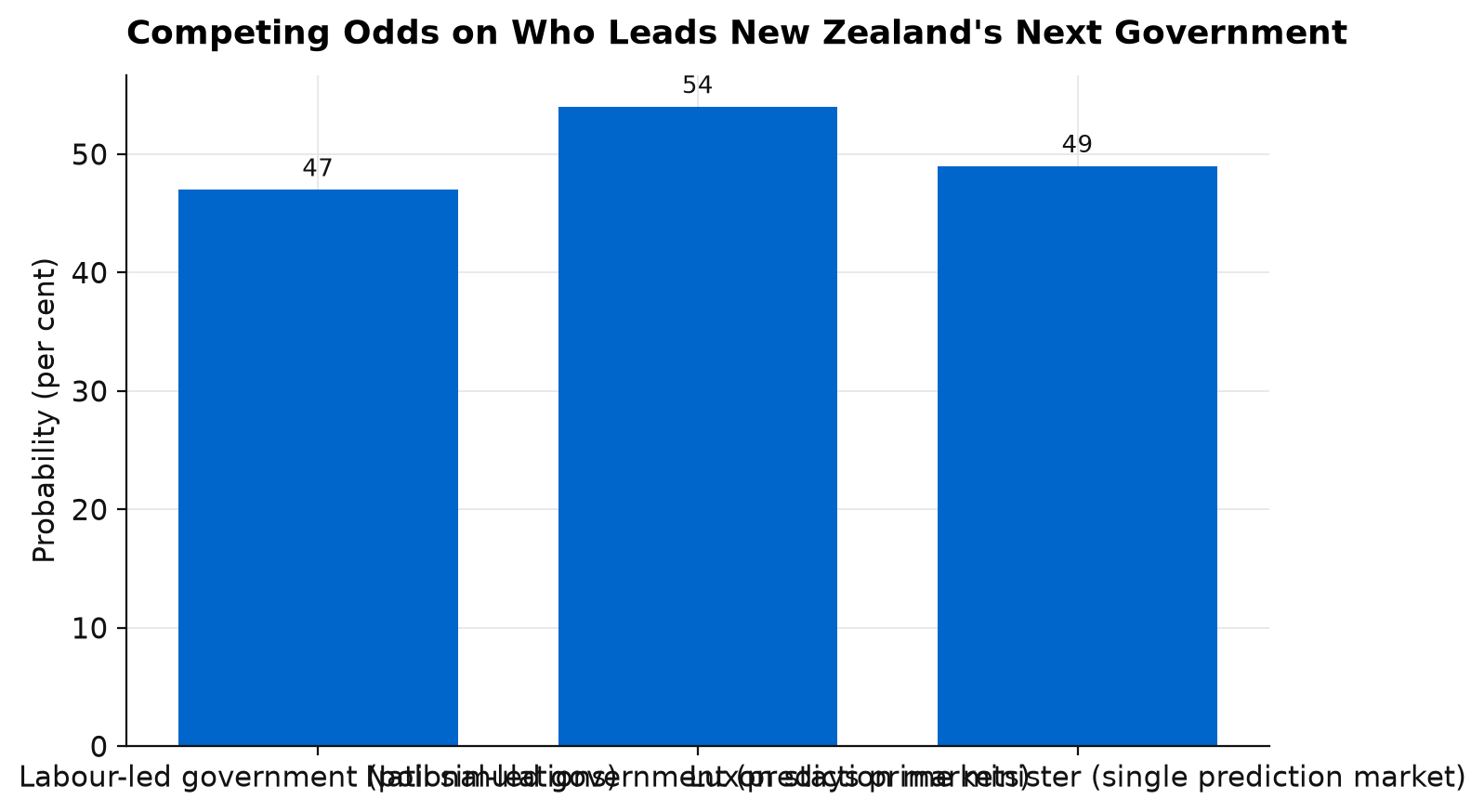
Running a large number of simulated elections off recent polling, each poll adjusted for its historical bias and weighted towards the most recent, the research finds a slight lean towards a Labour-led outcome and a hung parliament risk of around 9 per cent. Prediction markets, where people put real money on the result, leaned slightly the other way before the vote.
Why the Result Will Take Weeks
Preliminary results on election night exclude special votes, cast by people voting outside their home electorate, from overseas or otherwise off the standard roll. These are typically around one-fifth of the total and tend to lean left, and in 2017, 2020 and 2023 National lost two seats once they were counted.
After the official result on 27 November come the negotiations. Smaller parties can join as coalition partners or sit outside government under a confidence-and-supply agreement, backing it on budgets and no-confidence votes without taking ministries. In 2023 the government was formed 21 days after the final count, and in 2017 it took 12 days.
Fiscal Impact of the Two Platforms
The unemployment rate rose to a new cyclical high in the third quarter of 2026, inflation is elevated, and estimates of the output gap sit at about -1.5 per cent of potential GDP. The output gap measures how far an economy’s actual production sits from what it could produce without stoking inflation, and a negative figure means spare capacity. Voters rank the cost of living as their top concern, and Labour is viewed as the party most capable of managing it.
Labour has pledged cost-of-living relief in health and transport, partly paid for by the capital gains tax and by repealing the Investment Boost, a tax break on new business assets. National has pledged no new taxes, offsetting extra spending on roads, health and housing with savings on welfare and foreign aid. Both have committed to a budget surplus by FY29 and stay within the NZ$2.4bn per-Budget operating allowance set in Budget 2026, with National’s net new operating spending slightly higher once fully implemented, at 1 per cent of GDP against 0.7 per cent for Labour.
The research concludes that the two platforms would put similar pressure on interest rates. Minor parties will push their own priorities in coalition talks: the Greens want a wealth tax, ACT wants spending cuts and NZ First wants a lower company tax rate for smaller businesses.
Labour’s Property Tax and Other Policies
Labour proposes a 28 per cent tax on gains from commercial and residential investment property, applying to gains made after 1 July 2027 and excluding the family home, farms, KiwiSaver and shares. By cutting investors’ after-tax returns, the research expects it would contribute to lower house prices and weaker construction. Its rule of thumb is that each 10 per cent fall in house prices lowers GDP by about 1 per cent after a year, partly offset by Labour’s 6,000 additional social housing places.
A rules-based approach to leveraged ETFs
See how our quantitative strategy works and who it suits.
Explore the strategyBecome an authorised representative
Advise your clients under an established AFSL without building your own. Choose AR or CAR.
Become an AR or CARThe current bright-line test taxes investors only if they sell within two years, yet the median investor holds for 7 to 8 years, so the new tax would reach most property investors, who account for around one-third of residential property ownership. Labour is not changing the tax deductibility of mortgage interest, which is the main reason the research expects a smaller effect than in Australia.
Repealing the Investment Boost, introduced in 2025 to let businesses expense 20 per cent of the cost of new assets, would likely weigh on business investment at the margin. Labour would also restore the central bank’s dual mandate, adding maximum sustainable employment alongside price stability, as applied from 2018 to 2023. The research sees the change mattering only during persistent supply shocks that push prices up while costing jobs, such as the one emanating from the Middle East, when the central bank could respond marginally less aggressively.
Labour’s free GP visits and removal of the NZ$5 prescription fee could lower consumer price inflation by at most 20 basis points, a basis point being one-hundredth of a percentage point, while a NZ$4 an hour pay rise for about 65 thousand care and support workers would add to wage costs, though the research sees both as one-off changes with little bearing on monetary policy.
What It Means for Investors
The research treats the election as neutral for New Zealand interest rates in the near term, because a new government is unlikely to be in place in time for the central bank’s next meeting and key policy changes would take time to legislate and implement.
Australia legislated its property tax changes in mid-2026, and a Labour-led government would bring a broad capital gains tax to New Zealand from 1 July 2027. New Zealand residential property is exposed if the policy survives coalition talks intact, whether owned directly or through listed property, and so are banks’ mortgage books and the building sector.
ASX-listed companies with meaningful New Zealand earnings are exposed to housing, business investment and supermarket competition, with Labour, National, the Greens and NZ First each proposing a different overhaul of the major supermarket groups. Longer term, both major parties want larger KiwiSaver contributions by 2032, which would grow the pool of local retirement savings.
The dates to watch are the official result on 27 November, the text of whatever coalition or confidence-and-supply agreement follows, and the 9 December central bank meeting. This is general information only and does not take account of your personal circumstances.
Key Risks
Minor parties will likely be needed to form government and may push policy away from either major party’s platform, shifting the fiscal picture.
The research sees the mandate change altering interest rate decisions mainly if a persistent supply shock hits while a dual mandate is back in place. The capital gains tax could also bite harder on house prices and construction than expected, with knock-on effects for consumption through household wealth.
Special votes could swing seats between blocs, and with the governing coalition only narrowly ahead on the preliminary count, a hung parliament would extend the uncertainty.
Become an authorised representative
Advise your clients under an established AFSL without building your own. Choose AR or CAR.
Become an AR or CAR