
A note published by institutional sell-side research on 30 September 2026 asks whether the Reserve Bank of Australia’s expanded communication actually helps anyone predict what it will do next. The research ran RBA decision statements and Minutes through three kinds of text-analysis software to score how hawkish (leaning toward higher rates) or dovish (leaning toward lower rates) each one sounded. Its answer is a qualified no. The tone scores point in the right direction, but they add little in practice and do not reliably predict how markets move on decision day.
For Australian borrowers, savers and SMSF trustees watching the cash rate, the more useful finding is about uncertainty. The research finds the RBA’s use of hedging and uncertain language has risen since 2023 by more than global risk or inflation can explain, and that this has coincided with bigger market surprises on decision days. In plain terms, the RBA has stopped telling markets where it is heading, and that matters for Australian bonds, the AUD and rate-sensitive parts of the ASX.
Table of contents [hideshow]
Why The RBA Changed The Way It Talks
The starting point is the Review of the Reserve Bank of Australia, published in April 2023, which said a key lesson from the RBA’s past performance was the need to ‘continue to improve the Reserve Bank Board’s communication of its policy decisions and strategy’. The RBA responded by setting up a Communications Department and a Chief Communications Officer, committing its external members to at least one speech or public engagement each year, and expanding its outreach to media and stakeholders.
The style has shifted too. Decision statements grew longer after the Review, though the research notes they have recently been trimmed back. Since February 2024 the Governor has held a press conference after each meeting. Unscripted appearances, such as fireside chats, have become more common.
Can Software Read The RBA
The research used three methods of natural language processing, which simply means getting a computer to read and score text. The first is a dictionary approach, essentially a sophisticated word count that looks for word pairs with a hawkish or dovish meaning, such as ‘still-elevated inflation’ versus ‘subdued inflation’. The second is an older style of language model trained on central bank research papers and speeches, mostly from the US Federal Reserve and the European Central Bank. The third is a modern large language model asked to score each statement with no special training.
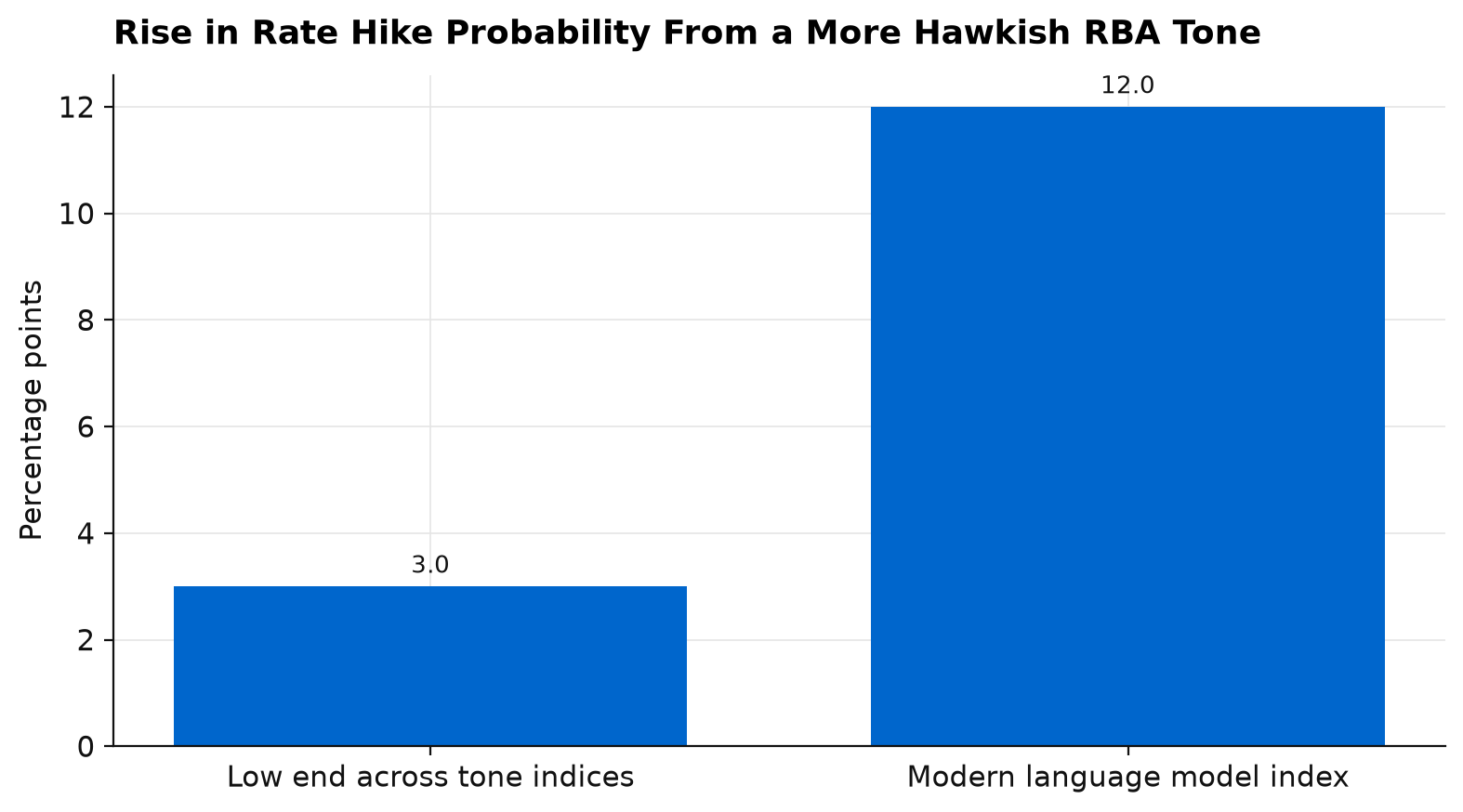
All three tone indices move in the same direction as actual cash rate changes. The modern model tracks them most closely but is the hardest to understand, while the dictionary method tracks less closely but is completely transparent. When the research tested whether a more hawkish tone predicts a hike at the next meeting, the answer was yes, statistically, but the effect is modest. A one standard deviation rise in the tone indices, roughly a move from a typical reading to a noticeably more hawkish one, lifts the probability of a hike at the next meeting by between 3 and 12 percentage points. For the modern language model the figure is 12 percentage points, but that index only moves beyond one standard deviation in either direction in approximately one-third of the period since 2010. The research is also cautious about that model’s results because it was trained on data covering the same period, so it may effectively know outcomes the RBA did not know at the time.
On markets the result is weaker still. The research looked at the 1-year overnight indexed swap rate, a market price reflecting where traders expect the cash rate to sit over the coming year, between 2pm and 3:30pm on decision days. Changes in tone did not explain market moves beyond what the cash rate decision itself already told traders. The likely reason is that by the time a statement lands, most of its information has already arrived through the data flow and the decision.
The software also misses nuance. When Governor Bullock said in May 2026 that the 3 hikes to date gave the RBA ‘space’ to pause and assess, it was a materially dovish signal, but a model trained on other central banks’ language had no way of knowing that phrase mattered. In August, the RBA said the impact of the Middle East conflict on inflation had been ‘less than expected’, which the research saw as material, yet the modern model mostly ignored it and kept focusing on statements that inflation remained high.
More Hedging, Bigger Surprises
The more practical finding concerns uncertainty. The research finds hedging and uncertain language in RBA Statements and Minutes has increased from early 2023, with evidence of a structural break, meaning a lasting step change rather than a temporary blip, in the Minutes towards end-2023, shortly after the Review was published.
Our exclusive top 5 stock picks
Five high conviction stocks that didn't make the public list. Backed by institutional research. Subscribe for free access.
Thanks for subscribing, please check your email to confirm your subscription to instantly access your report.
That rise persists after allowing for geopolitical risk and how far inflation has strayed from the RBA’s 2.5 per cent target. A doubling in the frequency of uncertain language appears to be more than those measures would suggest. The research thinks most of the unexplained part reflects the RBA’s deliberate move away from forward guidance, where a central bank signals in advance where rates are likely to head, toward a purely data-dependent approach.
This has coincided with larger average market surprises on decision days in the post-COVID period. Some of that reflects a more uncertain economy, but the research thinks part of it reflects the RBA’s caution about guiding markets before meetings. Governor Bullock has said she does not want to ‘front run’ the Board, that it will be ‘guided by incoming data’, and, plainly, ‘I’m not going to give forward guidance.’
Still A Work In Progress
The research is frank that the overhaul is unfinished. The RBA’s new semi-annual community survey shows high trust in the institution but gaps in understanding of how interest rates fight inflation, and only 29 per cent of respondents recognise the full employment side of the RBA’s dual mandate, its job of keeping both inflation in check and employment high. Readability has not improved either. Flesch-Kincaid scores, a common readability measure based on sentence and word length, show RBA Statements and Minutes still pitched at a university-graduate level.
The other change is who is speaking. Historically, two of nine Monetary Policy Board voters, the Governor and Deputy Governor, spoke publicly and generally represented the Board’s view. As external members begin their own public engagements, investors will hear a broader range of voices. Over time that should help explain the reasoning behind decisions, but the research warns it could also become more fragmented or noisy. It points to Deputy Governor Hauser’s remarks in early March 2026, widely seen as hawkish, which Governor Bullock later confirmed had been a misinterpretation.
What It Means for Investors
This is general information only and does not take into account your personal circumstances. The practical message for Australian investors is that RBA decision days are likely to keep delivering surprises. With the Bank deliberately stepping back from forward guidance, markets have less to go on between meetings, and the research links that shift to larger moves on the day.
For holders of Australian government and corporate bonds, and for SMSF trustees relying on term deposits or floating-rate income, rate expectations can reprice quickly on decision day rather than drifting gradually. The AUD and rate-sensitive parts of the ASX, such as banks, property trusts and other income-focused shares, can also move more on the day when pricing has to catch up.
The research points investors toward putting less weight on the tone of any single statement and more on the data the RBA says guides it, chiefly the trimmed mean, a measure of underlying inflation that strips out the biggest price rises and falls, and the labour market. The Governor’s press conference and the Minutes are worth reading for how the Board weighs that data, not for hints about the next move. As external members start speaking, treat any single remark with caution until it is clear it reflects the Board’s view.
Key Risks
The first risk is the evidence itself. The research notes identification is difficult because the rise in uncertain language coincided with higher geopolitical risk and an inflation overshoot, so the share it attributes to those factors should be viewed as an upper limit, and the timing of the structural break is sensitive to method. Second, decision statements do still contain some statistical signal, and a return to clearer guidance would change the picture. Third, a wider range of RBA voices could make policy easier to understand, or produce more noise and more misread comments like those in March 2026. Where we land, expect the RBA to keep its cards close and plan for decision days to move markets more than they once did.