

Applied Materials used an investor breakfast at SEMICON West and the unveiling of its new EPIC Center on 12-13 October to set out a longer-range plan built around artificial intelligence. The company expects AI to keep accelerating spending on wafer fab equipment through CY30, and it lifted its long-term targets to a gross margin of about 54 per cent and an operating margin of about 40 per cent by CY30. The share price fell 7 per cent amid a sector-wide selloff, a reaction that appears to reflect some disappointment that management gave no specific medium-term equipment forecast or earnings target before 2030. Institutional sell-side research has Applied Materials rated Buy with a 12 month price target of US$670.00, about 65.4 per cent above the recent close of US$404.98. The research expects the coming earnings season to refocus attention on how much higher Applied’s earnings power is likely to be by 2028, given outsized growth in its core equipment markets and its large exposure to deposition and etch, two of the key steps in building a chip.
Research published 21 October 2026. Price target and upside based on prices at time of publication.
Table of contents [hideshow]
About Applied Materials
Applied Materials supplies the equipment chipmakers use to build semiconductors, a category known as wafer fab equipment, or WFE. Its tools are concentrated in deposition, where thin layers of material are laid down on a silicon wafer, and etch, where patterns are carved into those layers. The company has exposure to about 55 per cent of the WFE market, the portion it can sell into, known as its served addressable market or SAM. Alongside equipment sales, its services business, AGS, earns recurring revenue maintaining and upgrading the installed base of tools under multi-year subscription agreements. Applied is also building positions in advanced packaging and in process control and inspection. The company reported revenue of US$28,368.0 million in its 2025 financial year, which ends in October, and trades on the Nasdaq under the ticker AMAT.
AI Is Lifting the Ceiling on Chip Equipment Demand
The biggest message from the October event was that management sees artificial intelligence accelerating growth in wafer fab equipment spending all the way through CY30. Two newer forms of AI sit at the centre of that view. Agentic AI refers to software that can plan and carry out multi-step tasks on its own, and physical AI refers to AI that operates in the real world through robots, vehicles and machines. The company expects the AI factory pods that run these workloads, large clusters of AI computing hardware, to drive 2 to 4 times greater wafer demand. More wafers means more chipmaking capacity, and more capacity means more equipment orders.
Where that growth is expected to land matters just as much. Roughly 75 per cent of WFE growth is expected to come from three areas. The first is leading-edge logic, the most advanced processors. The second is DRAM, the memory chips that hold data while a processor works on it. The third is advanced packaging, the process of joining several chips together into one high-performance unit. These are areas where Applied holds leadership positions and, according to management, is gaining share in the markets it serves. The company also noted that AI is driving 1.5 times more leading-edge process steps, and each extra step adds work for the deposition and etch tools where Applied is strongest.
Management also put numbers on its share ambitions. With about 55 per cent of WFE in its served market, Applied is targeting about 300 basis points of share gain in foundry and logic and about 500 basis points in DRAM. A basis point is one hundredth of a percentage point, so 300 basis points is 3 percentage points. Foundry refers to contract chipmakers that manufacture chips designed by other companies. Taken together, the company says those gains translate to about 200 basis points of overall WFE share gain. We read a target of that size as a sign of confidence in the product pipeline, because share in this industry is won one customer process at a time.
To support this growth, Applied plans to more than double its manufacturing and lab capacity while reducing capital expenditure intensity, meaning capital spending is expected to fall as a share of revenue even as the footprint grows. The new EPIC Center is the centrepiece of that build-out. It is a US$5 billion, 600,000 square foot facility designed to speed up collaboration between Applied and a wide range of customers through co-innovation, where the company and chipmakers develop new processes together. Applied is targeting up to 2 times faster chip development through EPIC, as AI drives 1.5 times more leading-edge process steps and 70 per cent higher semiconductor research and development. The aim is that when chipmakers develop new processes alongside Applied’s engineers, Applied’s tools are more likely to feature in the production lines that follow.
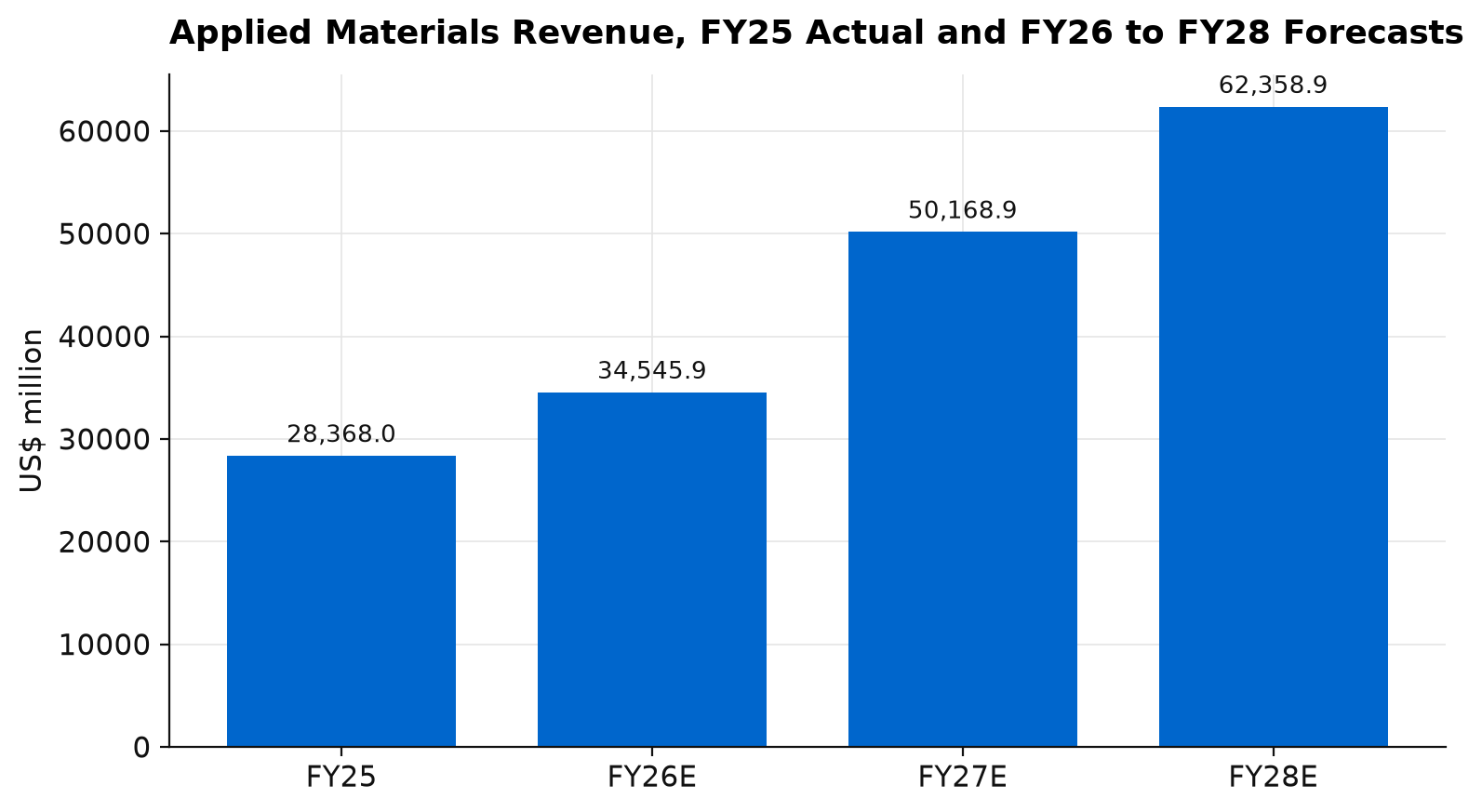
The research forecasts show what this could look like in the numbers. Revenue of US$28,368.0 million in FY25 is forecast to rise to US$34,545.9 million in FY26, US$50,168.9 million in FY27 and US$62,358.9 million in FY28. On those forecasts, revenue would more than double over three years, which is the scale of growth the AI demand argument rests on.
Services and Advanced Packaging Broaden the Growth Base
Equipment sales are the headline, but services are where Applied earns steadier, recurring revenue. AGS, the company’s services business, maintains, repairs and upgrades the tools already installed in customers’ factories. AGS revenue is set to grow 20 per cent this year and in the mid-teens thereafter, supported by two forces. The first is growth in the installed base, since every new tool sold becomes a future service customer. The second is rising service intensity, meaning customers are spending more on services for each tool they run.
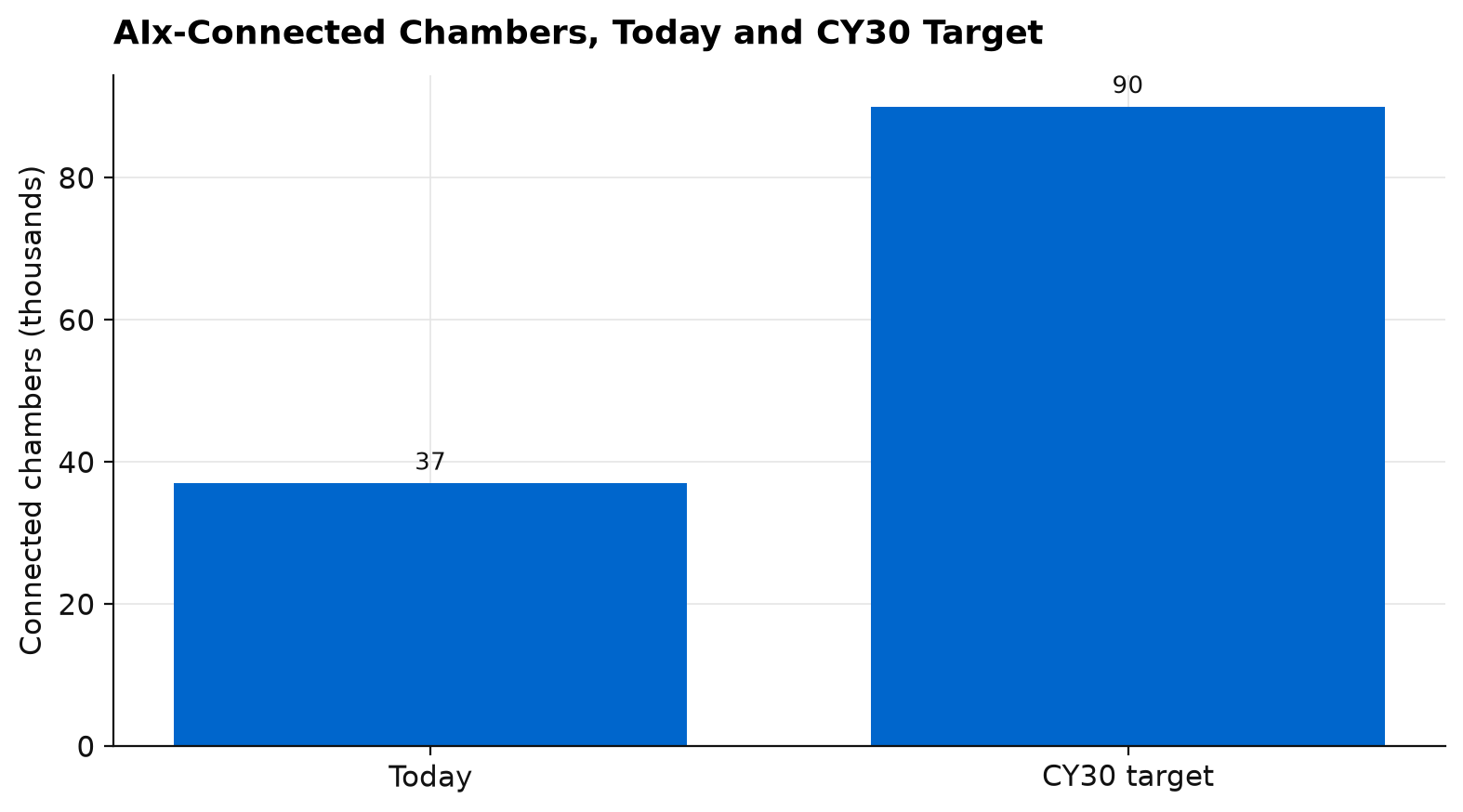
Connectivity is what drives that second force. A chamber is the compartment inside a tool where a wafer is actually processed, and Applied’s AIx-connected chambers are those linked to its data and software systems. They are expected to scale from more than 37,000 today to more than 90,000 by CY30. Connected chambers let Applied offer predictive maintenance, which spots problems before a tool breaks down, along with production quality optimisation and 30 per cent faster service resolution. The company expects this to help drive 20 per cent higher service revenue per tool.
This revenue also comes with strong visibility. Average subscription agreements run for more than 2.5 years and renewal rates sit at about 90 per cent. By CY30 the company expects US$15 billion in services revenue, growing at a mid-teens rate. We like this part of the business because contracted, recurring revenue tends to be steadier than one-off equipment sales, and it gives investors a clearer line of sight on a growing share of the company’s earnings.
Advanced packaging is the second growth lane. High bandwidth memory, or HBM, is memory built by stacking DRAM chips on top of each other and placing the stack beside an AI processor so data can move quickly between them. Hybrid bonding is a technique for joining those stacked chips directly together. Applied sees hybrid bonding in HBM driving a roughly 2 times expansion in its packaging served market. Against that backdrop it is targeting about 60 per cent share of HBM packaging and more than US$5 billion in annual advanced packaging revenue.
Our exclusive top 5 stock picks
Five high conviction stocks that didn't make the public list. Backed by institutional research. Subscribe for free access.
Thanks for subscribing, please check your email to confirm your subscription to instantly access your report.
Rising packaging complexity is also increasing the value of inspection, the tools that check chips for defects during production. Applied expects its process control and inspection business to grow by more than 50 per cent in CY26. As chips are built from more layers and more stacked pieces, catching faults early matters more to the chipmaker, and that is the market Applied is leaning into. Services, packaging and inspection together give the company growth that does not rely solely on the next round of factory equipment orders.
Higher Margin Targets Point to Much Bigger Earnings Power
The financial targets are where the investor event was most constructive. Applied is aiming for a gross margin of about 54 per cent and an operating margin of about 40 per cent by CY30. Gross margin is the share of revenue left after the direct cost of building the tools, and operating margin is what remains after running costs such as research, sales and administration are also paid. The company expects to get there through about 500 basis points of gross margin expansion and about 1000 basis points of operating leverage. Operating leverage means profits grow faster than revenue, because a large part of the cost base does not rise as quickly as sales.
Alongside US$15 billion in services revenue, the company expects US$2 billion in Other revenue by CY30, and it plans to return 80 to 100 per cent of free cash flow to shareholders over time. Free cash flow is the cash left after the business has paid for its operations and its investment in capacity. A commitment of that size means shareholders would share directly in the growth, rather than seeing the cash build up on the balance sheet.
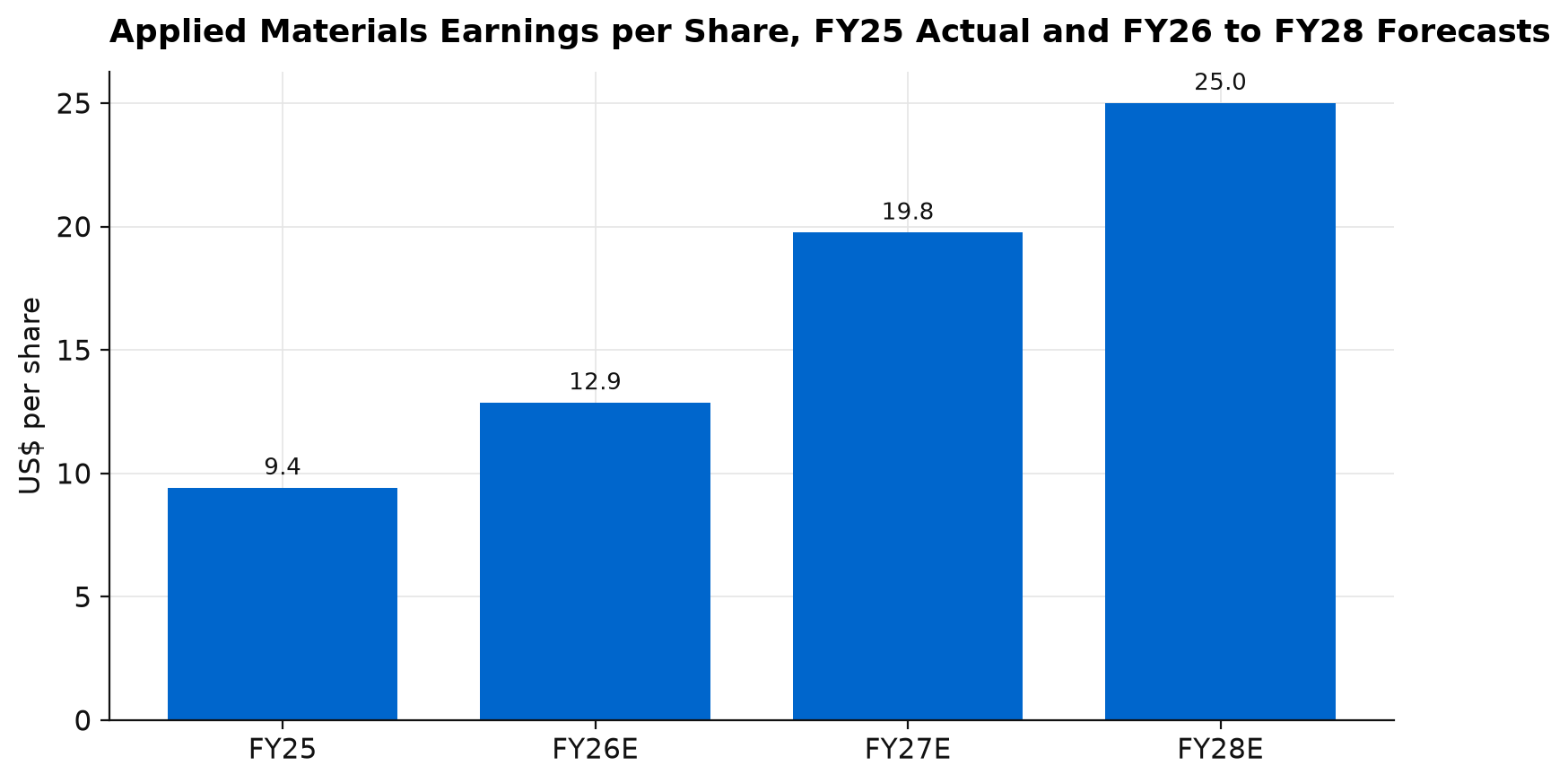
Institutional sell-side research views these targets as very constructive, while recognising that the long-dated CY30 timeline fell short of investor expectations. The forecasts suggest the earnings uplift does not have to wait until 2030. Earnings per share of US$9.42 in FY25 is forecast to rise to US$12.87 in FY26, US$19.76 in FY27 and US$25.01 in FY28. Operating profit, measured as earnings before interest and tax (EBIT), is forecast to climb from US$8,562.0 million in FY25 to US$22,752.3 million in FY28.
The quarterly path matters for the near term. Applied reported earnings per share of US$3.49 for the July 2026 quarter, and the research forecasts US$4.14 for the October 2026 quarter, US$4.21 for the January 2027 quarter and US$4.71 for the April 2027 quarter. The research expects the upcoming earnings season to validate its view that Applied’s earnings power is likely to be significantly higher by 2028, given outsized WFE market growth and the company’s outsized exposure to deposition and etch.
Valuation and Why the Selloff Looks Like an Opportunity
The 12 month price target of US$670.00 sits about 65.4 per cent above the recent close of US$404.98. The shares fell 7 per cent around the investor event amid a sector-wide selloff, and the research reads that reaction as disappointment about timing, given the lack of a specific medium-term equipment forecast or earnings target before 2030, and expects the stock to recover. The path to the target rests on three pillars. The first is outsized growth in the WFE market driven by agentic and physical AI, with Applied targeting about 200 basis points of overall share gain in the areas where most of that growth is expected to land. The second is a services business set to grow 20 per cent this year and in the mid-teens after that, backed by multi-year subscriptions and renewal rates of about 90 per cent, with advanced packaging and inspection adding new lanes of growth. The third is a margin plan that, together with the forecast lift in earnings per share to US$25.01 by FY28, points to substantially higher earnings power.
When a stock sells off because management declined to put a near-term number on its plan, rather than because the plan itself got worse, the risk-reward tends to tilt toward the buyer. The upside to the target is large, the growth drivers are spread across equipment, services and packaging, and the next quarterly result gives the market an early chance to check the earnings path. For investors comfortable with the swings that come with semiconductor stocks, the current weakness looks like a reasonable point to start building a position, with the October quarter result the first test of the thesis.
Key Risks
The main policy risk is incremental export restrictions, which could limit what Applied is able to sell to some customers and markets. On the competitive side, share gains by local China-based equipment suppliers are the second key risk the research identifies, and they would cut into the share gains the company is targeting. Execution is the next consideration, because more than doubling manufacturing and lab capacity while lowering capital spending intensity is an ambitious plan, and the US$5 billion EPIC Center has to deliver the faster development cycles it is designed for. The margin and revenue targets are also set for CY30, a long way out, which leaves room for the path to vary and for the market to stay impatient in the meantime. Finally, the stock has already shown it can fall sharply in a sector-wide selloff, and further weakness across semiconductor shares could weigh on the price even if the company delivers.
Our View
We think the market’s reaction to the investor event says more about timing than substance. Investors wanted a medium-term number, and management chose to anchor its targets to CY30 instead. We would rather see a company set long-dated targets it is confident of reaching than reach for a near-term figure it might later have to walk back. What stands out to us is how the business is changing shape. Services, advanced packaging and inspection are each becoming meaningful in their own right, and the AGS subscription base gives the company a steadier revenue stream alongside its equipment orders. The two risks we would watch most closely are policy and competition in China, export restrictions and the progress of local suppliers, and neither is fully in Applied’s control. On balance, we see the setup as constructive, and the next quarterly result is the near-term checkpoint.
If you would like to discuss Applied Materials, request a callback or call us on 1300 889 603.