

Buy
Talen Energy is a US power generator with nuclear and gas plants that sells electricity and capacity and signs long-term contracts with customers such as data centre operators.
Institutional sell-side research rates it Buy because the free cash flow base is now higher, with 2027 guidance of US$1,500 million to US$1,750 million, and more of it is under contract. New gas capacity deals and the AWS contract take contracted gross margin to 40 per cent through 2036 while keeping energy price upside. Potential new data centre contracts, a faster AWS ramp and better local pricing are not yet in the company's plan.
- Sell-side rating
- Buy
- Sell-side target
- US$502.00
- Upside to target
- +40.1%
- Initial price
- US$358.2719 Nov 2026
- Last close
- US$358.2718 Nov 2026
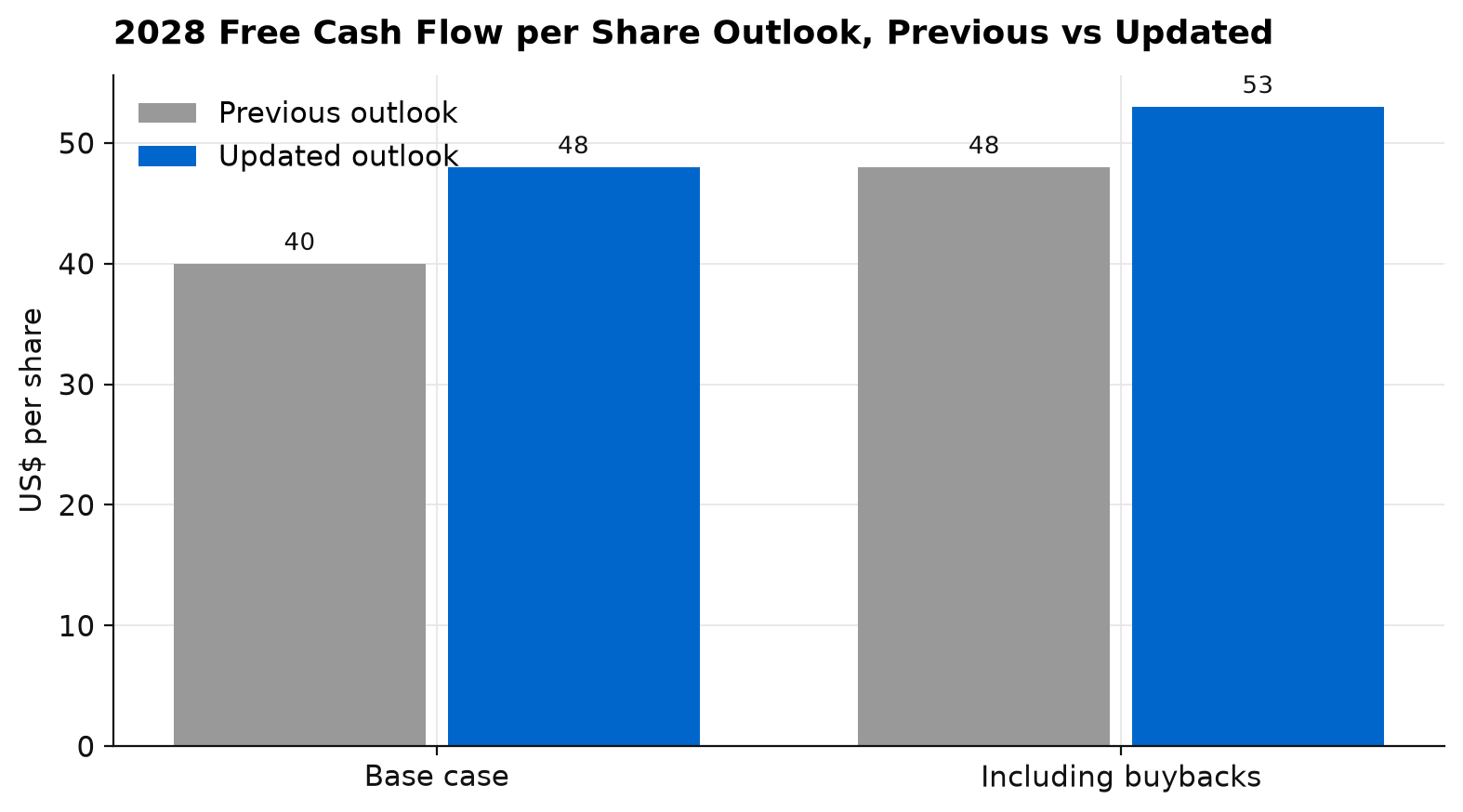
Talen Energy lifted its free cash flow outlook with its third-quarter 2026 result, and it has also signed a fresh set of long-term capacity deals for its gas plants. The company introduced 2027 adjusted free cash flow guidance of US$1,500 million to US$1,750 million and raised its 2028 base case outlook to US$48 a share from US$40. A new seven-year, 750 MW agreement at its Guernsey gas plant, together with its existing AWS data centre contract, takes contracted gross margin to 40 per cent through 2036. Institutional sell-side research has Talen Energy rated Buy with a 12 month price target of US$502.00, about 40.1 per cent above the share price of US$358.27 when this research was published. In the research’s view, the cash flow base is now higher, more of it is under contract, and several sources of upside sit outside the company’s own plan.
Talen gives Australian investors exposure to US data centre power demand, although most of the improvement in this update came from the existing business. Higher cash generation from the current fleet, better power pricing and a share buyback are lifting the per-share numbers. New data centre deals are not yet included in the plan.
Research published 19 November 2026. Price target and upside based on prices at time of publication.
Table of contents [hideshow]
- 1. About Talen Energy
- 2. Free Cash Flow Guidance Moves Higher With Upside Left Out of the Plan
- 3. Long-Term Gas Capacity Deals Add Visibility Without Capping Upside
- 4. More Paths to Data Centre Demand and a Higher Earnings Base
- 5. Valuation and the Price Target
- 6. Key Risks
- 7. Our View
- 8. Financial Summary
About Talen Energy
Talen Energy is a US power generator that trades on the NASDAQ under the ticker TLN. Its fleet includes nuclear generation and gas-fired plants, among them the Guernsey and Waterford gas plants, and it operates in PJM, the wholesale electricity market that covers a large part of the eastern United States. Talen makes money in three main ways. It sells the energy its plants produce, it gets paid for capacity, which is a commitment to have plants available when the grid needs them, and it signs longer-term contracts directly with customers. It already has a contract to supply AWS, a data centre customer. Beyond its power plants, the company holds about 4 GW of powered-land sites that can be grid connected in 2028/29, which it is offering to data centre customers alongside its existing generation.
Free Cash Flow Guidance Moves Higher With Upside Left Out of the Plan
Free cash flow is the cash a business has left after paying its running costs, interest and the spending needed to keep its assets working. That cash can go to paying down debt, buying back shares or funding growth. With its third-quarter update, Talen introduced 2027 adjusted free cash flow guidance of US$1,500 million to US$1,750 million, giving investors a formal range for next year.
The longer-dated numbers moved too. The company raised its 2028 free cash flow per share outlook to US$48 from US$40 on a base case, and to US$53 from US$48 including future buybacks. It also introduced a 2029 outlook of US$46 to US$50 a share on a base case and US$56 to US$60 including buybacks, which represents about 30 per cent annual growth from its original 2026 base. The buyback accounts for the gap between the two sets of figures. When a company buys back its own shares, the same cash is spread over fewer shares, so the per-share figure rises even if total cash flow does not.
Management put the improvement down to stronger underlying cash generation across the fleet and wider spark spreads, along with the accelerated share repurchase. A spark spread is the gap between the price a generator receives for a unit of electricity and the cost of the gas it burns to make it, so when spark spreads widen, each unit of power from a gas plant earns more. An accelerated share repurchase, or ASR, lets a company retire a large block of its shares up front, in one go. Talen also described its 2028 position as relatively open, with less of that year’s output sold forward at fixed prices, which lets it benefit from stronger power prices.
The raised guidance leaves out additional data centre contracts, a faster ramp-up of the existing AWS contract and any improvement in local power prices. For Talen, the relevant local pricing zone is PPL, where the research models power at a discount to the broader regional hub. A generator selling at a local discount earns less for the same output, so if that gap narrows, Talen earns more for each unit it sells.
Institutional sell-side research estimates 2027 and 2028 free cash flow of US$1,633 million and US$2,010 million, or about US$40 and US$53 per share. The 2027 estimate sits inside the company’s guidance range, and the 2028 figure matches the company’s outlook including buybacks. The research is positive on the higher base outlook, especially as several potential upside levers are still outside the plan.
Long-Term Gas Capacity Deals Add Visibility Without Capping Upside
A power generator in the PJM market earns two main kinds of revenue. Energy revenue comes from the electricity a plant actually produces and sells, at whatever the market pays at the time. Capacity revenue is a payment for being available. The grid operator, and increasingly large customers, pay generators to commit that a plant will be ready to run when demand peaks. Capacity revenue tends to be steadier than energy revenue because it does not depend on the hour-by-hour price of power.
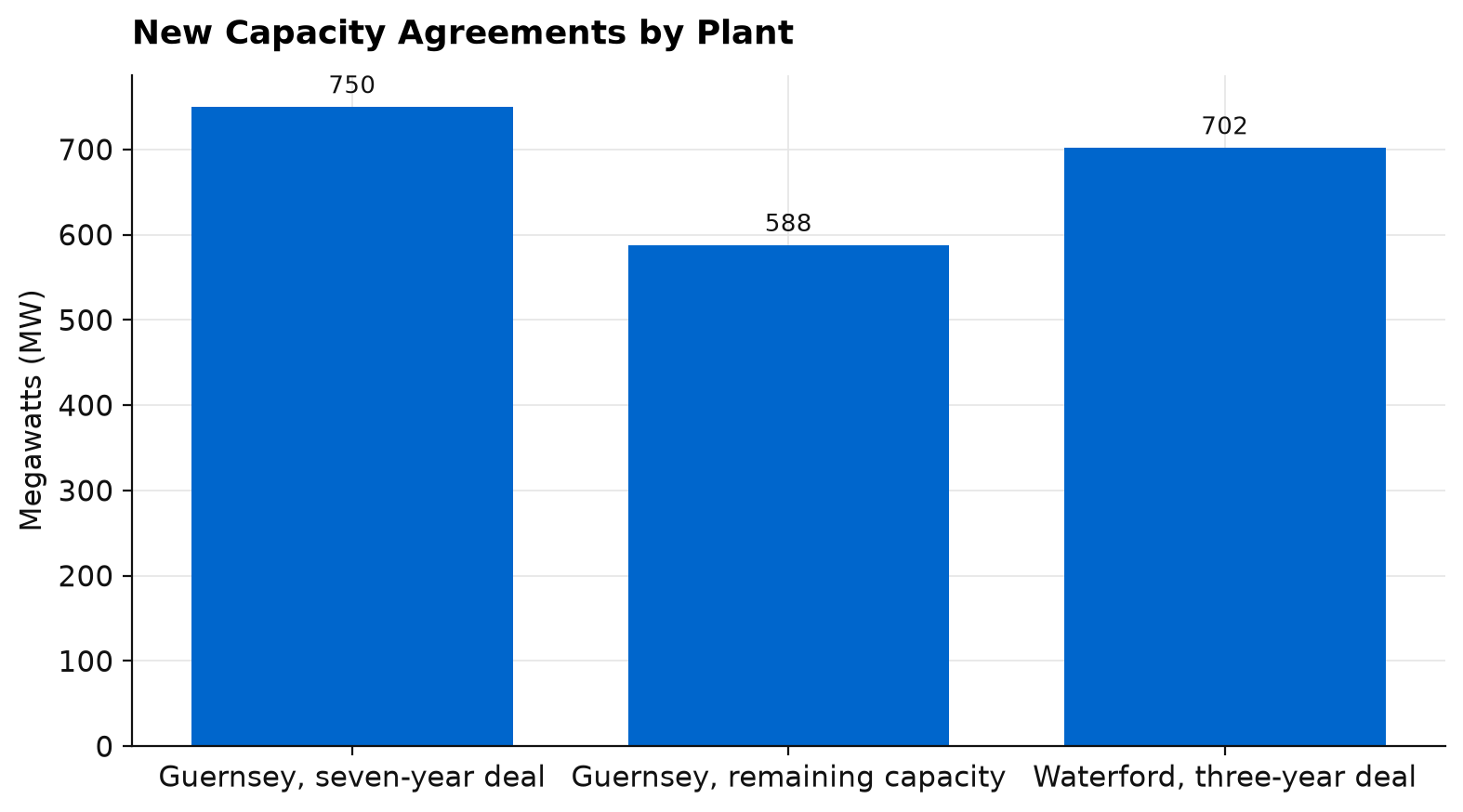
Talen has also announced PJM capacity agreements covering more than 2 GW for the 2029/30 capacity year. The centrepiece is a seven-year agreement for 750 MW at its Guernsey gas plant, running through the 2035/36 capacity year, with an investment-grade counterparty. Investment grade means the customer has a strong credit rating, so the chance of it failing to pay over the life of the contract is smaller than it would be with a weaker buyer. The 750 MW deal is expected to generate about US$100 million of annual revenue. Talen also contracted the remaining 588 MW at Guernsey for 2029/30, and 702 MW at its Waterford plant for three years through the 2031/32 capacity year.
A rules-based approach to leveraged ETFs
See how our quantitative strategy works and who it suits.
Explore the strategyBecome an authorised representative
Advise your clients under an established AFSL without building your own. Choose AR or CAR.
Become an AR or CARTogether with the AWS contract, the new 750 MW agreement takes Talen’s contracted gross margin to 40 per cent through 2036. Gross margin here means the profit the company makes on selling power and capacity before overheads, so 40 per cent of that profit is now covered by contracts through 2036. The new agreements pay for capacity, which leaves the energy those plants produce exposed to market prices, so Talen keeps the benefit if power prices rise.
Management also said the bilateral market has become more active. A bilateral contract is a deal struck directly between a generator and a buyer, outside the grid operator’s central auction. Customers are looking for greater price certainty, and that is pushing more of them to sign directly with generators for longer periods. Talen said it continues to work on other opportunities of this kind.
The research views the deals positively. Longer-dated revenue from a strong counterparty adds visibility to the cash flow outlook, and the deals show real demand for multi-year bilateral contracts from customers willing to commit, while Talen keeps its exposure to higher power prices.
More Paths to Data Centre Demand and a Higher Earnings Base
Talen continues to expect data centre deals beyond nuclear power and its AWS contract, although it acknowledges that the timing remains uncertain.
To serve those customers, Talen can draw on its existing gas fleet, batteries, peakers and demand response. Peakers are smaller plants that run only when demand is at its highest, and demand response means paying large users to cut their consumption at those peak times so the grid needs less new supply. On top of that, the company holds about 4 GW of powered-land sites that can be grid connected in 2028/29. Powered land is a site that has, or will have, a connection to the grid, which is something a data centre cannot operate without. Talen plans to pair these sites with existing generation, new capacity or a mix of both, and customer discussions have also included batteries and load curtailment, which is an agreement to reduce a site’s power draw when the grid is under strain.
Management also noted that gas deals are already happening across the market, and that existing gas generation, paired with better load management and curtailment, can offer a much faster and cheaper path than building a new CCGT. A CCGT, or combined-cycle gas turbine, is the large, efficient type of gas plant that new projects typically use, and building one from scratch takes longer and costs more than using a plant that already runs. The research sees this as giving Talen more ways to compete for data centre load without relying only on nuclear or expensive new generation.
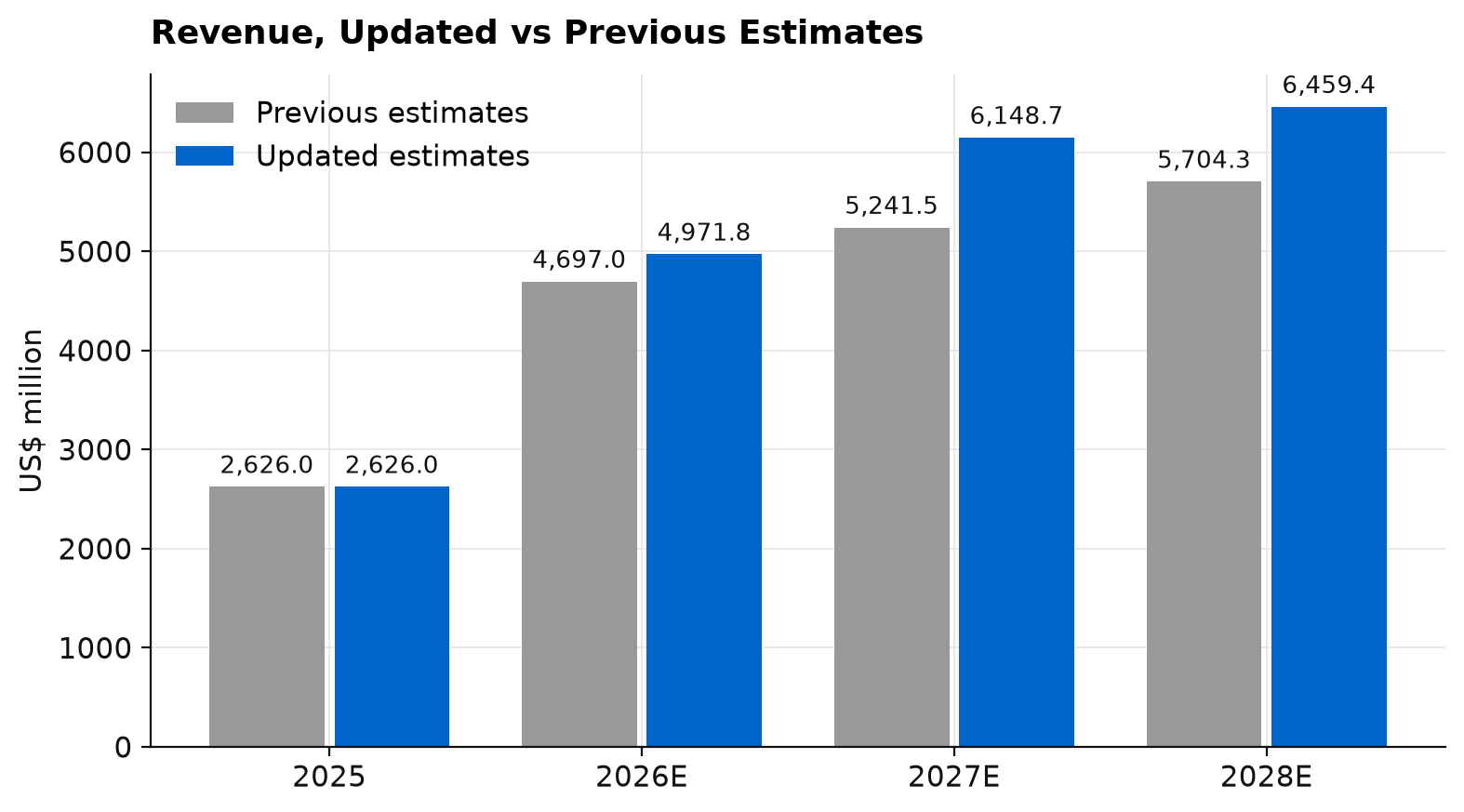
Institutional sell-side research now forecasts revenue of US$4,971.8 million in 2026, US$6,148.7 million in 2027 and US$6,459.4 million in 2028, up from earlier estimates of US$4,697.0 million, US$5,241.5 million and US$5,704.3 million. For context, reported revenue in 2025 was US$2,626.0 million. Adjusted EBITDA, which is earnings before interest, tax, depreciation and amortisation and a common measure of the cash earnings of an asset-heavy business, is estimated at US$2,200 million for 2026. That is at the top of the company’s narrowed guidance range of US$2,050 million to US$2,200 million.
Further out, the 2027 adjusted EBITDA estimate moved up slightly to US$2,850 million from US$2,828 million, while the 2028 and 2029 estimates moved down to US$3,108 million and US$3,310 million from US$3,274 million and US$3,420 million. Those changes reflect the latest quarter, an updated hedging program and the new gas capacity agreements, along with fine-tuning on operating costs, depreciation, interest and local power prices to align with company guidance. Hedging here means selling future output at fixed prices in advance to reduce exposure to price swings. Earnings per share estimates are US$29.15 for 2026, US$36.66 for 2027 and US$43.69 for 2028, against reported earnings per share of US$9.06 in 2025. The 2026 and 2027 figures rose from US$23.37 and US$31.23, while 2028 eased from US$44.46. Estimates for the nearer years have stepped up while those for the later years were trimmed.
Valuation and the Price Target
The 12 month price target of US$502.00 sits about 40.1 per cent above the share price of US$358.27 when this research was published. The research sets its target by blending two approaches, one based on Talen’s earnings before interest, tax, depreciation and amortisation and one based on its free cash flow yield, which compares free cash flow per share with the share price. It lifted its estimates for the nearer years and, at the same time, lowered the valuation it applies to those earnings and cash flows, citing market uncertainty after the elections and regulatory risk compared with other parts of the AI trade. Taken together with rolling the valuation forward to a later period, those changes moved the target to US$502 from US$501.
The research’s Buy case starts with the higher base free cash flow outlook, with 2027 guidance of US$1,500 million to US$1,750 million and a 2028 base case of US$48 a share, built without counting new data centre contracts, a faster AWS ramp or better local pricing. A growing contracted floor adds to it, with the new Guernsey deal and the AWS contract taking contracted gross margin to 40 per cent through 2036 while leaving energy upside in place. Talen also has several ways to win more data centre business, from the existing gas fleet and batteries through to about 4 GW of powered land that can be grid connected in 2028/29.
The research sees multiple paths to growth in free cash flow per share, helped by the share buyback, with more of the cash flow now contracted with a strong counterparty and the larger potential upside drivers still outside the company’s plan.
Key Risks
The research names three main risks. The first is regulatory and interconnection risk, where rule changes in PJM or delays in connecting new load and generation to the grid could slow both new contracting and the data centre opportunity. The second is lower-than-anticipated power prices. Talen’s 2028 position is relatively open and its capacity deals leave energy exposed to the market, so a fall in power prices or narrower spark spreads would reduce the cash flow gains behind the higher outlook. The third is a slowdown in data centre demand, which would weaken the bilateral market that has been producing new contracts and make it harder for Talen to turn its powered-land sites and gas fleet into new deals.
Our View
The improvement in this update comes from parts of the business investors can already see, namely higher cash generation, wider spark spreads and the buyback. The current outlook does not assume new data centre deals, so they remain potential upside on top. From here, the signs to watch are further bilateral capacity deals on similar terms, any sign that the AWS ramp is running ahead of the company’s assumptions, and a gas-backed data centre agreement for the powered-land sites.
If you would like to discuss Talen Energy, request a callback or call us on 1300 889 603.
Financial Summary
Become an authorised representative
Advise your clients under an established AFSL without building your own. Choose AR or CAR.
Become an AR or CAR