

Hold
Cochlear is the Australian market leader in implantable hearing devices, mainly cochlear implants, with the United States as its key market at around half of revenue.
Institutional sell-side research rates Cochlear Hold because a recovering hearing market, higher US Medicare reimbursement and a better gross margin support earnings. Against that, MED-EL and Advanced Bionics are building on product differentiation, and market share is the key risk. The shares already trade above the target and few near-term catalysts are expected.
- Sell-side rating
- Hold
- Sell-side target
- A$137.40
- Upside to target
- −10.3%
- Initial price
- A$141.154 Nov 2026
- Last close
- A$153.1718 Nov 2026
Cochlear had a difficult FY26. Implant unit volumes fell, management lowered its trading outlook in April, and the company conceded market share in places such as Germany. Since then, hearing aid demand has started to pick up, the US Medicare outpatient reimbursement rate for cochlear implants is set to rise about 8 per cent in calendar 2027, and a run of manufacturing projects gives the company room to lift its gross margin. Institutional sell-side research has Cochlear rated Hold with a 12 month price target of A$137.40, about 2.7 per cent below the share price of A$141.15 when this research was published. The research nudged its earnings forecasts higher and sees some upside risk to the company’s FY27 earnings guidance, but rising competition is the key risk to those numbers, and with the shares already trading above the target, the research sees risk and reward as well balanced.
Research published 4 November 2026. Price target and upside based on prices at time of publication.
Table of contents [hideshow]
About Cochlear
Cochlear Limited is the market leader in the manufacture and distribution of implantable hearing products. Most of its business is cochlear implants, surgically implanted hearing devices that work with an external sound processor such as the company’s N8, alongside its newer Nexa product. It also sells bone-conduction implants through its Acoustics business, where the Osia 3 sound processor is due to launch in the first half of FY27. The United States is its key market at around half of revenue, and more than half of US revenue comes from commercial insurers. Germany is its second largest market. Cochlear manufactures in Sydney, Malaysia and Chengdu in China, runs an Innovation Fund with several investments, reports on a 30 June year end and is listed on the Australian Securities Exchange.
The Hearing Market Is Starting to Recover
When Cochlear lowered its outlook in April, management pointed to fewer referrals from the hearing aid channel as a reason growth had slowed. The cochlear implant market has historically moved in the same direction as the hearing aid market, just at a faster rate. Many implant candidates come through the hearing aid channel, so a softer hearing aid market tends to show up as fewer referrals for implants.
That hearing aid market now looks healthier. Demant, one of the key hearing aid makers, recently raised its outlook for 2026 hearing aid market value growth to 4 to 5 per cent, from 3 to 4 per cent, following estimated market growth of 6 to 7 per cent in the third quarter of 2026. Much of that growth has come from product launches lifting the average selling price, meaning the average price paid per device. Higher prices have done little to dent volumes, which the research reads as a sign that people treat hearing loss as a necessity. In the US Veterans Affairs channel, hearing aid units grew 1.8 per cent and sales grew 22 per cent across the 12 months, as buyers moved to dearer devices.
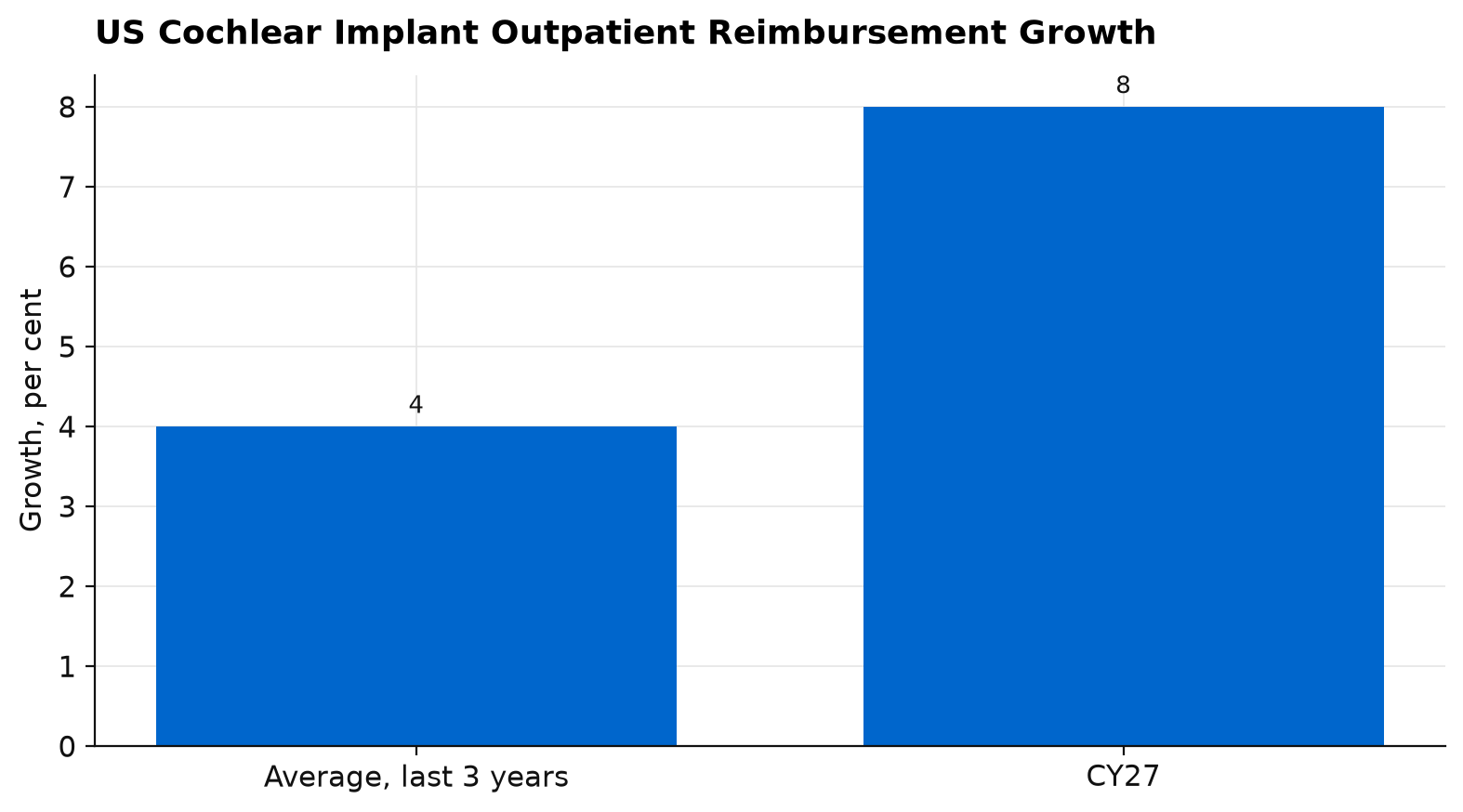
Medicare, the US government health insurance scheme, pays hospitals a set outpatient fee, or reimbursement, for each cochlear implant procedure, and that fee is set to grow about 8 per cent in calendar 2027, against an average increase of about 4 per cent over the last three years. A bigger fee makes implants more attractive for hospitals to offer, and the US accounts for around half of Cochlear’s revenue. The uplift also helps Nexa, whose share gains were delayed in FY26, largely because of difficult pricing outcomes that forced Cochlear to give ground on the size of price increases in some regions. Key Nexa features such as pre-loaded maps are likely to appeal to US clinics that are short on capacity.
Outside the US, the Middle East remains a headwind, and in Germany funding has tightened, with cuts to DRG payments, the fixed amounts hospitals are paid for each type of treatment, alongside changes to hospital funding. Cochlear has started a clinical trial of Nexa in Germany with the aim of showing superior hearing outcomes. China volumes are strong, and the research expects that to continue. Adverse weather events explain only part of the FY26 fall in units. The research forecasts a gradual improvement in both implant unit growth and implant revenue growth, led by the US and Asia Pacific, and its FY27 earnings forecast sits about 4 per cent above market consensus.
Market Share Is Contested as Rivals Launch New Devices
The research sees market share as the main risk to its forecasts. At its FY26 result Cochlear said it had grown in line with the market in the US but conceded it had lost share in markets such as Germany. The research’s own analysis, which compares Cochlear’s revenue with the public accounts of Advanced Bionics, owned by Sonova, and the private accounts of MED-EL, indicates Cochlear’s share has declined over the last few years, and that its global share of industry revenue fell in 2025.
Over longer periods, share in cochlear implants tends to be cyclical, moving mostly with product launch cycles. The launch of Cochlear’s N8 helped its share over FY23 and the first half of FY24. Advanced Bionics then gained ground across the second half of FY24 and FY25 on the back of its remote programming innovation. In FY25, MED-EL’s growth is estimated to have stepped up with a new processor launch and an FDA label indication for people with residual hearing.
Both rivals have fresh products in market. MED-EL has launched the UNICO in Europe, a totally implantable cochlear implant, or TICI, with the whole device, including the microphone, under the skin. The battery is expected to last up to 40 hours between charges and recharges fully in about an hour through a device called the GoPod, and the implant is MR Conditional at 1.5 T and 3.0 T, so patients can have MRI scans without surgery. Channel checks suggest many patients would prefer a fully implanted device, and the research thinks hearing outcomes that match external processors would be enough to drive wide adoption. Industry feedback indicates it is priced materially above a traditional implant, though, so reimbursement is likely to limit take-up for now, with initiatives under way in Germany to address that. MED-EL was first to market, ahead of Cochlear’s own totally implantable device.
A rules-based approach to leveraged ETFs
See how our quantitative strategy works and who it suits.
Explore the strategyBecome an authorised representative
Advise your clients under an established AFSL without building your own. Choose AR or CAR.
Become an AR or CARAdvanced Bionics, meanwhile, has received approval for its Integro platform, with the Naída CI Integro processor for adults and the Sky CI Integro for children. It brings SoundFinder technology to help users locate sounds, AI-powered processing that adapts to changing listening environments, and expanded Bluetooth connectivity.
In the US, Cochlear is ramping up its commercial presence with a particular focus on ENT specialists, the ear, nose and throat doctors at the centre of implant care, and it is rolling out software upgrades to Nexa aimed at improving mapping outcomes. Management said at the FY26 result that more Nexa improvements and new features are planned. The research expects these steps to bring a gradual recovery in Cochlear’s US market share. Outside the US it takes a more conservative view, because competitors such as MED-EL have a stronger presence in regions like Germany.
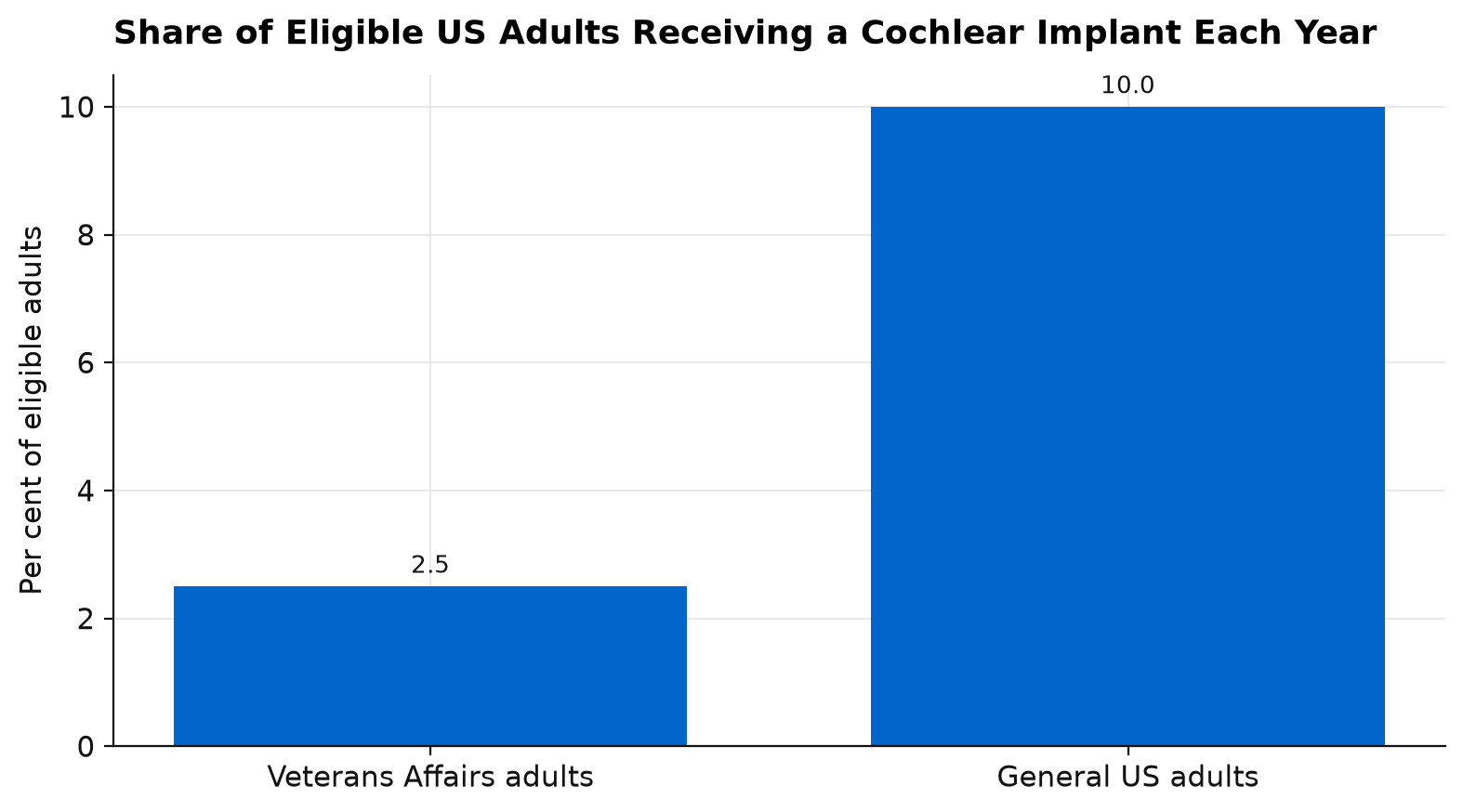
Growth can also come from reaching more of the patients who qualify for an implant. In the US Veterans Affairs channel, industry estimates suggest only about 2.5 per cent of eligible veteran adults receive a cochlear implant each year, against about 10 per cent of the general US adult population. Veterans Affairs accounts for about 17 per cent of the US hearing aid market by units, and Cochlear has started the SALUTE trial comparing its N8 processor with the earlier N7 in veterans who already have implants. Cochlear also won an FDA label expansion in 2022 for patients with single sided deafness, or SSD, but Medicare does not yet cover implants for them. In November 2024 the American Cochlear Implant Alliance asked the Centers for Medicare and Medicaid Services to extend Medicare coverage to SSD, and Cochlear’s own trial, due to conclude in mid calendar 2027, has the potential to support that coverage. In the UK there are efforts to have the NHS lower its hearing threshold for implants.
Gross Margin Has Room to Recover
Gross margin is the share of revenue left after paying the direct cost of making the product, and at Cochlear it has gone backwards. Between FY22 and FY26 it fell by around 400 basis points, or about four percentage points. The main drivers were the ramp-up of Nexa volumes and manufacturing at the company’s facility in China, with currency moves and price cuts in China adding to the pressure. China’s volume-based procurement, a government tendering system that exchanges lower prices for larger volumes, was the main reason Cochlear’s average selling price fell over FY24 to FY26.
China prices are falling again, with an impact in special access zones from the second half of FY26. Even so, management has guided to some improvement in gross margin in constant currency terms, which exclude the effect of exchange rate moves. Guiding to an improvement despite another round of price cuts implies progress elsewhere in the cost base, and the research points to two sets of initiatives.
One is the cloud computing and ERP programme, where ERP, or enterprise resource planning, is the core software a company uses to run finance, supply and manufacturing. Cochlear started the transformation in FY22 at an estimated cost of $100 million to $150 million before tax over four to five years. By FY26 it had cost more than $200 million before tax, and it is expected to reach about $300 million once completed in FY27. The aim was to simplify the organisation, clarify who makes which decisions and standardise processes. In the factories it should reduce manual data entry, which helps bring down labour costs.
The other is a set of manufacturing changes: new production lines in Sydney and Malaysia and the ramp-up of the Chengdu facility should improve fixed cost absorption, meaning the fixed costs of running a factory are spread across more units. Since 2019 Cochlear has also received more than 100 pre-market approvals from the US Food and Drug Administration, and about 45 per cent of them related to manufacturing or process changes. Several cover automation, which should lower the cost of making each unit over time.
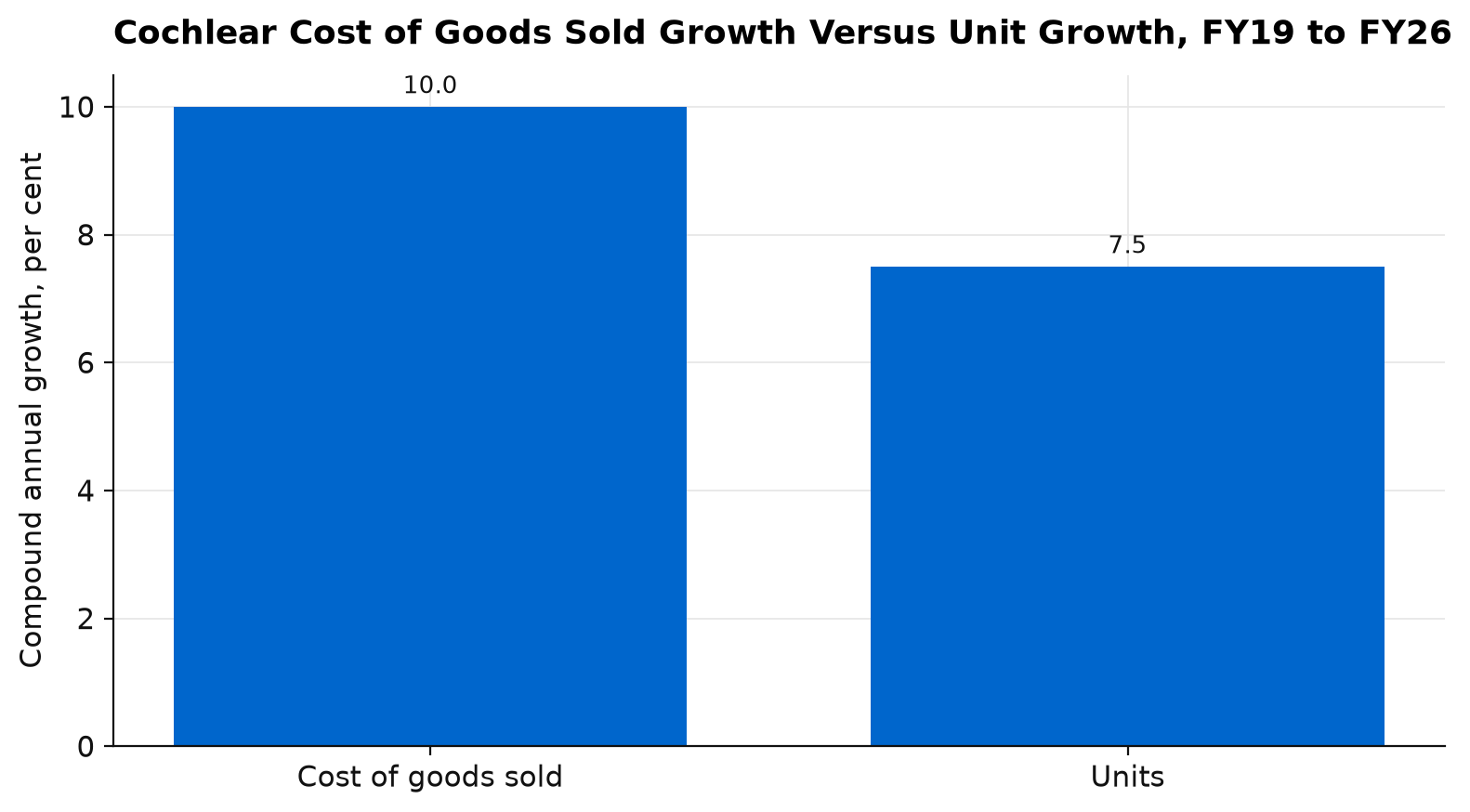
Across FY19 to FY26, Cochlear’s cost of goods sold grew at a compound rate of about 10 per cent, while units grew at about 7.5 per cent, so each unit cost more to make. If the new systems, lines and automation close that gap, margin can recover even with flat pricing. The research has lifted its gross margin outlook to reflect this, and it sees scope to reinvest the savings over the longer run in Cochlear’s own totally implantable device.
Valuation and the Hold Rating
The research made three changes to its forecasts. It lifted implant revenue to reflect stronger consumer sentiment in the hearing aid market and the higher Medicare reimbursement, lifted Acoustics revenue for the launch of the Osia 3 sound processors in the first half of FY27, and improved its gross margin outlook for better manufacturing efficiency. Earnings per share, the profit attributable to each share, is now forecast at A$5.42 for FY27, up from A$5.29, then A$5.77 for FY28, up from A$5.69, and A$6.59 for FY29, up from A$6.54. Those are upgrades of about 3 per cent, 1 per cent and 1 per cent, from FY26 earnings per share of A$4.93. Revenue is forecast to grow from A$2,347.6 million in FY26 to A$2,396.5 million in FY27, A$2,539.6 million in FY28 and A$2,747.2 million in FY29.
On the back of that upgrade, the 12 month price target rose about 2 per cent, to A$137.40 from A$134.30. That is about 2.7 per cent below the share price of A$141.15 when this research was published. On the trailing dividend of A$3.45 a share, the stock yields about 2.4 per cent, partly franked.
In the research’s view, a recovering market and a better gross margin support earnings, with hearing aid demand improving, US reimbursement rising faster than its recent average, the systems programme finishing and the newer factories scaling. Against that, MED-EL and Advanced Bionics are building on product differentiation. With the share price already above the target, the research sees limited near-term catalysts and rates the stock Hold.
Key Risks
Reimbursement and hospital funding cuts in Germany, further price cuts in China and uncertainty over emerging markets revenue given the Middle East conflict could all slow growth. Cochlear could lose a material amount of market share to new feature launches from Sonova or MED-EL, a new market entrant, particularly in China, or a product recall due to reliability or safety issues, although its reliability record, research and development spending and manufacturing scale help offset this. Capacity is a limit, because implant surgery is performed in a concentrated group of clinics and hospitals, so if expanding clinical capacity takes longer than planned, unit growth is likely to slow, and extra sales and marketing spend to widen the referral base would weigh on margins. Restrictions on raw materials or critical minerals could affect key inputs, and while most of its electronics, batteries and precious metals come from Australia, the US and Switzerland, a global shortage could push those prices up and hurt gross margin. The gross margin recovery also depends on the systems programme, new lines and automation delivering on time. On the upside, reimbursement wins such as US Medicare coverage for single sided deafness have historically accelerated implant sales and could lift the shares further above the target.
Our View
Cochlear remains the market leader in implantable hearing products, and its market is recovering. Demant has raised its outlook for the hearing aid market, the US funding uplift is larger than usual, and the systems programme has a clear end date in FY27. Our watch point is market share, which has slipped for a few years, and MED-EL was first to the totally implantable device, the next leg of competition. Cochlear’s past launches have won share back, but the timing of the next recovery is hard to forecast. At the next result we will be watching for US share to stabilise and gross margin to turn up.
If you would like to discuss Cochlear, request a callback or call us on 1300 889 603.
Financial Summary
Become an authorised representative
Advise your clients under an established AFSL without building your own. Choose AR or CAR.
Become an AR or CAR