

Hold
Computershare keeps share registers for listed companies, runs employee share plans and acts as a corporate trustee, earning interest on the client cash it holds.
Institutional sell-side research rates it Buy because first quarter FY27 indicators look supportive of full-year guidance of $770 million in margin income and 154 cents of earnings per share. Its interest rate forecasts sit above the company's assumptions, and merger volumes and IPO activity looked solid. Cost control and possible acquisitions give the company extra levers if one part of the business disappoints, though the financial year is still young.
- Sell-side rating
- Buy
- Sell-side target
- A$42.50
- Upside to target
- −7.0%
- Initial price
- A$42.5929 Oct 2026
- Last close
- A$45.6819 Nov 2026
Initial Buy based on A$42.59. Now Hold since 30 Oct 2026: the price passed the A$42.50 target.
Computershare keeps share registers for listed companies, administers employee share plans and acts as a corporate trustee, and across those businesses it earns interest on the cash it holds for clients. In the first quarter of FY27, institutional sell-side research’s interest rate forecasts sat above the company’s own assumptions, merger volumes looked fairly strong and IPO activity was solid, and the research thinks those trends support the full-year guidance of $770 million in margin income and 154 cents of earnings per share, while noting that the financial year is still young. Institutional sell-side research rates Computershare Buy with a 12 month price target of A$42.50, about 0.2 per cent below the share price of A$42.59 when this research was published. The shares trade almost exactly at the target, so a return from here would need earnings forecasts, and the target with them, to rise over the next year.
Research published 29 October 2026. Price target and upside based on prices at time of publication.
Table of contents [hideshow]
About Computershare
Computershare is a global technology and administration services provider listed on the Australian Securities Exchange under the code CPU. Its best-known business is share registry work, keeping the record of who owns a listed company’s shares, which Computershare reports under Issuer Services. It also runs employee share plans, administering the shares that companies grant to their staff, and a Corporate Trust business that acts as trustee on debt securities, including asset-backed and mortgage-backed issues in the United States. Around 60 per cent of group earnings before interest and tax come from the US, so currency movements matter to reported results. The financial year ends in June, and the company reported its FY26 result in August 2026. Computershare has also formed a partnership with Securitize on the tokenisation of securities.
Interest Rates Point to Upside on Margin Income
Margin income, shortened to MI in the research, is the interest Computershare earns on cash balances it holds on behalf of clients across its businesses. What it earns in any year depends on the interest rate available on that cash and the size of the balances. For FY27 the company has guided to margin income of $770 million, and institutional sell-side research forecasts slightly more. Computershare reports in US dollars, so margin income, revenue and earnings figures in this piece are in US dollars, while the share price, target and dividends are in Australian dollars.
The research traces most of that gap to interest rates, because its own macroeconomic forecasts for the FY27 cash rate, the short-term official rate set by central banks, sit above the assumptions Computershare used when it set guidance. Higher short-term rates lift the return on the portion of client cash that is not locked in.
Computershare fixes the rate earned on part of its client balances through hedges, which are contracts that lock in an interest rate for a set period. The company has guided to a hedged rate of 3.64 per cent for FY27, and the research thinks the actual figure is likely tracking better than that because the five-year swap rate has improved. A swap rate is the fixed rate that can be exchanged for a floating rate over a set term, five years in this case, so an improvement means each new hedge the company adds locks in a better fixed return, which the research describes as positive for incremental hedges.
The research also expects client balances to hold up, supported by ongoing merger activity and initial public offerings, where a private company lists its shares on a stock exchange for the first time. It flags some uncertainty in that view, given inflation, higher interest rates and geopolitical tension. The company has also guided to a recapture rate of around 96 per cent, which is the share of the official cash rate that Computershare actually earns on its rate-exposed client balances.
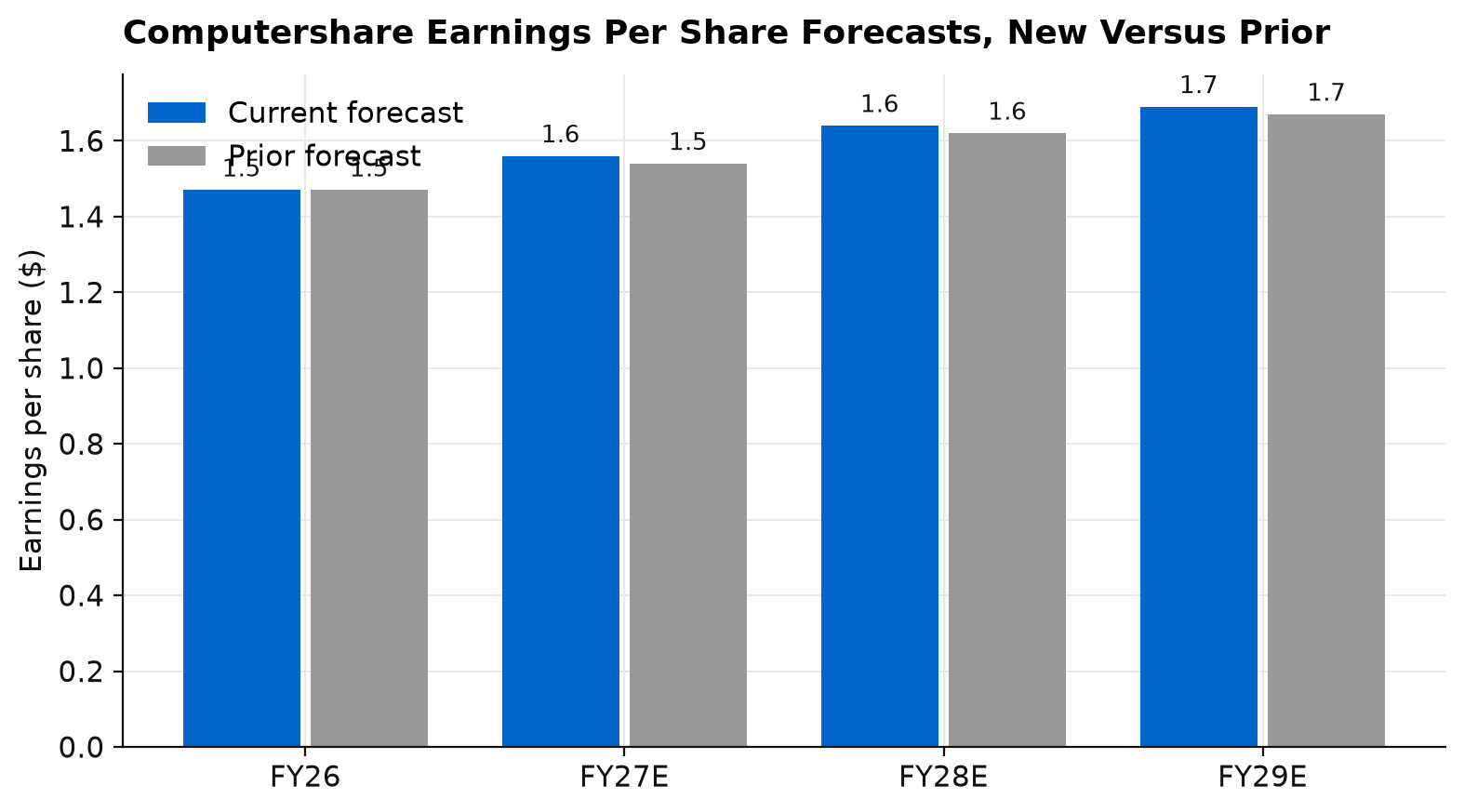
The research describes its latest forecast changes as slight earnings upgrades, driven by higher margin income. Its FY27 earnings per share forecast moves to $1.56 from $1.54, above the company’s own guidance of 154 cents, while FY28 rises to $1.64 from $1.62 and FY29 to $1.69 from $1.67, all building on reported FY26 earnings per share of $1.47.
Deal Activity and Equity Markets Support Transaction Revenue
Outside margin income, the research reads Computershare’s first quarter activity as generally strong across mergers and IPOs, while acknowledging some uncertainty in the outlook. Merger and acquisition volumes over the quarter appear fairly strong. Computershare is paid when a deal completes, so revenue from announced deals can arrive with a lag, and the research reads the relatively strong activity of the past six months as a good sign for revenue still to come.
At its August 2026 result the company flagged that its pending deal count, the deals under way but not yet completed, was 8 per cent higher, which points to revenue that has not yet reached the accounts.
Global equity IPO volume was also strong over the first quarter of FY27, although it softened slightly from a strong fourth quarter of FY26. Each new listing creates a share register that Computershare can be paid to maintain, so a steady flow of listings adds to its pool of potential clients.
A rules-based approach to leveraged ETFs
See how our quantitative strategy works and who it suits.
Explore the strategyBecome an authorised representative
Advise your clients under an established AFSL without building your own. Choose AR or CAR.
Become an AR or CARBroader equity markets have also been supportive, and the research tracks the main share indices in Computershare’s key regions, the S&P/ASX 200 in Australia, the S&P 500 in the US, the FTSE 100 in the UK and the S&P/TSX in Canada, comparing the average level of each index across each half year with the half before. Firmer markets support transaction revenue, meaning the fees that rise and fall with the volume of activity passing through the company, and Computershare itself expects growth in this line, although the research notes there is still some risk given the uncertain macro environment.
In Corporate Trust, Computershare acts as trustee on debt securities. The research tracks US asset-backed and mortgage-backed securities issuance, which are bonds backed by pools of loans such as car loans or home mortgages, ranked by trustee across the top five players. With interest rates shifting higher, the research sees some uncertainty around debt issuance volumes into the first half of FY27, since higher borrowing costs can hold back new issues.
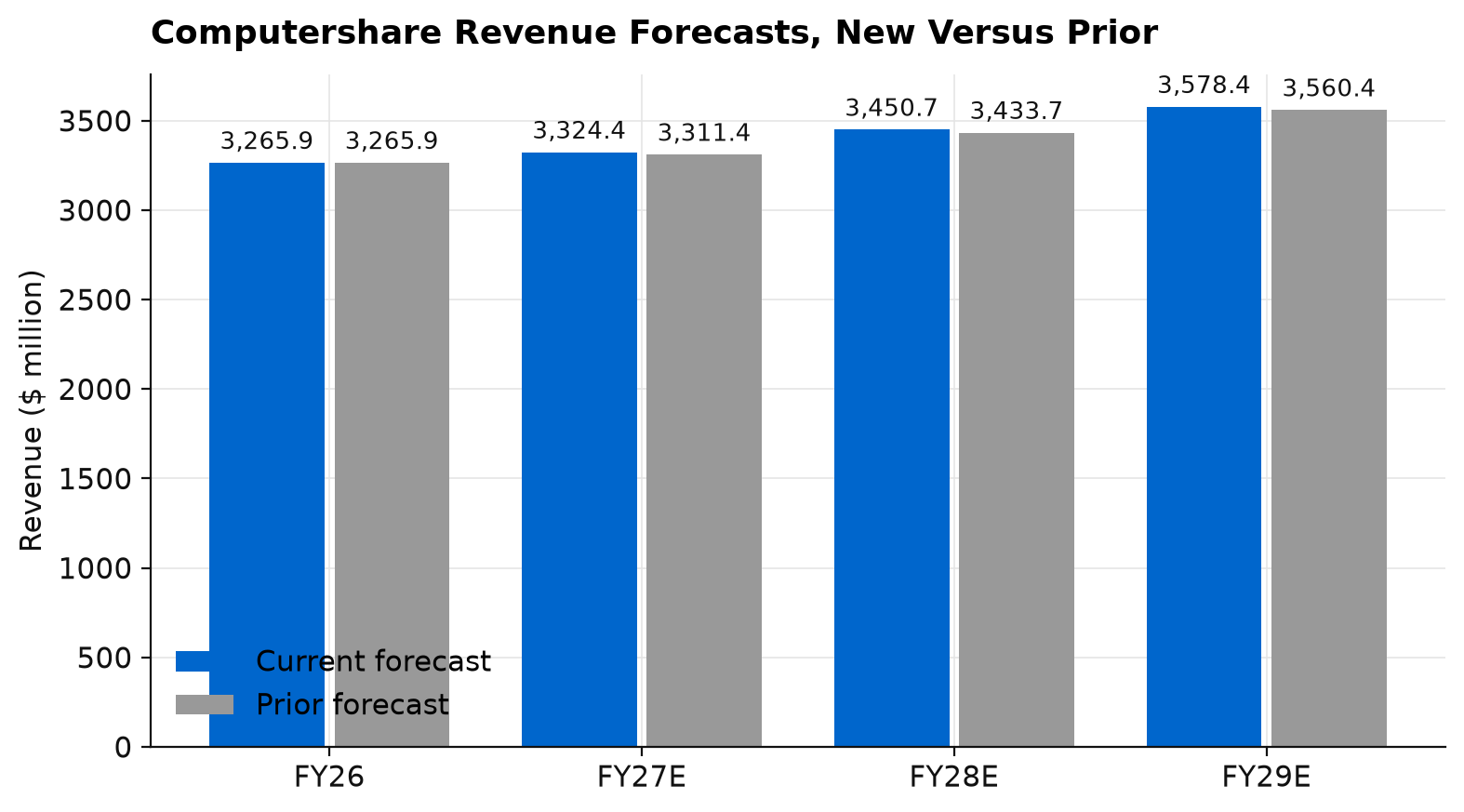
Currency also matters, because around 60 per cent of Computershare’s earnings before interest and tax come from the US, so the exchange rate between the Australian and US dollar changes how those earnings look once converted. The research notes that AUD/USD was broadly stable over the third quarter of 2026. The research’s revenue forecasts reflect this activity, with FY27 revenue now forecast at $3,324.4 million, up from $3,311.4 million previously, against reported FY26 revenue of $3,265.9 million. FY28 is forecast at $3,450.7 million, previously $3,433.7 million, and FY29 at $3,578.4 million, previously $3,560.4 million.
Cost Control and Acquisitions Support the Earnings Outlook
The research’s Buy case also rests on Computershare having levers to manage its earnings to FY27 guidance even if one part of the business disappoints. The first is cost control, which the research expects to drive margin expansion in EBIT excluding margin income. EBIT is earnings before interest and tax, and stripping out margin income leaves the profit from the fee-based businesses such as registry, employee share plans and corporate trust, so a rising margin there means more profit from each fee dollar.
Because that profit does not depend on interest rates, it would help cushion earnings if rates fell faster than expected.
The second lever is acquisitions, where the research sees upside potential through accretive M&A, meaning deals that add to earnings per share once they are completed. The research does not name a deal or put a size on one, so this is potential upside only, although the research counts it among the pillars of its Buy case.
Taken together, these levers show up in the research’s forecasts for EBITDA, which is earnings before interest, tax, depreciation and amortisation, a rough measure of operating profit before accounting charges for the wear on assets. EBITDA is forecast to rise from $1,284.9 million in FY26 to $1,333.3 million in FY27, $1,384.7 million in FY28 and $1,423.3 million in FY29.
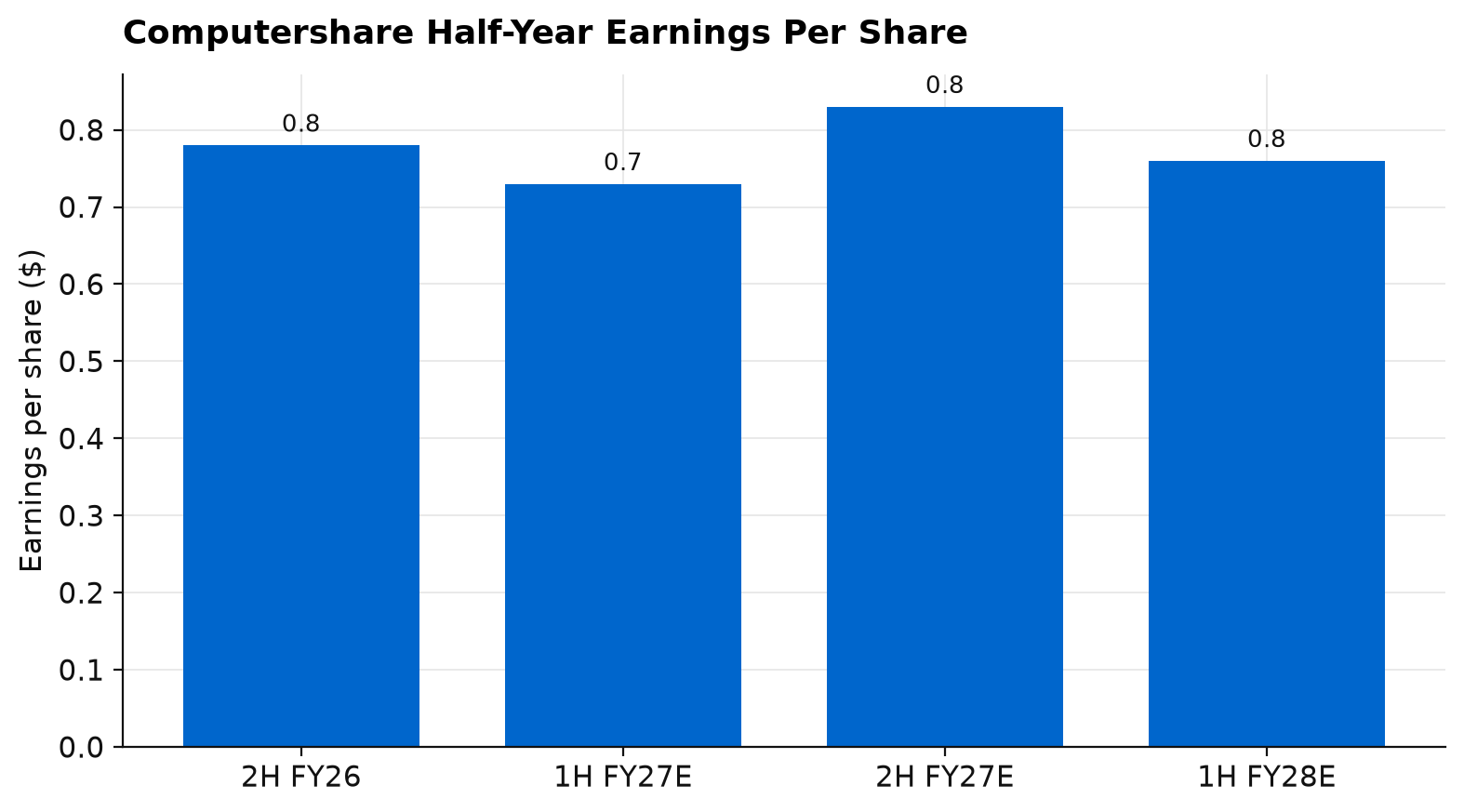
The research expects earnings per share to vary across the halves. The research forecasts $0.73 for the first half of FY27, the six months to December 2026, against $0.78 in the second half of FY26, before a stronger $0.83 in the second half of FY27 and $0.76 in the first half of FY28. The two FY27 halves add up to the $1.56 full-year forecast, so a softer first-half result would not on its own signal that the year is off track.
The research also thinks Computershare’s partnership with Securitize reduces the risk from tokenisation. Tokenisation means recording ownership of a security as a digital token on a blockchain-style ledger, and the concern for a registry business is that if ownership records move onto such systems, some of the work and the client cash Computershare handles today could move elsewhere. The partnership gives Computershare a foothold in the technology, although the research still lists tokenisation among its risks.
Valuation and Why the Buy Case Now Rests on Earnings
The 12 month price target from institutional sell-side research is A$42.50, and at the 29 October 2026 close of A$42.59 the shares traded about 0.2 per cent above the price target. The research keeps its Buy rating on four pillars, potential upside from acquisitions, margin expansion in earnings excluding margin income, a supportive interest rate environment and ongoing strength in transaction and cyclical revenues, the fees that move with the corporate activity cycle of mergers, listings and market trading.
On income, Computershare has paid A$1.20 per share in dividends over the past twelve months, a trailing dividend yield of about 2.8 per cent at the current price, and those dividends are unfranked, so they carry no franking credits for Australian investors. The research’s case is built on earnings growth, with forecast earnings per share rising from $1.47 in FY26 to $1.69 by FY29.
If margin income, deal completions and transaction revenue run ahead of guidance, as the first-quarter indicators suggest, forecasts are more likely to move up than down and the target could follow. In a tougher year the company has cost and acquisition levers to help protect its guidance.
Key Risks
The largest macro risk is greater-than-expected cuts to official interest rates, which would reduce margin income directly, and with around 60 per cent of earnings before interest and tax generated in the US, a stronger Australian dollar would also reduce the value of those earnings once converted. Corporate Trust carries its own cyclical exposure, as debt issuance volumes into the first half of FY27 are uncertain with interest rates shifting higher. On the structural and competitive side, tokenisation of securities could in time eat into margin income and Issuer Services revenue and spill over into parts of the business outside the registry, even with the Securitize partnership in place. Execution risk centres on costs, because the company’s cost-out programs will eventually come to an end, which could bring higher expense growth, while persistent below-the-line costs, items excluded from management earnings, continue to drag statutory earnings below the management figure. Finally, employee share plan revenue has been strong and could moderate, and merger and IPO activity can stall quickly if the macroeconomic backdrop deteriorates.
Our View
This update leaves us more confident about FY27 guidance than about the near-term share price. The first-quarter indicators the research tracks, from interest rate expectations and the hedged rate to merger volumes, IPO activity and equity markets, are mostly supportive of the guidance in the research’s reading, and the upgrades are modest and come from several sources, so they do not rely on everything going right. Faster than expected rate cuts are the risk we would watch most closely, since interest rates are the biggest swing factor in earnings and outside management’s control. We would also keep watching the gap between statutory and management earnings, because below-the-line costs that keep recurring should be counted as ordinary costs. Tokenisation is the main longer-term risk, and the Securitize partnership is a sensible early response. On balance, Computershare looks to us like a quality business that is executing well, and the share price already reflects that.
If you would like to discuss Computershare, request a callback or call us on 1300 889 603.
Financial Summary
Become an authorised representative
Advise your clients under an established AFSL without building your own. Choose AR or CAR.
Become an AR or CAR