

Hold
IAG is one of Australia's largest insurers, selling home and motor cover to households under brands such as NRMA, plus commercial insurance in Australia and New Zealand.
Institutional sell-side research rates IAG Buy because its margin guidance is ahead of consensus and strong investment yields are adding to profit. The RACI acquisition is expected to add A$1.2 billion of gross written premium net of the NRMA sale and about A$100 million a year of pre-tax synergies. Earnings per share are forecast to grow from A$0.43 in FY26 to A$0.53 by FY29.
- Sell-side rating
- Buy
- Sell-side target
- A$8.60
- Upside to target
- −4.6%
- Initial price
- A$8.8030 Oct 2026
- Last close
- A$9.0118 Nov 2026
Initial Buy based on A$8.80. Now Hold since 4 Nov 2026: the price passed the A$8.60 target.
IAG has put a fresh set of concessions on the table to get its acquisition of RACI, the Western Australian insurer behind RAC branded products, past the competition regulator. The biggest is an offer to sell the renewal rights to its existing NRMA home and motor policies in Western Australia to another insurer. That book carries about A$300 million of gross written premium, which is the total value of premiums on policies written before any reinsurance is taken out. The sale would pull IAG’s post-deal share of the WA market down by up to about 10 per cent, to below 50 per cent. IAG kept its guidance on synergies and on how much the deal adds to earnings per share despite giving up that book, and the research suggests its original accretion estimates may have been conservative. Institutional sell-side research has IAG rated Buy with a 12 month price target of A$8.60, about 2.3 per cent below the share price of A$8.80 when this research was published.
Research published 30 October 2026. Price target and upside based on prices at time of publication.
Table of contents [hideshow]
About IAG
Insurance Australia Group is one of Australia’s largest personal and commercial insurance companies. It sells home and motor cover to households through brands including NRMA, runs an Intermediated Insurance business that writes cover through intermediaries, and has a New Zealand operation that includes commercial lines. The group relies heavily on reinsurance, which is insurance an insurer buys to pass on part of its own risk, and runs its businesses on a shared enterprise platform. It holds catastrophe volatility and reserve protection covers to smooth the effect of bad weather years and old claims. IAG is listed on the Australian Securities Exchange and reports on a 30 June financial year. It has a through the cycle insurance margin target of 15 per cent, and the RACI deal contributes to a lift in its return on equity target to 15 per cent.
Concessions Aimed at Winning ACCC Approval for RACI
The Australian Competition and Consumer Commission, the ACCC, has raised concerns that IAG buying RACI would result in a substantial lessening of competition, the legal test for mergers, which asks whether a deal would leave customers with much less choice and less pressure on price. The ACCC flagged that IAG’s share of the WA market after the deal would sit at 50 to 60 per cent in home insurance and 55 to 65 per cent in motor insurance.
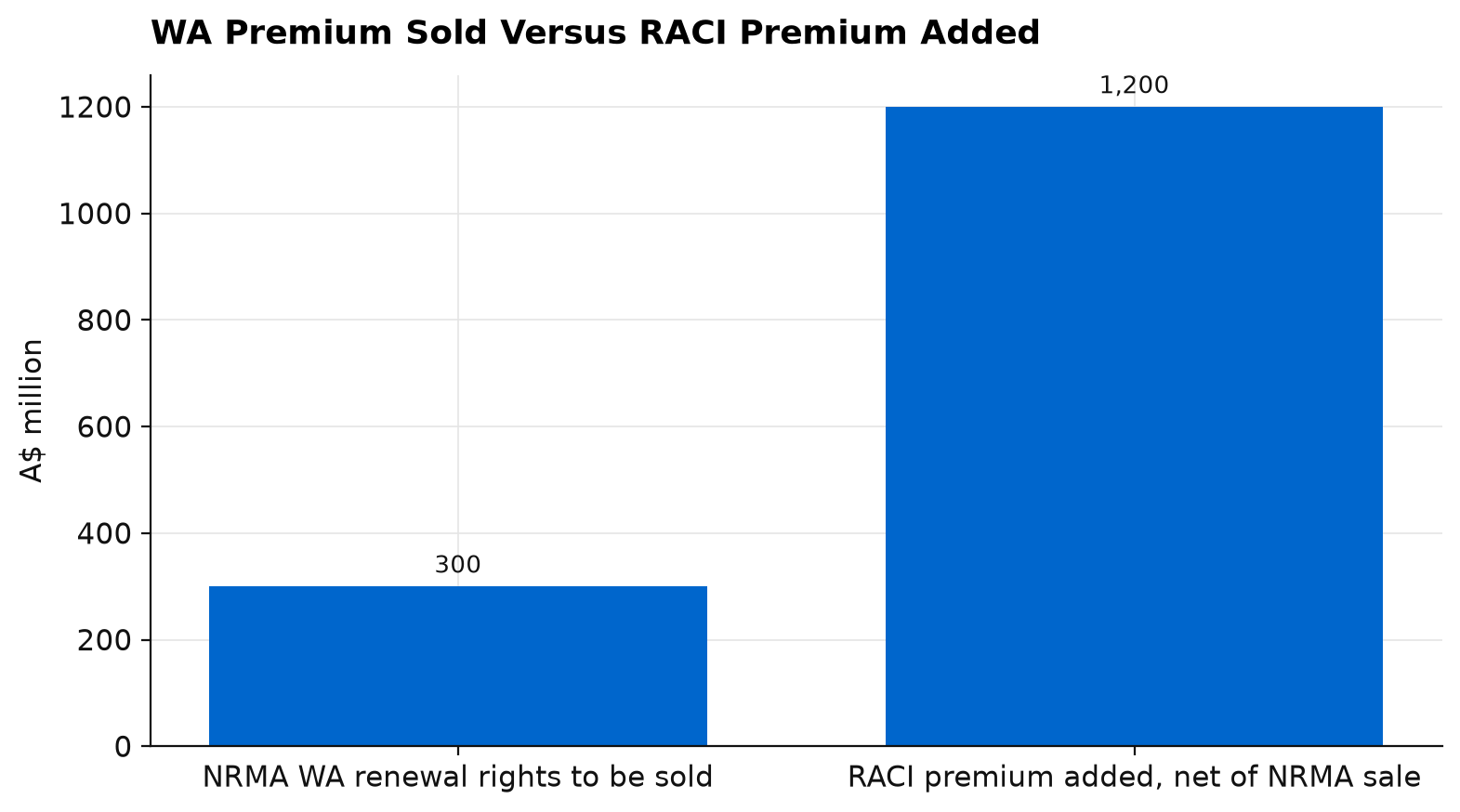
To address competition directly, IAG is committing to sell the renewal rights to its existing NRMA home and motor policies in WA to another insurer. Renewal rights let the buyer offer those customers a new policy when their current one comes up for renewal, so the book of customers moves to a competitor over time. The book carries about A$300 million of gross written premium. Net insurance revenue from it is lower once quota share reinsurance is taken out. Quota share is an arrangement where an insurer passes a fixed slice of every policy, premiums and claims alike, to a reinsurer. The sale would cut IAG’s post-acquisition share in WA by up to about 10 per cent, taking it below 50 per cent. IAG believes the ACCC may be more supportive with that in place.
IAG’s other commitments speak to the net public benefits test. A deal can also be approved by a separate route if its benefits to the public outweigh the harm from lost competition. Here IAG has committed to address insurance availability in towns in the north of Western Australia, and plans to price accordingly. It is investing A$20 million over the next 10 years to support community resilience building initiatives in WA. It has also offered stronger measures that would apply if it breached competition or product pricing requirements on RAC branded products, and those measures extend to its distribution agreement with RAC, so the agreement, the main asset IAG is buying, is at risk if IAG does not keep its side of the bargain.
The ACCC assessment is targeted for December 2026, with some uncertainty around that date. The new commitments add moving parts, including a question over whether the ACCC could require IAG to sell its NRMA policies before it reviews or approves the RACI acquisition, which would leave IAG giving up the WA book before knowing the deal is done.
What RACI Brings and What IAG Is Paying
In FY26 RACI reported insurance margins of about 30 to 32 per cent, after a strong FY25, although underlying margins were lower. The insurance margin is the profit from writing insurance, plus the investment income earned on money held to pay claims, expressed as a share of revenue. IAG’s own through the cycle target is 15 per cent, so RACI’s recent results sit well above that, helped by a good run of years. Net of the NRMA sale, IAG says the acquisition is expected to contribute A$1.2 billion of gross written premium.
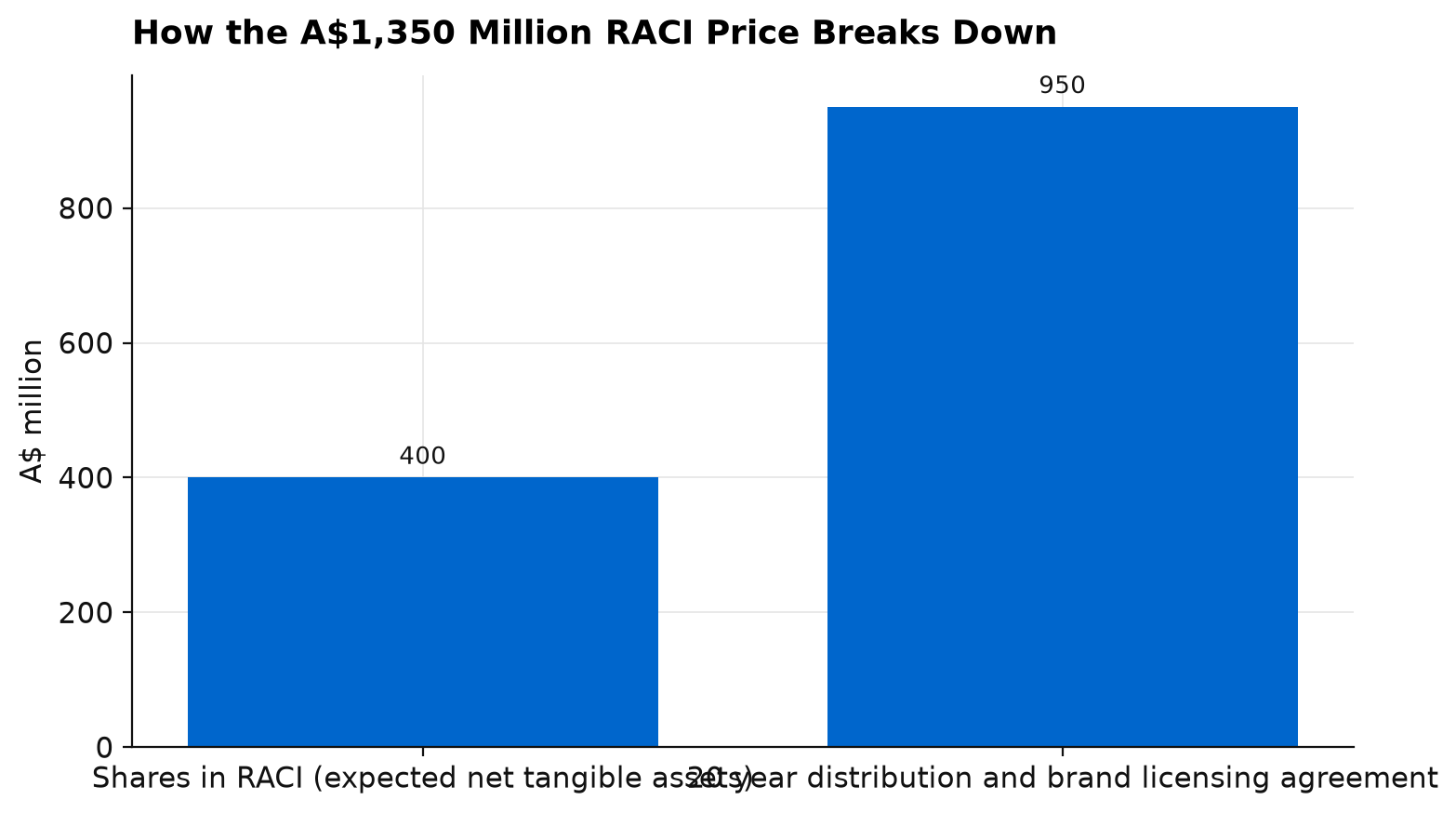
Of the A$1,350 million upfront cash price, A$400 million buys shares in RACI equal to the expected net tangible asset value at completion, which is broadly the insurer’s assets less its liabilities, leaving out intangibles. The other A$950 million pays for a 20 year distribution and brand licensing agreement, the right to sell insurance under the RAC brand, booked as an intangible asset. IAG expects to write it down evenly over the 20 year term of the agreement, with about A$48 million a year flowing through acquisition expenses.
A rules-based approach to leveraged ETFs
See how our quantitative strategy works and who it suits.
Explore the strategyBecome an authorised representative
Advise your clients under an established AFSL without building your own. Choose AR or CAR.
Become an AR or CARIAG expects annual run-rate synergies of about A$100 million before tax. These come predominantly from reinsurance and operating efficiencies, as RACI moves onto IAG’s reinsurance arrangements and enterprise platform. Against that sit transaction costs of about A$20 million, and annual integration costs of between A$15 million and A$25 million over the next three years. The company expects the deal to add to earnings per share in the first full year of ownership, and to lift them by a mid single-digit percentage once synergies are running at full pace. That outcome already includes the synergies, the integration expenses that are not capitalised, the amortisation of the distribution agreement and some debt funding costs. IAG describes the financial outcomes as consistent with its 15 per cent insurance margin target.
IAG kept that guidance after agreeing to give up about A$300 million of WA premium. It is unclear what value IAG is assuming for the NRMA book, or whether it is valued on the same measures as the RACI acquisition. With most of the price going on the distribution agreement, the long-term value depends on how well IAG keeps RAC branded customers renewing over two decades, and on the stronger breach measures now tied to that agreement.
Margins, Reinsurance and Investment Income Underpin Earnings
Away from the deal, institutional sell-side research sees IAG’s margin guidance as ahead of consensus expectations, meaning ahead of the average forecast across the market, with margins generally strong. They are supported by profit commissions, the RACQ recovery, expenses and reinsurance, although premium rate increases are moderating and New Zealand commercial is under pressure.
In the Intermediated Insurance business, IAG is targeting ongoing improvement in margins and return on equity. Return on equity measures the profit a company earns on each dollar of shareholders’ money. The improvement is driven by expense ratio savings, meaning a smaller share of premium spent on running the business, and may include a reinsurance transaction.
IAG also has catastrophe volatility and reserve protection covers in place. These are reinsurance contracts that limit how much a heavy season of storms, floods or bushfires, or a deterioration in older claims, can hit the result in a given year, and the research expects them to make margins more stable and consistent.
Strong yields on the money IAG holds between collecting premiums and paying claims also support its margins.
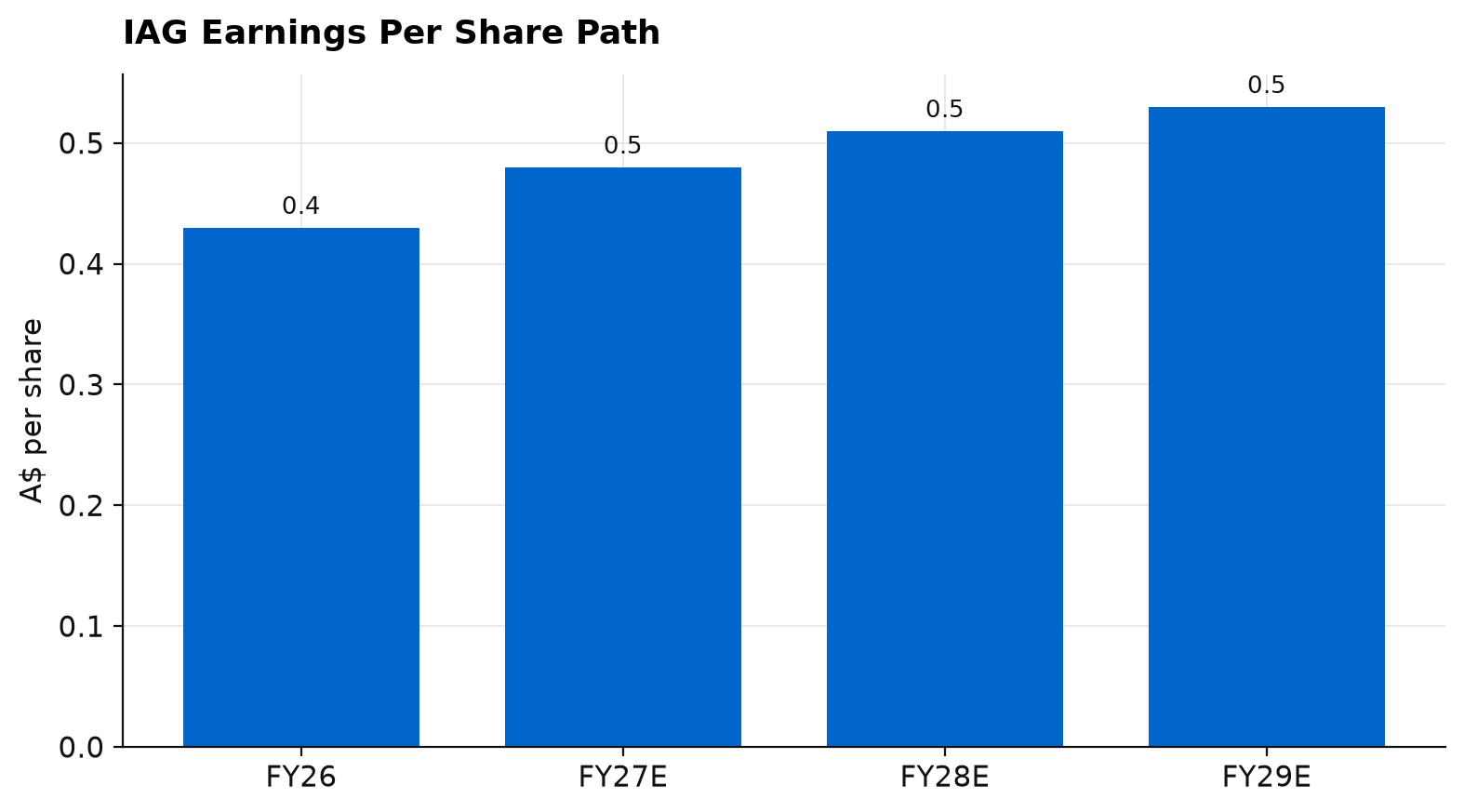
Institutional sell-side research forecasts net income rising from A$1,025.0 million in FY26 to A$1,146.9 million in FY27, then A$1,201.0 million in FY28 and A$1,257.4 million in FY29. Earnings per share fell 12.1 per cent in FY26 to A$0.43. They are forecast to rebound 12.7 per cent to A$0.48 in FY27, then grow 4.5 per cent a year to A$0.51 in FY28 and A$0.53 in FY29. On a half-yearly view, earnings per share are forecast at A$0.24 for the half to December 2026, up from A$0.22 in the June 2026 half, followed by A$0.24 and A$0.25 in the next two halves.
Valuation and the Buy Rating
Institutional sell-side research has a 12 month price target of A$8.60 on IAG, and the shares closed at A$8.80 on the publish date, putting the target about 2.3 per cent below the share price.
The Buy rating is relative to the other stocks the research covers, and rests on the core business, where margin guidance is ahead of consensus, catastrophe and reserve covers support steadier results, and strong investment yields add to profit. RACI is expected to add A$1.2 billion of gross written premium net of the NRMA sale, about A$100 million a year of pre-tax synergies, and a lift to earnings per share from the first full year of ownership, all consistent with a 15 per cent insurance margin target and a lifted 15 per cent return on equity target. Earnings per share are forecast to grow from A$0.43 in FY26 to A$0.53 by FY29.
IAG paid A$0.32 a share in dividends over the past twelve months, a trailing dividend yield of 3.6 per cent at A$8.80, partly franked. Institutional sell-side research forecasts the dividend rising to A$0.34 in FY27, A$0.36 in FY28 and A$0.38 in FY29, so the income stream is expected to grow alongside earnings.
The RACI contribution depends on the ACCC clearing the deal around December 2026 and the synergies arriving as guided.
Key Risks
If premium rate momentum weakens materially and falls below loss cost inflation, meaning the rising cost of repairs and rebuilding, margins would come under pressure, and lower investment yields would remove a current tailwind. Higher prices or a stronger rival in WA, including whichever insurer takes on the NRMA renewal rights, could cost IAG customers. RACI brings execution risk, since the ACCC assessment is targeted for December 2026 with some uncertainty, IAG may be asked to sell the NRMA book before approval, and the synergies and integration costs still have to land as guided. Persistent claims inflation or a run of natural perils can also hurt results even with reinsurance covers in place. RACI’s FY26 insurance margins of about 30 to 32 per cent were above its underlying level, so the acquired book may not repeat those results.
Our View
We think the WA concessions are a sensible trade. Giving up the NRMA book costs IAG about A$300 million of premium and answers the regulator’s main objection, with IAG’s earnings guidance unchanged. Without the concession, the deal would leave IAG with more than half of a state’s home and motor market. Our watch point is the order of events, because if the ACCC insists on the NRMA sale before it rules on RACI, IAG gives up the NRMA book with no certainty that the RACI approval follows.
If you would like to discuss IAG, request a callback or call us on 1300 889 603.
Financial Summary
Become an authorised representative
Advise your clients under an established AFSL without building your own. Choose AR or CAR.
Become an AR or CAR