

Hold
IDP Education helps international students choose and enrol at overseas universities and owns and administers the IELTS English test, listed on the ASX as IEL.
Institutional sell-side research rates it Hold because the stock looks fairly priced. Cost cuts, a balance sheet with net debt of A$119 million and expected market share gains support the case. Against that, student placement volumes fell 27 per cent, FY27 guidance assumes another 20 to 30 per cent market fall, and there is limited visibility on when volumes turn and less room for further cost cuts.
- Sell-side rating
- Hold
- Sell-side target
- A$2.13
- Upside to target
- −12.0%
- Initial price
- A$1.579 Sep 2026
- Last close
- A$2.4218 Nov 2026
IDP Education‘s FY26 result landed where management said it would, with earnings before interest and tax (Ebit, the profit the business makes from its operations before borrowing costs and tax) of A$123 million, in line with the guidance it gave in late June. Student placement volumes fell 27 per cent and IELTS English test volumes fell 8 per cent, and the result relied on heavy cost cuts and a few one-off items. Guidance for FY27 Ebit of A$95 million to A$115 million assumes the student placement market falls another 20 to 30 per cent, and the research sees less scope for further cost cuts. Institutional sell-side research has IDP Education rated Hold with a 12 month price target of A$2.13, about 35.7 per cent above the share price of A$1.57 when this research was published. The target was lowered after the result, and the research sees limited visibility on when volumes will stop falling.
Research published 9 September 2026. Price target and upside based on prices at time of publication.
Table of contents [hideshow]
About IDP Education
IDP Education is a large global player in tertiary student placement and is the owner and administrator of the IELTS test. Student placement means helping international students choose and enrol at universities overseas. IELTS is a leading global high-stakes English test, needed for higher education and work predominantly in the United Kingdom, Canada and Australia. In FY26 Student Placement earned A$303 million of revenue and IELTS earned A$389 million, within group revenue of A$795.2 million. IDP Education has used its university relationships and its own data offerings to help institutions find the students they want. It is listed on the ASX under the code IEL and reports in Australian dollars. It is also expanding into new markets, with IELTS testing now offered directly in China and student placement launched in Malaysia and the UAE.
Student Placement and IELTS Volumes Are Still Falling
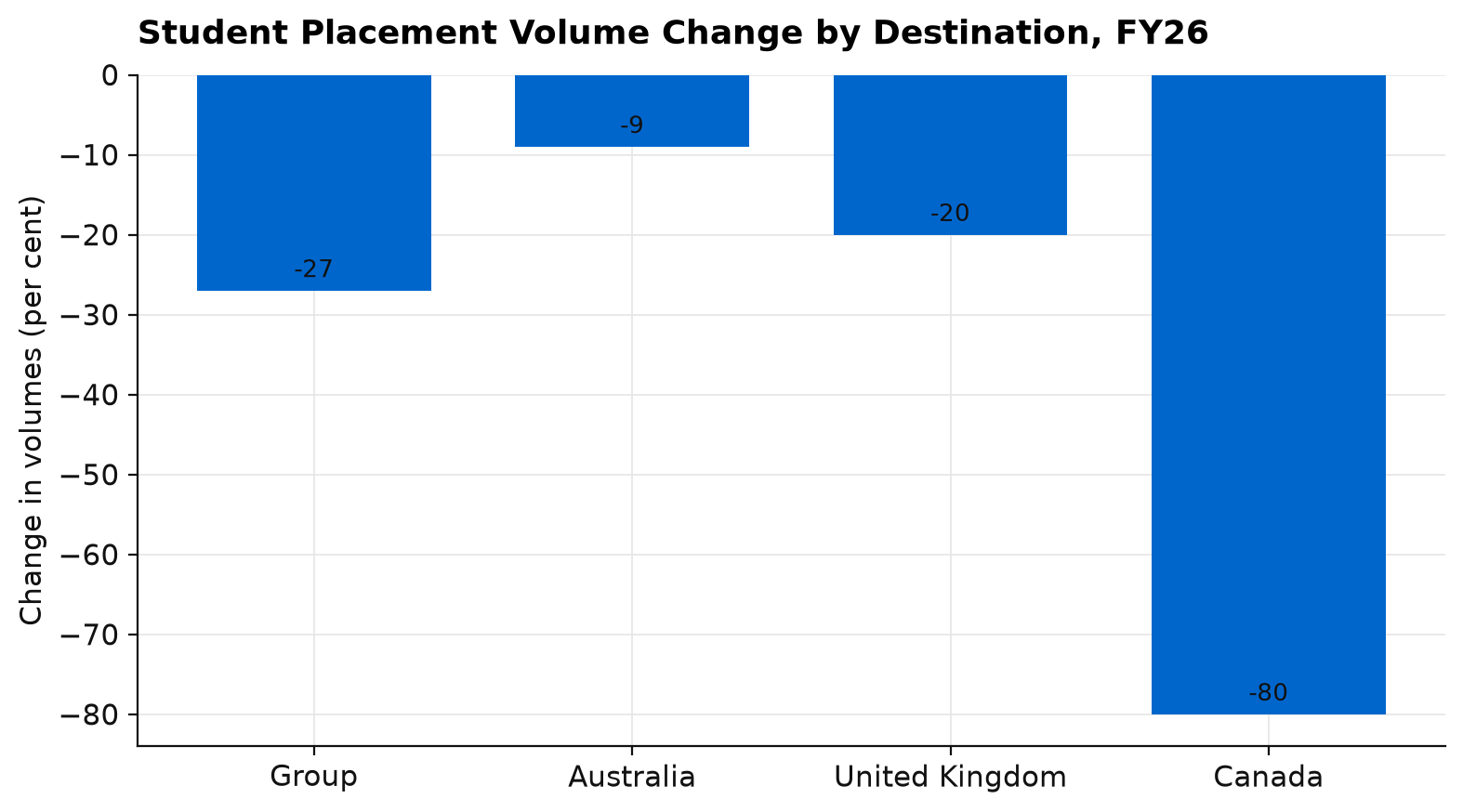
Student Placement, the part of the business that earns a fee when it places an international student at a university, saw volumes fall 27 per cent in FY26. Revenue from the division came in at A$303 million, which was 8 per cent below what the market had been expecting. The declines were spread across every major destination country. Placements into Australia fell 9 per cent, into the United Kingdom 20 per cent, and into Canada 80 per cent. These falls reflect policy changes in the destination countries and a challenging environment across the key regions students come from, with Indian student volumes down 40 per cent.
Price gave some offset: the average revenue IDP Education earned per placement rose 11 per cent in constant currency terms, which means after stripping out the effect of exchange rate movements. Part of that came from higher tuition fees and improved commercial terms with institutions, and part came from one-off items that will not repeat, including changes to provisions for students who drop out and a shift in the mix of destinations.
IELTS revenue was A$389 million, 4 per cent below market expectations, as test volumes fell 8 per cent. The weakness is concentrated in India, a key source market, where volumes fell 22 per cent, compared with 3 per cent outside India. The average price per test rose 7 per cent in constant currency, driven by price increases and geographic mix. The research also points out that Google searches for IELTS in India remain at lows, while searches for PTE, a competing English test, have improved recently, which may mean some of the weakness in India reflects competition as well as a smaller market.
Looking ahead, company guidance assumes the student placement market falls another 20 to 30 per cent in FY27, and the institutional sell-side forecast sits at a 22 per cent decline. The research then expects a further 5 per cent fall in FY28 before volumes stabilise in FY29.
Cost Cuts Supported FY26 Earnings
IDP Education took A$32 million of net cost out of the business in FY26, in line with the A$30 million guidance given at the June trading update. Most of that came from staff, with about 1,250 roles removed, roughly 20 per cent of the workforce.
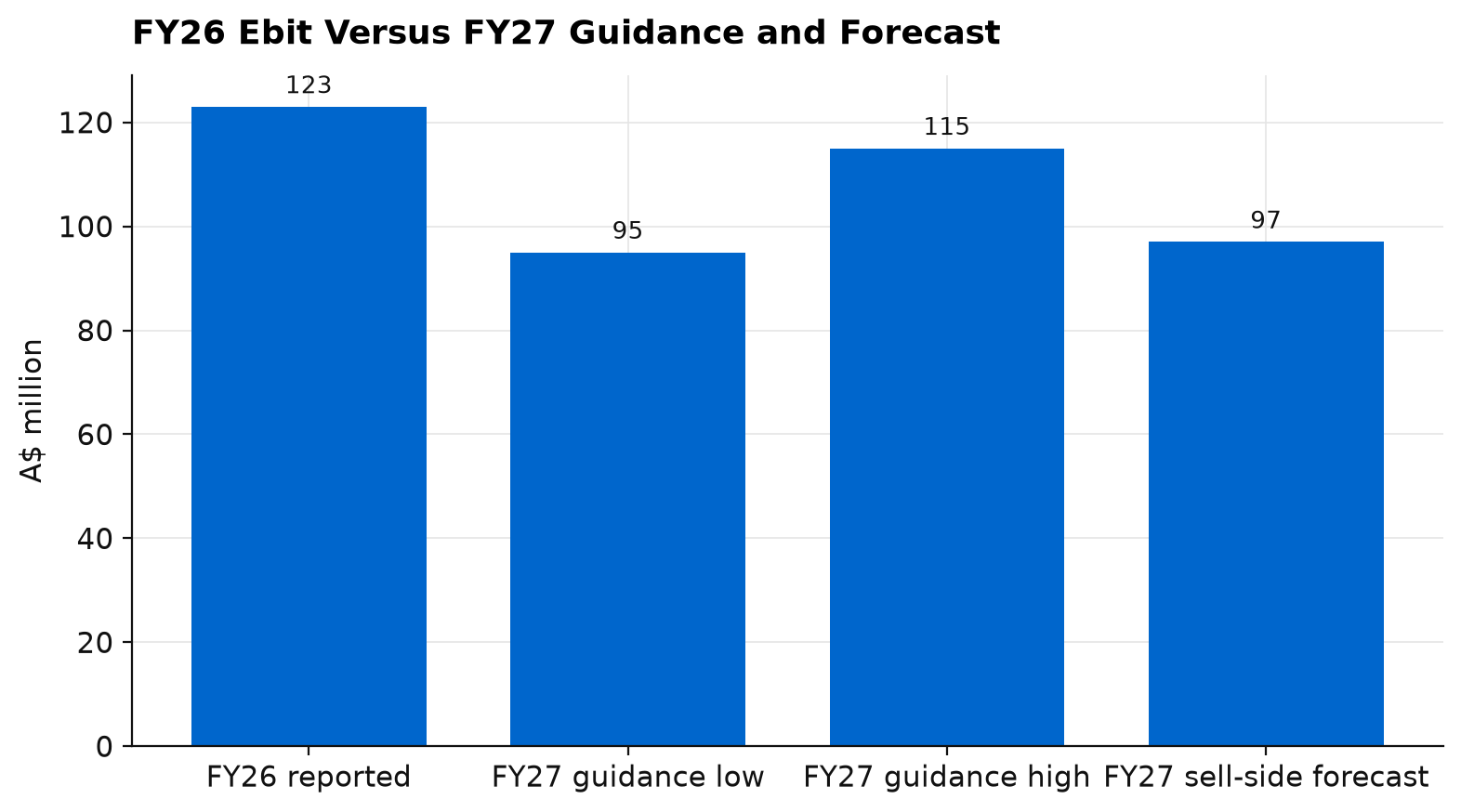
The FY26 Ebit of A$123 million matched market expectations and the company’s late-June guidance of about A$122 million. Beyond the A$32 million of cost savings, the result included a one-off revenue gain of about A$6.6 million, and the guidance excluded credit losses, amounts the company no longer expects to collect, of A$6.0 million. The research describes the underlying operating result as soft.
For FY27, management has guided to Ebit of A$95 million to A$115 million. That range already includes a further A$15 million of net cost reduction, and it assumes prices for both student placement and IELTS grow by mid-single digits. The research forecasts 6 per cent price growth for each. The guidance came in below market consensus, which was already at the top end of the range. The institutional sell-side forecast is A$97 million, close to the bottom of the range.
A rules-based approach to leveraged ETFs
See how our quantitative strategy works and who it suits.
Explore the strategyBecome an authorised representative
Advise your clients under an established AFSL without building your own. Choose AR or CAR.
Become an AR or CARThe company expects one-off transformation costs of A$40 million in FY27, including about A$20 million on modernising its ERP system, the core software that runs finance and operations across a business. After successive years of headcount reductions, the research flags execution and the potential operational impact of these structural changes as the key risk.
Earnings per share are forecast to fall from A$0.26 in FY26 to A$0.18 in FY27, then sit at A$0.19 in both FY28 and FY29.
Balance Sheet and New Markets
Net debt, which is borrowings minus cash, fell to A$119 million from A$165 million in FY25. Leverage, a measure of net debt relative to annual earnings, eased to 1.0 times, well inside the lending covenant, a limit written into its loan agreements, of less than 3.0 times. IDP Education also has A$341 million of undrawn facilities, meaning money it has arranged to borrow but has not used.
Its direct IELTS testing in China had 25 test centres as of August, up from 13 at the June year end. The research sees this and the student placement launches in Malaysia and the UAE as potentially supportive of long-term volumes but considers the near-term benefit immaterial, and it is waiting for more detail on how quickly the new regions ramp up and how large they can become.
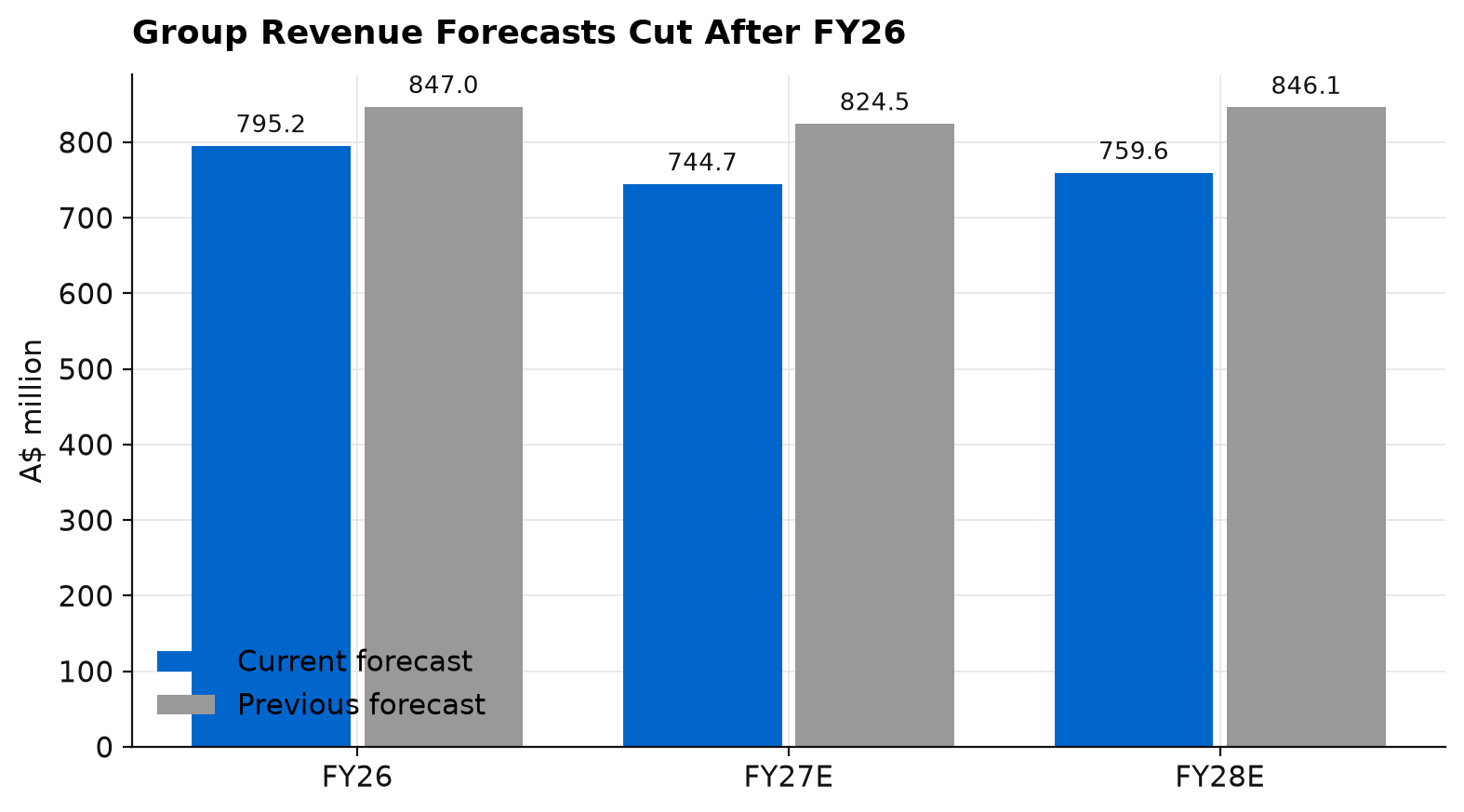
Group revenue of A$795.2 million in FY26 is forecast to fall to A$744.7 million in FY27, before recovering to A$759.6 million in FY28 and A$800.1 million in FY29. Before this result, the research had forecast FY26 revenue of A$847.0 million, FY27 revenue of A$824.5 million and FY28 revenue of A$846.1 million. On the new numbers, FY29 revenue returns to about the FY26 level.
The research still expects IDP Education to emerge from the current industry challenges with greater market share, once immigration policy and student placement demand stabilise. It sees the near-term outlook as uncertain, with key policy outcomes still to come across the core regions, limited visibility on immigration stability, and uncertain demand from the regions students come from.
Valuation and the Hold Rating
The 12 month price target is A$2.13, lowered from A$2.50 after the result. The cut reflects a 15 per cent reduction in Ebit forecasts, taking FY27 down to A$97 million, driven almost entirely by further falls in student placement and IELTS volumes. At the share price of A$1.57 when this research was published, the target is about 35.7 per cent above the market price.
The research weighs a cost base that has been cut hard, a balance sheet with modest debt and A$341 million of undrawn facilities, and expected market share gains after this downturn against limited visibility on when volumes will turn, ongoing policy uncertainty in the main destination countries, and less room to keep cutting costs to defend earnings. It rates the stock Hold and describes the risk as fairly priced.
IDP Education paid A$0.09 per share in dividends over the past twelve months, a trailing dividend yield of 5.7 per cent at the A$1.57 share price, unfranked, so it carries no franking credits for SMSF trustees or other Australian investors.
The research lists the September UK student intake, the main intake period, changes to Australian policies including visa prices, and the implementation of the UK White Paper as the key catalysts, and describes the outlook they give for volumes as mixed.
Key Risks
The biggest risk is political, because immigration and visa policy in Australia, the United Kingdom and Canada can discourage international students from travelling, and changes such as higher Australian visa prices and the implementation of the UK White Paper could push volumes below the 20 to 30 per cent market decline already assumed for FY27, while better-than-expected volumes would work the other way. Competition is another risk, in both student placement and English testing, including from the rival PTE test, whose search interest in India has improved. Execution on cost cutting is also a risk, because after removing about 1,250 roles and with a further A$15 million of net savings planned, deeper cuts could start to affect how the business operates, and the ERP modernisation has to be delivered on time and on budget alongside that. Risks specific to the business model include key IELTS agreements that can be terminated with 12 months’ notice and reliance on third parties to deliver parts of the service.
Our View
In our view management handled a hard year well: it hit its guidance, cut costs quickly and brought net debt down to A$119 million. But volumes are still falling in every key destination, the price gains included one-offs that will not repeat, and FY27 Ebit is forecast to land near the bottom of guidance even with another A$15 million of savings. We will watch for two things: a reporting period in which student placement volumes stop falling, and evidence that IELTS is holding its ground in India. The September UK intake is the next data point on volumes.
If you would like to discuss IDP Education, request a callback or call us on 1300 889 603.
Financial Summary
Become an authorised representative
Advise your clients under an established AFSL without building your own. Choose AR or CAR.
Become an AR or CAR