

The US government has put a number on the laboratory fee cuts hanging over Sonic Healthcare, and it is close to the figure the company had already given investors. On 21 September 2026 the Centers for Medicare and Medicaid Services, the agency that runs the Medicare health programme, released preliminary laboratory payment rates for 2027 through 2029. The average cut is about 16 per cent, phased in over several years, and Sonic had previously estimated an A$15 million impact for FY27. Institutional sell-side research has Sonic Healthcare rated Buy with a 12 month price target of A$23.70, about 24.9 per cent above the share price of A$18.97 when this research was published.
Research published 22 October 2026. Price target and upside based on prices at time of publication.
Table of contents [hideshow]
About Sonic Healthcare
Sonic Healthcare is a medical diagnostics company listed on the Australian Securities Exchange. Its work centres on laboratory testing, known as pathology, and on diagnostic imaging services. The business is globally diversified, with operations in Australia, Germany, the United States, Switzerland and the United Kingdom, as well as several other regions. Sonic reports on a June year end, and it generated revenue of A$10,852.4 million in FY26. It ranks among the two largest operators in its key regions and grows both organically and by acquiring smaller rivals. Across FY24 the company carried out several initiatives that still shape the investment case, including a restructure of its US business and several large acquisitions in Europe. The forecasts in this piece come from institutional sell-side research and run on the same June year end.
The Medicare Fee Cut Now Has a Number
Part of Sonic’s US business is paid by Medicare. Medicare pays laboratories from a price list called the Clinical Laboratory Fee Schedule, which sets a fee for each type of test. The September release set out preliminary rates under that schedule for 2027 through 2029. It was made under the Protecting Access to Medicare Act, usually shortened to PAMA. Sonic’s FY27 guidance excludes the impact, because the company was uncertain how the changes would be implemented. Investors had the company’s own estimate to work with but, until this release, no official rates to test it against.
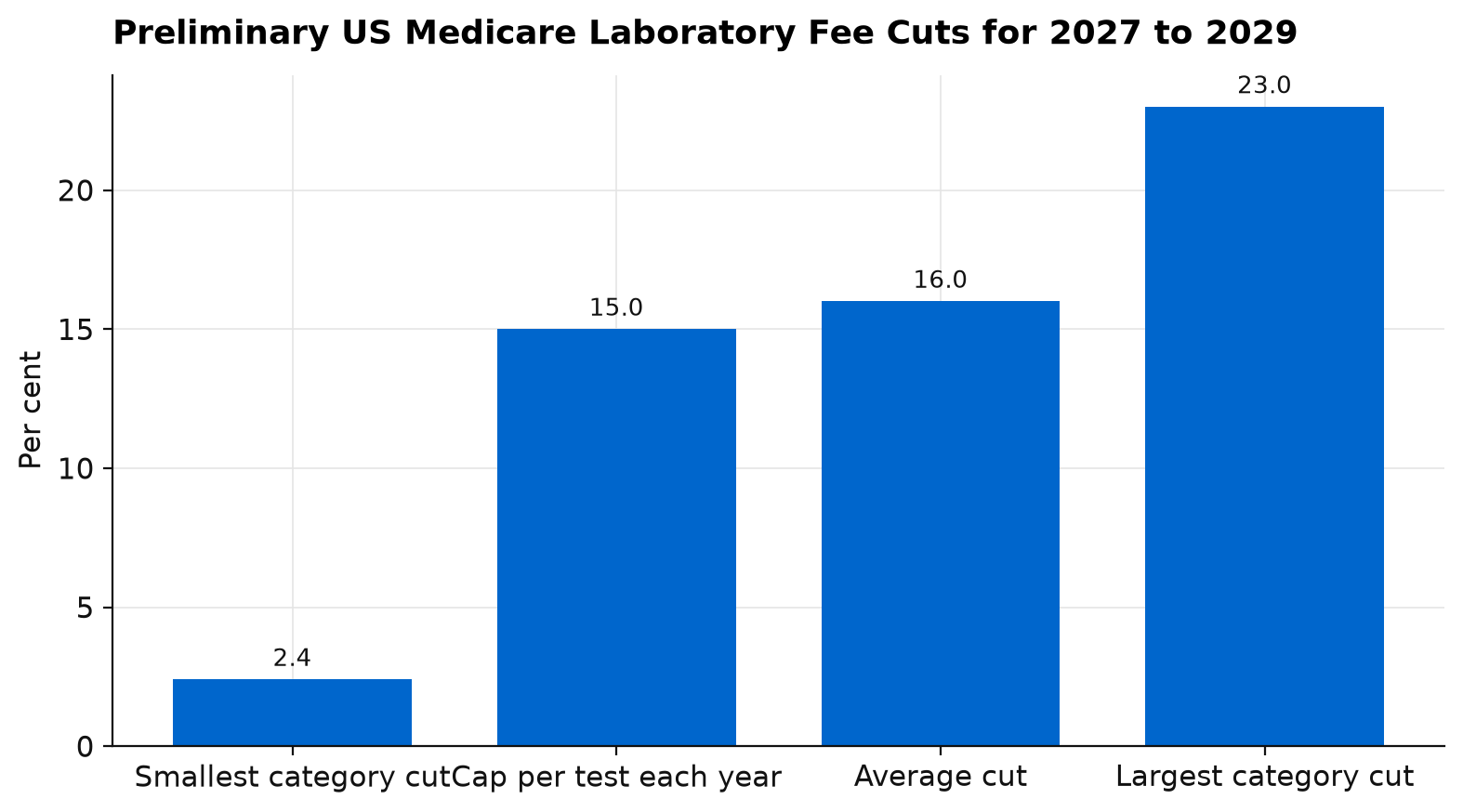
The headline is an average cut of about 16 per cent against 2026 rates. The agency published a range of weighted rate changes by category of test, and the cuts run from 2.4 per cent at the light end to 23 per cent at the heavy end. A laboratory’s exposure depends on which tests it performs most.
The reductions will not take effect all at once. Payment for any single test also cannot be cut by more than 15 per cent in a year compared with the year before. A test facing a 23 per cent reduction in total therefore cannot take the full cut in the first year. Because some categories sit well below the 15 per cent ceiling, institutional sell-side research notes that the impact of the cuts in calendar 2027 may come in below 15 per cent. The research is waiting for Sonic to say whether its A$15 million estimate changes once it has worked through the detail.
For shareholders, the main point is that the size of the published cuts is broadly in line with what the company had already quantified. PAMA is now a known cost.
Size of the Cut Against Group Earnings
Institutional sell-side research estimates that on an annualised basis, meaning a full year of the cuts, the proposed reductions represent about 1.5 per cent of Sonic’s US revenue and about 1.5 per cent of group EBITDA. EBITDA stands for earnings before interest, tax, depreciation and amortisation. It is a rough measure of the profit the operations produce before financing costs and accounting charges for wear on equipment. Group EBITDA was A$1,933.1 million in FY26, so the cut is a modest slice of a large profit base.
The research also measures the impact against earnings per share, or EPS, which is the profit attributable to each share. On that basis the annualised effect of the proposed cuts is about 4 per cent of its group forecast.
Because Sonic’s FY27 guidance excludes PAMA, the guidance figure and the PAMA estimate sit side by side. When the company updates the market, investors will need to hold both numbers in mind. If the final rates land near the preliminary ones, the A$15 million estimate becomes the number to subtract, and it is a number the market has already seen.
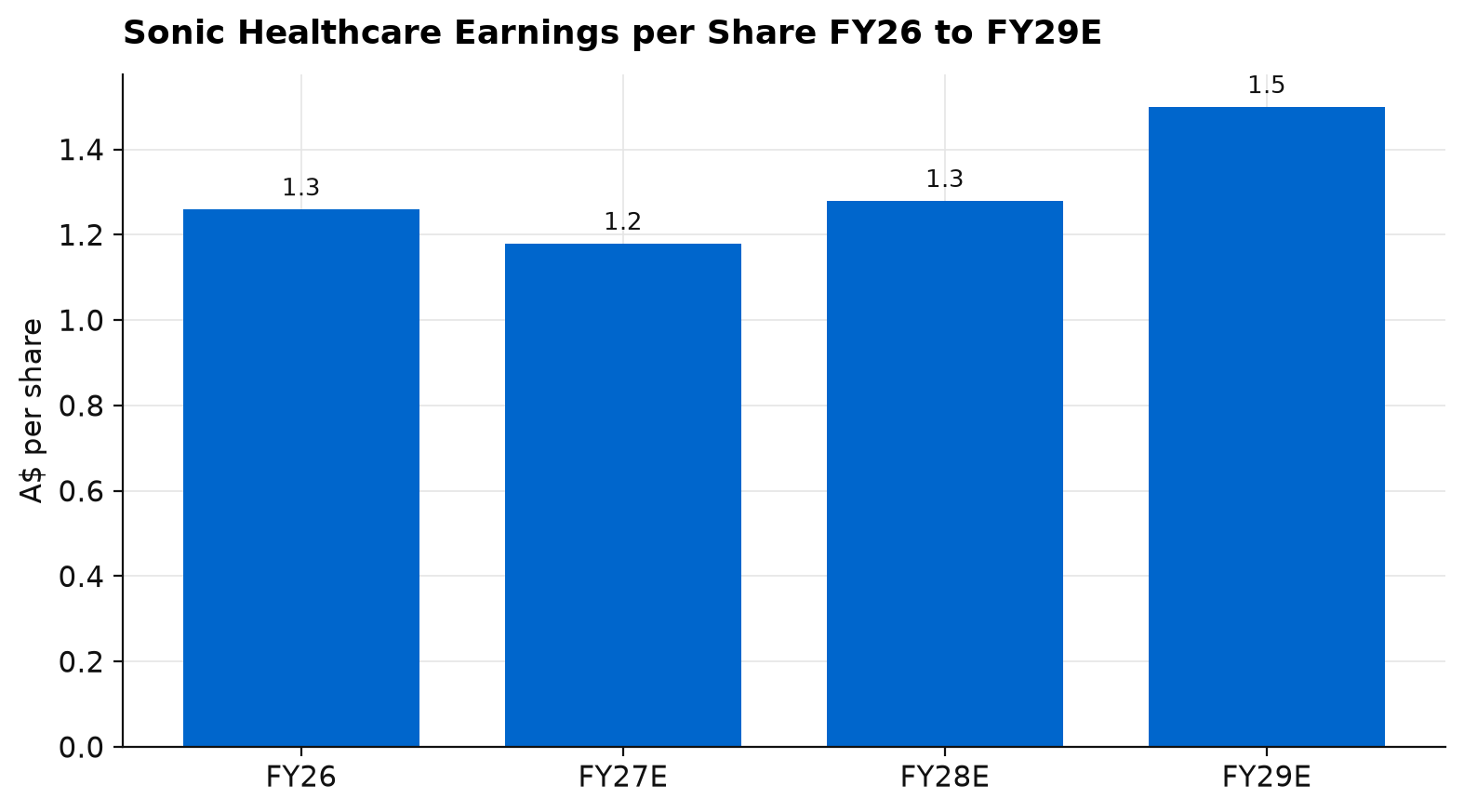
The earnings path in the research shows a soft year followed by recovery. EPS was A$1.26 in FY26. The research forecasts A$1.18 in FY27, then A$1.28 in FY28 and A$1.50 in FY29. By half year, EPS was A$0.53 in the December 2025 half and A$0.72 in the June 2026 half. The research expects A$0.49 for the December 2026 half and A$0.69 for the June 2027 half. FY27 is the trough in this outlook.
Final Rates and the RESULTS Act
The September rates are preliminary. The agency has given the public 30 days to comment on the changes, and it plans to publish final payment rates for calendar 2027 on its website in November 2026. It is the point at which Sonic can test its A$15 million estimate against final rates, and the point at which institutional sell-side research is waiting for more clarity from the company.
Separate legislation is under consideration in the United States, called the Reforming and Enhancing Sustainable Updates to Laboratory Testing Services Act, or the RESULTS Act for short. It proposes to limit potential funding cuts to a maximum of 5 per cent a year. That would be a much tighter limit than the 15 per cent per test cap under the current rules. After the preliminary rates came out, one of Sonic’s large US laboratory peers issued a statement on the proposed payment rates, saying it continues to support the bipartisan RESULTS Act. Bipartisan means the bill has backing across both major US political parties.
Institutional sell-side research takes no view on how the legislation will turn out, and we do not either. Legislation can stall, change shape or pass, and a single statement from one company is not enough to forecast the outcome. Under the current rules, the cut is phased, capped at 15 per cent per test each year and broadly in line with Sonic’s own estimate. Under the RESULTS Act as proposed, the yearly cuts would be capped at 5 per cent.
Scale and Productivity Drive the Longer Case
Sonic’s position in its key regions, noted above, lets it grow market share in two ways. It can win more work through the laboratories and imaging sites it already runs, or buy smaller operators and fold them into the network. Institutional sell-side research bases its Buy view on that ability to keep growing share by both routes.
A rules-based approach to leveraged ETFs
See how our quantitative strategy works and who it suits.
Explore the strategyBecome an authorised representative
Advise your clients under an established AFSL without building your own. Choose AR or CAR.
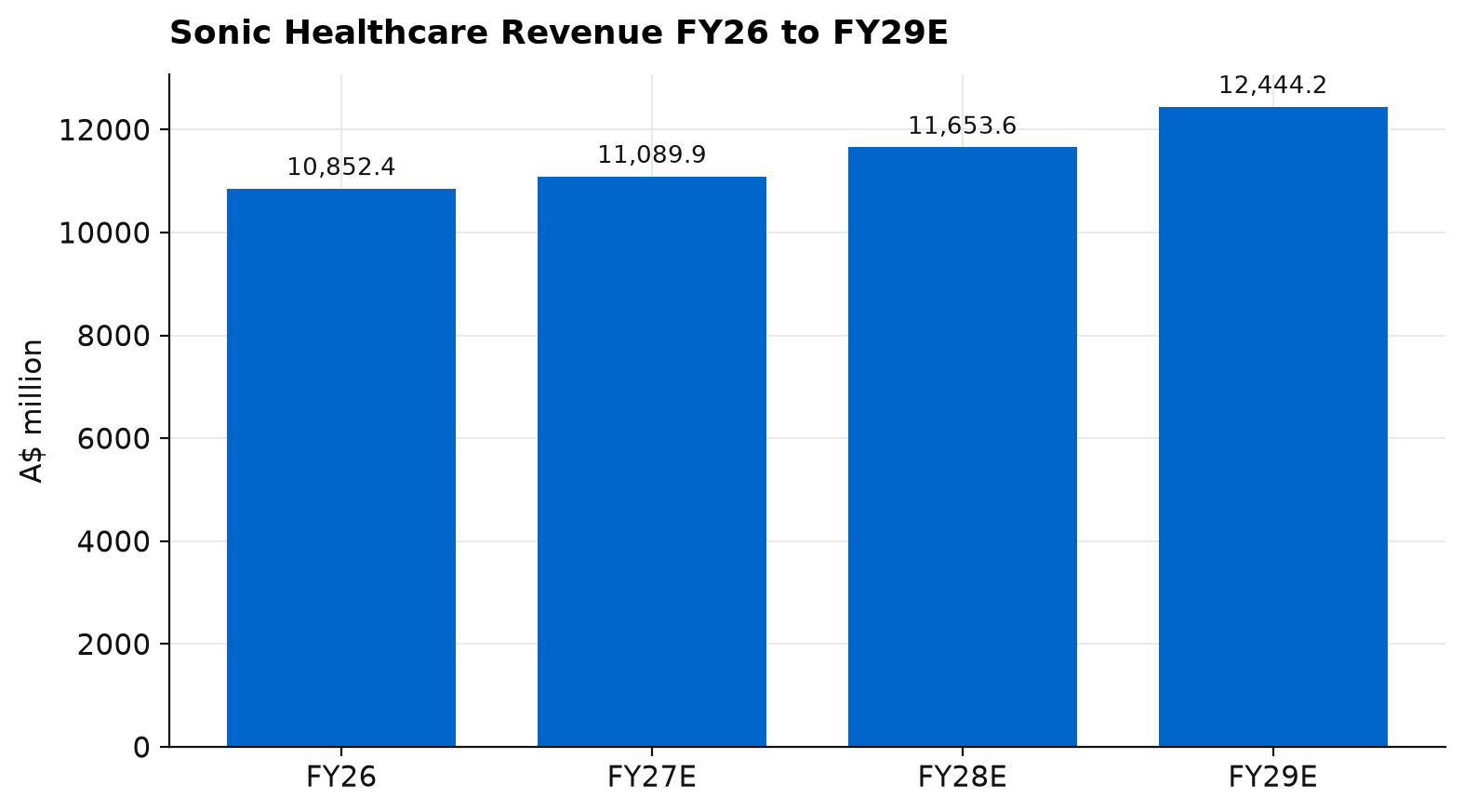
Become an AR or CARThe forecasts show steady growth in sales. Revenue was A$10,852.4 million in FY26. The research expects A$11,089.9 million in FY27, A$11,653.6 million in FY28 and A$12,444.2 million in FY29. EBITDA follows a similar shape, from A$1,933.1 million in FY26 to A$1,952.5 million in FY27, A$2,096.1 million in FY28 and A$2,308.7 million in FY29. The FY27 step is small on both measures. The larger steps come in FY28 and FY29, and that is where the earnings recovery in the research comes from.
The research also expects productivity gains. Across FY24, Sonic restructured its US business and completed several large acquisitions in Europe. The research argues the company is well positioned to deliver productivity improvements following that work. Productivity here means producing more tests and more revenue from the same base of laboratories, staff and equipment, which lets more of each extra dollar of revenue reach profit.
The research also argues that the current share price does not reflect the ability of these initiatives to generate meaningful growth. If the productivity gains come through, the share price has room to move toward the target.
Valuation and the Case for Buying Before the Final Rates
Institutional sell-side research has a 12 month price target of A$23.70 on Sonic Healthcare, about 24.9 per cent above the share price of A$18.97 when this research was published.
The preliminary cuts average about 16 per cent, are phased in, are capped at 15 per cent per test each year and are broadly in line with the A$15 million FY27 impact Sonic had already estimated.
Market share also supports the target. The company has the scale to keep growing organically and to keep acquiring smaller operators, and the research expects revenue to reach A$12,444.2 million by FY29.
The FY24 restructure of the US business and the European acquisitions underpin a forecast for EPS to rise to A$1.50 by FY29, from A$1.18 in FY27.
Over the past twelve months Sonic paid dividends of A$1.08 per share. At the share price of A$18.97 when this research was published, that is a trailing dividend yield of about 5.7 per cent, partly franked. Franking credits are tax credits for company tax already paid in Australia. Depending on an investor’s tax position, they can add to the after-tax income from the dividend. The board sets the dividend each period and it can change, but the current payout gives holders a cash return while the earnings recovery plays out.
Our read is that the risk and reward favour owning Sonic into the November final rates. If those rates confirm the preliminary numbers, the US cuts are settled and the focus shifts to the earnings recovery. If the RESULTS Act gains ground, the cuts get smaller. With about 24.9 per cent upside to the target and a dividend yield of about 5.7 per cent, partly franked, on top, we think Sonic is a stock to accumulate at current levels for investors with a 12 month view or longer.
Key Risks
The risks start with US pricing. The final Medicare rates due in November 2026 could differ from the preliminary ones, and Sonic’s A$15 million estimate for FY27 may change once the company has worked through them. The second is German funding, where the January 2025 funding reforms could reduce pathology revenue growth in a country where Sonic has operations. The third is cost pressure, because an uptick in wage inflation in key markets ahead of pricing growth would squeeze margins. The fourth is competition, with the risk of further loss of US market share following the restructure of that business. Any of these could pull earnings below the forecasts in the research and slow the path toward the A$23.70 target.
Our View
The published cuts now broadly match the company’s own estimate, which removes much of the uncertainty. The shape of the cut also helps, because it is phased in and capped per test each year.
Our caution is focused on the other risks the research lists. Germany’s funding reforms and wage inflation are less visible than a US fee schedule, and either could weigh on the FY28 and FY29 recovery. Those are the numbers we will watch most closely when the company next reports.
For now the cost of the Medicare change is known. Earnings growth is forecast to return from FY28, and the dividend pays holders while that happens.
If you would like to discuss Sonic Healthcare, request a callback or call us on 1300 889 603.
Financial Summary
Learn to trade with a plan
Our free 5-day course covers entries, exits and risk management.
Start the free courseBecome an authorised representative
Advise your clients under an established AFSL without building your own. Choose AR or CAR.
Become an AR or CAR