
Every time the Reserve Bank of Australia sets the cash rate, the official interest rate that flows through to mortgages, term deposits and the Australian dollar, markets pick over its statement line by line. A note published by institutional sell-side research on 30 September 2026 asks whether that close reading pays off. Using three text-analysis tools, including a modern large language model, the research scores RBA statements and Minutes as hawkish (leaning towards higher rates) or dovish (leaning towards lower rates), then tests whether that tone predicts the next decision or the market’s reaction on the day.
Tone helps a little in predicting the direction of the next RBA move but not how markets move on decision day. RBA language has grown more hedged since the 2023 Review of the Bank. Australian investors in cash, bonds, the AUD and the ASX can learn more from the data and the decision.
Table of contents [hideshow]
How the Research Read the RBA
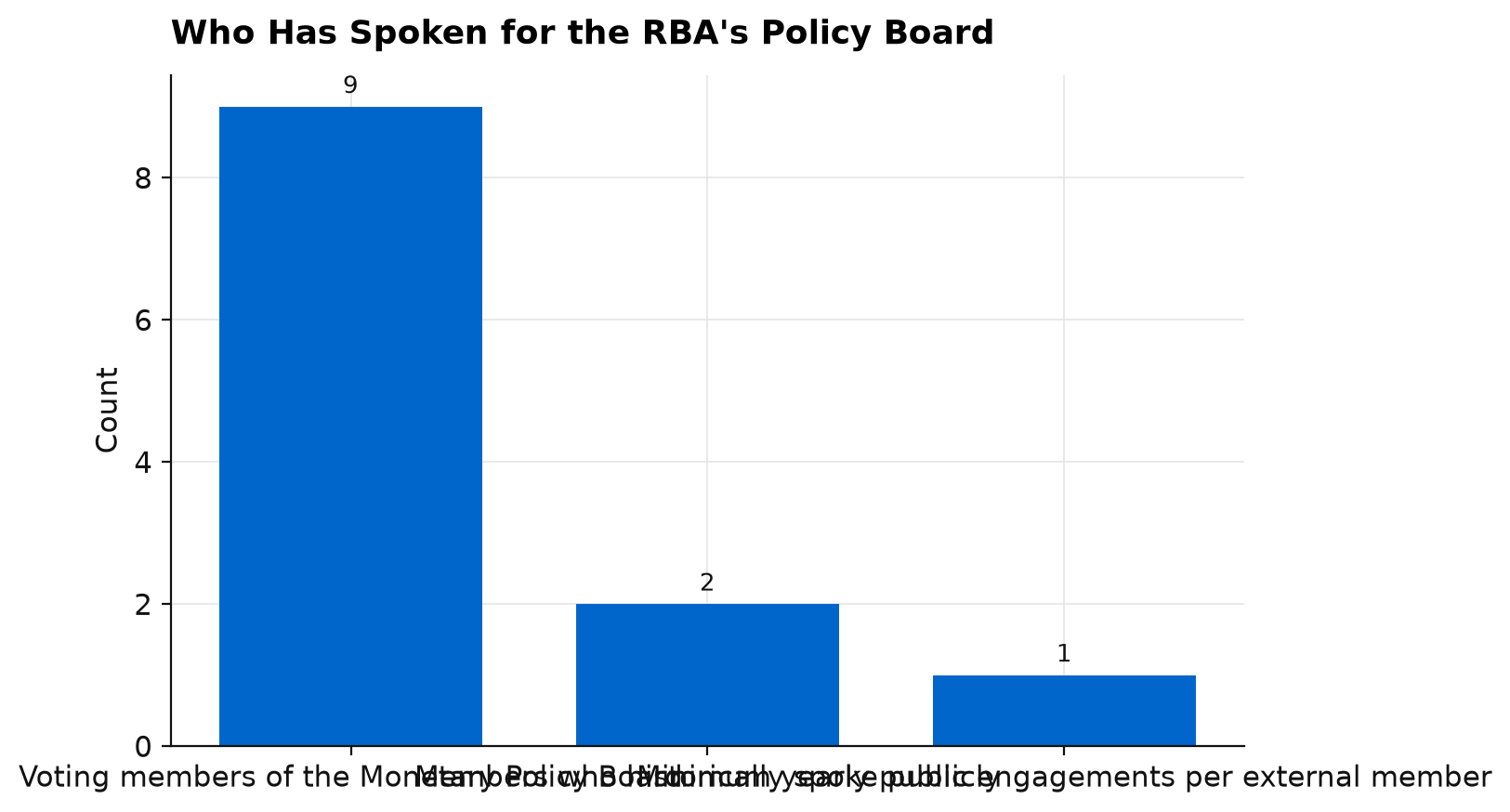
The Review, published in April 2023, said the Bank needed to keep improving how it communicates its decisions and strategy. The RBA has since created a Communications Department and Chief Communications Officer, widened its outreach to media and stakeholders, and committed external board members to public speeches or engagements each year. Statements grew longer after the Review before being trimmed back recently, and since February 2024 the Governor has held a post-meeting press conference. Unscripted formats such as fireside chats are also more common.
To test whether this extra communication carries information, the research built three tone measures. The first is a dictionary approach, in effect a sophisticated word count of phrases such as “still-elevated inflation” (hawkish) or “subdued inflation” (dovish). The second is a specialised language model trained on central bank speeches and research, skewed towards the US Fed and the ECB. The third asks a modern large language model to score each statement from most dovish to most hawkish with no special training. Of the three, the modern model tracks actual cash rate changes most closely.
A Weak Guide to the Next Move
All three measures move with the cash rate, and for each the link to the direction of the next move is statistically significant, meaning it is unlikely to be chance. On the modern language model measure, a one standard deviation rise in hawkish tone (a typical-sized swing away from the average) is associated with a 12 per cent increase in the probability of a hike at the next meeting. Across the measures, the effect ranges from 3 to 12 percentage points, and the index only swings that far in roughly one-third of the period since 2010.
Once the RBA’s own inflation forecasts are allowed for, tone adds only marginal explanatory power. The research is cautious even about the modern model’s stronger result, because it may have been trained on data covering the same period, so its real predictive power is likely much lower.
The research also tracks the 1-year overnight indexed swap rate, a market price reflecting where traders expect the cash rate to average over the coming year, between 2pm and 3:30pm on decision days. Tone adds no significant signal beyond the cash rate decision itself, likely because most of what a statement says has already been absorbed from the flow of data.
In May 2026, Governor Bullock gave what the research reads as a materially dovish signal, explaining that three hikes to date had given the RBA “space” to pause and assess; the central bank model, built mostly on other banks’ language, misses RBA-specific phrasing like this. In August, the RBA judged that the Middle East conflict’s effect on inflation had been “less than expected”, which the research saw as material, yet the modern model mostly ignored it.
More Hedging Since the Review
Using the dictionary approach, the research finds hedging and uncertain language rising from early 2023, with evidence of a lasting shift (a structural break) towards the end of 2023, shortly after the Review. The rise persists after allowing for geopolitical risk and inflation’s distance from target, and a doubling in the frequency of uncertain language looks larger than those proxies would suggest.
The research attributes most of the gap to the RBA’s explicit shift away from forward guidance, meaning clear signals about where rates are heading, towards a data-dependent posture. Governor Bullock has said the RBA will be “guided by incoming data” and that “I’m not going to give forward guidance.” Market surprises on decision days have been larger on average in the post-COVID period, which the research puts down to a more uncertain world and to the RBA explaining decisions after the fact.
A rules-based approach to leveraged ETFs
See how our quantitative strategy works and who it suits.
Explore the strategyBecome an authorised representative
Advise your clients under an established AFSL without building your own. Choose AR or CAR.
Become an AR or CARMore Policy Voices Beyond the Governor
The Bank’s new semi-annual community survey shows high trust but gaps in understanding how interest rates curb inflation. Only 29 per cent of respondents recognise the full employment side of the RBA’s dual mandate, its job of pursuing both stable prices and full employment. Flesch-Kincaid readability scores, based on sentence length and syllables per word, still sit at a university-graduate level.
The historical pattern of the Governor and Deputy Governor speaking for the Monetary Policy Board is also giving way to public engagements by external members. The research expects this to reach a wider audience but warns the message could fragment. Markets read Deputy Governor Hauser’s remarks in early March 2026 as hawkish, and Governor Bullock later corrected that reading.
What It Means for Investors
On this research, statement wording is a weak guide to both the next move and the day’s market reaction. Holders of cash, term deposits and bonds, whose returns track the cash rate path most directly, may learn more from the inflation and jobs releases the RBA says it is guided by, including the trimmed mean measure of underlying inflation it forecasts, than from the wording of its statements.
Short-term interest rates, the AUD and rate-sensitive parts of the ASX can move more sharply around meetings now that the RBA gives no forward guidance. The post-meeting press conference and the monetary policy section of the Minutes explain each decision, though unscripted remarks should be treated with caution, as the March 2026 episode showed.
Key Risks
The rise in hedging overlaps with higher geopolitical risk and an inflation overshoot, so cause and effect are hard to separate. Language tools still struggle with central bank qualifiers, and the modern model’s results may be flattered by hindsight. A more decentralised set of RBA voices could produce more misreadings like March 2026, adding volatility around speeches as well as decisions.
Where We Land
We think RBA statement wording adds little to the decision and the data. For retail and SMSF investors, we suggest tracking the inflation and jobs data the RBA tracks, allowing for bigger moves on decision days, and waiting for the Board’s actions before acting on any single speech.
This article is general information only and does not take into account your objectives, financial situation or needs.
Interested in how we can help? Get in touch with our team.
Become an authorised representative
Advise your clients under an established AFSL without building your own. Choose AR or CAR.
Become an AR or CAR