

Last updated: 6 November 2026. Outlook refreshed when new sell-side notes or material market moves warrant, not on a fixed cadence.
Table of contents [hideshow]
Defense spending in the United States is being redirected toward drones, counter-drone systems, space and a large push to restock munitions. That is the message from institutional sell-side research, drawn from meetings with 14 companies at the 2026 AUSA defense conference, ranging from large defense contractors to smaller defense-technology firms and government IT providers. The starting point is a base budget of $1.15 trillion for fiscal 2027, with most industry participants expecting a small amount of extra spending on top.
The research does not expect that budget to grow quickly from here, given how high the base already is.
About the Aerospace & Defense Sector
The companies in the note sell mainly to the US defense department, referred to in the note as the DoW, and to the Army, Navy and Marine Corps. They fall into four groups. Large-cap defense contractors are often called primes, because they hold the main contract on a program and manage the suppliers beneath them. Small and mid-cap defense companies include specialist suppliers to those primes. Defense-technology firms focus on newer areas such as autonomy, software and space. Government IT providers deliver technology services to defense customers. Funding comes from the annual base budget, $1.15 trillion for fiscal 2027, plus any reconciliation or supplemental spending, which are separate legislative routes for adding money on top of the base.
A Big Budget That Grows Slowly From Here
Most participants at the conference expect further growth beyond fiscal 2027 because capability needs remain high, but at slow rates of change given the high base and difficult comparisons. With a starting base of $1.15 trillion, even solid demand adds only modest growth in percentage terms.
Timing is also a live issue, as the US government has been operating under a continuing resolution since 1 October. A continuing resolution is a stopgap that keeps the government funded without passing a new full-year budget, and the note says it could affect program schedules, though it is still too early to gauge. One defense company noted that upcoming midterm election results may change the size and shape of the fiscal 2027 budget, including the balance between the base budget and reconciliation, while staying confident that near-term drone programs remain funded given bipartisan support for unmanned aircraft. That company, Aevex, reported about $175mn of orders in the third quarter, more than in the whole first half of 2026.
Cheap, Unmanned and Made in Volume
The note lists the priority spending areas as unmanned systems, counter-UAS, space, electronic warfare, hypersonics and munitions restocking, both exquisite and low cost. UAS stands for unmanned aircraft systems, so counter-UAS means equipment that detects and defeats drones. Electronic warfare means jamming or disrupting an opponent’s radio, GPS and communications. Hypersonics covers very high-speed missiles and the defenses against them.
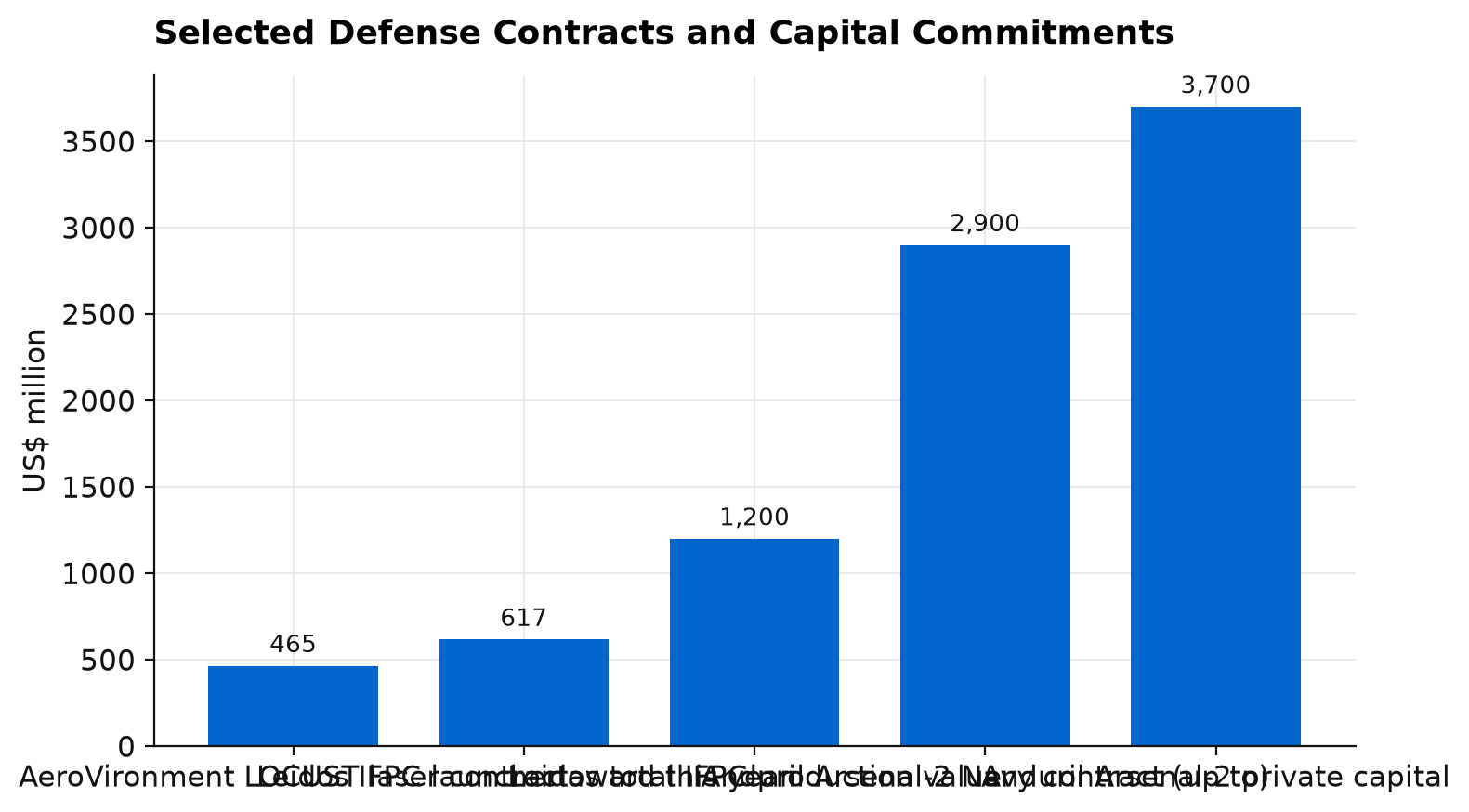
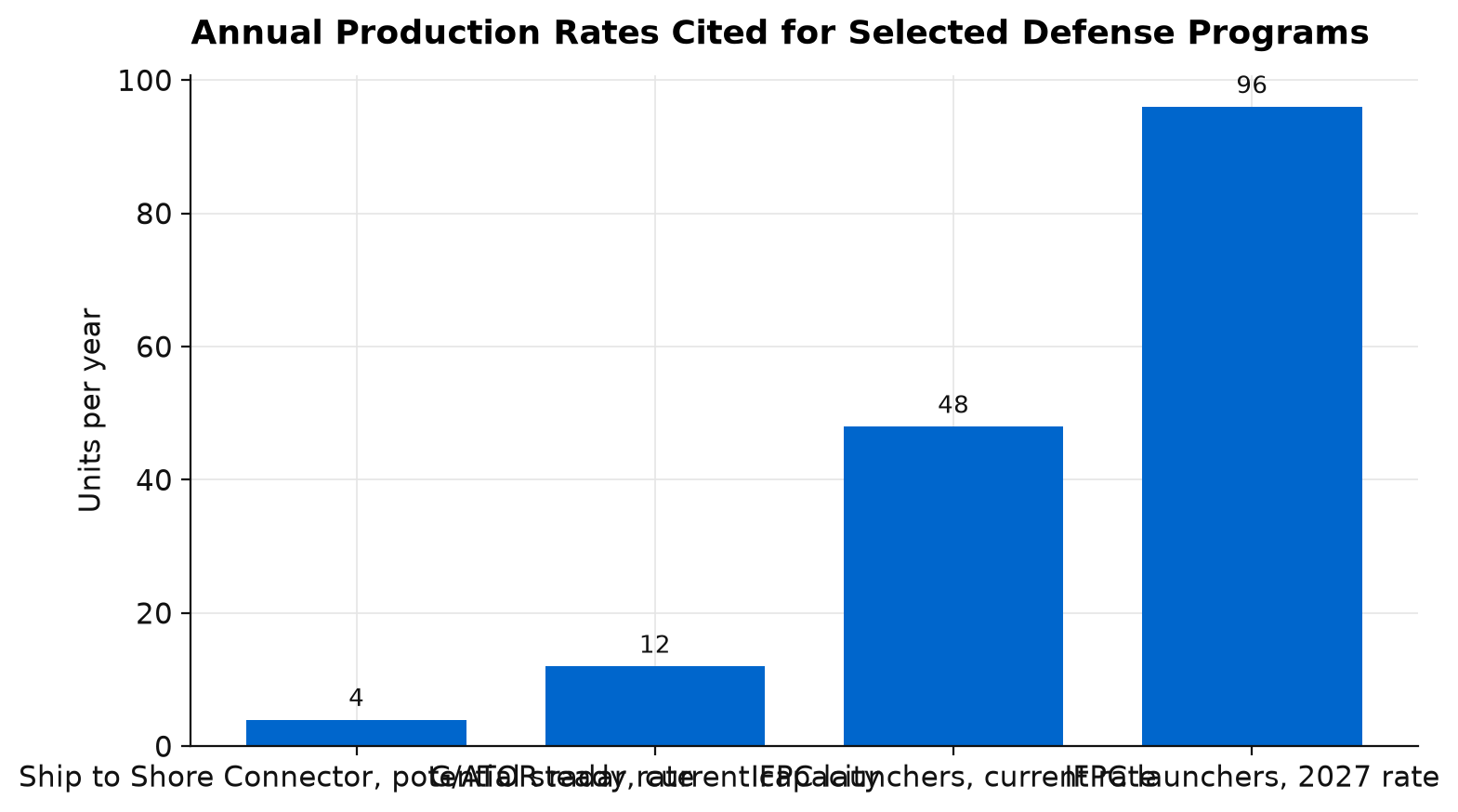
Across all of these areas, customers are prioritising attritable systems, meaning equipment cheap enough to lose in combat, and low-cost effectors, the weapons or devices that actually engage a threat. The government is aiming for low-cost munitions under $250k per unit, and the military wants low-cost interceptors priced in the low six figures. Anduril’s new Steelfin interceptor family aims to cost a third of the price of the PAC-3 missile. Leonardo DRS is developing uncooled infrared sensors that deliver about 80 to 90 per cent of a cooled sensor’s capability at about 10 per cent of the cost, with annual volumes expected above 100k, and recently booked an order for 50,000 drone camera units. Leidos is manufacturing 3,000 low-cost containerized munitions, starting production in 2027, aiming for under $500k per shot and with room to lift output above 5,000 a year if customer demand stays strong.
The research links faster growth and margin expansion to exposure to these priority areas and to the ability to operate commercial-style business models.
Industrial Base Constraints
The note describes defense primes ramping production across products, particularly missiles, with companies working to diversify supply chains in critical areas so they can substantially lift output. Ducommun, a supplier to the primes, said they have been less price sensitive than in past years as the focus shifts to supply security, and it expects munitions allocations to remain favourable even without top-line budget growth. It also noted that strong munitions demand still has to be converted into production contracts.
Kratos described propulsion as a bottleneck across the US missile industrial base and sees its propulsion business growing to multiples of its current size through the end of the decade. Teledyne said rare earths remain a bottleneck for gimbals, the stabilised camera mounts carried by drones, and it is seeking supply away from China. CACI believes the industry is unprepared for the high demand for gimbals.
Leonardo DRS has lifted capital spending from 2.0 to 2.5 per cent of revenue to about four per cent as it invests in manufacturing capacity and inventory. The Navy is funding facility expansion to shorten a steam turbine generator lead time of about six to seven years. Anduril is building Arsenal-2, a 187-acre shipyard in Baltimore that will make components for the Virginia-class submarine, with initial operations expected in 2030.
Software and Space
Beyond hardware, the Army’s Next-Gen Command and Control effort aims to connect networks, applications and hardware from across the force under a common software architecture. Anduril cited a howitzer firing process that fell from about two hours to about four minutes after integrating its Lattice software, and said its body-worn Voyager compute business has doubled year on year and been sold into more than 10 countries.
In space, HawkEye 360, a satellite data company, aims to cut revisit rates (how often a satellite passes over the same area) and data latency (the delay before data reaches the customer) to 10 minutes from about 30 to 40 minutes over the next two to three years. Its Block III satellites are 75 per cent less capital intensive to produce than Block II, and it reports growing demand from the Middle East, Eastern Europe and the Indo-Pacific given conflicts in those regions. Kratos says hypersonic programs are inflecting as the defense department focuses on offensive hypersonic capability and defenses against it.
Tools for Aerospace & Defense Exposure
ITA, the iShares U.S. Aerospace & Defense ETF, gives broad, unleveraged exposure to the theme. It tracks the Dow Jones U.S. Select Aerospace & Defense Index at 1x, long and vanilla, meaning no leverage and no daily reset. It suits an investor who wants sector exposure over a longer horizon and accepts that the fund moves with the whole index.
DFEN, the Direxion Daily Aerospace & Defense Bull 3X ETF, offers 3x daily long exposure to the same index. Because it resets every day, its result over weeks or months can differ sharply from three times the index move. In a choppy market that rises and falls without a clear trend, daily compounding erodes value, an effect known as volatility decay, so DFEN suits short directional views. MFAM trades DFEN inside its systematic equity strategy, which sets clear entry, sizing and exit rules.
Catalysts to Watch
The fiscal 2027 budget process comes first: how long the continuing resolution lasts, whether reconciliation or supplemental spending arrives on top of the $1.15 trillion base, and how the midterm election results shape the balance between the two. Suppliers are watching munitions funding in the 2027 reconciliation bill.
Among program milestones, slides published by GE point to first proof of flight for Beta Technologies’ MV250 aircraft in the fourth quarter of 2026, with early production possibly slipping to 2027 or 2028. The Army’s XM30 vehicle down select, where it chooses between competing designs, is expected in mid to late 2027. Northrop Grumman is under contract to deliver two IBCS air defense prototypes by June 2027. Teledyne expects full rate production of its Black Recon drone system in 2028, and Anduril aims for full rate Steelfin production in late 2028 or early 2029.
Key Risks
A prolonged continuing resolution, delayed approvals to move money between programs, or a midterm result that reshapes the fiscal 2027 budget could slow program schedules, and growth beyond fiscal 2027 is expected to be slow given the high base.
On the sector side, the note flags new entrants taking market share, operational execution, the capital intensity of product development and manufacturing, supply bottlenecks in propulsion and rare earths, and the gap between strong munitions demand and signed production contracts.
The research also names premium valuation among the key risks in its coverage, and where expectations are high, a delay or cut in a priority program matters more for the companies most exposed to it.
Where We Land
We are constructive on the theme, though slower budget growth and funding delays will make progress uneven. Over a longer horizon, a broad unleveraged fund such as ITA is the better tool, and DFEN is for short tactical trades with clear rules.
If you would like to discuss Aerospace & Defense exposure, request a callback or call us on 1300 889 603.
ETF Universe
- ITA · iShares U.S. Aerospace & Defense ETF · 1x Dow Jones U.S. Select Aerospace & Defense Index, long, vanilla
- DFEN · Direxion Daily Aerospace & Defense Bull 3X ETF · 3x daily long Dow Jones U.S. Select Aerospace & Defense Index
Note. Leveraged ETFs are designed for daily directional exposure and exhibit volatility decay over multi-day holding periods. They are appropriate inside a systematic trading framework with defined entry, sizing, and exit rules, not as buy-and-hold instruments.