

Last updated: 20 November 2026. Outlook refreshed when new sell-side notes or material market moves warrant, not on a fixed cadence.
Table of contents [hideshow]
- 1. About the Permian Basin
- 2. Growing Free Cash Flow Per Share
- 3. Consolidation Continues With Oil Prices Elevated
- 4. From Acquisitions to Organic Development
- 5. Flexible Share Buybacks
- 6. Gas, Water and the Data Centre Opportunity
- 7. Tools for Energy Exposure
- 8. Catalysts to Watch
- 9. Key Risks
- 10. Where We Land
- 11. ETF Universe
- 12. References
Institutional sell-side research on the Permian Basin puts free cash flow per share at the centre of how it judges US oil producers. That is the cash a producer has left after paying for its wells and running costs, divided by the number of shares on issue. One producer, Permian Resources, lifted that figure from US$0.88 in 2Q26 to US$0.98 in 3Q26, in a quarter when the oil price was lower.
The research covers producers still buying acreage while oil prices are high, a shift toward developing land companies already own, share buybacks stepped up when a company’s own shares are weak, and new sources of cash from natural gas and water infrastructure. In each case it looks at what the change does for free cash flow per share.
About the Permian Basin
The Permian Basin is a US oil and gas region that includes the Midland Basin, centred on Midland, Texas, and the Delaware Basin. The companies that drill there are known as E&Ps, short for exploration and production companies. Their income depends on how much oil and gas they produce, the price they receive, and what it costs to drill and operate wells. The research focuses on two of them, Permian Resources and Diamondback Energy. It describes the basin as becoming more mature, and Diamondback points to a scarcity of acreage on the market that combines high quality resource, undeveloped locations and oil-focused economics. Some operators, Permian Resources among them, hold acreage on federal lands in New Mexico, where federal policy can affect operations.
Growing Free Cash Flow Per Share
Permian Resources’ management is focused on compounding free cash flow per share through the cycle, which means growing it on top of earlier growth, year after year. In 3Q26, free cash flow per share rose even though oil was cheaper than in 2Q26, and the research sees the business as well positioned to keep growing it.
The research points to four sources of further growth: strong oil production, further gains in operating efficiency, a meaningful pickup in natural gas sales, and continued success with the company’s ground game, the steady work of adding and trading smaller parcels of acreage.
Consolidation Continues With Oil Prices Elevated
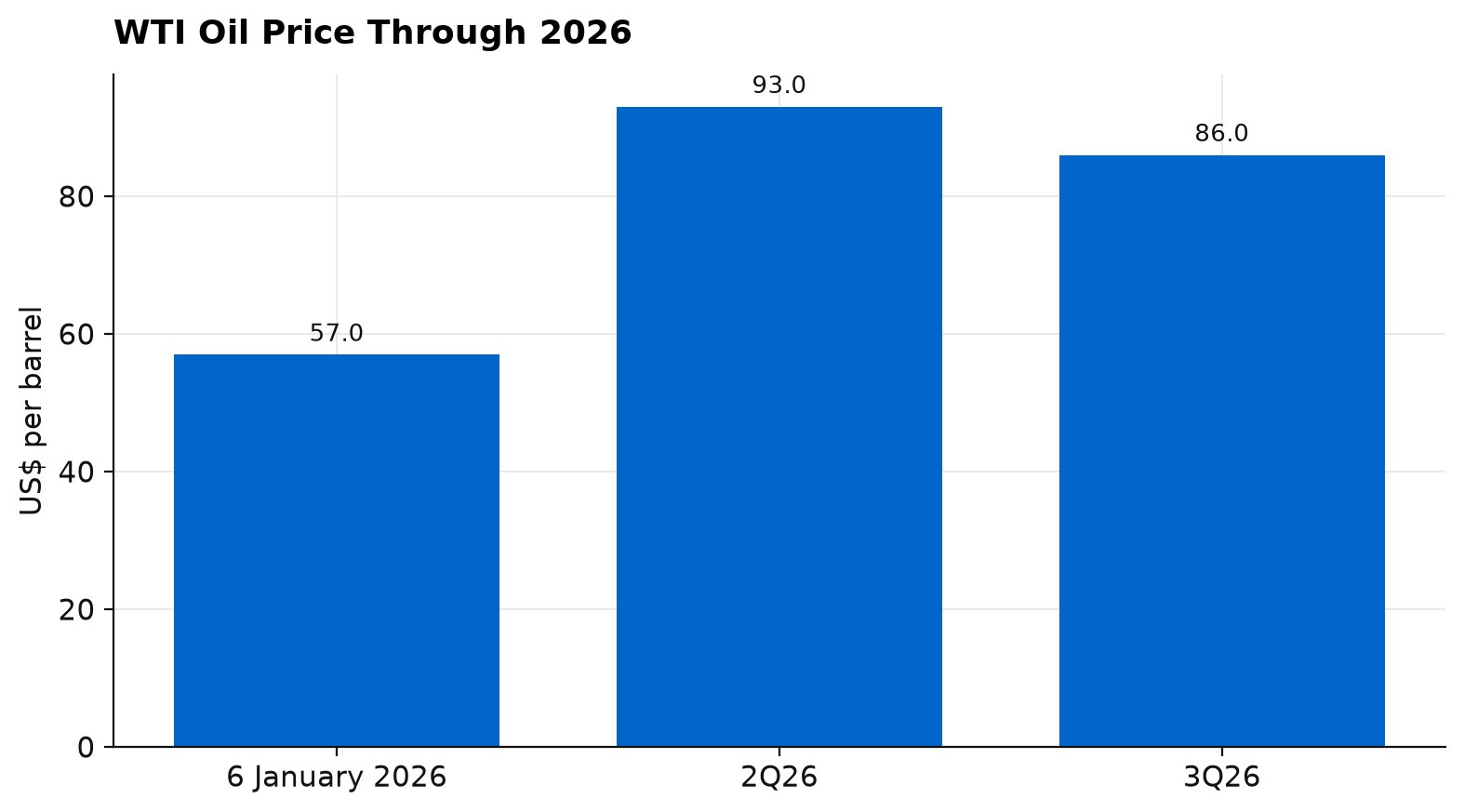
Acquisitions usually get harder when oil is expensive, because sellers want more for their acreage and the numbers are harder to make work for the buyer. In January, with oil at the low point shown in the chart above, Permian Resources said it was willing to consolidate the Delaware Basin in softer markets. Prices then rose, yet by its 3Q26 earnings the company had announced about US$2.20 billion of transactions year to date.
On the Ridge Runner transaction, management said flexibility in the payment structure helped finalise the agreement. The deal uses contingent payments, which are extra amounts paid to the seller later if oil prices end up higher, so both sides share in any upside. Management also highlighted the affiliated royalties business included in the deal. A royalty is a share of production revenue, so owning it lifts the company’s net revenue interest, the share of each well’s revenue it keeps. Permian Resources sees 3-5 years of further consolidation opportunities in the Delaware Basin.
From Acquisitions to Organic Development
At Diamondback Energy, the research expects a greater focus on organic development, meaning drilling acreage the company already owns, after a decade of growth through corporate acquisitions that most recently included Endeavor Energy. Management pointed to the scarcity of high quality, oil-focused acreage on the market and to the depth of the position it has already built, which supports more organic development over the next decade.
Management said organic opportunities such as the Barnett offer upside over a longer period as development costs come down, while noting that this acreage has to compete for capital with the rest of the company’s portfolio. Diamondback released productivity data alongside its 3Q26 earnings, and a research chart compares the oil productivity of its Midland wells in the first 9 months of 2026 with peer wells, finding its execution improving even as the basin matures.
Flexible Share Buybacks
Alongside its 1Q26 earnings in May, Diamondback changed how it returns cash to shareholders. It removed its target of returning a set percentage of free cash flow and gave management more flexibility for counter-cyclical share repurchases, which means buying back more stock when the share price is weak. Management reiterated that it is willing to buy back stock opportunistically when the shares screen as cheap on the company’s own internal metrics.
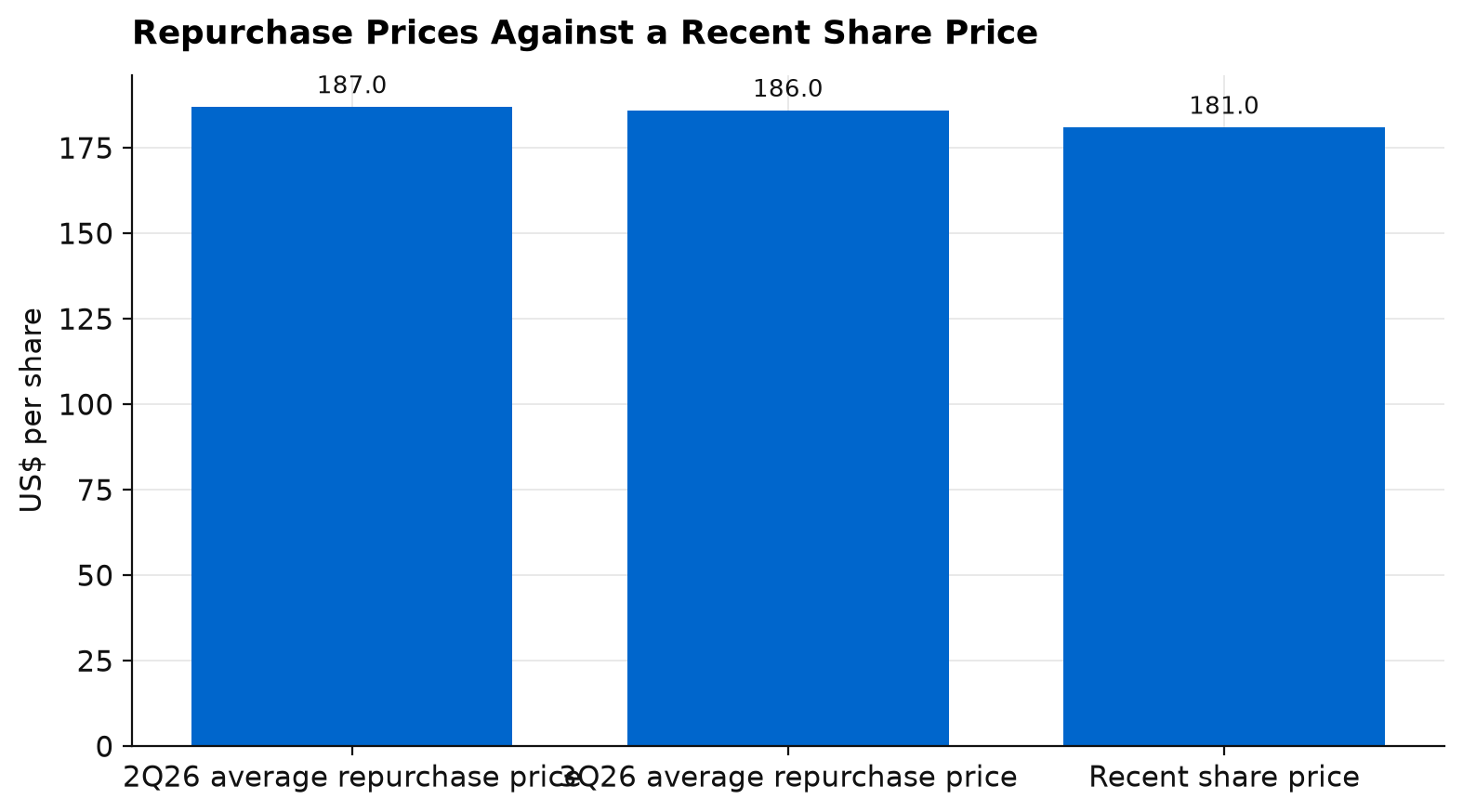
Diamondback has a history of stepping up buybacks when its shares are out of favour, and it bought back stock in both 2Q26 and 3Q26. The research says the flexible framework has allowed prudent capital allocation while oil prices have been high.
Gas, Water and the Data Centre Opportunity
Natural gas is a growing source of cash for Permian producers. The research expects improving gas realisations, meaning the price a producer actually receives, to support a turn higher in cash flow across the basin, measured as natural gas sales net of processing costs.
Diamondback has also announced a partnership with KKR to jointly acquire Five Point Infrastructure’s 70 per cent stake in Deep Blue, a water infrastructure business in the basin. Management sees KKR as a strong partner for easing limits on water handling in the basin, and sees more control over Deep Blue as an advantage of the pending structure. More broadly, Diamondback is building the capabilities to become an all-encompassing partner for data centre customers by owning more of the infrastructure in the basin, which would give it customers beyond the traditional oil and gas market.
Tools for Energy Exposure
XLE, the State Street Energy Select Sector SPDR ETF, gives broad exposure to large US energy companies. It provides 1x long exposure to the Energy Select Sector Index, meaning it aims to rise and fall in line with that index. With no leverage and no daily reset, it suits a longer holding period.
ERX, the Direxion Daily Energy Bull 2X ETF, aims to deliver two times the daily move of the Energy Select Sector Index. Because the fund resets its leverage each day, its return over several days can stray well away from two times the index move. In choppy markets, where the index swings up and down without trending, that daily reset erodes value, an effect known as volatility decay, so ERX suits short-term tactical views. MFAM trades ERX inside its systematic equity strategy, which sets clear entry, sizing and exit rules.
Catalysts to Watch
After the recent mid-term elections, investor attention on federal lands risk in New Mexico could increase. The research’s base case is that policy has limited impact on value, and it is more confident that the value of oil and gas businesses on federal lands will not be materially affected.
Oil and gas prices also matter, including WTI, the main US benchmark oil price, and natural gas realisations, because the case rests on producers growing cash per share across different price environments. Further catalysts include deal flow, such as more Delaware Basin consolidation, completion of the pending Deep Blue structure and the wider M&A market for scarce acreage, and well productivity, including Barnett development and Midland results against peers.
Key Risks
Commodity price volatility is the first risk the research names, since a sharp fall in oil or gas prices would pressure cash flow however disciplined a producer is. Government pronouncements are the second, particularly any change affecting operations on federal lands in New Mexico after the mid-term elections.
The research also names costs and well results as risks. Organic projects such as the Barnett rely on development costs coming down over time, and weaker well results in a maturing basin would mean less oil for each dollar spent on drilling. High oil prices also make acquisitions harder to make work, which could slow further consolidation.
Sentiment can also weigh on individual producers for reasons beyond operations. The research notes that Diamondback’s shares have lagged this year on M&A concerns and a shareholder overhang, meaning the risk that a large existing investor sells down its stake.
Where We Land
We are constructive on the energy theme as the research frames it. The producers it covers are growing cash per share, still consolidating when the numbers work, and buying back more stock when their shares are weak. Over a longer horizon, a broad unleveraged fund such as XLE is the better tool, and ERX is for short tactical trades with clear rules, since the oil price will still swing these shares in both directions in the short term.
If you would like to discuss Energy exposure, request a callback or call us on 1300 889 603.
ETF Universe
- XLE · State Street Energy Select Sector SPDR ETF · 1x Energy Select Sector Index, long, vanilla
- ERX · Direxion Daily Energy Bull 2X ETF · 2x daily long Energy Select Sector Index
Note. Leveraged ETFs are designed for daily directional exposure and exhibit volatility decay over multi-day holding periods. They are appropriate inside a systematic trading framework with defined entry, sizing, and exit rules, not as buy-and-hold instruments.