

Last updated: 23 October 2026. Outlook refreshed when new sell-side notes or material market moves warrant, not on a fixed cadence.
Table of contents [hideshow]
- 1. About the US Tech Theme
- 2. AI Is Prompting Software Consolidation
- 3. Proprietary Data Is Gaining Value
- 4. Enterprises Are Adopting AI Faster Than Small Business
- 5. Dependence on Shopify and Palantir
- 6. Tools for US Tech (Nasdaq-100) Exposure
- 7. Catalysts to Watch
- 8. Key Risks
- 9. Where We Land
- 10. ETF Universe
- 11. References
A sector note from institutional sell-side research, published on 16 October 2026, argues that AI is making US software spending more selective. Looking at two US marketing software companies, the research finds that businesses are trimming overlapping software to free up money for AI, and that the vendors gaining ground are the ones with hard-to-copy data and large enterprise customers. The share prices already reflect the split. One of the two companies is up 65 per cent this year, while the other is down 44 per cent.
The note covers two US marketing software companies, not the Nasdaq-100, but the same question applies to software stocks in the index: do software businesses keep their moats, the competitive advantages that protect their profits, once AI arrives?
About the US Tech Theme
The research covers what it calls emerging software, younger listed companies that provide marketing and customer engagement tools. The two businesses help companies reach consumers through email, mobile, web, social and connected TV, and are adding AI agents, software that can carry out a task such as drafting a campaign or answering a customer query on its own. One serves mainly large enterprises and agencies, combining marketing and advertising in one platform. The other has traditionally served small and medium-sized businesses (SMBs) in eCommerce, with 78 per cent of its annual recurring revenue (ARR, the yearly value of its subscription contracts) coming from customers that are Shopify merchants.
AI Is Prompting Software Consolidation
According to the research, industry conversations suggest enterprises are prioritising AI investment and looking hard at where existing software spend can be consolidated. As companies make room for AI, they are asking which products remain strategic and where overlapping tools can go.
Managing campaigns across separate products for data, decisions and execution is operationally complex, and AI needs a shared view of the customer to work well. That pushes customers toward fewer, more integrated platforms. Zeta, one of the companies in the note, has said its initial implementations can consolidate eight to twelve vendors. The research argues that with data, identity, campaign execution and measurement on one platform, AI can optimise across more of the workflow.
As enterprises move from testing standalone agents to running AI in live production, governance, shared context and connections between systems become requirements. For investors, AI can shrink the number of tools a customer pays for, which favours broad platforms and squeezes single-purpose ones.
Proprietary Data Is Gaining Value
According to the research, without data AI cannot tell a marketer who a consumer is or what they will do. The quality of an agent’s recommendations depends on the context it is given.
Zeta’s dataset is the note’s example. It covers more than 240mn US consumers, around 70 per cent of the population, with thousands of indicators per person updating in real time. No single source contributes more than a third of the data, and around 80 per cent comes from networks the company owns or operates, such as its email infrastructure and advertising platforms.
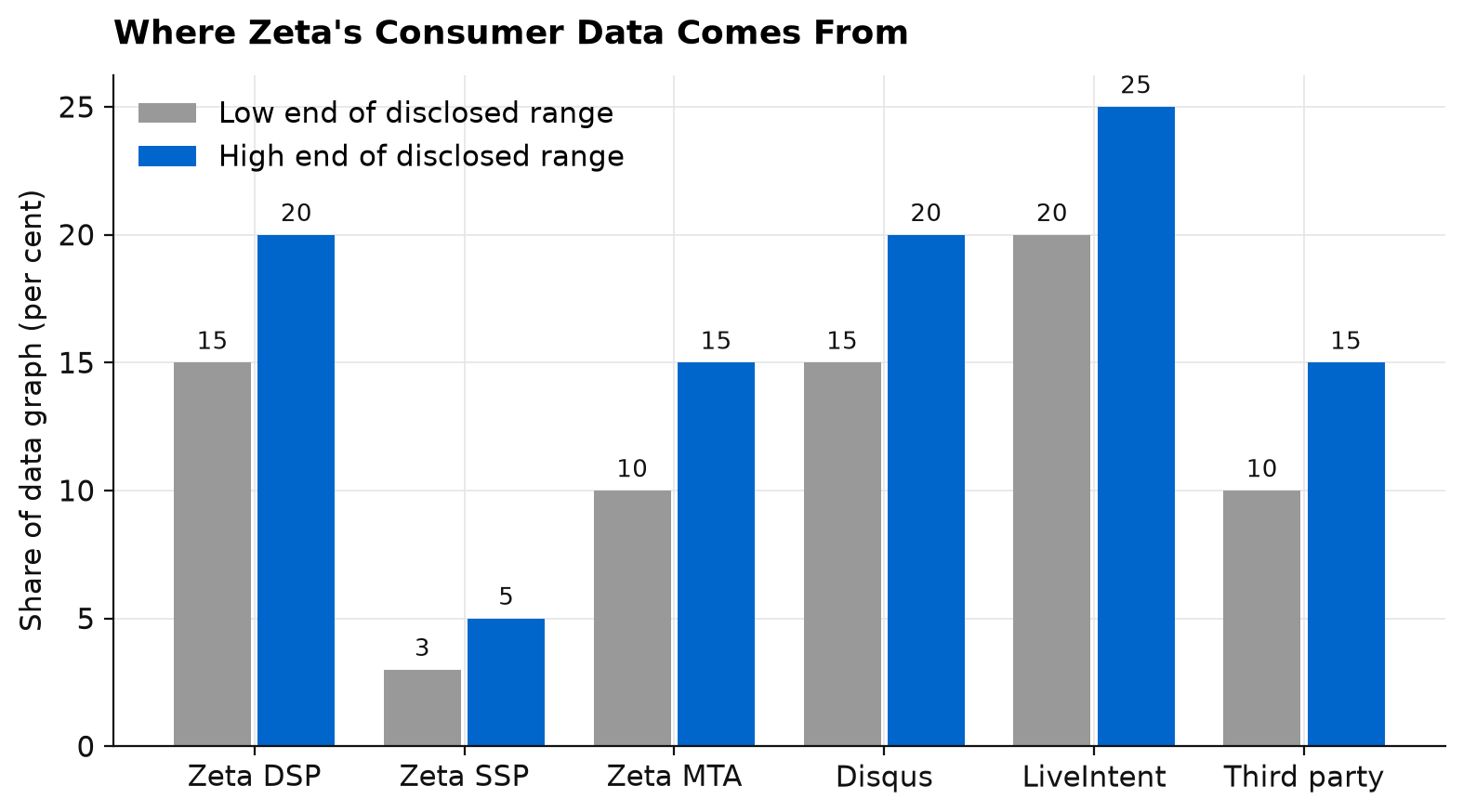
Owning the networks that feed the data makes it harder to replicate than a dataset bought from third parties, and the spread of sources reduces reliance on any one provider. That is increasingly important as browser identifiers and other third-party data become less reliable. The research notes a heavier regulatory and governance burden. The value of this kind of data depends on evidencing consent, tracking where data came from, and handling opt-outs and deletions as privacy rules evolve.
Enterprises Are Adopting AI Faster Than Small Business
Industry conversations cited by the research suggest enterprises are deploying AI more systematically than SMBs. Larger organisations are more likely to have dedicated AI budgets, implementation teams, and existing software or labour costs they can consolidate. Smaller businesses have fewer staff and less spare technology budget, so they experiment more before committing. Where money is available, they often favour general-purpose AI tools over new specialist applications.
Klaviyo, the second company in the note, shows how this plays out. Around 60 per cent of its ARR comes from customers below $50k in ARR, so its SMB exposure is significant. Its larger customers are growing quickly, with customers above $50k of ARR reaching 4,477 in 2Q26. Usage of its AI tools is strong too. Composer, an agent that produces full campaigns from a single prompt, passed 95,000 users within its first month and reached 138k users by the company’s K:BOS event, and 27 per cent of mid-market and enterprise customers are already users. Its Customer Agent has exchanged more than 1.3 million messages.
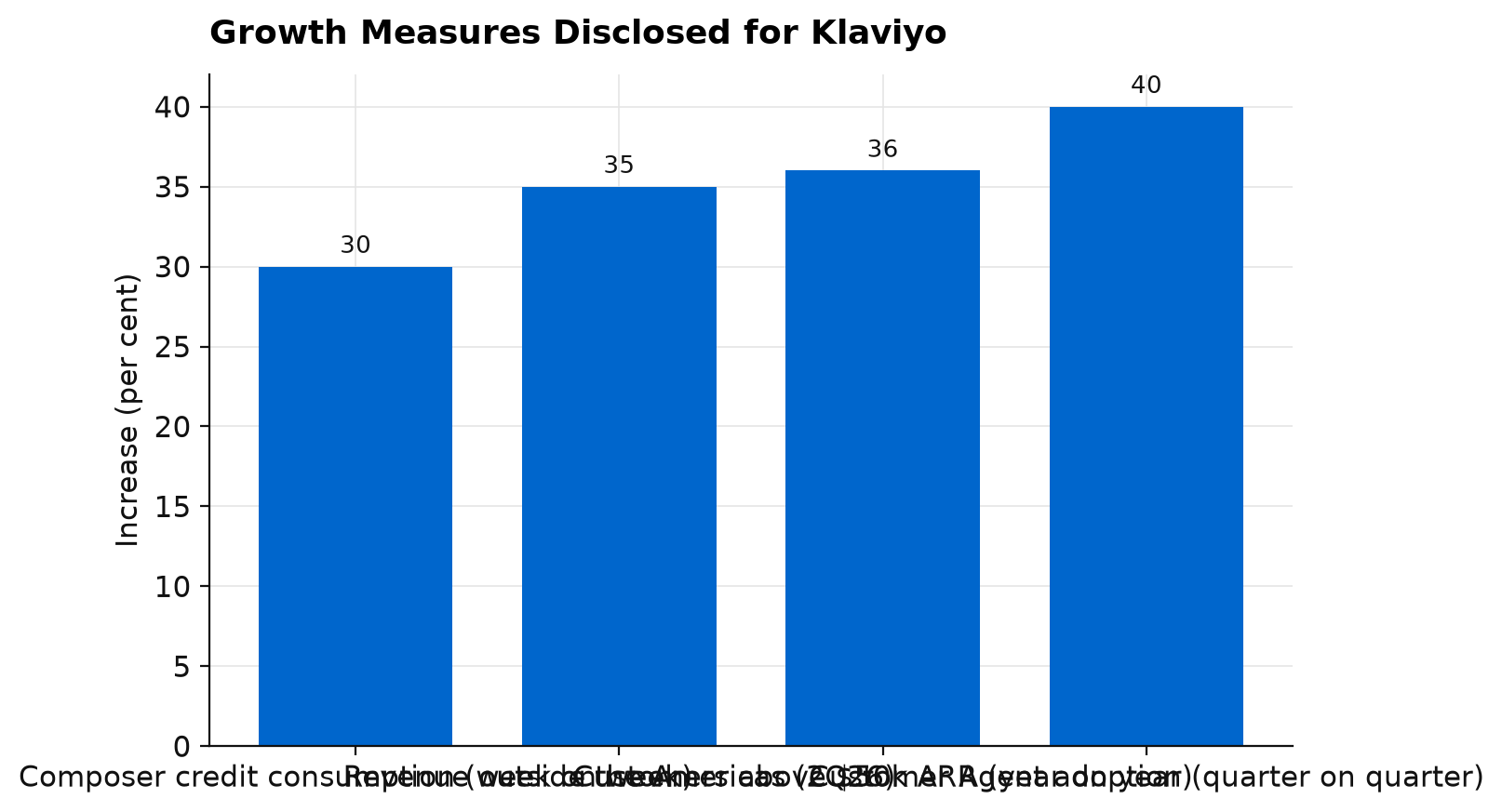
The research frames this as a debate about the timing and size of monetisation. Usage is high, but there is limited visibility into how much customers will pay for agents, so software firms focused on smaller businesses may be paid later.
Dependence on Shopify and Palantir
Klaviyo has a deep integration with Shopify and is its recommended email solution for Shopify Plus customers. Their partnership agreement became effective in July 2022 with a seven-year initial term through 2029. Around 78 per cent of Klaviyo’s ARR at the end of 2025 came from customers that also used Shopify, yet only 7 per cent of new ARR in 2025 came through the Shopify app store. Meanwhile, Shopify keeps investing in its own email marketing and in Sidekick, which can now create customer segments, edit emails and set up promotions. The research still sees the relationship as a net advantage today, but notes that investors are debating future product overlap.
Zeta is moving its Data Cloud onto Palantir Foundry, and management has highlighted early pilots that are larger than Zeta’s typical pilots. Management believes the partnership can generate more than $100mn in annual revenue in coming years. The research cautions that it is still early and that the deal gives no automatic distribution across Palantir’s customer base.
Tools for US Tech (Nasdaq-100) Exposure
For broad exposure to US tech, the simplest tool is QQQ, the Invesco QQQ ETF. It offers 1x long exposure to the Nasdaq-100 Index in a simple structure. QQQ holds the whole index, so it owns the software companies that gain from AI and the ones that lose.
TQQQ and SQQQ are leveraged ETFs. TQQQ, ProShares UltraPro QQQ, offers 3x daily long exposure to the Nasdaq-100 Index, and SQQQ, ProShares UltraPro Short QQQ, offers 3x daily short exposure, with the multiple applying to a single day’s move only. Over longer periods, and especially in choppy markets where the index swings up and down, that daily reset causes volatility decay, meaning the fund can lose value even when the index ends roughly where it started. They suit short-term directional views.
MFAM trades TQQQ and SQQQ inside its systematic equity strategy.
Catalysts to Watch
The note does not name dated index events, so the things to watch are the data its argument rests on. For the enterprise consolidation case, watch whether the Palantir pilots convert into paying deals, whether further joint wins are announced, and whether management gives more detail on deal size and time to implementation.
For the SMB side, watch paid attach rates for AI agents (how many customers add a paid agent product) and any sign of contract uplift. Klaviyo also faces a tougher 2026 comparison after enforcing contracted profile limits more consistently in 2025, so growth should read more cleanly once that is lapped. Updated mobile pricing passes higher carrier fees through to customers starting in 2H26, though management does not expect a material 2026 revenue benefit. Further out, the Shopify agreement’s initial term ends in 2029, after which it renews for one-year periods unless either side gives notice. Also track privacy regulation and platform data policy changes.
Key Risks
On macro and policy, these businesses depend on marketing volumes and consumer activity, so slower economic growth or pressure on consumer spending would hit channel volumes and SMB budgets. Stricter privacy rules on data collection or bulk email and SMS sending, or large platforms limiting data collection, would weigh on the data-led businesses the research favours most.
Big platforms can add native features that overlap with specialist software, as Shopify has done with its own email tools. Many SMB customers told the research they are price sensitive, so price competition can intensify quickly. Software firms pushing into adjacent areas also meet established data, analytics, planning and operational software vendors that already own those workflows and buyer relationships.
The research attributes the 65 per cent rally in one of the companies to positive earnings revisions (analysts raising their profit forecasts) and optimism about a partnership that is still early, with limited disclosed conversion and revenue data. The other company’s fall reflects investor concern about the durability of software moats.
Where We Land
We are constructive on US tech as a longer-horizon theme. For shorter, tactical views, the leveraged daily-reset funds fit only inside a rules-based framework, because volatility decay erodes value over long holds.
If you would like to discuss US Tech (Nasdaq-100) exposure, request a callback or call us on 1300 889 603.
ETF Universe
- QQQ · Invesco QQQ ETF · 1x Nasdaq-100 Index, long, vanilla
- TQQQ · ProShares UltraPro QQQ · 3x daily long Nasdaq-100 Index
- SQQQ · ProShares UltraPro Short QQQ · 3x daily short Nasdaq-100 Index
Note. Leveraged ETFs are designed for daily directional exposure and exhibit volatility decay over multi-day holding periods. They are appropriate inside a systematic trading framework with defined entry, sizing, and exit rules, not as buy-and-hold instruments.