

4D Molecular Therapeutics is a clinical-stage gene therapy company heading toward the most important event on its calendar: Phase 3 results for its lead therapy 4D-150 in wet age-related macular degeneration (wet AMD), due in 2Q27. Wet AMD is a chronic eye disease in which abnormal blood vessels leak under the retina. The standard of care is a long-running course of injections into the eye, which in real-world practice often means a visit every 6 to 7 weeks. 4D-150 is designed to replace that routine with a single treatment. Management has set out what a successful readout could look like: a gain of 5 to 7 letters on the standard eye chart test and a supplemental injection-free rate of 70 to 80 per cent, in line with what the company saw in its Phase 2 study. Institutional sell-side research has 4D Molecular Therapeutics rated Buy with a 12 month price target of US$32.00, about 148.6 per cent above the recent close of US$12.87. The thesis rests on three things. The first is a Phase 3 bar that looks achievable on the Phase 2 evidence. The second is a large market that has repeatedly rewarded longer-lasting treatments. The third is a second Phase 3 program, in diabetic macular edema, that is already enrolling. This is a loss-making biotech whose value hinges on clinical data, so the upside comes with a binary event attached.
Research published 16 October 2026. Price target and upside based on prices at time of publication.
Table of contents [hideshow]
About 4D Molecular Therapeutics
4D Molecular Therapeutics is a United States biotechnology company listed on the NASDAQ under the ticker FDMT. Its lead product, 4D-150, is a gene therapy for retinal disease. A gene therapy uses an engineered virus, called a vector, to carry genetic instructions into cells so that the cells make a therapeutic protein themselves. 4D-150 is built on the company’s proprietary R100 vector and instructs retinal cells to produce anti-VEGF, the class of drug that patients currently receive by repeated injection. The company has a Phase 3 program in wet AMD and has enrolled the first patient in a global Phase 3 trial in diabetic macular edema, where Asia-Pacific regional rights are partnered with Otsuka. Outside the eye, it has a cystic fibrosis program that management says gives it the option to advance into Phase 3. The R100 platform can also support different doses, payloads and new indications such as geographic atrophy.
Why the Phase 3 Bar in Wet AMD Looks Achievable
The first question to ask about any biotech that depends heavily on one asset is how high the bar is. Here, management argues the Phase 3 program has been built to give the Phase 2 result the best chance of repeating. The trial uses a traditional design. The comparator is Eylea (aflibercept 2 mg), the established anti-VEGF injection, given every two months as labelled. Anti-VEGF drugs block a growth signal that drives the leaky blood vessels in wet AMD, and they are the backbone of treatment today.
The design also reflects what actually happens in clinics. Although Eylea is labelled for dosing every 8 weeks, real-world patients often receive it every 6 to 7 weeks. To accommodate that, the trial allows supplemental Eylea rescue injections when a patient needs them. That sets up the two endpoints that matter. The primary endpoint is best-corrected visual acuity (BCVA), which in plain terms is how many letters a patient can read on a standard eye chart while wearing their best glasses or lenses. The secondary endpoint is the supplemental injection-free rate, the share of patients on 4D-150 who get through the study without needing an extra injection. Management sees potential for a visual acuity gain of 5 to 7 letters and a supplemental injection-free rate of 70 to 80 per cent, consistent with the Phase 2 PRISM study.
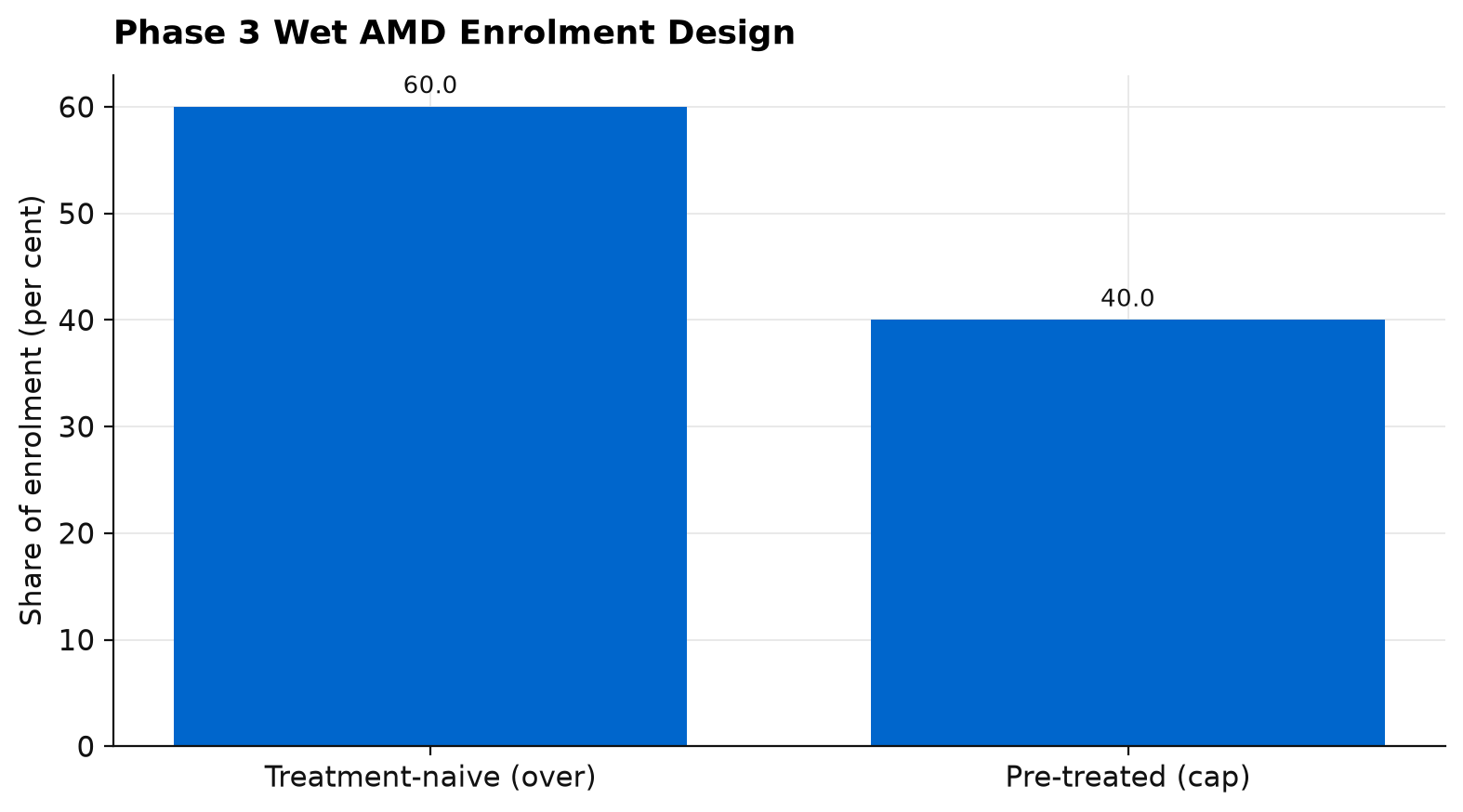
The patient mix is the part of the design that deserves the most attention. More than 60 per cent of patients enrolled will be treatment-naive, meaning people who have not yet been on the usual injection routine. The pre-treated group is capped at 40 per cent and limited to patients who have received up to 4 prior injections within 6 months of trial initiation. That matters because in Phase 2, recently diagnosed patients, defined as those diagnosed within about 6 months and used as a stand-in for the mostly treatment-naive Phase 3 population, achieved a superior reduction in treatment burden, in the high 80s in per cent terms.
The enrolment criteria have been tightened in other ways too. Baseline central subfield thickness (CST), a scan measurement of how swollen the centre of the retina is, is capped at 500 microns. That cap is designed to exclude patients with pigment epithelial detachments (PEDs), a type of lesion that has historically been harder to treat with standard anti-VEGF drugs. Put simply, the company has filled the trial with the kind of patient that responded best in Phase 2 and screened out a kind of patient that tends to respond poorly to standard therapy.
There is no guarantee of success. Phase 3 trials are larger, and results can differ from Phase 2. But the read-through from Phase 2 to Phase 3 looks more direct here than it often does, because the Phase 3 population has been chosen to resemble the Phase 2 subgroup that performed best. For a retail investor, the practical point is that the market is not being asked to believe in a new idea, only that a result already seen in a smaller study can be repeated in a bigger one.
Durability, Dose and Safety Make the Commercial Case
Management projects the anti-VEGF market for retinal indications alone will reach US$20 billion by 2030, driven by an aging population and improvements in how long each treatment lasts. That second driver is the one 4D-150 is built around. Management notes that each increase in durability has historically produced a step-change in care, and that there have been historically high rates of switching to therapies offering even incremental improvements in injection frequency.
The underlying problem is treatment burden. Retinal vascular diseases are chronic, so patients face injections indefinitely. Real-world data show that limited clinic capacity and patient fatigue leave most patients perpetually undertreated, and the high burden leads some to drop off therapy. 4D-150 aims to solve this with a single dose that establishes continuous disease control through sustained expression, meaning the treated retinal cells keep producing the anti-VEGF protein themselves. Clinical data to date show patients remaining injection-free for two years. Because retinal cells do not turn over, management expects the therapy to keep expressing anti-VEGF for the life of the patient. There is no plan to re-dose, although clinicians could later treat the fellow eye, since patients frequently develop wet AMD in both eyes.
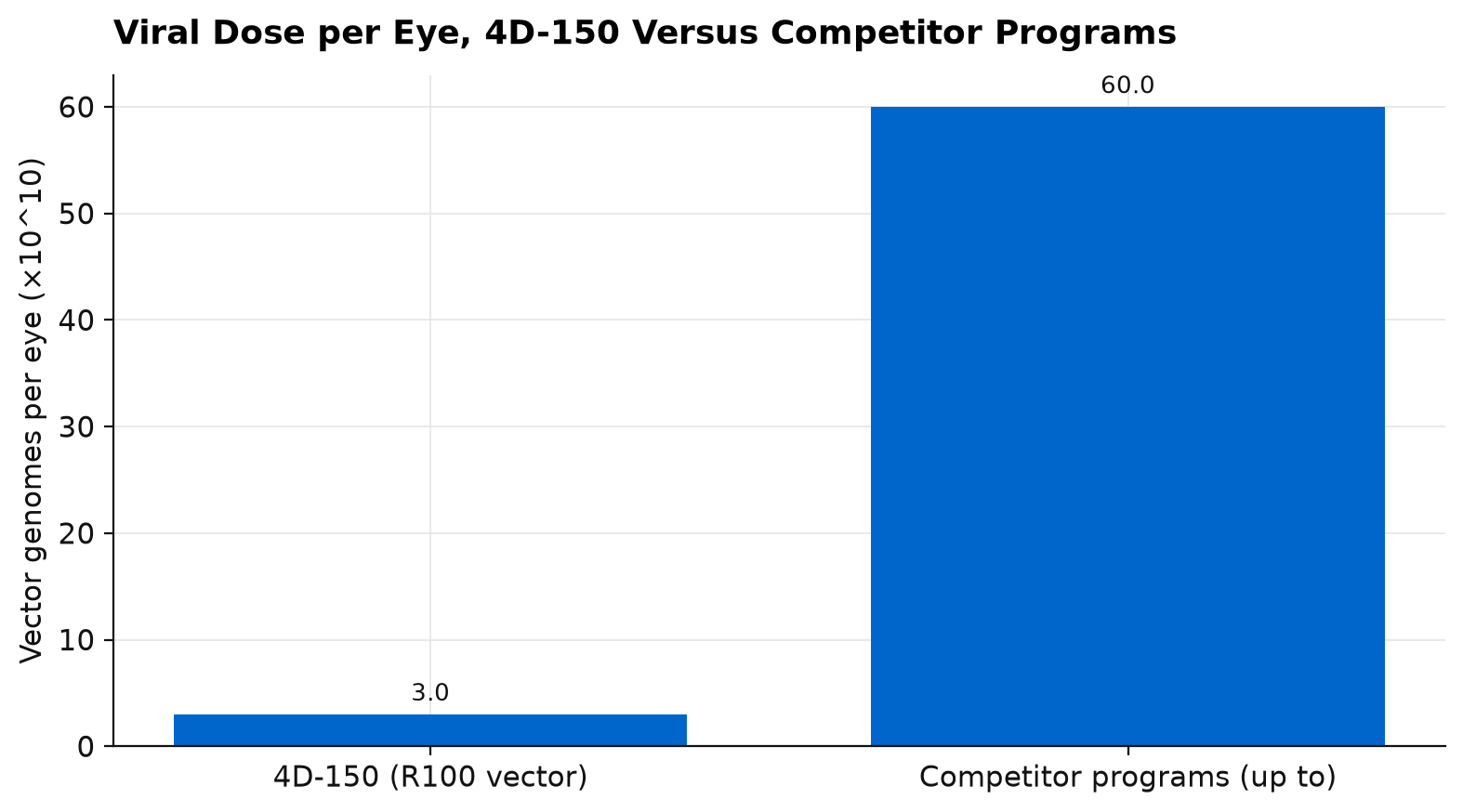
The competitive argument comes down to dose and safety. The company’s proprietary R100 vector was discovered using non-human primate models rather than mice, which management says yields highly specific targeting of retinal cells. Better transduction efficiency, meaning more of the delivered dose actually gets into the cells it is meant to reach, allows 4D-150 to use a significantly lower viral dose of 3×10^10 vector genomes per eye, compared with competitor programs that require doses of up to 60×10^10 vector genomes per eye. Management stresses the critical importance of balancing dose to achieve efficacy without triggering inflammation, because a higher viral load in the eye brings a greater risk of an inflammatory reaction.
That is not an academic point. Management says safety remains a key concern for leading retina specialists. On that front, 4D-150 has shown a favourable profile, with a mild intraocular inflammation (IOI) rate, meaning inflammation inside the eye, of 2 to 3 per cent, and patients successfully completing steroid prophylactic tapers, a short preventive course of steroids that is gradually stepped down. Management positions 4D-150 well on durability, safety and potency against tyrosine kinase inhibitors (TKIs), a type of small-molecule drug, and against other therapies in development, including the RGNX gene therapy RGX-314, which has Phase 3 data due in 4Q.
The 4Q readout for RGX-314 is a near-term marker. It will give the market a fresh look at a rival gene therapy in a late-stage trial before 4D-150 reports in 2Q27. A clean result could support the broader idea of gene therapy in wet AMD, while any inflammation issue could sharpen the dose contrast management is drawing. Either way, it is a data point investors will hear about well before the main event.
Our exclusive top 5 stock picks
Five high conviction stocks that didn't make the public list. Backed by institutional research. Subscribe for free access.
Thanks for subscribing, please check your email to confirm your subscription to instantly access your report.
Diabetic Macular Edema and the Platform Widen the Opportunity
Wet AMD is the lead indication, but it is not the only one. The company recently announced that the first patient has been enrolled in 4SIGHT, its global Phase 3 trial of 4D-150 in diabetic macular edema (DME). DME is swelling in the centre of the retina linked to diabetes, and like wet AMD it is treated with repeated anti-VEGF injections. Asia-Pacific regional rights are partnered with Otsuka. Management makes the point that DME patients are known to fall off chronic therapy much faster than wet AMD patients, which raises the medical need for a durable option.
Management views the DME trial as de-risked by two-year results from the Phase 2 SPECTRA study. At the Phase 3 dose, patients showed a mean visual acuity gain of +10.8 letters and a 176 µm reduction in central subfield thickness, alongside a 61 per cent reduction in treatment burden. In plain terms, patients read more letters on the eye chart, the swelling in their retina came down, and they needed far fewer injections. A second Phase 3 program running in parallel means the company is not wholly dependent on one trial in one disease, even if wet AMD remains the near-term focus.
Beyond these two programs, management describes the R100 platform as offering high optionality. It can support different doses, different payloads, meaning the genetic instructions the vector carries, and expansion into additional indications. Geographic atrophy (GA), another form of macular degeneration, is one that management views as highly suitable for gene therapy. For longer-term life-cycle management, the company is exploring a dual-action payload that could treat both wet AMD and GA at the same time. Outside the eye, the cystic fibrosis program helps support confidence in the vector platform, demonstrating localised delivery with lower systemic toxicity, and gives management the option to advance into Phase 3.
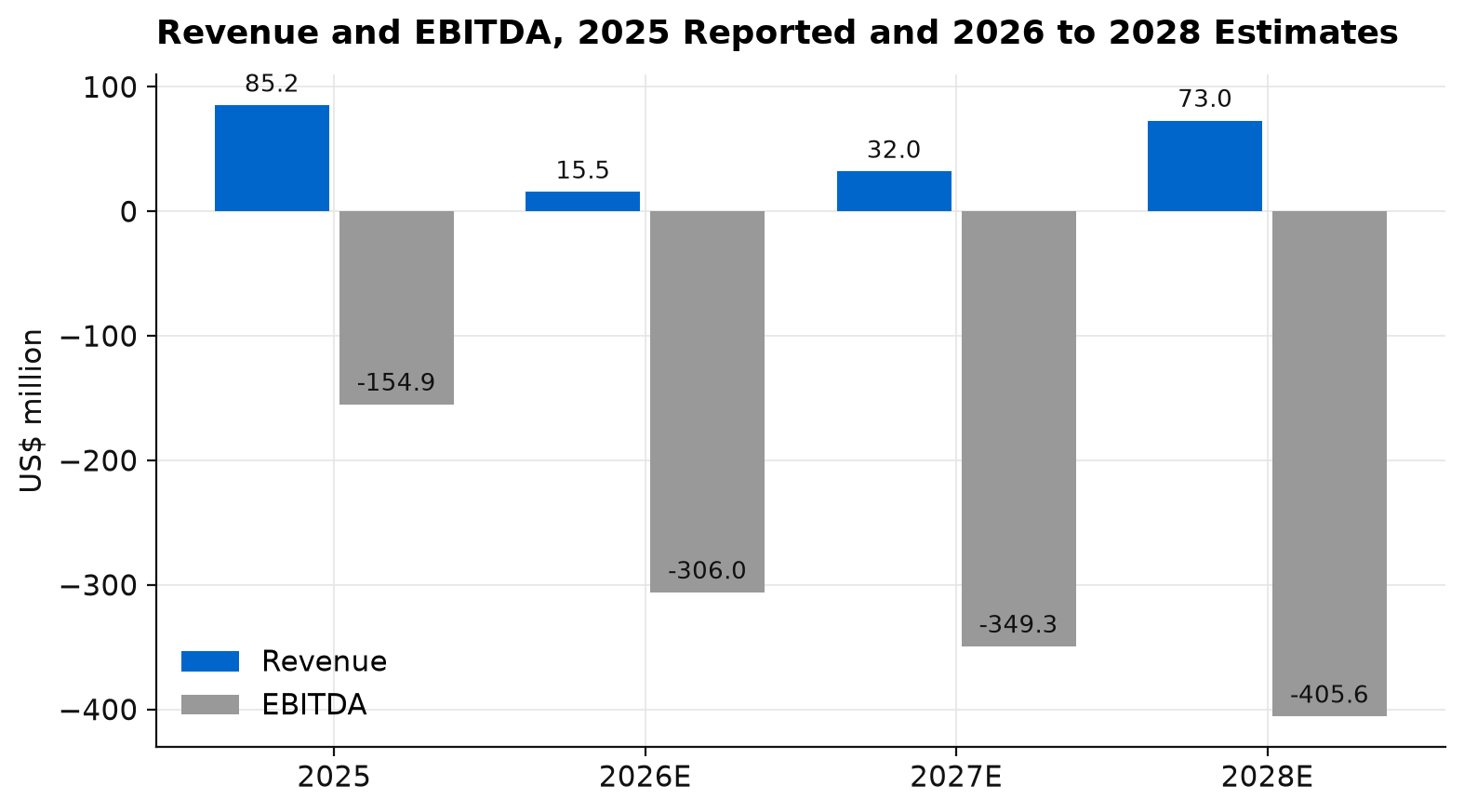
The financial forecasts make clear how early this all is. The company reported revenue of US$85.2 million in 2025, and institutional sell-side research estimates revenue of US$15.5 million in 2026, recovering to US$32.0 million in 2027 and US$73.0 million in 2028. With 4D-150 still in Phase 3, those revenue lines do not yet carry the commercial story. Over the same period, EBITDA losses, meaning losses before interest, tax, depreciation and amortisation, are forecast to widen from US$154.9 million in 2025 to US$306.0 million in 2026, US$349.3 million in 2027 and US$405.6 million in 2028. On a per-share basis, the loss is forecast at US$4.22 in 2026, US$4.94 in 2027 and US$5.34 in 2028, after US$2.42 in 2025. The company reported a loss of US$1.04 per share in the June 2026 quarter, with quarterly losses forecast to edge up to US$1.13 by the March 2027 quarter.
These are the numbers of a company in late-stage clinical development, and they are what you would expect at this point. The investment case is about what 4D-150 could be worth if the data hold, not about near-term earnings.
Valuation and the Case Ahead of the Readout
The 12 month price target of US$32.00 implies about 148.6 per cent upside from the recent close of US$12.87. That is a wide gap, and it suggests the market is giving the Phase 3 program far less credit than the Phase 2 evidence would support. The path to the target rests on three pillars. First, a Phase 3 wet AMD trial designed around the patient group that did best in Phase 2, with management pointing to a visual acuity gain of 5 to 7 letters and a supplemental injection-free rate of 70 to 80 per cent. Second, an anti-VEGF market projected to reach US$20 billion by 2030 that has historically rewarded even small improvements in injection frequency, where 4D-150 offers two years of injection-free durability to date, a low viral dose and a mild inflammation rate of 2 to 3 per cent. Third, a second Phase 3 program in DME backed by SPECTRA data showing a 61 per cent reduction in treatment burden, plus platform optionality in geographic atrophy and beyond.
The target reflects a view about clinical and commercial success rather than current earnings, which are negative and forecast to stay that way for several years. What makes the setup attractive is its shape. Between now and 2Q27, the share price is likely to trade on sentiment around the readout and on competitor data such as RGX-314 in 4Q. A positive Phase 3 result would validate a single-dose treatment in a market where the incumbent standard requires injections every few weeks, and the price target suggests the stock has room to more than double from here. That asymmetry is the core of the Buy case.
For investors who understand that this is a catalyst-driven biotech, the practical approach is to treat 4D Molecular Therapeutics as a speculative position, sized modestly and held with the 2Q27 date in mind. This is not a stock to own for income or stability. It is a stock to own for a specific catalyst with a clearly defined bar, where the upside to the target is large relative to the current price.
Key Risks
Financing is the broadest risk, because the company is forecast to keep losing money through 2028 and will need access to capital to complete late-stage development. The competitive field is crowded, with other gene therapies such as RGX-314 and other approaches such as TKIs in development, and if the company’s patents were challenged its commercial success could be at risk. Clinical risk is the most important single factor, because if 4D-150 fails to maintain efficacy and safety in Phase 3, the potential of the therapy may be limited and questions could be raised about the company’s scientific approach. Gene therapies are also novel, complex and difficult to manufacture, so production problems could delay development or commercialisation, or limit supply. Finally, failure to obtain regulatory approvals in the US or in other markets would stand in the way of commercial success even after positive data.
Our View
What we find most persuasive here is the discipline of the trial design rather than the size of the market. Large market numbers are easy to quote. A Phase 3 program that deliberately enrols the type of patient who did best in Phase 2, and screens out lesions that have historically been hard to treat with standard anti-VEGF drugs, is a sign of a management team trying to control what it can. We would rather see that than a broad trial run in the hope that a big population produces a clean signal. We also like that DME gives the company a second late-stage program, and that the DME data at the Phase 3 dose came with a visual gain as well as fewer injections. The weak point is the balance between time and cash. Losses are forecast to widen every year to 2028, so a strong readout in 2Q27 matters for funding flexibility as much as for the science. Before then, we would watch the RGX-314 data in 4Q as a read on how the market treats gene therapy in wet AMD. For investors comfortable with clinical risk, this is a clearly defined catalyst trade rather than a long-term compounder at this stage.
If you would like to discuss 4D Molecular Therapeutics, request a callback or call us on 1300 889 603.