

Advanced Micro Devices reported its latest quarter after Intel’s weak guidance the week before had lowered investor expectations. AMD posted quarterly revenue of US$13.4 billion, ahead of consensus at US$13.1 billion, with Datacenter the largest contributor at US$8.5 billion, and guided fourth quarter revenue to US$17.0 billion at the midpoint, well above the US$16.3 billion the market had expected. Institutional sell-side research has Advanced Micro Devices rated Buy with a 12 month price target of US$700.00, about 35.9 per cent above the share price of US$515.21 when this research was published. Gross margin was in line with expectations.
Research published 11 November 2026. Price target and upside based on prices at time of publication.
Table of contents [hideshow]
About Advanced Micro Devices
Advanced Micro Devices is a United States semiconductor company that designs processors used in data centres, personal computers, gaming and embedded applications. It reports revenue across segments including Datacenter, Gaming and Embedded. Its products include server CPUs, or central processing units, the general-purpose chips that run most computing workloads, built on the x86 architecture, as well as GPUs, or graphics processing units, the chips now used heavily to run artificial intelligence workloads. The research highlights the ramp of its MI450 product at key customer accounts and the deployment of AMD GPUs related to its deal with Meta. In the most recent quarter, US$8.5 billion of the company’s US$13.4 billion in revenue came from Datacenter, its largest segment. AMD is listed on the Nasdaq under the ticker AMD.
A Beat on Revenue, Operating Margin and Earnings
AMD reported revenue of US$13.4 billion for the quarter. The institutional sell-side research forecast had been US$13.3 billion, and consensus, the average forecast across the analysts who cover the stock, sat at US$13.1 billion, so revenue beat both, by a wider margin against consensus.
Gross margin, which is the share of each dollar of revenue left over after paying the direct cost of making the product, came in at 55.9 per cent. That was in line with the institutional sell-side research forecast of 56.2 per cent and consensus at 56.1 per cent. For a chip designer, gross margin is a useful read on pricing power and product mix, and a higher figure usually means a company is selling more of its premium products, or charging more for them, relative to what they cost to build.
Operating margin measures what is left after paying for both the cost of the product and the running costs of the business, such as research and development, sales and administration. AMD reported an operating margin of 29 per cent, in line with the institutional sell-side research forecast of 28.7 per cent and above consensus at 28.0 per cent. Reported non-GAAP operating earnings per share were US$2.09, above the research forecast of US$2.03 and consensus at US$1.95. Non-GAAP means earnings adjusted to strip out certain items that companies argue distort the underlying picture, such as one-off charges. Earnings per share, or EPS, is the profit attributable to each share on issue, and it is the figure investors most often use to compare what they pay for a stock with what the business earns.
By segment, Datacenter, the largest of the three, delivered the biggest beat in dollar terms, with revenue of US$8.5 billion above the research forecast of US$8.26 billion and consensus at US$8.24 billion. Gaming revenue of US$773 million beat both the research forecast of US$756 million and consensus at US$674 million. Embedded revenue of US$1.1 billion was in line, against a research forecast of US$1.12 billion and consensus of US$1.09 billion.
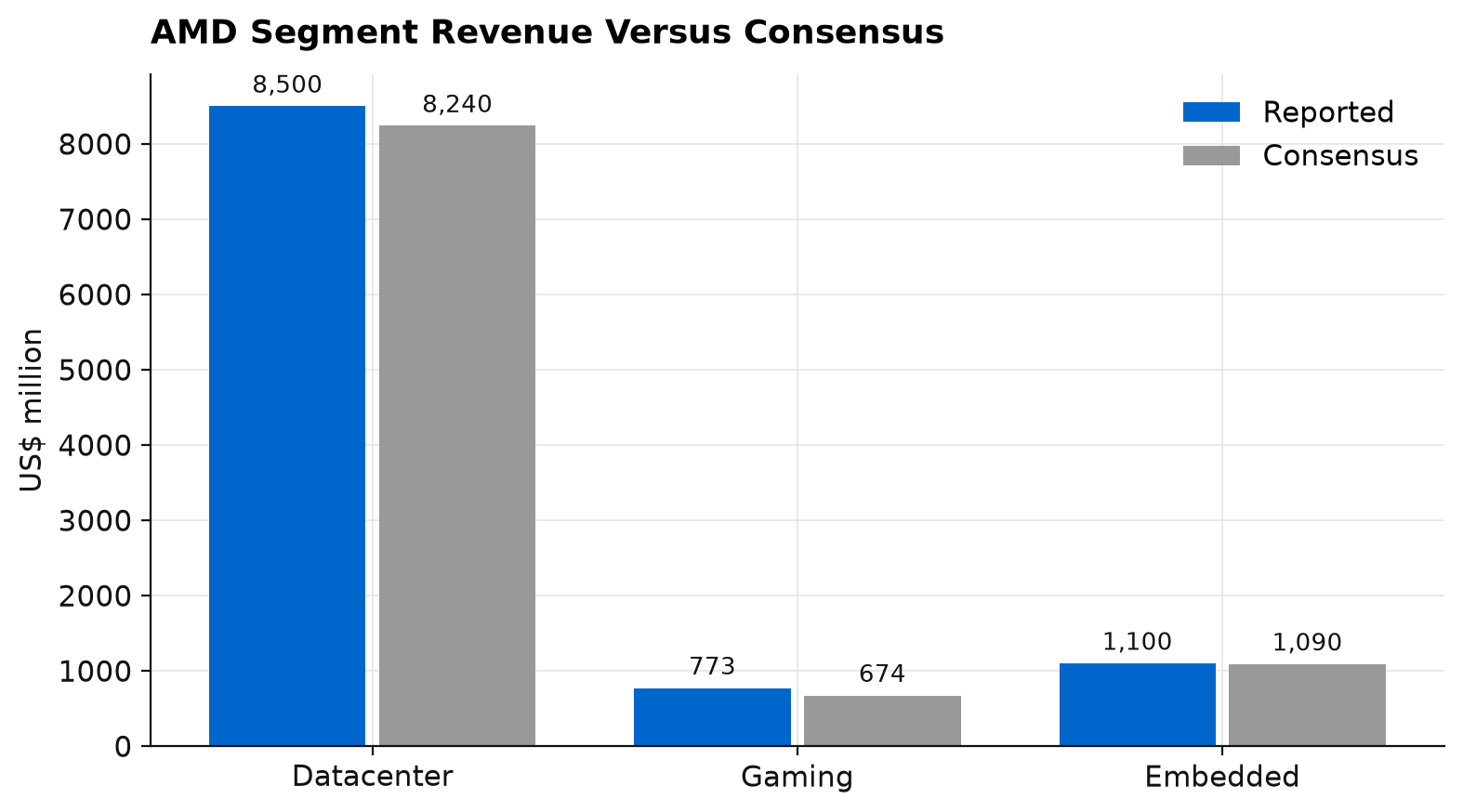
The research names continued strength in Datacenter and an operating expense outlook in line with expectations among the key highlights of the result. Operating expense, or OpEx, is the running cost of the business outside the direct cost of the product.
Fourth Quarter Guidance Moves the Bar Higher
Guidance is the forecast a company gives for its own next reporting period, usually as a range, with the midpoint used as the headline figure. AMD guided fourth quarter revenue to US$17.0 billion at the midpoint. That was slightly below the institutional sell-side research forecast of US$17.6 billion and above consensus at US$16.3 billion. A share price reflects the views of the whole market, so the gap to consensus tends to drive the immediate reaction, and that gap was in AMD’s favour.
The company has just reported US$13.4 billion of revenue for the quarter and is guiding to US$17.0 billion at the midpoint for the next one. The research attributes the better guidance to Datacenter, the same segment that produced the biggest beat in the quarter just reported.
Non-GAAP gross margin was guided to 55 per cent, just above the research forecast of 54.4 per cent and in line with consensus at 55.3 per cent. Implied EPS guidance of US$2.92, worked out from the revenue, margin and cost guidance the company provided, sits above consensus at US$2.65 and modestly below the research forecast of US$2.97. The fourth quarter figure of US$2.92 compares with the US$2.09 just reported.
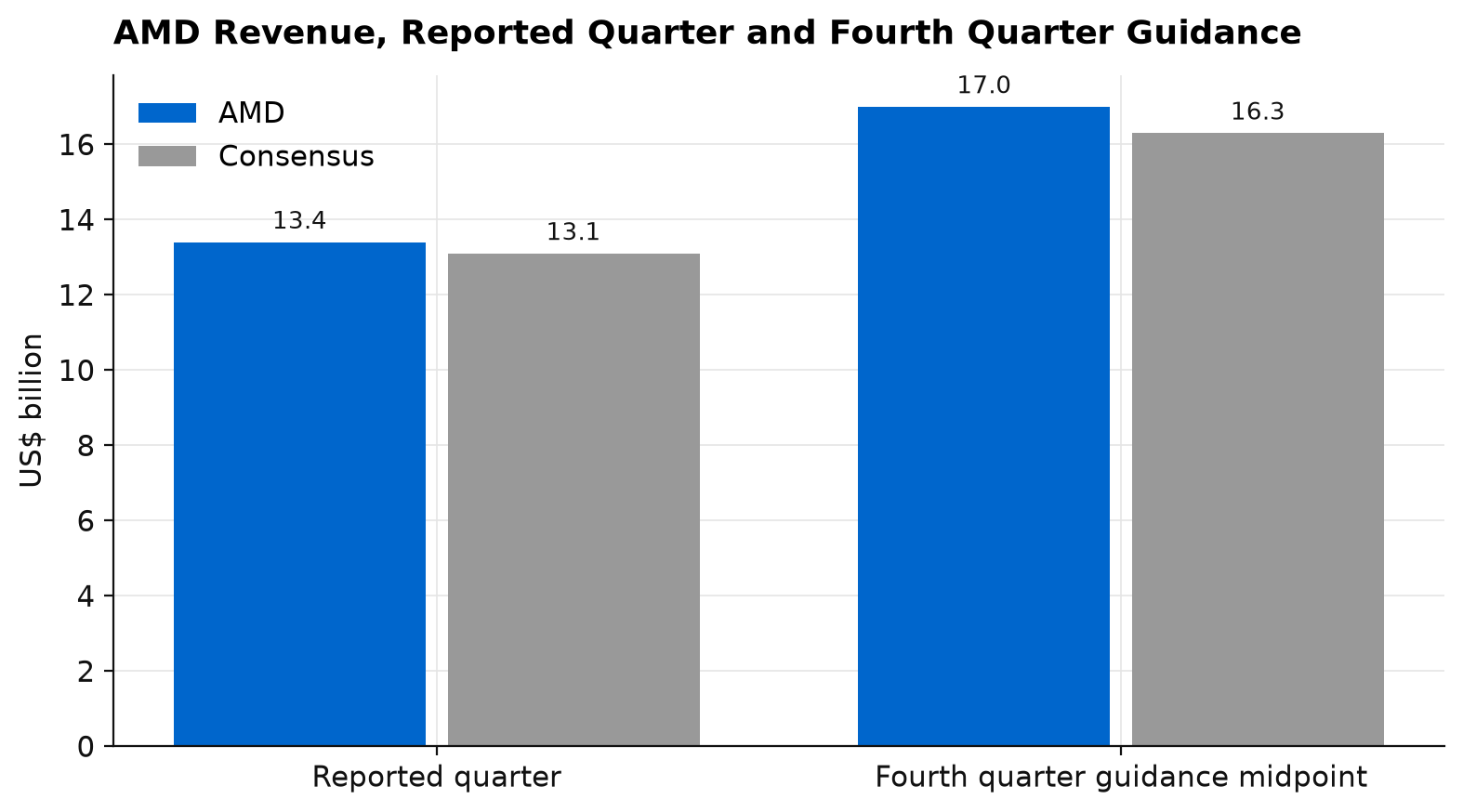
Institutional sell-side research expects the stock to trade higher following the stronger results and guidance. When the market goes into a result with lowered expectations and gets better guidance, the share price reaction can be sharp. The in-line operating expense outlook also removes a common reason a strong revenue guide fails to flow through to earnings, which is costs rising just as fast as sales.
The revenue guide of US$17.0 billion was below the research forecast of US$17.6 billion, so AMD has to keep delivering to meet the more optimistic forecasts.
A rules-based approach to leveraged ETFs
See how our quantitative strategy works and who it suits.
Explore the strategyBecome an authorised representative
Advise your clients under an established AFSL without building your own. Choose AR or CAR.
Become an AR or CARMI450, Server CPUs and the Earnings Path to 2028
Beyond the quarter, the research lists four topics for investors to focus on during the company’s conference call: the shape of the MI450 ramp at key customer accounts through the fourth quarter and into 2027, visibility into how sustainable Server CPU growth is in 2027, gross margin trends, and the PC demand environment.
In our view the MI450 ramp, the period when the new chip goes from early shipments to volume production at customers, is the biggest swing factor. How quickly volumes build, and at which customers, matters because revenue from a major new product tends to arrive unevenly. The research also names slower-than-anticipated deployment of AMD GPUs related to the Meta deal as a key risk.
A server CPU is the main processor in a data centre server, the chip that runs the operating system and general workloads, and AMD’s server processors are built on the x86 architecture, a family of chip designs used widely in servers and PCs. The research asks whether Server CPU growth can be sustained into 2027, and its list of risks includes share erosion of the x86 architecture in enterprise AI, the risk that alternative chip designs take a larger slice of AI work inside corporate data centres. The research also names PC demand as an investor focus, without a forecast attached.
Institutional sell-side research estimates revenue rising from US$34,639.0 million in the year to December 2025 to US$52,648.5 million in 2026, US$95,868.3 million in 2027 and US$129,510.9 million in 2028. EBIT, or earnings before interest and tax, a measure of operating profit, is forecast to rise from US$6,130.0 million in 2025 to US$13,027.8 million in 2026, US$30,768.7 million in 2027 and US$47,049.4 million in 2028. EPS is forecast to go from US$2.64 in 2025 to US$6.60 in 2026, US$15.77 in 2027 and US$23.68 in 2028.
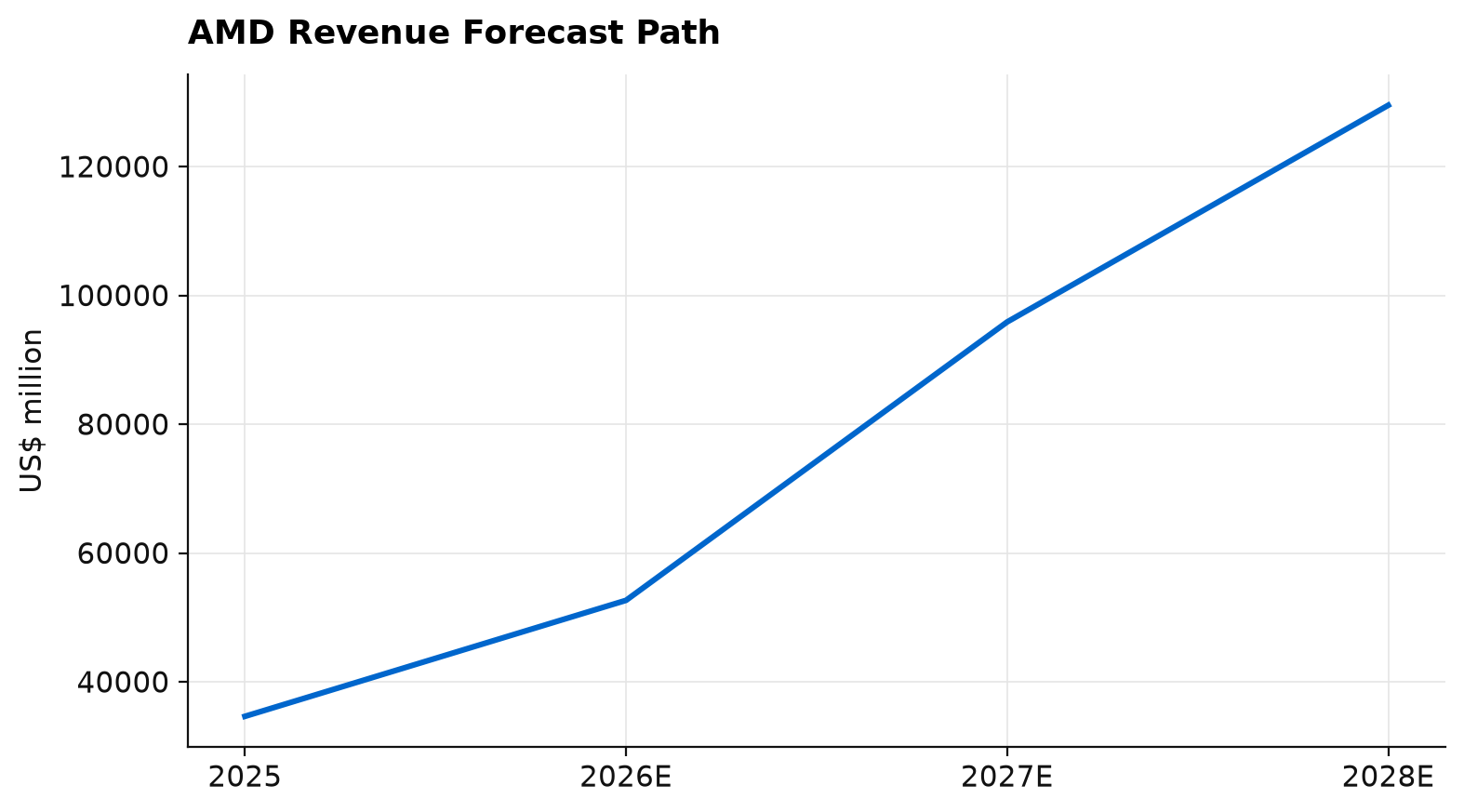
In those forecasts profit grows faster than revenue, which is operating leverage: costs grow more slowly than sales, so each extra dollar of revenue adds more profit. The largest single step in revenue, EBIT and EPS comes in 2027, which lines up with the period the research identifies for the MI450 ramp at key customer accounts, so a slower or smaller ramp would show up first in 2027. Lack of operating leverage is also listed as a key downside risk.
On these forecasts AMD would be several times larger by 2028, and each quarterly result is a progress check on whether Datacenter is still beating, gross margin is holding and costs are growing more slowly than revenue.
Valuation and What the Target Rests On
The 12 month price target of US$700.00 sits about 35.9 per cent above the share price of US$515.21 when this research was published. Behind it are Datacenter, which delivered US$8.5 billion in the quarter, beat both the research forecast and consensus and is the stated driver of the stronger guidance, and the fourth quarter guide, with revenue of US$17.0 billion at the midpoint and implied EPS of US$2.92, both above consensus going into 2027. The longer-term support is the earnings path, with EPS forecast to go from US$2.64 in 2025 to US$23.68 in 2028, built on the MI450 ramp and on AMD turning revenue growth into faster profit growth.
At US$515.21, the shares trade on forecasts that imply a far larger scale of earnings within a few years. The result eased the near-term concern that Intel’s guidance had created, the guidance cleared consensus and the operating cost outlook was in line, so more of the extra revenue should flow to profit. The target is about 35.9 per cent above the publication price, and the next leg of growth is tied to a product ramp the market can track quarter by quarter. Shares in high-growth chip companies can move sharply.
Key Risks
Slower-than-expected adoption of agentic AI, meaning AI systems that complete multi-step tasks with limited human input, would weigh on the data centre spending behind the Datacenter forecasts, and the PC demand environment is another swing factor. On competition, share erosion of the x86 architecture in enterprise AI would undercut the Server CPU growth the research wants visibility on into 2027. On execution, the risks are slower-than-anticipated deployment of AMD GPUs related to the Meta deal and a weaker shape to the MI450 ramp at key customer accounts. A lack of operating leverage, where costs grow alongside revenue, would mean profit does not outpace sales as forecast and would flatten the earnings path to 2028. With expectations now reset higher by the fourth quarter guide, a miss against that new bar could weigh on the shares.
Our View
We like that the upside came from Datacenter and that operating costs held in line, which supports the operating leverage built into the forecasts. The gap to watch is between AMD’s revenue guide of US$17.0 billion and the research forecast of US$17.6 billion.
Datacenter delivery over the next few quarters is the near-term test, and the 2028 forecasts depend on the MI450 ramp in 2027. A slip in that ramp would likely show up in the share price quickly.
If you would like to discuss Advanced Micro Devices, request a callback or call us on 1300 889 603.
Financial Summary
Become an authorised representative
Advise your clients under an established AFSL without building your own. Choose AR or CAR.
Become an AR or CAR