

Bellevue Gold has handed investors a mixed set of results this reporting season. The FY26 result was better than the market expected, helped by lower corporate costs, and the balance sheet finished the year with net cash. Then the company flagged that the first quarter of FY27 will come in below plan, because a change of mining contractor has taken longer to settle than hoped. The shares have lagged some key peers recently, mostly because the market is focused on gold the company has already sold forward at prices well below today’s spot price. That is exactly the part of the story that changes over the next year. Institutional sell-side research has Bellevue Gold rated Buy with a 12 month price target of A$1.90, about 32.9 per cent above the recent close of A$1.43. The target was trimmed slightly after the result, but the core argument is intact. Once the hedge book clears during FY27, far more of every ounce Bellevue Gold produces is sold at the market price, and that is when free cash flow is expected to step up sharply.
Research published 20 October 2026. Price target and upside based on prices at time of publication.
About Bellevue Gold
Bellevue Gold is an Australian gold producer listed on the ASX. It reports in Australian dollars on a financial year ending 30 June. The company runs an underground gold mine feeding its own processing plant, and its ore is high grade. Its resource grade is already above peer gold grades. The business is guided to produce 150,000 to 170,000 ounces of gold in FY27. Its near-mine targets include Deacon North, where infill drilling is feeding mine planning, plus earlier-stage prospects at Westralia and Tribune South. The processing plant has an expanded capacity of 1.35 million tonnes a year. The company has also previously outlined a larger Stage 2 mill expansion to about 1.6 million tonnes a year, which is currently paused.
A Cost Beat in FY26 and a Contractor Hiccup in the First Quarter
Start with the year just gone. Bellevue Gold reported underlying EBITDA of about A$238 million for FY26, ahead of market expectations. EBITDA stands for earnings before interest, tax, depreciation and amortisation, and it is a rough measure of the profit the operation makes before financing costs and accounting write-downs. The beat came from lower corporate costs. Performance at the mine site itself was in line with institutional sell-side research forecasts, so the improvement came from the head office rather than the mine. The EBITDA margin, meaning EBITDA as a share of revenue, was about 41 per cent on FY26 revenue of A$576.3 million. Statutory net profit after tax, the bottom line once every cost is deducted, was much smaller at about A$7 million.
The balance sheet also finished the year in good shape. Cash and gold on hand totalled about A$206 million, leaving the company with net cash of about A$106 million after its debt, a figure it had already flagged in its fourth quarter update. Debt is unchanged at A$100 million. There are no mandatory principal repayments until calendar 2027, and Bellevue Gold can repay early without penalty if it chooses. The board did not declare a final FY26 dividend. That was in line with expectations, given the company’s capital needs and its renewed focus on near-mine exploration that it believes can add value.
The less welcome news is about the current quarter. Bellevue Gold has changed its underground mining contractor, the firm that supplies the crews and equipment to dig the ore, and the handover has been slower than planned. The company pointed to three causes. Workforce availability has been tight, new equipment has needed commissioning before it can run at full pace, and access to some of the planned high-grade stoping areas has been restricted. A stope is the underground opening from which ore is extracted, so losing access to the best stopes for a period means fewer ounces through the mill. The company has been clear that this is a volume problem tied to the transition, not a sign that the geology or the grade is disappointing.
The size of the hit is modest. The plan had been for relatively consistent quarterly production through FY27, give or take scheduled mill shutdowns. The September quarter is now expected to come in below that plan, and institutional sell-side research now forecasts about 34,000 ounces for the period. The company expects to recover the deferred ounces over the following quarters, and FY27 guidance is unchanged at 150,000 to 170,000 ounces at an all-in sustaining cost of A$2,800 to A$3,100 an ounce. All-in sustaining cost, usually shortened to AISC, is a miner’s broadest measure of what it costs to produce an ounce, including the ongoing capital spending needed to keep the mine running. Institutional sell-side research has taken a more cautious line, softening its own FY27 forecast to near the bottom of the production range at a cost of A$3,150 an ounce, slightly above the top of the cost range.
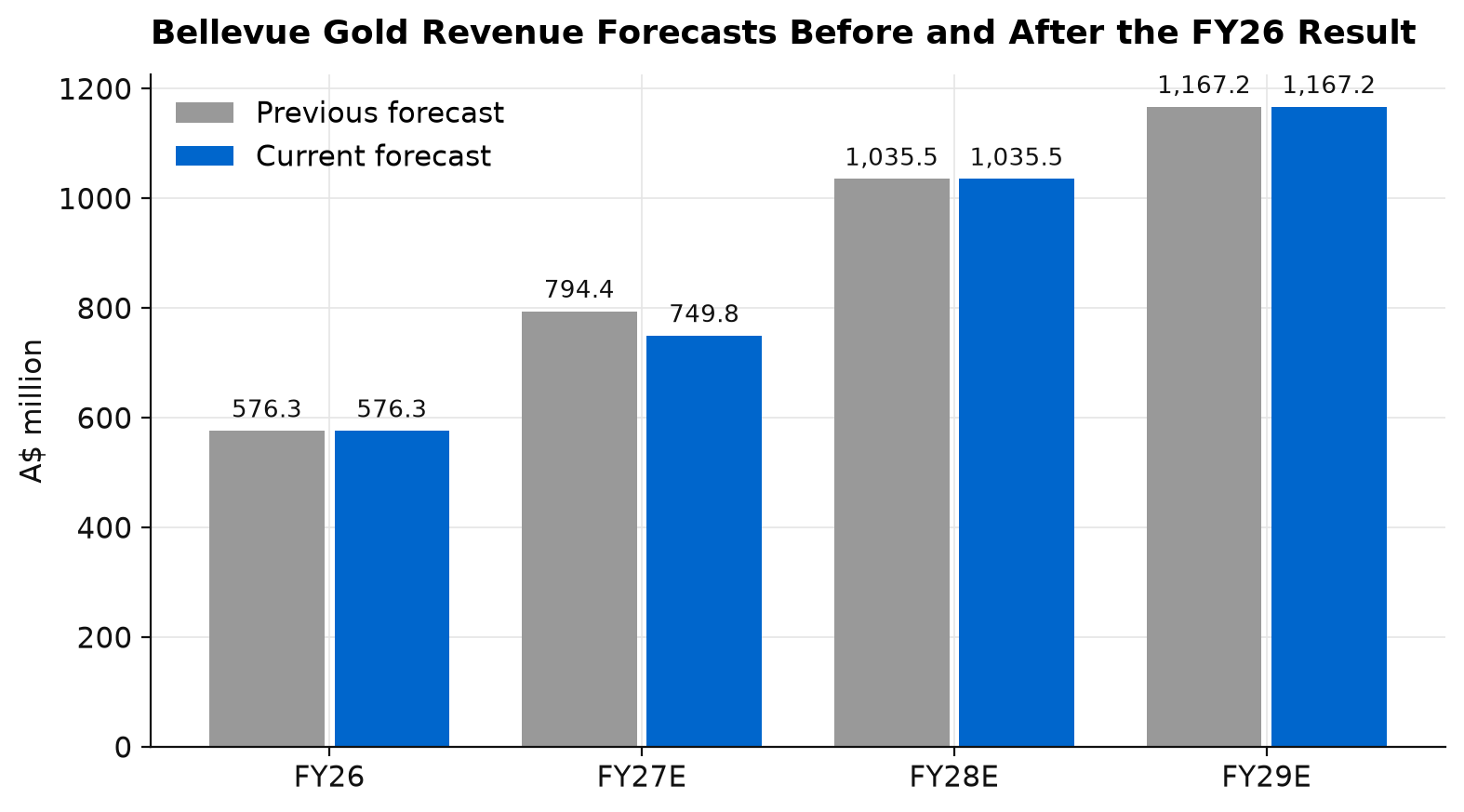
The flow-through to the forecasts is concentrated in a single year. FY27 revenue is now forecast at A$749.8 million, down from A$794.4 million before the update, while FY28 and FY29 are unchanged at A$1,035.5 million and A$1,167.2 million. FY27 EBITDA was cut by 9 per cent, with the two later years untouched, and FY27 earnings per share now sit at A$0.05 against A$0.08 previously. That is what a timing problem looks like in the numbers. We would rather see a contractor change cost a few thousand ounces in one quarter than a grade shortfall that lowers every year of the mine plan, and on the evidence so far this is the former.
The Hedge Book Rolls Off and Cash Flow Steps Up
The single most important thing to understand about Bellevue Gold today is its hedge book. A hedge book is a set of contracts under which a miner agrees in advance to deliver a fixed amount of gold at a fixed price. It locks in revenue, but if the gold price rises after the hedges are struck, the miner still has to deliver those ounces at the old, lower price. That is the position Bellevue Gold is in. Its remaining hedges sit at roughly half of spot prices, which is why near-term free cash flow, the cash left over after operating costs and capital spending, looks thinner than the gold price alone would suggest. It is also the main reason the shares have lagged some key peers.
The good news is that the book is shrinking fast. Through the fourth quarter of FY26 the company kept delivering gold into its hedges ahead of schedule, lowering its total forward gold hedging commitments, at an average price of A$3,004 an ounce, running out to the third quarter of FY28. No contractual hedge deliveries are due until the fourth quarter of FY27, and the company is free from mandatory hedging commitments until June 2027. Management has said that through FY27, positive cash flow beyond modest balance sheet improvements will go toward delivering early into the shorter-dated forward contracts, with the aim of clearing the hedge book by the end of FY27. As it works through the book, the company plans to keep at least one quarter hedge free at each quarter end.
Institutional sell-side research has pushed its own assumption for clearing the book back by one quarter, to the third quarter of FY27 from the second, because the softer September quarter leaves less spare gold to deliver early. The research also notes that Bellevue Gold could still close the book sooner alongside an early refinancing of its debt. Either way, the direction is clear. With gold prices in contango, meaning gold for future delivery trades above today’s spot price, the research views the roll-off as supportive and as speeding up the turn in operating free cash flow.
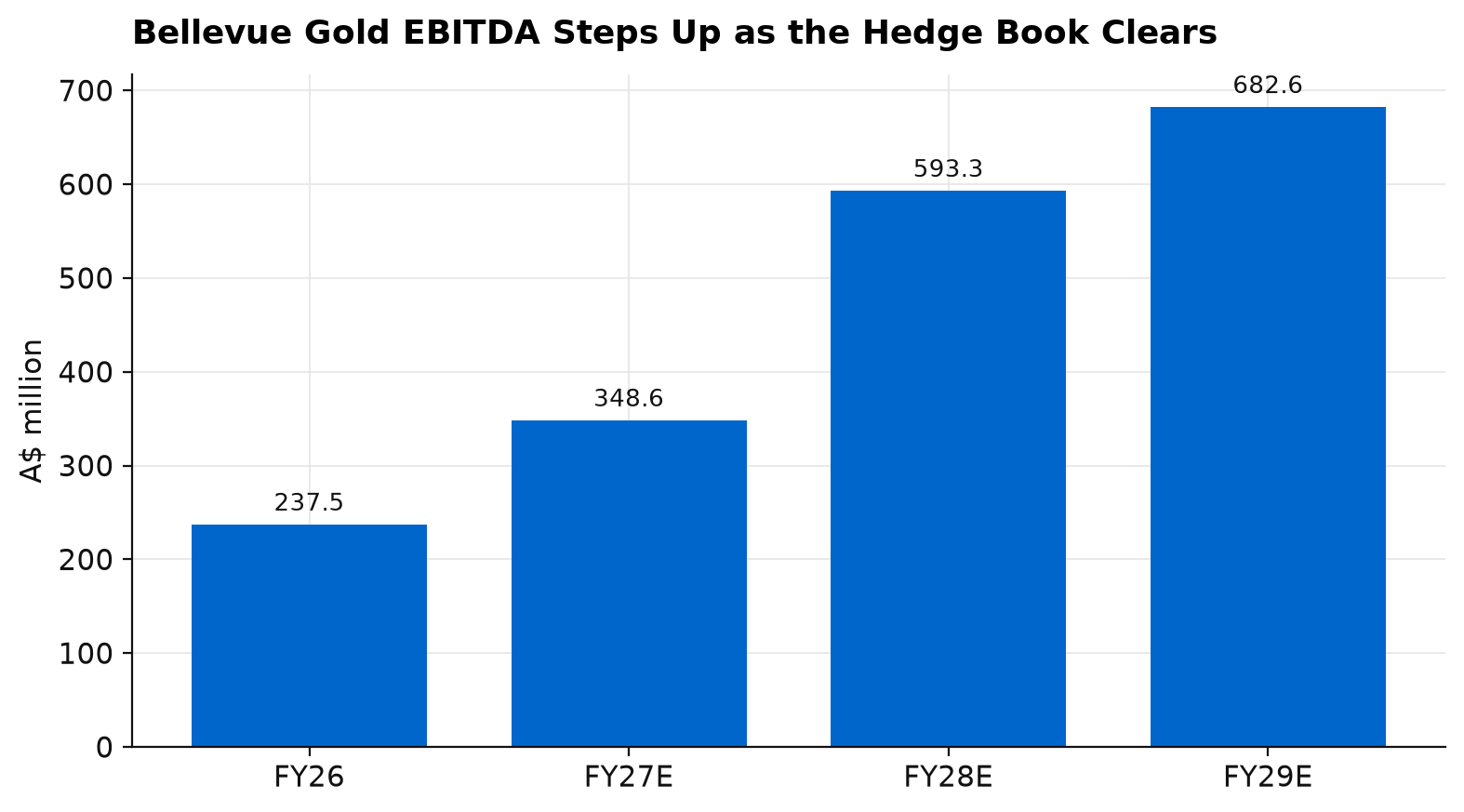
Once the hedges are gone, more of every ounce is sold at the market price, and the forecasts show what that does. EBITDA is forecast to rise from A$237.5 million in FY26 to A$348.6 million in FY27, then to A$593.3 million in FY28 and A$682.6 million in FY29. Earnings per share are forecast to climb from A$0.00 in FY26 to A$0.05 in FY27, A$0.17 in FY28 and A$0.21 in FY29. Free cash flow is expected to inflect from the second half of FY27, with FY28 the first full year of largely unhedged sales. Unwinding the hedges also gives the company choices. It has said that exposing a bigger share of future production to spot prices adds the flexibility to build cash, invest in exploration or fund capital projects from its own resources.
This is the heart of the Buy case. The hedges are a known, shrinking drag with a visible end date, not a permanent feature of the business. Investors who wait for the cash flow to show up in reported results may find the market has moved before they do.
Spare Plant Capacity and Exploration Offer Upside Beyond the Plan
The third pillar is optionality, meaning upside that is not in the base forecasts but could be. Start with the processing plant. Bellevue Gold optimised its FY26 operations at a rate of about 1 to 1.2 million tonnes a year, and the plant has an expanded capacity of 1.35 million tonnes a year. The crusher, the first stage of the plant where ore is broken up, is already oversized at 1.7 million tonnes a year, which makes it easier to lift throughput if the mine can supply more ore. The company itself expects to run at about 1.25 million tonnes a year over the medium term, improving toward nameplate capacity toward the end of the decade, and the research assumes the same 1.25 million tonne average.
That leaves room. If exploration finds enough extra ore to fill the spare capacity, more ounces could run through infrastructure that is already built. Beyond that, the company has previously outlined a Stage 2 mill expansion to about 1.6 million tonnes a year. That project is paused, but institutional sell-side research sees potential for it to come back on the table, possibly supported by third party ore sources, meaning ore from outside Bellevue Gold’s own mine. None of this is in the base case, and investors should treat it as a possible bonus rather than something the target relies on.
Exploration is the other lever. During FY26, drilling was almost entirely grade control, which is tightly spaced drilling close to where mining is about to happen, used to guide the miners day to day. For FY27 the exploration budget is unchanged from the fourth quarter update and funds an additional underground rig, with about 30 per cent of underground drilling metres aimed at resource definition and exploration, up from a minimal share before. Recent high-grade infill results at Deacon North continue to support mine planning, and early-stage drilling at Westralia and Tribune South points to further upside outside the current mine plan. Significant investment in the underground mine to date has opened several faces to drill from, rather than drilling from the surface. The most recent assays came back at grades well above the current resource, which is itself already above peer gold grades, and point to potential additional high-grade shoots.
The annual resource statement shows why that drilling matters. The Mineral Resource, the total estimated gold in the ground, declined in the latest statement. The Ore Reserve, the part that can be mined economically under the current plan, fell to 1.0 million ounces from 1.3 million ounces. The company put the decline down to minimal exploration while the focus was on grade control, mining depletion and refined resource modelling, partly offset by lifting the gold price assumption used for the reserve to A$3,250 an ounce from A$2,750. A falling reserve is not something to wave away, but the cause is understandable, and the step-up in exploration drilling is the direct response.
Valuation and the Case for Buying Before the Inflection
Institutional sell-side research sets a 12 month price target of A$1.90, about 32.9 per cent above the recent close of A$1.43. The target was trimmed by about 3 per cent from A$1.95 after the result, reflecting the softer first quarter and a slower hedge roll-off rather than a change in the longer-term view. FY28 and FY29 revenue and EBITDA forecasts were left unchanged, which tells you the research sees the problem as confined to the near term.
The case rests on three pillars. The first is that the operating plan is intact. FY27 guidance of 150,000 to 170,000 ounces has been held, and the September quarter shortfall reflects a contractor handover rather than the ore body. The second, and the most important, is the hedge roll-off. Near-term free cash flow is held back by hedges priced at roughly half of spot, but with the book on track to clear during FY27 and gold in contango, the research expects free cash flow to inflect from the second half of FY27 and step up sharply in FY28 on largely unhedged sales. The third is optionality from spare plant capacity, a possible Stage 2 expansion and a much larger exploration effort, none of which sits in the base forecasts.
The relative picture also helps. Bellevue Gold has underperformed some key peers recently, largely because of the hedge-related drag on cash flow, and that drag unwinds in the second half of FY27. Measured against a group of Australian mid-cap gold producers, the company’s market value has drifted back to about where it stood at the time of its April 2025 equity raise. In the research’s view, the relative valuation backdrop remains supportive.
There is no dividend to collect in the meantime, as no final FY26 dividend was declared, so this is a capital growth position rather than an income one. Our read on the trade is straightforward. The bad news, a soft September quarter, is known and quantified, and the forecasts have already absorbed it. The good news, a hedge book that disappears and leaves the company selling into a much higher spot price, sits ahead on a visible timetable. With about 32.9 per cent upside to the A$1.90 target and further optionality not in the numbers, the balance of risk and reward looks skewed to the upside for investors who can tolerate gold price swings. For existing holders, the first quarter wobble is not a reason to sell. For those looking to build a position, weakness around the soft quarter looks more like an opportunity than a warning.
Key Risks
The biggest risk is the gold price itself, along with broader macro conditions, because as the hedge book clears Bellevue Gold becomes more exposed to spot prices, which is the point of the thesis but also means a sharp fall in gold would flow straight through to revenue and cash flow. Cost inflation is a related pressure, and institutional sell-side research already assumes FY27 costs of A$3,150 an ounce, slightly above the top of company guidance. In competitive terms, the share price case leans on the stock closing its gap to peers, and if the hedge roll-off runs slower than expected the relative underperformance could persist. Operationally, the contractor transition may take longer to settle than hoped, and if access to the planned high-grade stopes stays restricted the deferred ounces may not be recovered within FY27. The falling Ore Reserve means exploration has to deliver to extend the mine plan, and any revival of the Stage 2 expansion would bring construction and commissioning risk. Finally, the company’s growth plans, the returns it earns on new capital and any mergers or acquisitions all carry their own execution risk.
Our View
We like the way Bellevue Gold is handling the hedge book. Using spare cash to deliver early into shorter-dated contracts, while keeping at least one quarter hedge free as it goes, is a disciplined way to get out from under below-market contracts without stretching the balance sheet. We would rather see that than a company borrowing to buy its way out. The point we will be watching most closely is the reserve. A drop from 1.3 million to 1.0 million ounces is a meaningful step down, and while part of the cause is a year spent on grade control drilling rather than exploration, the extra underground rig and the higher share of drilling aimed at new resources need to show results over the next year or two. The next few quarterly production reports will also tell us whether the contractor handover is behind the company. If both of those land, the hedge roll-off can do the rest.
If you would like to discuss Bellevue Gold, request a callback or call us on 1300 889 603.