

Hold
Bendigo and Adelaide Bank is an ASX-listed Australian bank that sits a step below the big four, offering home loans, business lending and deposits through its Community Bank branch network.
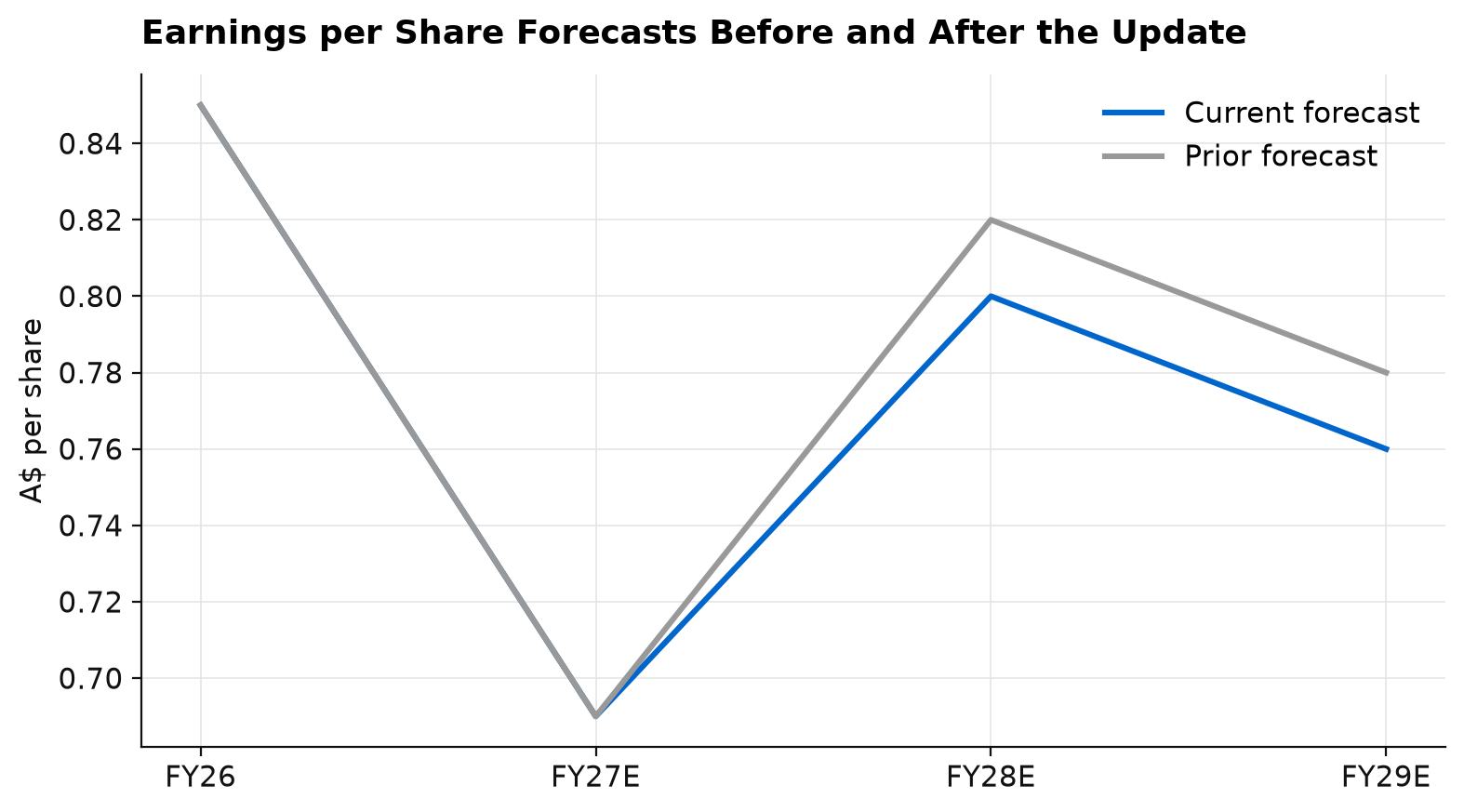
Institutional sell-side research rates it Buy because it sees the weak first quarter, with shrinking loans and a lower net interest margin of 1.94 per cent, as mostly seasonal or one-off. It expects the margin to stabilise at 1.94 per cent in the second quarter, and longer-term cost growth below inflation still looks intact. Earnings per share are forecast to recover from A$0.69 in fiscal 2027 to A$0.80 in fiscal 2028.
- Sell-side rating
- Buy
- Sell-side target
- A$11.20
- Upside to target
- +5.9%
- Initial price
- A$10.7710 Nov 2026
- Last close
- A$10.5819 Nov 2026
Initial Buy based on A$10.77. Now Hold since 16 Nov 2026: the price reached within 5% of the A$11.20 target.
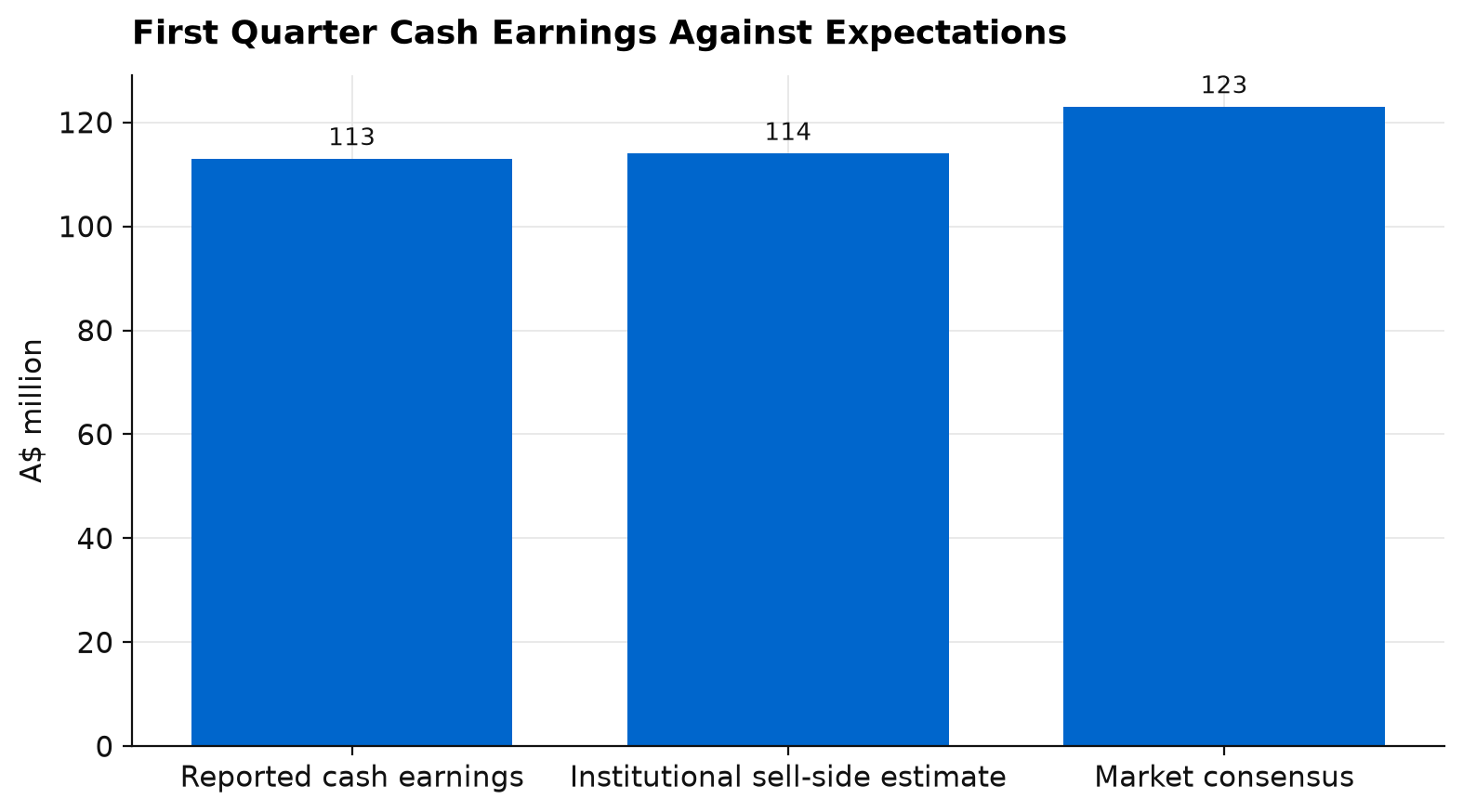
Bendigo and Adelaide Bank reported a first quarter in which loans shrank, deposits and wholesale funding grew, the bank built up a large amount of extra cash, and its net interest margin, the core measure of how much it earns on its lending, slipped 6 basis points to 1.94 per cent. Cash earnings for the quarter came in at A$113 million, in line with the institutional sell-side estimate but behind market consensus. The research sees most of these moves as seasonal or one-off, and expects the margin to stabilise at 1.94 per cent in the second quarter. Institutional sell-side research has Bendigo and Adelaide Bank rated Buy with a 12 month price target of A$11.20, about 4.0 per cent above the share price of A$10.77 when this research was published, and the trailing dividend yield is 5.8 per cent, fully franked.
Research published 10 November 2026. Price target and upside based on prices at time of publication.
Table of contents [hideshow]
About Bendigo and Adelaide Bank
Bendigo and Adelaide Bank is an ASX-listed licensed bank formed in 2007 through the merger of Bendigo Bank and Adelaide Bank, creating one of Australia’s largest second-tier banks. It sits a step below the four major banks in size and competes with them for home loans, business lending and deposits. It operates through three main divisions, consumer, business and agribusiness, and its financial year ends on 30 June. It differs from the major banks through its Community Bank model, in which a share of each branch’s profits goes back to its local community. Bendigo Bank pioneered this model in the late 1990s, and the group now operates more than 300 Community Bank branches around Australia.
First Quarter Earnings and Costs
Cash earnings, the profit measure banks use to strip out accounting items that do not reflect the underlying business, were A$113 million for the first three months of the 2027 financial year. That figure was in line with the institutional sell-side estimate of A$114 million but behind the market consensus of A$123 million, and the research kept its Buy rating after the update.
Other operating income, meaning the money the bank makes from sources other than the gap between lending and deposit rates, fell 10.3 per cent. The main driver was slower property turnover in Sydney and Melbourne, which brought Homesafe realisations, income booked as properties sell, back to more normal levels. Lower Homesafe income is one reason the research has trimmed its later-year forecasts.
Business-as-usual costs, the everyday running costs of the bank before one-off items, came in better than expected and fell 2.6 per cent against the average of the second half of fiscal 2026. Longer-term cost growth below inflation is one of the four reasons the research gives for its Buy rating. Notable expenses, the one-off items that sit outside business-as-usual costs, are now expected to fall more heavily in the first half of the year, split roughly 75 per cent in the first half and 25 per cent in the second.
Falling Loans and Rising Funding Squeezed the Margin
A bank makes most of its money by borrowing from depositors and wholesale markets and lending that money out at a higher rate. The difference, expressed as a share of the assets that earn interest, is the net interest margin, usually shortened to NIM. NIM is measured in basis points, where one basis point is one hundredth of a percentage point. This quarter, NIM fell 6 basis points to 1.94 per cent.
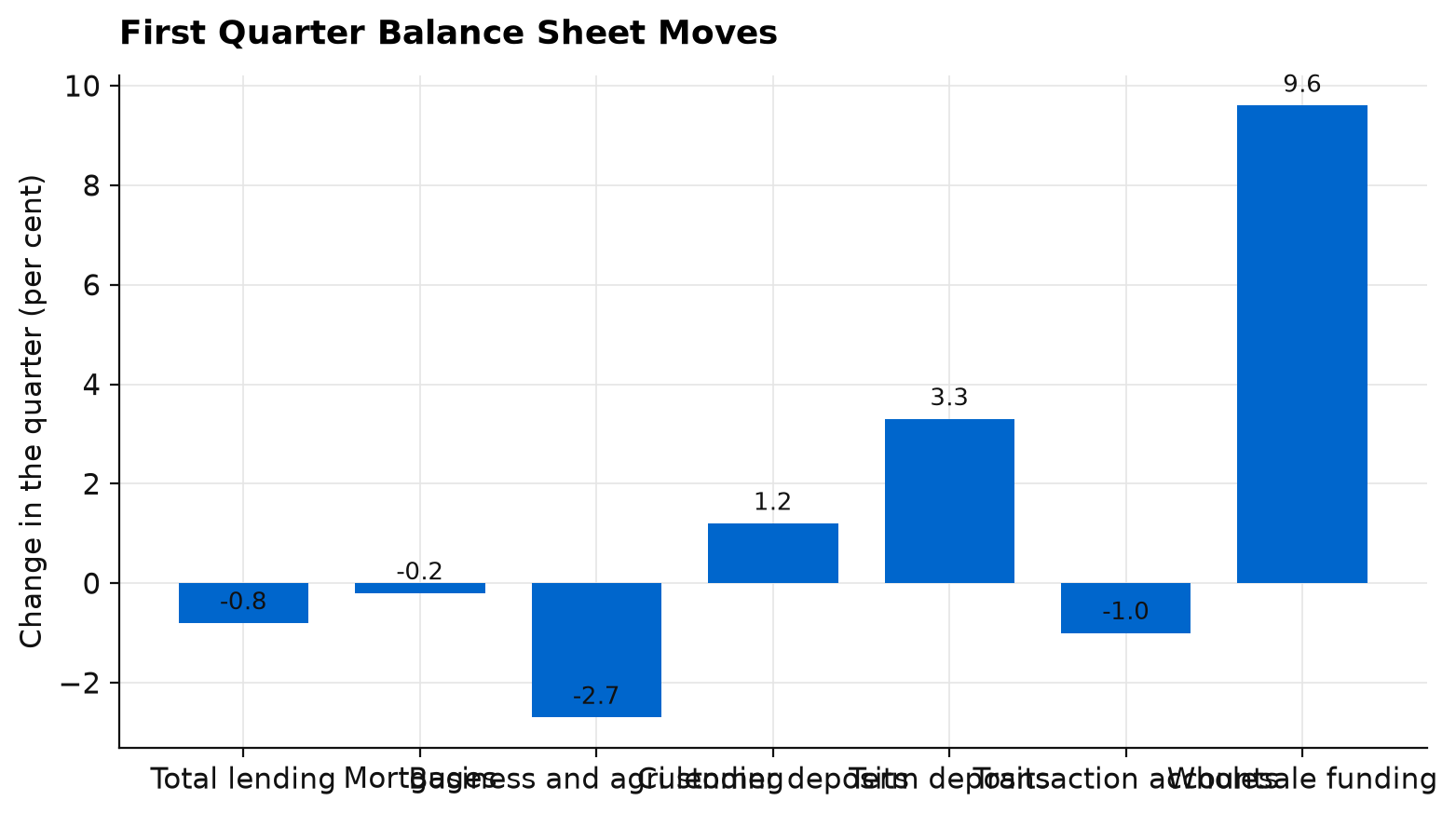
Total lending balances contracted 0.8 per cent in the quarter. Mortgage lending slipped 0.2 per cent, while business and agribusiness lending combined fell 2.7 per cent. On the business side, the bank lost one large business lending customer, described as a portfolio funding client, and agribusiness lending had its seasonal outflow, as balances follow the farming calendar.
Customer deposits rose 1.2 per cent, led by a 3.3 per cent increase in term deposits, which are savings accounts that lock money away for a fixed period at a fixed rate. Wholesale funding, the money a bank raises from professional investors in debt markets, grew 9.6 per cent, or A$1.0 billion, in the quarter. Low-cost transaction accounts, the everyday accounts where customers keep money they spend and which pay little or no interest, fell 1 per cent due to seasonal factors.
A rules-based approach to leveraged ETFs
See how our quantitative strategy works and who it suits.
Explore the strategyBecome an authorised representative
Advise your clients under an established AFSL without building your own. Choose AR or CAR.
Become an AR or CARWith funding rising faster than lending, the bank held the surplus as liquid assets, cash and easily sold securities kept on hand to meet withdrawals and regulatory requirements. Liquid assets, which earn less than loans, jumped by A$2.7 billion in the quarter and diluted the margin. At the same time, the funding mix moved toward more expensive sources, with term deposits and wholesale funding growing while cheap transaction balances fell, which also lowered NIM.
The research expects NIM to stabilise at 1.94 per cent in the second quarter as many of these balance sheet moves unwind. Over the full 2027 financial year, the research expects the impact of the liquid asset build in the first half to reverse in the second half, leaving a neutral effect on NIM for the year as a whole. It has lowered its NIM forecasts by 2 to 3 basis points over the next three years, because of an adverse shift in the deposit mix in the near term and the bank’s interest rate risk management. Partly offsetting that are stronger replicating portfolio yields and a more favourable lending mix. A replicating portfolio is the way banks invest the money held in low-interest deposits and their own capital, spreading it across a rolling ladder of fixed-rate investments so income is smoother through the interest rate cycle. The research has also lifted its estimate of average interest-earning assets, the average pool of loans and securities that earn interest, by 2 per cent for fiscal 2027, because of the build-up of liquid assets in the first quarter.
Earnings Forecasts and the Buy Rating
After the update, the research left its fiscal 2027 cash earnings forecast unchanged but cut fiscal 2028 and fiscal 2029 by 2 per cent each. Revenue forecasts are unchanged for fiscal 2027 and down 1 per cent in each of the following two years. Forecasts for other operating income are 2 to 3 per cent lower over the next three years, reflecting lower Homesafe income as property turnover slows in Melbourne and Sydney. Operating cost forecasts are unchanged. Forecasts for bad and doubtful debts, the provisions a bank sets aside for loans that may not be repaid, have been lowered by 2 to 11 per cent on lower lending volumes, which partly offsets the weaker revenue.
On the research’s numbers, net income moves from A$530.2 million in fiscal 2026 to A$454.2 million in fiscal 2027, before recovering to A$526.3 million in fiscal 2028 and easing to A$506.7 million in fiscal 2029. Earnings per share follow the same shape, from A$0.85 in fiscal 2026 to A$0.69 in fiscal 2027, then A$0.80 in fiscal 2028 and A$0.76 in fiscal 2029. Before this update, the fiscal 2028 and fiscal 2029 figures were A$0.82 and A$0.78. In growth terms, that is an 18.1 per cent fall in earnings per share in fiscal 2027, a 15.1 per cent rebound in fiscal 2028 and a 4.3 per cent decline in fiscal 2029. Within fiscal 2027, the research has earnings per share of A$0.32 in the first half and A$0.37 in the second, so the year is expected to be weighted to the second half, when notable expenses are expected to be lower.
The research rates the bank a Buy for four reasons: it has reignited mortgage lending growth while continuing to deliver strong business and agribusiness credit growth; its deposit base is shifting toward lower-cost products; the longer-term path for business-as-usual cost growth below inflation looks intact, even though one-offs are lifting near-term costs; and the recent decline in the share price does not reflect the improving earnings outlook.
This quarter’s figures cut against the first two of these, with mortgages slightly lower, business lending down and the deposit mix moving toward term deposits. The research puts the weakness down to a single lost client, a seasonal agribusiness outflow, seasonal weakness in transaction accounts and a temporary build-up of cash, and has kept its Buy rating, with costs moving in the bank’s favour. The company expected its purchase of RACQ Bank’s retail loan and deposit book to complete in November, and RACQ’s website now says that business has transitioned to Bendigo Bank, though the research does not set out the deal terms.
Valuation and Income
The institutional sell-side 12 month price target is A$11.20, unchanged after the quarterly update even though the later-year earnings forecasts were trimmed by 2 per cent. That target sits about 4.0 per cent above the share price of A$10.77.
Over the past twelve months the bank has paid A$0.63 per share in dividends, which at the current price is a trailing dividend yield of 5.8 per cent, fully franked, and more than the gap to the target, though future payments may differ. Fully franked means the company has already paid tax on the profits behind the dividend, and the franking credits that come with it can reduce the tax an Australian investor pays, or be refunded to some low-tax investors.
For the Buy case to hold, NIM needs to stabilise at 1.94 per cent in the second quarter, with the liquid asset build reversing in the second half. Costs need to stay under control, after business-as-usual costs fell 2.6 per cent against the second half fiscal 2026 average, with longer-term cost growth below inflation still looking intact. Earnings also need to recover as forecast, from A$0.69 per share in fiscal 2027 to A$0.80 in fiscal 2028.
NIM holding at 1.94 per cent and lending returning to growth at the second quarter update would support the research’s view that the quarter’s problems were temporary. If the margin keeps falling or lending keeps shrinking, the case for an earnings recovery would be weaker, and the dividend is not guaranteed.
Key Risks
The research names three key downside risks: costs growing above inflation, a material change in the asset impairment cycle, and further regulatory and financial outcomes from the bank’s AML/CTF compliance issues. A change in the impairment cycle, meaning more borrowers unable to repay, would push bad debt charges above forecasts that have just been lowered. AML/CTF stands for anti-money laundering and counter-terrorism financing, the rules banks must follow to detect and report suspicious transactions. If customers keep moving money out of low-cost transaction accounts into term deposits and the bank keeps leaning on wholesale funding, the margin may not stabilise as expected. Lending also needs to return to growth after the loss of a large business client, while slower property turnover in Sydney and Melbourne is already weighing on Homesafe income.
Our View
The research expects most of the causes behind the quarter’s falling loans, rising funding and lower margin to pass, while underlying costs fell. The shift in the deposit mix could take longer to recover.
If you would like to discuss Bendigo and Adelaide Bank, request a callback or call us on 1300 889 603.
Financial Summary
Become an authorised representative
Advise your clients under an established AFSL without building your own. Choose AR or CAR.
Become an AR or CAR