

Chrysos delivered a strong FY26 result in August and the shares rallied about 20 per cent over two sessions, only to give back much of that gain as two worries took hold. The first is whether the company can keep deploying its PhotonAssay units at a fast pace beyond the first half of FY27. The second is a falling gold price, which has weighed on the stock since gold put in a late-August top. A recent institutional sell-side note takes both concerns head on, and its answer is that the pipeline is deeper and the lead indicators firmer than the share price suggests. Institutional sell-side research has Chrysos rated Buy with a 12 month price target of A$10.26, about 50.9 per cent above the recent close of A$6.80. For investors willing to look past a choppy few months, the pullback has reopened a gap between what the business is doing and what the market is paying for it.
Research published 16 October 2026. Price target and upside based on prices at time of publication.
About Chrysos
Chrysos Corp. is the company behind PhotonAssay, a technology for testing mining samples that it places with customers under lease agreements. Those customers fall into two groups, laboratories and direct-to-mine customers that take a unit for their own operation. The business depends on two things, how many units are deployed and how many samples flow through them, which is why exploration activity and the gold price matter to the story. Chrysos reported revenue of A$88.1 million in FY26, its financial year ending in June, and entered FY27 with a record 41 signed leases yet to be deployed. Western Australia is its most established market, with 15 deployments there, and it has leases tied to Scotland, Morocco and Suriname. It holds inventory, has manufacturing capacity of about 18 units a year, and is listed on the ASX under the code C79.
A High-Confidence Pipeline of 24 Units
The bear case on Chrysos is not really about demand for the technology. It is about timing. Institutional sell-side research expects about 13 deployments in FY27, broadly in line with market consensus, and that requires the company to keep installing more than six units every half beyond the first half of the year. Investor scepticism about that pace is high, for two reasons. The company has a chequered deployment history, having missed guidance or expectations on several occasions, including in FY26. And there is a worry that many of the 41 units in the pipeline, meaning leases that have been signed but where the unit is not yet installed, are headed to unfavourable jurisdictions, are signed with smaller counterparties, or have sat dormant for a long time.
To test that worry, the research worked through the company’s public releases and those of its customers, and identified the counterparties, the locations and in some cases the timing for substantially all of the 41 signed leases. From that work it carves out a high-confidence group of 24 units. Six are already being installed. The other 18 are signed with Tier 1 counterparties, meaning large and well-established groups, or are headed to jurisdictions where PhotonAssay already operates or that carry less operating risk, or both. The research argues those 24 units are more than enough to support the roughly 13 deployments expected across FY27, including the roughly six expected in the second half.
The detail matters, so it is worth walking through the groups. The six units being installed at the time of the FY26 result typically take about six to eight weeks to complete, and they underpin a forecast of 7 deployments in the first half of FY27. Next come 8 leases the research labels most likely. These are signed with Tier 1 counterparties and are going into existing regions or into Western Australia, where Chrysos has its strongest track record with 15 deployments. All eight are seen as theoretically deployable in FY27. Then there are 10 leases labelled likely, which are a little more speculative. Some are with existing Tier 1 customers but in new and untested regions, some have undisclosed locations, and some are in well-understood places such as Scotland but with first-time customers.
There is also a useful detail in the company’s own deployment pipeline. At the FY26 result, 5 units were awaiting installation in addition to the six being installed. Those five were either at or near site and waiting for the site to be ready. That makes 11 units either being installed or awaiting installation, which gives the second half of FY27 a firmer starting point than the sceptics allow.
Beyond the base case there is upside. The research expects a further 9 lease signings over the balance of FY27, three in the first half and six in the second. Only the first-half three are counted as potentially deployable within the year, because a lease signed in the second half is unlikely to be installed before the year ends. A further 6 leases sit in a possible but not assumed group. MSALABS could deploy one more unit, Paragon two more, and a recently announced Afrilab unit headed to Morocco could also go in. Newmont is a Tier 1 counterparty, but its two units for Suriname have been in the pipeline for more than 12 months, so they are treated as upside rather than relied upon. On the other side of the ledger, the research accepts that around 11 leases are longer-dated opportunities that are unlikely to be deployable in FY27 for various reasons.
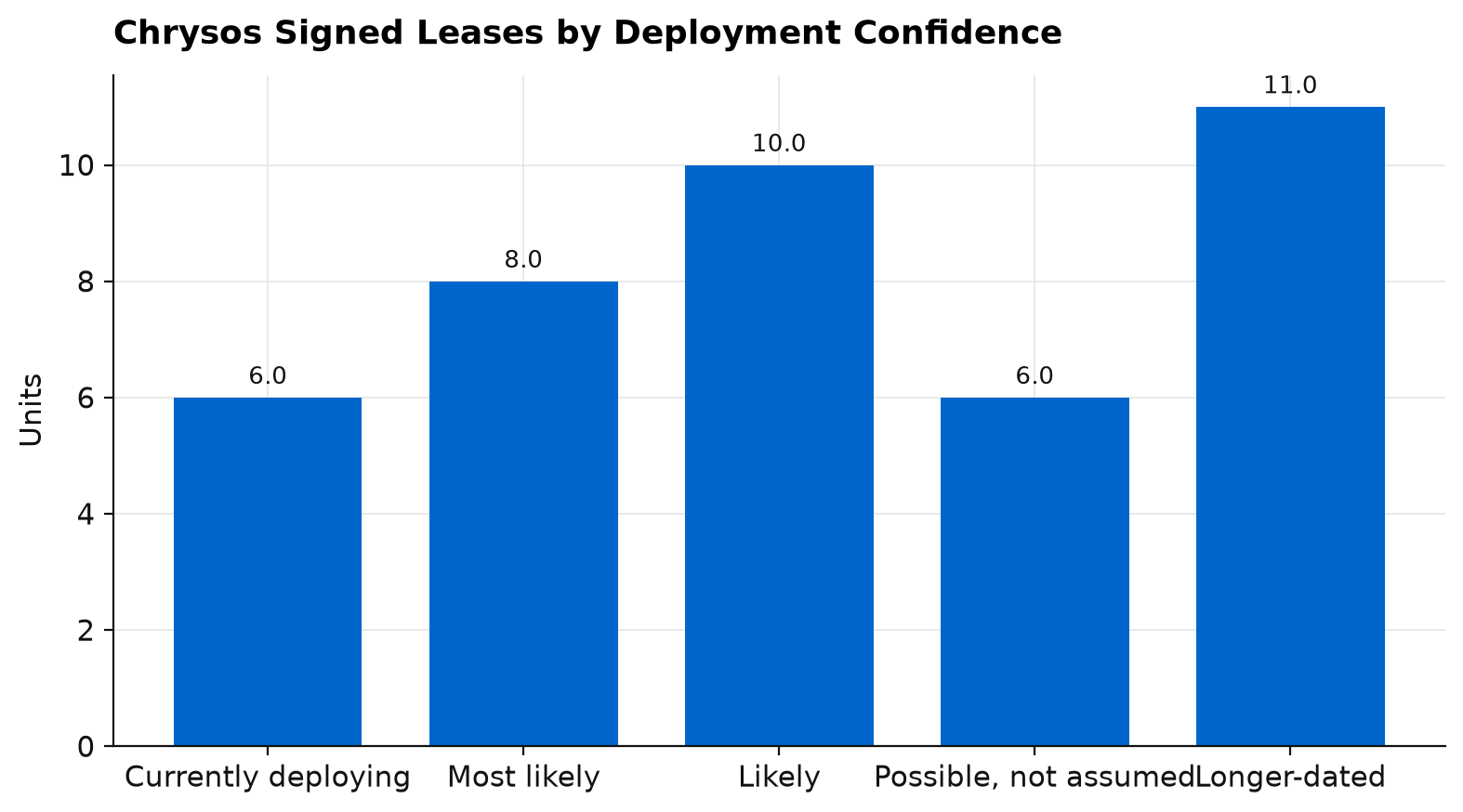
We think this is the right way to frame the debate. The question was never whether Chrysos has enough signed demand. It was whether enough of that demand is real, near-term and with counterparties that will actually take delivery. Splitting the 41 leases into these groups shows a base case that needs only part of the high-confidence group to land, rather than one that depends on the slower-moving or more speculative leases. That is a more comfortable position than the share price implies.
Gold Has Pulled Back but the Lead Indicators Have Held
The second worry is the gold price. A weaker gold price can cool exploration, and exploration is what generates the samples that flow through PhotonAssay units, so the market has tended to trade Chrysos alongside gold. That link has been on display since late August. Gold put in a local top around then and pulled back, and the Chrysos share price has been soft over the same period, coinciding with a meaningful decline that erased much of the post-result rally.
The research looks past the gold chart to the indicators that sit closer to the business. It tracks two lead indicators for Chrysos’s sample volumes. One is junior capital raisings, the money smaller mining companies raise from investors, measured here as raisings below US$50 million each. Fresh capital is what funds exploration programmes, so this is a useful early read on activity across the sector. The other is a real-time tracker of sample volumes maintained by the research team. Both were strong again in September. The tracker suggests the strength in sample volumes seen in late calendar 2025 and early calendar 2026 is continuing. Junior capital raisings remain below their October 2025 peak, but they are still elevated.
On gold itself, the research’s global team recently maintained its forecast of US$5,400 per ounce by the end of 2027. It held that view despite the US Federal Reserve raising interest rates in September, with economists expecting more hikes to come, although it now sees a slower path of appreciation in the near term. The key structural driver of that constructive view is continued diversification by central banks, which in plain terms means central banks spreading their reserves across more assets, including gold. Estimates put central bank gold purchases at 91 tonnes a month, averaged over three months and seasonally adjusted, against a pre-2022 average of 17 tonnes.
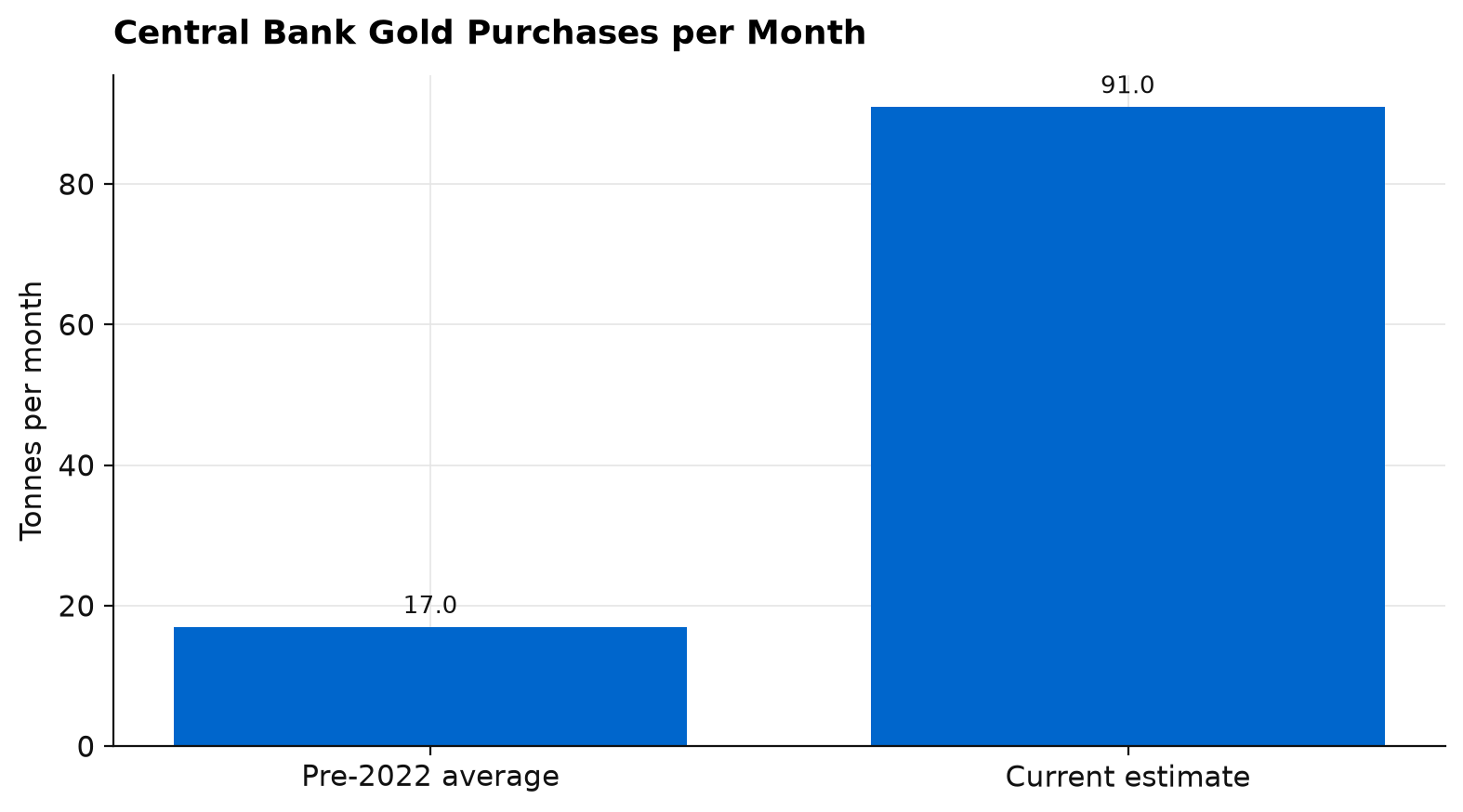
The practical point for investors is that a share price and a business can move apart for a while. A falling gold price is a reasonable thing to worry about, but the indicators closest to Chrysos’s actual sample volumes held up in September. If those indicators stay firm, the recent pullback looks more like the market trading the gold chart than a change in the company’s trading conditions. If they roll over, that would be a more serious signal, which is why they are worth watching alongside the gold price itself.
Record Breadth and a Shifting Customer Mix Support the Long Run
Stepping back from FY27, there are five reasons the longer-term deployment outlook looks well supported. The first is pipeline depth, which has never been greater. Chrysos entered FY27 with a record 41 units yet to be deployed. The second is that lease activity has been running well ahead of deployments. The company signed 24 leases in FY26, yet the forecasts assume only 13 new leases in FY27, which leaves room for upside if signings keep anything like their recent pace.
The third is breadth, meaning the number of different customers that have signed leases. That has also reached a record high, with 15 separate customers currently looking to take delivery of a PhotonAssay unit. It points to wider industry acceptance of the technology, and it matters for risk as well as growth, because a pipeline spread across many customers is less exposed to any one of them changing its plans. The fourth is spread more generally. Current leases show a good mix of counterparties and geographies, so the business is not overly exposed to any one region.
Within that mix, direct-to-mine customers are a rising share of the lease portfolio. These are mining companies taking a unit for their own operation rather than relying on a laboratory. The research puts the total addressable market for direct-to-mine customers, meaning the full pool of potential demand, at about twice that of the laboratories. A growing direct-to-mine share therefore widens the long-run opportunity rather than simply filling the existing one.
The fifth is the ability to deliver. Chrysos holds inventory and has manufacturing capacity of about 18 units a year, comfortably above the 13 deployments expected in FY27. On those figures, supply of units should not be the thing that holds the company back.
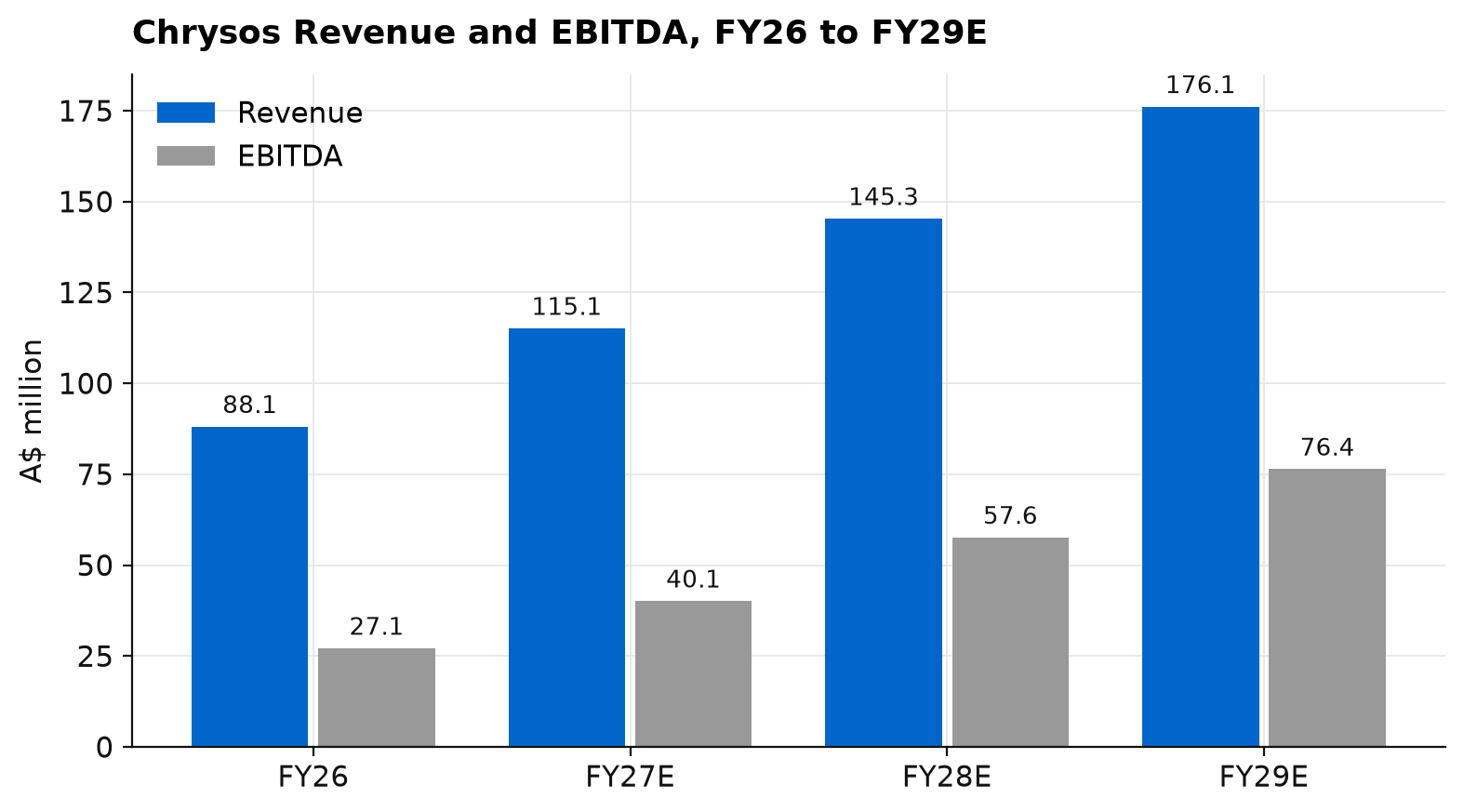
Those drivers show up in the forecasts. Institutional sell-side research expects revenue to climb from A$88.1 million in FY26 to A$115.1 million in FY27, A$145.3 million in FY28 and A$176.1 million in FY29. EBITDA, which is earnings before interest, tax, depreciation and amortisation and a rough gauge of operating profit, is forecast to rise faster, from A$27.1 million to A$40.1 million, A$57.6 million and then A$76.4 million. Earnings per share are forecast to step up from A$0.02 in FY26 to A$0.10, A$0.17 and A$0.26 over the same years. Profit is forecast to grow faster than revenue, which is why the deployment cadence matters so much to the share price.
Valuation and the Case for Buying the Pullback
The 12 month price target of A$10.26 sits about 50.9 per cent above the recent close of A$6.80. That is a large gap, and it has opened up largely because the share price has given back its post-result gains. The price now reflects the two worries covered above rather than the strong FY26 result that came before them.
The case rests on three pillars. The first is deployments. A high-confidence pipeline of 24 units sits against expectations of about 13 deployments in FY27, with 11 units already being installed or awaiting installation at the FY26 result. The second is demand. Lead indicators for sample volumes held up in September despite the pullback in gold, and the research’s US$5,400 per ounce end-2027 gold forecast still stands. The third is structure. Pipeline depth and customer breadth are both at records, direct-to-mine customers are a growing share of leases and address a market about twice the size of the laboratories, and capacity of about 18 units a year gives the company room to deliver.
The way we think about the risk and reward is this. If Chrysos delivers the 7 deployments forecast for the first half of FY27 and keeps the second half on track, the market’s main objection weakens and the gap to the target leaves plenty of room. If deployments slip again, the stock will be punished, as it has been before. But the pipeline analysis suggests that a miss would more likely be about timing than about demand disappearing, and a business with a record number of signed leases and a record number of customers has a deep pool of work to draw on. That makes the trade uneven in the investor’s favour, with more to gain if the cadence holds than there is likely to lose if it wobbles for a quarter or two.
So what do you do with it? This is a growth stock, and its share price will stay sensitive to the gold price and to each deployment update. For investors with a growth tilt and the patience to sit through that volatility, we think the pullback offers a better entry than the post-result highs, and building a position in stages around the first-half FY27 update is a sensible way to manage timing. Investors who need steady income or a smooth ride should look elsewhere.
Key Risks
The first risk is the cycle, because a cyclical turn lower in exploration, whether driven by a weaker gold price or by tighter funding as interest rates rise, would weigh on sample volumes and on demand for new leases. The second is competition, since any rival that wins customers or pressures pricing would slow lease growth and deployments. The third is execution, where the company’s record of missing deployment guidance, including in FY26, means the FY27 cadence cannot be taken for granted. Manufacturing and supply chain problems could add to that, delaying units even where customers are ready. The fourth is the balance sheet, since deploying leased units requires heavy upfront capital spending and any funding strain would limit how fast the fleet can grow. Finally, there are company-specific risks in customer concentration, where the delay or loss of a large customer would be felt, and in key person risk.
Our View
We think the debate around Chrysos has narrowed to one question, and it is a measurable one. The business has never had more signed demand, more customers or more capacity to deliver. What it has not yet done is prove it can convert that pipeline at a steady pace, and its history gives investors fair reason to want proof. The good news is that the proof arrives quickly. The six units being installed at the FY26 result typically take six to eight weeks, so the first-half FY27 deployment count should show whether the forecast of 7 is on track, and the progress of the 5 units awaiting site readiness will say a lot about the second half. We would rather own a business whose problem is turning a record backlog into installations than one searching for demand. At A$6.80, we think the market is pricing the risk of another miss more heavily than the evidence in the pipeline warrants.
If you would like to discuss Chrysos, request a callback or call us on 1300 889 603.